



Iron ore swings 20% in a quarter.
Tariffs reshape your competitive position overnight.
Demand from China or India ripples through your entire pricing structure.
Pricing has to balance margin protection with market responsiveness and execution speed, not just recover cost. In practice, that usually means a mix of cost‑plus pricing as a baseline, dynamic pricing to stay market‑responsive, and value‑based pricing to capture premiums on specialized or higher‑performance products.
- Steel pricing is complex because raw material costs, geopolitics, and demand are highly volatile.
- Teams juggle cost-plus pricing that must be frequently updated to keep margins intact.
- They also use dynamic pricing that reacts to real-time market movements.
- Value-based pricing helps capture premiums on specialized or higher-performance steel products.
- Automation and predictive analytics now forecast price trends, handle complex rebates, and protect profitability at a global scale.
Key Factors Impacting Steel Pricing
Three key forces shape pricing: global demand volatility, fluctuations in raw material and energy costs, and competitive pressure.
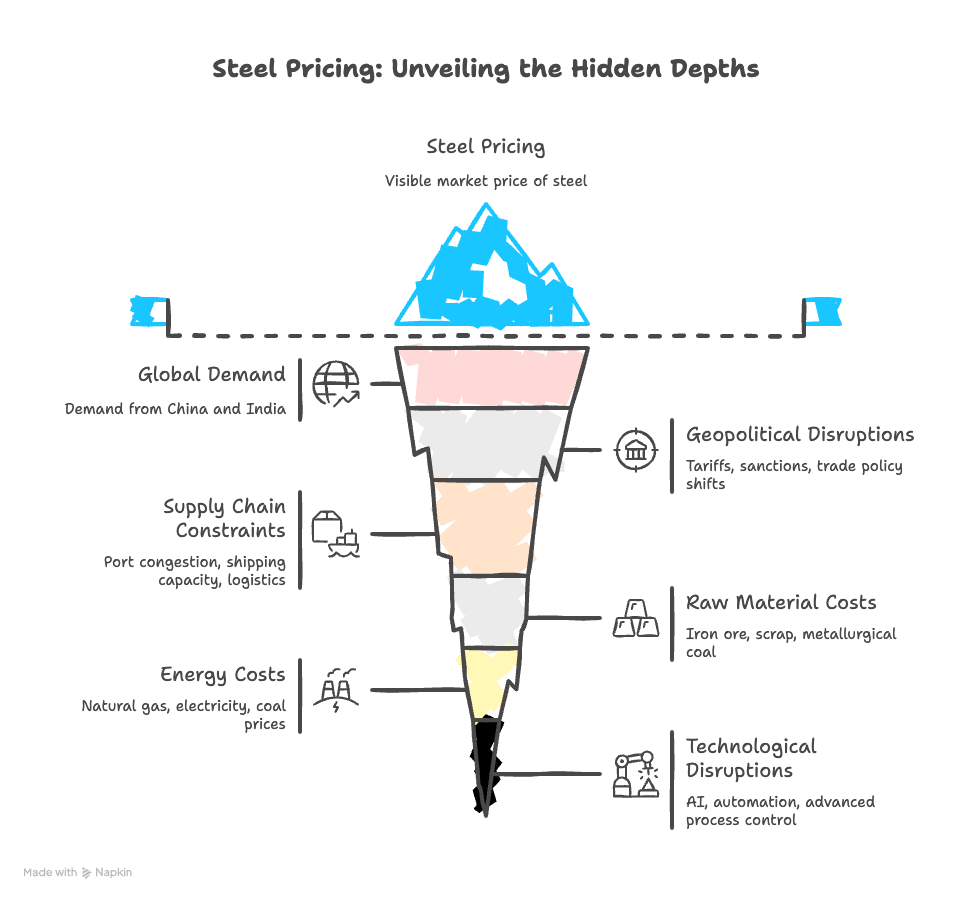
The visible market price of steel and the layers of hidden cost beneath it
Global demand and supply dynamics
Demand from China and India drives global prices when either accelerates infrastructure or manufacturing spending. As producers redirect supply to higher-value markets, global prices rise.
Geopolitical disruptions, tariffs, sanctions, and trade policy shifts create immediate pricing swings. For instance, the U.S. Section 232 tariffs created pricing advantages for domestic producers while raising costs for importers. Added to these are supply chain constraints, such as port congestion, shipping capacity, and land logistics bottlenecks, which directly impact pricing responsiveness and margin protection.
Raw material and energy price fluctuations
Iron ore represents 50-70% of your steelmaking costs for blast furnace operations. When benchmark prices for 62% Fe content ore from Australia shift from $120 to $90 per metric ton, your cost basis changes dramatically. You’re recalculating pricing weekly because these fluctuations directly impact whether your current price list maintains target margins.
Scrap costs directly drive your margins. When shredded scrap prices jump $50 per ton, as they regularly do, you face an immediate choice: absorb it or adjust your pricing. For EAF producers, this volatility is non-negotiable; scrap represents 40-60% of your raw material cost, so you’re making pricing moves weekly when markets shift.
Energy costs multiply your vulnerability. Natural gas, electricity, and coal prices directly flow into your production cost structure, and any spike puts your margins under immediate pressure. The 2022 European energy crisis proved this: natural gas prices doubled, forcing you to either raise prices (risking customer loss) or absorb the hit to profitability.
Metallurgical coal and coke prices hit you directly; they’re 25-30% of your blast furnace costs. When supply disruptions strike major producers such as Australia or Russia, you face volatile pricing with no hedging options. You adjust your prices or watch margins compress, depending on your customer contract terms.
Technological disruptions in steel production
AI and automation change pricing in four ways:
- AI quality control cuts scrap by 15-25%, thereby reducing unit costs and supporting sharper pricing on high-volume, low-margin contracts
- Automated lines lower labor costs, improve consistency, and support premium pricing for quality-critical applications such as automotive, energy, and electrical steel
- Advanced process control optimizes energy and raw material use in real time, cutting energy consumption 8–12% and improving pricing flexibility
Moreover, new production methods, such as hydrogen-based direct reduction, will also shift your cost structure. These emerging processes increase capex and current operating costs, but they’ll lower long-term energy expenses and position you to meet rising demand for low-carbon steel.
So, your pricing strategy needs to account for this transition now.
Advanced Pricing Models for Steel Producers
You rarely rely on a single pricing model. You mix approaches by product, customer segment, and competitive context, and the real skill is knowing which model to use where and having systems that apply it consistently across thousands of SKUs and relationships.
Cost-plus pricing: building on costs
You calculate production costs, raw materials, energy, labor, and overhead, then add a markup to hit target margins, especially on commodity rebar or structural steel, where consistency matters more than differentiation.
Your risk comes from input costs moving faster than your contract prices. For instance, when iron ore jumped 10 to 18% in a month, as it did in early 2024, adapting the cost-plus model gives you a baseline to protect margins, dynamic pricing lets you react quickly to spot and short-term opportunities, and value-based and premium models help you capture the upside where your steel delivers differentiated performance or risk reduction.
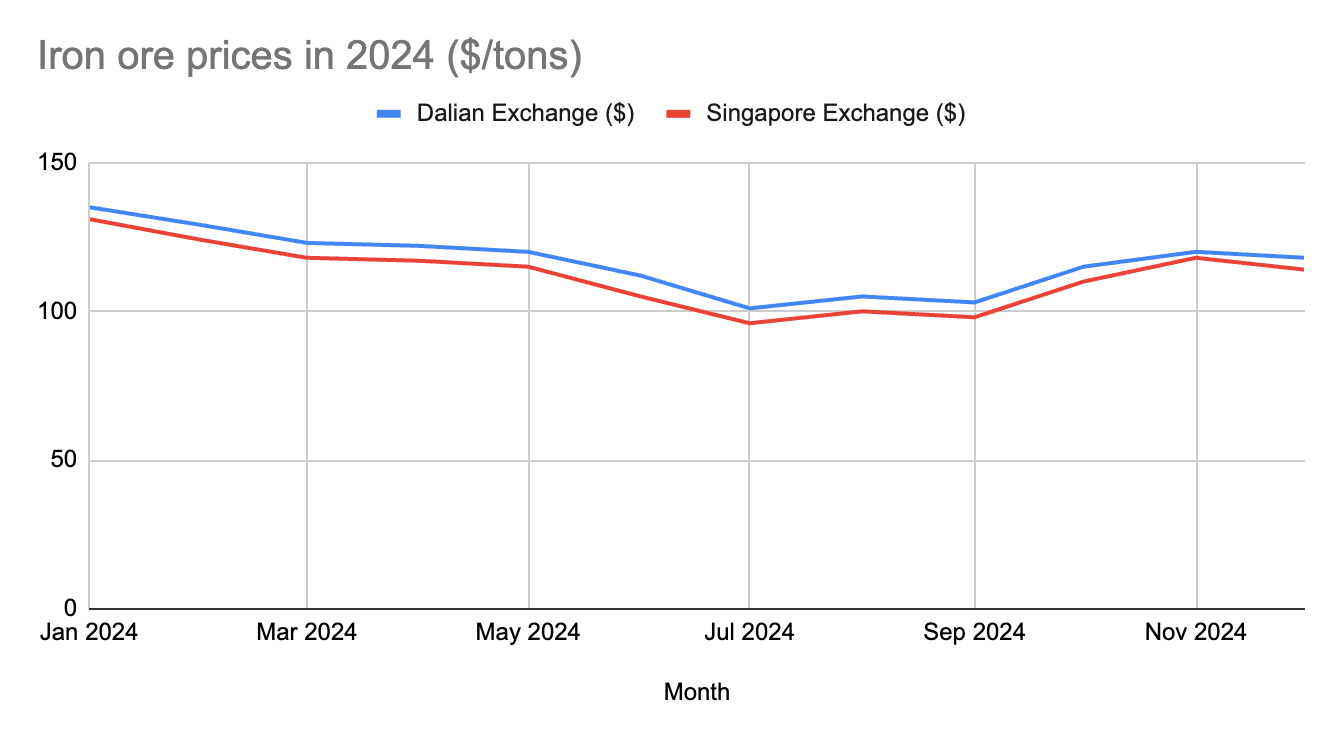
Shift in iron ore prices in 2024 (Source: GMK Center)
Cost-plus works best where customers understand cost drivers and accept formulas tied to public benchmarks such as the Midwest Hot-Rolled Coil Index or China steel spot prices.
Value-based pricing: charging for outcomes
For high-strength low-alloy automotive grades, you price against the value you create: lighter vehicles, better crash performance, and longer life. Hence, a 10% premium is acceptable when a 5% weight reduction saves thousands in lifetime fuel costs per vehicle.
In aerospace, titanium-alloyed steels and nickel-chromium grades reflect stringent quality, certification, and performance requirements, which is why a ton of aerospace steel can justify an $8,000 price point.
Your reputation for consistent quality, on-time delivery, and technical support often earns you 5–15% premiums even on similar specs, because customers are paying to reduce risk, not just for metal.
To sustain value-based pricing, you quantify how your steel improves customer economics. For example, framing electrical steel pricing around core loss and 20–30 years of energy savings, not just dollars per ton.
Dynamic pricing: adjusting in real time
You track inventory, backlogs, and market prices in near real time and adjust spot and short-term contract prices, raising them 5–10% when your order book stretches to eight weeks and competitors are at twelve, and cutting them when stock rises above targets.
Using data from platforms like Metal Bulletin and Platts Steel, you move Midwest hot-rolled coil quotes within hours when reported transactions climb by $40 per ton. When outages or trade actions tighten supply, systems that monitor capacity utilization, import flows, and demand signals help you raise prices on available tons with confidence.
AI pricing engines then pull in costs, competitor prices, inventory, and order patterns to recommend moves that protect both margin and share, so you spend your time validating decisions instead of rebuilding spreadsheets.
Penetration pricing: entering and expanding markets
When you enter a new region or launch a product, you price below cost-plus to win trials and build volume. For example, you can set galvanized coil 8% below local competitors in the Southeast and accept six months of margin pressure to land key fabricators and distributors.
You define in advance how long you can sustain this and what success means, after which you revert to cost-plus pricing. You treat early margin loss as customer acquisition cost, acceptable only if those accounts become long-term relationships worth $2–5 million in annual revenue with strong retention rather than switching when rivals match your price.
Penetration pricing works best when incumbents are comfortable and your cost base. For example, a new mini-mill with 15% lower production costs and better energy contracts, allows you to stay aggressive and still reach profitability faster than they can respond.
Premium pricing: monetizing exclusivity
For ultra-high-strength steels above 1,000 MPa used in safety-critical automotive, defense, or specialized industrial applications, you price 40–60% above conventional high-strength grades because alternatives are limited and performance is mission-critical.
You see similar premiums on stainless grades with specific corrosion resistance, where customers pay for metallurgical precision, rigorous testing, and certification, not just alloy content. Likewise, when your brand is specified by name in engineering standards or procurement rules, you gain insulation from commodity pricing and can charge for reduced technical and supply risk.
Tight global capacity further supports premium pricing, but you oversee the ceiling; if you push too far, you invite new entrants or encourage customers to qualify alternatives, eroding the exclusivity you worked to build.
Pricing Automation: Future of Steel Pricing
Manual pricing breaks down at enterprise scale when you’re managing thousands of SKUs, hundreds of contracts, and weekly or even daily price moves. Automation takes over the heavy lifting, handling calculations, enforcing policies, tracking rebates and lets your team focus on strategy instead of spreadsheets. Predictive models then use AI to recommend optimal prices based on market conditions, competitor moves, and your own cost and capacity constraints.
Automated rebate and discount management
You run complex rebate programs by customer size, product mix, and annual commitments, which quickly becomes error‑prone if managed manually. On top of that, you layer early‑payment discounts, freight allowances, and promotional deals, so the list price often looks nothing like the net realized price.
Automated engines calculate rebates in real time from ERP data, track progress to thresholds, and flag customers nearing higher tiers so sales can use that insight in negotiations. They also maintain full audit trails for tax and compliance, showing how each rebate was calculated, which transactions qualified, and when payments were made. For instance, Vistaar’s pricing platforms push this even further by combining rebate calculation with centralized control over list, floor, and target prices across products, channels, and regions.
That means the same engine that calculates and audits rebates from your ERP data also enforces guardrails, simulates deal economics, and gives sales real-time guidance at the point of negotiation.
Integrating AI and machine learning for predictive pricing
Machine learning models train on several years of transaction data to identify price points that maximize margin by segment, product, and market context, often lifting quote win rates by 15–20% compared to manual pricing. Demand forecasting layers on seasonality, macro indicators, and order histories to signal when to push prices for extra margin and when to use targeted discounts to protect volume and utilization.
As competitive price feeds come in, the system adjusts recommendations. Hence, you stay competitive while still expanding margins wherever possible. The models continue to learn from wins and losses, refining how different customers react in strong versus weak markets, making recommendations more accurate over time.
Data Analytics in Steel Pricing: Tracking Performance and ROI
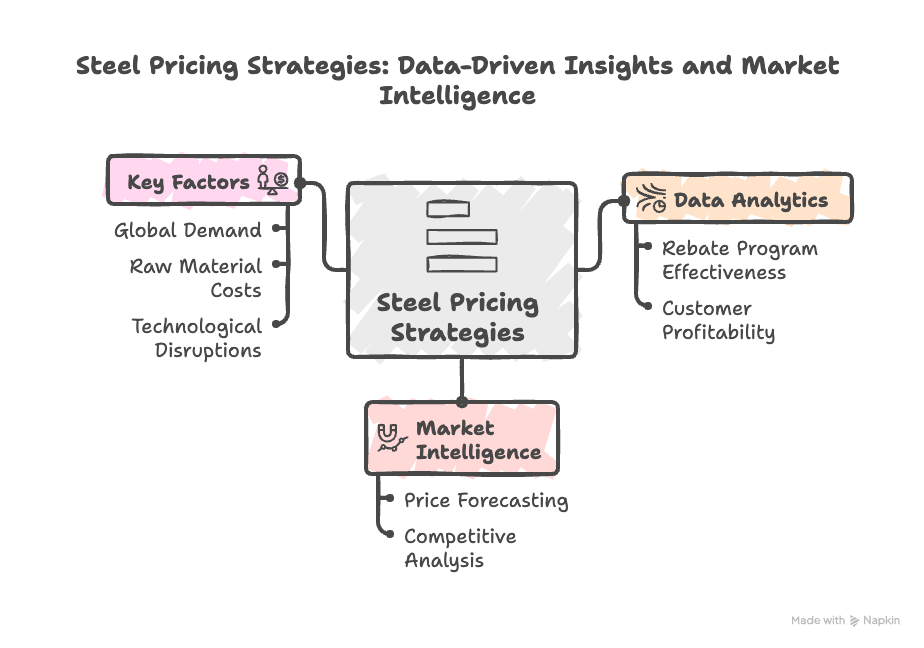
Different factors that shape steel pricing strategies
Every quote, order, invoice, and rebate tells you what works in your pricing: data analytics turns that noise into a clear picture of margin, leakage, and growth. You use it to see which segments are truly profitable, which rebate programs drive incremental volume, and where net realized prices slip between list, discounts, and terms. Market intelligence then layers in external signals, enabling you to forecast price moves and competitive shifts instead of reacting late.
Using data to track rebate program effectiveness
You review rebate programs by segment to separate incentives that drive profitable growth from those that just give away margin. For instance, with Vistaar’s SmartRebates, you can design tiered and growth rebates, see accrued and projected payouts in real time, and tie every dollar paid to clear volume, mix, or margin improvements instead of blanket rewards for historical spend. You can then redesign structures around incremental volume and clear targets, rather than blanket rewards for historical spend.
Regional analysis adds another lens.
If your Southeast region shows rebates at 22% of revenue, while the Midwest, with similar growth, shows rebates at 15% of revenue, you know it is time to tighten structures and reclaim margin. Customer profitability views close the loop. When high‑revenue accounts above $5 million turn negative after rebates and discounts, you can use that insight to renegotiate or exit value‑destroying deals.
Forecasting steel prices with market intelligence
You subscribe to indices from Platts, Metal Bulletin, and regional spot markets to track hot‑rolled coil, cold‑rolled coil, rebar, and structural benchmarks and to plan price actions ahead of renewals. Capacity utilization, imports, service‑center inventories, and construction data then help you read whether markets are tightening or loosening. For example, U.S. utilization above 78–80% and inventories below 2.5 months often precede price increases within four to six weeks. Raw material forecasts, such as iron ore futures pointing to a 15% rise next quarter, feed into contract and spot discussions so you can plan pass‑through rather than scrambling after the fact.
Scenario planning lets you test strategies before you move. You model aggressive increases that trade some share for margin, moderate moves that balance both, and defensive pricing to protect key accounts, then choose the path that fits your business objectives.
Optimizing Steel Pricing for Long-Term Success
You’re managing pricing complexity that spans multiple models, hundreds of customers, and constantly shifting market conditions. Cost-plus pricing establishes profitability floors. Value-based approaches capture premiums for differentiated products. Dynamic pricing responds to real-time supply and demand. Each requires data, systems, and processes that execute consistently across your operation.
The evolution toward automated, data-driven pricing addresses the scale challenges you face. Manual processes can’t adjust prices daily across thousands of SKUs, track complex rebate programs across multiple jurisdictions, or incorporate market intelligence fast enough to capture pricing opportunities. Automation handles the calculation complexity while predictive analytics forecasts optimal price points.
Your pricing performance depends on having systems that integrate transaction data, market intelligence, and operational metrics into actionable insights. You need visibility into net realized prices after all discounts and rebates, rebate program ROI, competitive positioning by product and region, and pricing variance between quotes and actual sales. These capabilities enable continuous refinement of pricing strategies and faster response to market changes.
Pricing platforms now provide these capabilities in integrated systems.
Rather than cobbling together spreadsheets, disconnected databases, and manual processes, you can execute sophisticated pricing strategies through purpose-built tools. Vistaar’s Smart Pricing capabilities, for instance, enable pricing teams to manage complex structures while maintaining governance and visibility across global operations. For manufacturing organizations specifically, these platforms address the unique requirements of managing both commodity and specialty product pricing with appropriate controls and automation.
The long-term opportunity lies in building pricing capabilities that become competitive advantages. When you can respond to market changes faster than competitors, capture more value from product differentiation, and execute complex rebate strategies without errors, pricing becomes a profit driver rather than just a cost-recovery mechanism.
Frequently Asked Questions
How does steel pricing work?
Steel pricing combines multiple factors, such as production costs, market supply and demand dynamics, product specifications and quality requirements, and competitive positioning, with market conditions driving adjustments based on capacity, inventory, and backlogs.
What is CWT in steel pricing?
CWT stands for “cost per hundredweight” and represents pricing per 100 pounds of steel. This unit is standard in U.S. steel pricing, particularly for flat-rolled products, structural steel, and rebar.
Where to track steel prices?
Steel prices are tracked via commodity indices, industry publications, producer disclosures, futures exchanges, and subscription pricing services that provide benchmarks, forward indicators, and detailed market analytics.
Why is steel pricing increasing?
Steel prices rise when raw material and energy costs increase, demand exceeds supply, trade policies add costs, or disruptions and strong construction/manufacturing demand tighten availability.
