




- Tobacco pricing operates across 50+ state tax jurisdictions with excise rates ranging from $0.17 to $5.35 per pack, plus federal and local taxes.
- 25 states enforce Minimum Price Laws; Fair-Trade states mandate specific markup calculations that spreadsheets cannot track reliably.
- Automated platforms reduce operational workload by 30-50%, eliminate multi-jurisdictional tax calculation errors, and ensure real-time regulatory compliance.
- API integration with manufacturer systems prevents billback payment losses by automating promotional buydown tracking.
- AI-driven optimization balances profitability and compliance through elasticity modeling, competitive intelligence, and margin analysis.
State-level pricing volatility is driven by extreme tax differences; for instance, Maryland charges $5.00 per tobacco pack in excise taxes, while Missouri charges $0.17. Between these extremes lie 48 other state rates, creating a pricing environment in which compliance demands precision in every transaction. Layer federal excise taxes ($1.01 per pack), local jurisdiction additions (New York City adds $1.50, Cook County adds $3.00), Minimum Price Laws in 25 states, Fair-Trade pricing regulations, and you are operating within a system where calculation errors trigger penalties or billback revenue losses worth millions.
You balance excise tax compliance, contractual obligations with suppliers, cost determination regulations for cigarettes, and operational demands to continuously update prices driven by quarterly tax changes. Manual spreadsheets that once supported limited SKU portfolios fail when scaled to thousands of products across dozens of tax codes, each with Fair-Trade versus Non-Fair-Trade calculation requirements.
This guide explains how automated tobacco pricing reduces compliance risk, protects profitability, and scales without multiplying operational dependency on manual processes.
The Complexity of Tobacco Pricing and Compliance
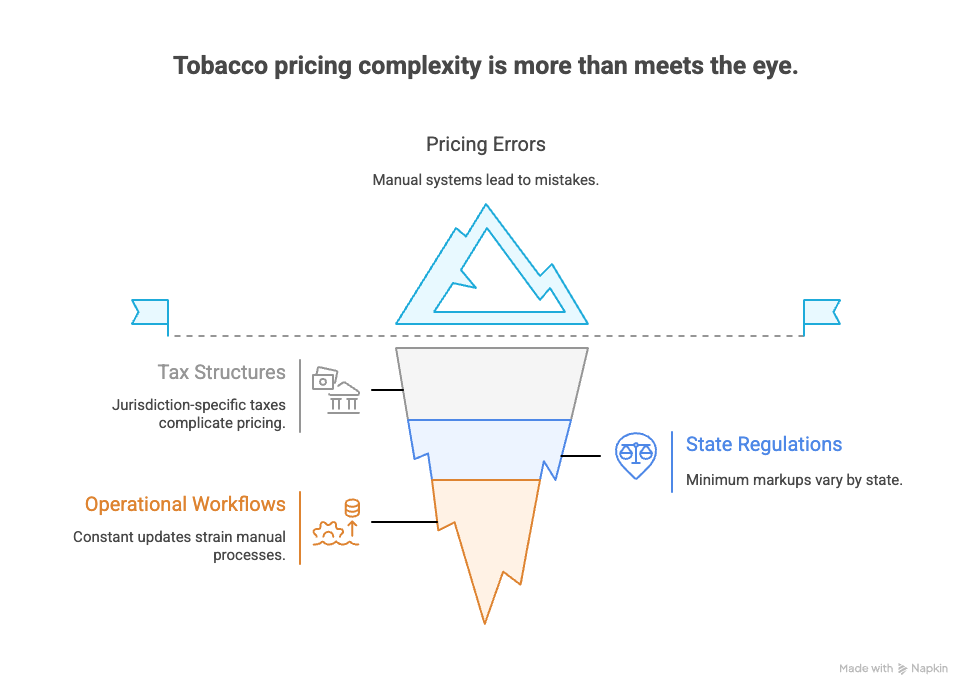
Tobacco pricing complexity extends far beyond surface-level pricing errors
Tobacco pricing complexity is driven by three forces working simultaneously: jurisdiction-specific tax structures, state-level pricing regulations, and operational workflows that demand constant updates. Each layer introduces its own constraints. Together, they make pricing errors inevitable when managed manually.
Excise Taxes and Jurisdiction-Specific Pricing
At the tax level, tobacco pricing begins with federal excise duty, currently set at $1.01 per pack. From there, complexity escalates quickly at the state and local level. State taxes range from $0.17 (Missouri) to $5.35 (New York City), averaging $1.97 as of January 2025.
These taxes are not applied uniformly.
Some jurisdictions calculate excise as a percentage of wholesale price, others apply tiered rates based on product type, and many impose minimum tax floors regardless of price. Large cigars, for example, are often subject to a fixed minimum tax even when their wholesale cost is low. Export programs add another layer, allowing drawback refunds of up to 99% of excise tax, which introduces complex reconciliation and accounting requirements.
Beyond taxes, pricing rules differ sharply based on whether a state enforces Fair Trade laws. Fair Trade states, including Pennsylvania, New Jersey, New York, Minnesota, Indiana, Mississippi, South Dakota, Nebraska, and many others, prohibit below-cost sales and mandate strict markup calculations. These laws define how cost must be calculated and what markups must be applied at both wholesale and retail levels.
Non-Fair-Trade states offer more flexibility, but still impose minimum price laws that require specific percentage markups, limiting how aggressively prices can be adjusted. For instance,
- Minnesota’s Unfair Cigarette Sales Act presumes a 4.5% wholesale markup and an 8% retail markup on the manufacturer’s invoice price plus excise taxes, resulting in a minimum retail price roughly 12.9% above that base cost.
- Massachusetts publishes brand-specific minimum prices that differ between chain and non-chain stores: Marlboro must retail for $14.29 in non-chain stores, versus $14.08 in chains.
In practice, this means a pricing system must simultaneously manage multiple parameters and this level of interdependency quickly overwhelms manual tools.
Manual pricing: The risks and challenges
Spreadsheet-based pricing breaks down structurally at scale. Managing just 500 SKUs across 10 states already creates roughly 5,000 unique price points. Each price point requires a chain of calculations: base cost, federal excise, state excise, local taxes, wholesale markup, retail markup, minimum price validation, promotional allowance adjustments, and billback eligibility. As portfolios grow, the problem compounds. At 2,000 SKUs across 25 states, pricing teams are managing more than 50,000 price points. Layer in temporary promotions and buydowns, and the number of tracked data elements easily exceeds 100,000.
At that scale, spreadsheets become slow, fragmented, and unreliable. Analysts split data across multiple files to keep performance manageable, breaking the single source of truth. Version control becomes impossible. Audit trails disappear. When regulators request documentation, manual systems cannot reconstruct how a price was calculated or when it changed.
Compliance risk rises sharply as a result.
States frequently adjust excise rates with as little as 30 to 90 days’ notice. Formula errors propagate silently across entire portfolios. Fair Trade violations occur when mandated markups are misapplied. Promotional billbacks are lost when manufacturer pricing conditions are not met precisely. Each failure carries financial penalties, lost reimbursements, or regulatory exposure.
Operational burden and inefficiency
The operational burden is equally severe.
Pricing teams often spend 40–60% of their time on manual data entry rather than strategic analysis. Quarter-end cycles stretch into weeks as teams validate prices across markets, reconcile promotional spend against billback claims, and assemble compliance documentation. Coordination across finance, sales, and compliance introduces further friction, especially when multiple versions of pricing files exist. Emergency tax updates, overlapping promotions, and regulatory reporting requirements turn pricing into a constant fire drill.
In this environment, automation is not a productivity upgrade. It is a requirement for maintaining compliance, protecting margins, and sustaining operations as regulations and market conditions continue to evolve.
Power of Automation in Tobacco Pricing
Automation replaces the repetitive work with a centralized pricing engine that applies rules once and enforces them everywhere. Instead of updating spreadsheets market by market, pricing and compliance teams govern principles centrally while the system executes them across channels, ensuring every SKU remains profitable and compliant as conditions shift.
Real-Time Tax and Price Updates
When a state like Maryland raises excise tax, the system immediately recalculates all impacted SKUs, applies Fair-Trade markup rules, validates minimum price compliance, and publishes updated prices to distribution channels, cutting response time from days or weeks to minutes.
This real-time execution extends beyond taxes.
Manufacturer cost updates flow through instantly, scheduled promotional buydowns activate automatically, contract changes trigger price recalculations, and competitive signals can be acted on quickly without breaching compliance rules. Pricing teams move from reactive fixes to controlled, system-driven execution.
API integration with manufacturer systems is also a key enabler.
Instead of waiting for emailed spreadsheets (e.g., “5% off all 12-pack SKUs in February”), promotional data is pulled directly into the pricing platform as soon as it is created. No manual uploads, no re-keying, no reconciliation. For example, Vistaar’s Smart Pricing Engine pulls data directly from supplier APIs, reducing manual entry time by up to 80% and eliminating transcription errors.
Streamlining Price Adjustments Across Regions
Pricing strategy shouldn’t fragment as a business expands into more markets. Automation allows enterprises to define pricing rules centrally, protecting margin targets and compliance, while the system automatically applies local requirements such as Fair-Trade rules, Minimum Price Laws, chain-specific minimums, local taxes, and brand-level constraints. Regional teams execute within governed guardrails, not spreadsheets or ad-hoc overrides.
This structure becomes even more important as regulations evolve.
When states modify licensing fees, minimum price formulas, or promotional restrictions, centralized governance ensures that updates cascade automatically across jurisdictions without local recalculation. For example, California will raise its annual tobacco retailer license fee from $265 to $450 per location starting July 1, 2026, with authority to increase it to $600 in future years.
Managing changes of this nature requires coordinated, system-wide updates, something decentralized pricing processes cannot support at scale.
Improved Profitability Through AI-Driven Price Optimization
Automation ensures pricing accuracy; AI drives better decisions. Machine learning models evaluate demand elasticity, competitive price positioning, promotional lift, and margin impact to recommend price actions that protect profitability while staying compliant. Rather than replacing pricing strategy, AI strengthens it with evidence grounded in real market behavior and regulatory constraints.
Platforms like Vistaar’s SmartOptimizer help you to perform scenario modeling, letting teams anticipate impact before activation. Pricing leaders can simulate scenarios, such as an excise tax increase or a promotional shift and see the downstream impact on margin, volume, and billbacks.
This moves pricing from reactive adjustments to informed trade-offs, enabling teams to choose price paths that preserve revenue and compliance under changing conditions.
Key Benefits of Automating Tobacco Pricing
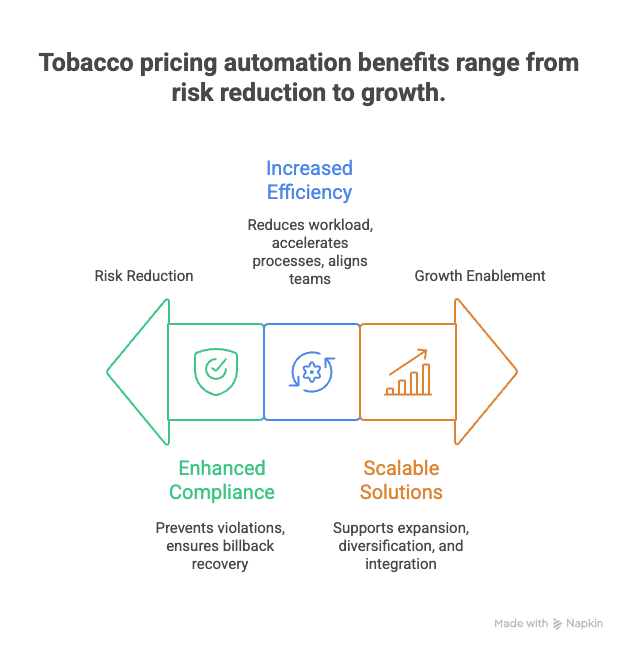
Benefits of tobacco pricing automation span from risk reduction to sustainable growth
Automation delivers compliance assurance through regulatory validation, operational efficiency through the elimination of manual processes, and scalable infrastructure that supports growth without proportional cost increases.
Enhanced Compliance and Reduced Risk
- Protect margin and cash recovery: Automated compliance validation ensures prices meet minimum price laws and Fair-Trade rules, safeguarding eligibility for manufacturer-funded billbacks and preventing lost promotional reimbursements.
- Prevent regulatory and financial risk before it happens: Real-time monitoring flags violations, before prices go live, reducing penalties, chargebacks, and audit exposure.
- Create audit-ready confidence at scale: Centralized systems like Vistaar’s SmartRebates eliminate manual tax errors, track regulatory changes automatically, enforce approval workflows, and maintain complete documentation, turning compliance from a reactive burden into a controlled, repeatable process.
Increased operational efficiency
In tobacco pricing, routine changes, tax updates, promotional buydowns, billback adjustments, trigger hundreds of dependent calculations across SKUs, states, and channels. In spreadsheet-driven environments, these updates consume entire days and introduce compliance risk. Automated pricing and rebate platforms compress this workload into minutes, shifting teams away from reconciliation and toward margin protection and strategic decision-making.
For instance, John Griffin, CEO and Co-founder of Spiral Scout, says,
“Businesses using AI agents see a 30-50% reduction in manual workload, allowing teams to focus on higher-value work.”
What once required sequential handoffs across sales, finance, and compliance now executes in parallel within a governed system.
Operational Efficiency Gains from Rebate Management Automation
| Area | Spreadsheet-Based Process | Automated Platform Impact |
|---|---|---|
| Tax & Price Updates | Analysts manually update rates and recalculate hundreds of SKUs | Rates update once; all affected SKUs recalculate automatically in minutes |
| Promotional Programs | Promotions entered via emailed spreadsheets and manual setup | Promotions pulled directly via supplier APIs with automatic activation |
| Price Distribution | Price lists emailed and re-uploaded across systems | Prices published automatically to downstream systems |
| Finance Accruals | Separate files maintained for accrual tracking | Accruals update in real time alongside pricing |
| Audit & Compliance | Manual logs and fragmented documentation | System-generated audit trails and approvals |
| Quarter-End Close | Weeks of reconciliation and error correction | Close cycles reduced to days |
| Error Correction | High rework due to formula and version errors | Minimal rework through automated validation |
| Team Focus | Analysts spend time on data entry and fixes | Teams focus on pricing strategy and optimization |
By eliminating manual touchpoints and enforcing a single source of truth, automation improves speed, accuracy, and cross-functional alignment simultaneously. Pricing changes move faster, financial visibility improves, and compliance documentation is always audit-ready, without increasing operational burden.
How to Implement Tobacco Pricing Automation in Your Business
Successful implementation requires systematic assessment, careful solution selection, and ongoing optimization. This framework guides from the initial audit through continuous improvement.
Step 1: Assess your current pricing system
Conduct a comprehensive pricing process audit across functions and markets.
Data Sources Inventory
- Cost data origin (manufacturer invoices, ERP systems, manual entry)
- Tax rate update method (manual tracking, subscription services, ad hoc research)
- Promotional data location (contracts, emails, shared drives)
- Pricing decision documentation (spreadsheets, email trails, undocumented knowledge)
Process Gap Analysis
- Tax change implementation timeline from notification to price update
- Monthly pricing error frequency requiring correction
- Billback payment failure percentage due to pricing non-compliance
- Regulatory audit pricing violation frequency
Compliance Assessment
- States currently enforcing Minimum Price Laws
- Fair-Trade calculation requirement understanding across applicable jurisdictions
- Current documentation satisfying regulatory audit requirements
- Compliance failure frequency and location
Workflow Evaluation
- Handoffs between cost data receipt and final price publication
- Departments requiring pricing data and current access methods
- Approval processes governing pricing changes
- Version control issues are creating conflicting price information
Document all the findings quantitatively: “Current system requires 12 hours to implement single-state tax change, introduces errors in 8% of manual updates, lacks audit trails for 40% of pricing decisions.”
Step 2: Choose the right automation solution
Select platforms based on tobacco industry-specific requirements rather than generic pricing software capabilities.
Vistaar’s pricing platform provides tobacco-specific functionality, including automated excise tax calculations, Fair-Trade pricing compliance, and integrated rebate management for manufacturer promotional programs. The platform connects to leading ERP and CRM systems via pre-built integrations.
Step 3: Monitor, optimize, and scale
Automation delivers ongoing value through continuous monitoring and AI-driven optimization.
Performance Tracking
- Pricing accuracy rates (target: 99.9% compliance with minimum price requirements)
- Time to implement regulatory changes (target: same-day updates for all tax changes)
- Billback payment recovery rates (target: 95%+ of eligible promotional reimbursements)
- Pricing team productivity (target: 30-50% reduction in manual workload)
Continuous Optimization
- Machine learning models refine elasticity assumptions based on actual volume response
- Competitive intelligence integration enables proactive pricing adjustments
- Margin analysis identifies underperforming SKUs or markets for strategic review
- Promotional effectiveness measurement informs future program design
Scalability Monitoring
- System performance as SKU count, market coverage, and user base grow
- Integration with connected ERP, CRM, and business intelligence platforms
- Data quality and completeness across all pricing inputs
- User adoption rates and training effectiveness
AI and ML-driven optimization improve continuously. Over time, platforms learn from your specific market performance, competitive dynamics, and promotional results to provide increasingly accurate recommendations. Also, regular platform reviews (quarterly, recommended) assess new regulatory requirements that require configuration updates, business strategy changes affecting pricing objectives, technology evolution that enables enhanced capabilities, and organizational growth that drives additional user needs.
Why Choose Vistaar for Tobacco Pricing Automation
Vistaar’s pricing platform serves consumer packaged goods companies managing billions in revenue through comprehensive solutions for pricing, promotion, rebate management, and quote configuration.
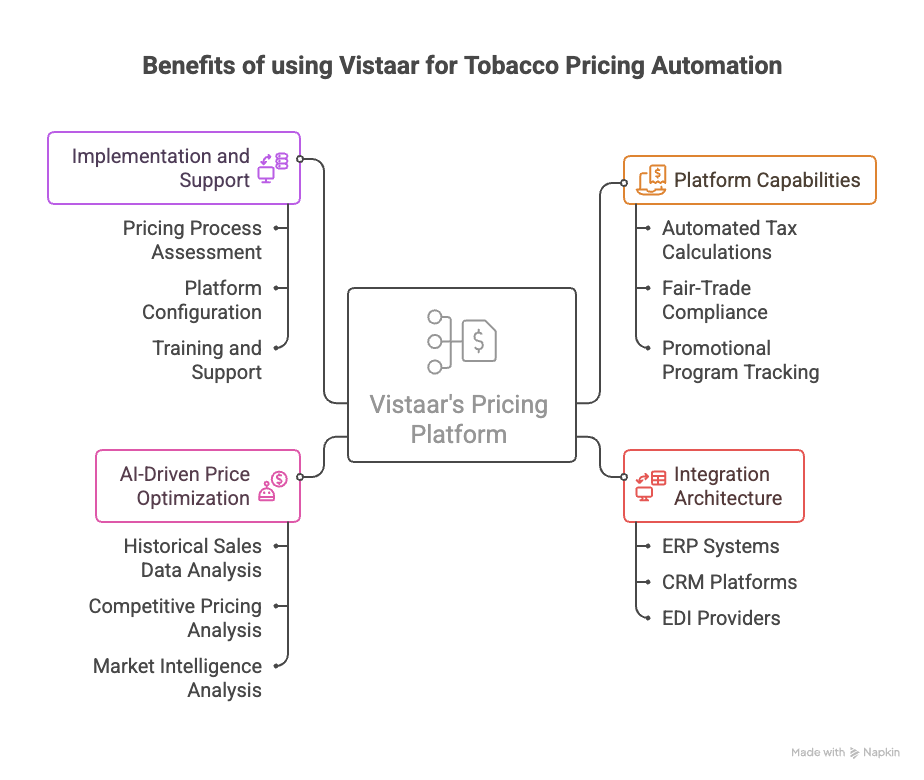
Exclusive benefits of using Vistaar’s SmartPricing for Tobacco Pricing Automation
Platform Capabilities
Vistaar Smart Pricing automates end-to-end tobacco pricing from manufacturer cost through retail shelf price. The platform
- Centralizes pricing governance (single system manages all SKUs, markets, channels with role-based access),
- Automates tax calculations (maintains current excise tax rates with automated updates)
- Ensures Fair-Trade compliance (applies jurisdiction-specific markup requirements), tracks promotional programs (integrates with manufacturer APIs)
- Provides scenario modeling (simulates tax increases, cost changes before implementation)
- Generates audit documentation (complete traceability for regulatory reviews).
Integration Architecture
The platform connects to existing infrastructure through ERP systems for cost data and financial accruals, CRM platforms for customer-specific pricing, EDI providers for automated transaction data exchange, business intelligence tools for analytics, and manufacturer API systems for promotional program automation. Bi-directional data flow eliminates manual data transfer.
AI-driven Price Optimization
Vistaar’s machine learning algorithms analyze historical sales data, competitive pricing, and market intelligence to recommend optimal prices, maximizing profitability within compliance constraints. Predictive models account for variations in price elasticity, competitive positioning, and likely responses, as well as promotional effectiveness and baseline cannibalization, and optimize margin contribution across portfolios.
Implementation and Support
Vistaar’s pricing consultants assess current pricing processes, configure platforms to business rules and regulatory requirements, integrate with existing systems, train pricing, finance, and sales teams, and provide ongoing support as your business evolves.
Implementation timelines range from 8 to 16 weeks, depending on business complexity. Vistaar’s SaaS model ensures continuous platform updates, regulatory change management, and new capability releases without disrupting operations.
Proven Results
Consumer goods companies using Vistaar report revenue improvements of 2-4% through optimized pricing strategies, a 30-50% reduction in operational workload through eliminated manual processes, and faster time-to-market for pricing changes and regulatory compliance.
For tobacco businesses specifically, automated compliance monitoring, billback payment protection, and multi-jurisdictional tax management deliver measurable financial benefits justifying platform investment within the first year.
Our thoughts
Tobacco pricing has outgrown the limits of spreadsheets.
With 50+ tax jurisdictions, Fair-Trade rules, Minimum Price Laws, constant regulatory change, and high-stakes billback programs, manual processes cannot deliver the speed, accuracy, or auditability the industry requires.
Automation provides a structural solution to this bottleneck.
Companies that modernize their pricing systems achieve faster regulatory updates, fewer compliance failures, higher billback recovery, and measurable productivity gains across pricing, finance, and sales. Modern pricing infrastructure is now the foundation for sustainable profitability and long-term resilience in a highly regulated, complexity-heavy industry.
Learn how Vistaar transforms tobacco pricing operations here.
Frequently Asked Questions
What are the main challenges in tobacco pricing?
Tobacco pricing faces multi-jurisdictional tax complexity, Fair-Trade state markup requirements, Minimum Price Laws, manufacturer promotional program compliance, and constant regulatory changes demanding immediate price updates across thousands of SKUs.
How does automation help with tobacco pricing compliance?
Automated platforms like Vistaar’s Retail Tobacco maintain current tax tables for all jurisdictions, automatically validate pricing against minimum price floors, apply Fair-Trade markup calculations according to state-specific rules, track manufacturer promotional compliance for billback protection, and generate complete audit trails documenting pricing logic and approvals for regulatory reviews.
What are the financial benefits of automating tobacco pricing?
Companies that implement automated pricing systems typically see measurable performance gains. Most organizations report higher revenue driven by more accurate and optimized pricing decisions, significant reductions in manual workload due to the elimination of repetitive data-entry processes, improved recovery of incentive or rebate payments through automated compliance checks, and faster responses to regulatory or policy changes.
What is the implementation process for tobacco pricing automation?
Implementation follows three phases: (1) Assessment audit of current pricing processes (2) Platform selection based on tobacco-specific requirements (3) Ongoing optimization through performance monitoring.
