




Key Takeaways
• Rebate management software automates the full rebate cycle, from program setup and impact modeling to nightly accruals, claim matching, settlement, and effectiveness reporting
• The hardest problem it solves is precedence: when one transaction qualifies for several programs, the system has to apply the same stacking rules every time, with an audit trail behind each amount
• Stacking math matters: a 3% volume rebate and a 5% promotional rebate total 8% when added, but 7.85% when the second is calculated net of the first
• ERP rebate modules can handle a small number of standard programs; dedicated software earns its cost when programs multiply, stack, need modeling before launch, or need partner visibility
• Evaluate platforms on program flexibility, modeling, accrual logic, claims matching, integration, partner visibility, and audit trail, and phase rollout by program family
Rebate management software automates the setup, calculation, accrual, claims validation, and settlement of rebate programs, so every payout follows contract terms and can be traced back to the transactions behind it. Enterprise rebate programs improve margin when they are designed and run well, and they turn into revenue leakage when calculation complexity outgrows manual tracking.
Take a manufacturer running volume-tiered rebates, promotional incentives, and growth bonuses across 2,000 distributor relationships, with 50,000+ rebate-eligible transactions a month. Each transaction has to be checked against several programs, calculated in the right order, and documented for audit.
Spreadsheets and basic ERP add-ons struggle to hold that accuracy at scale. Misapplied tiers, miscalculated promotional overlaps, and slow dispute resolution each cost a little, and together they cost a lot.
What Is Rebate Management Software?
Rebate management software automates the calculation, tracking, accrual, and payout of rebate programs across enterprise distribution networks. Rebates are post-purchase incentives that encourage volume growth, reward loyalty, and influence buying behavior without lowering the price on the invoice.
For example, a pharmaceutical distributor might offer a volume rebate of 2% on purchases above 10,000 units a quarter, a growth incentive of an additional 1.5% for year-over-year increases, and a promotional rebate of 3% on featured products during specific campaigns.
Spreadsheets can handle a single-volume tier with quarterly payouts to fewer than 50 partners. Enterprise rebate management is a different problem, and a spirits supplier's program architecture shows why:
- Volume-based rebates: Calculated by brand family
- Growth incentives: Current performance compared with the prior year
- Promotional rebates: Tied to specific marketing periods
- Ship-and-debit programs: Reimbursing distributors when they sell to specific customers below their acquisition cost under an approved price
Each rebate type applies different calculation logic, eligibility rules, and documentation requirements. When one transaction qualifies for several programs at once, the system has to apply precedence rules that prevent incompatible stacking and record exactly how each payout was calculated.
Why Stacking Rules Change the Payout
A distributor buying 12,000 units of premium bourbon during a spring promotion might qualify for a 3% volume rebate once annual purchases pass 10,000 units, a 5% promotional rebate on purchases from March to May, and a 2% growth bonus for a 15% year-over-year increase. The payout depends on how those programs stack:
On $1 million of qualifying purchases, the gap between additive and sequential stacking alone is $1,500 per program pair, and it repeats across every distributor and period. Without a stacking hierarchy written into the system, different analysts produce different answers for identical transactions.
Rebate management software such as Vistaar SmartRebates serves as the central calculation engine: it matches transactions to programs, applies each contract's rules and precedence, updates accruals as data arrives, and keeps the calculation history behind every payout.
The system also handles diverse program structures:
- Flat-rate payouts: A fixed dollar amount per unit
- Tiered volume incentives: Cumulative or non-cumulative tracking against thresholds, as in most volume incentive rebates
- Growth-based bonuses: A growth rebate measured against a baseline period
- Price supports: Funding that offsets specific price commitments
- Ship-and-debit and promotional programs: Date-limited eligibility with claim-based settlement
Manual vs. Automated Rebate Management
Here is how spreadsheet-based rebate management compares with software:
Manual systems can feel good enough at first. They become a bottleneck as partners, programs, and transaction volume grow.
Key Features of Rebate Management Software
Modern rebate management systems address enterprise complexity through a set of connected capabilities that prevent the calculation errors, compliance gaps, and visibility problems manual processes create.
1. Program Design and Impact Modeling
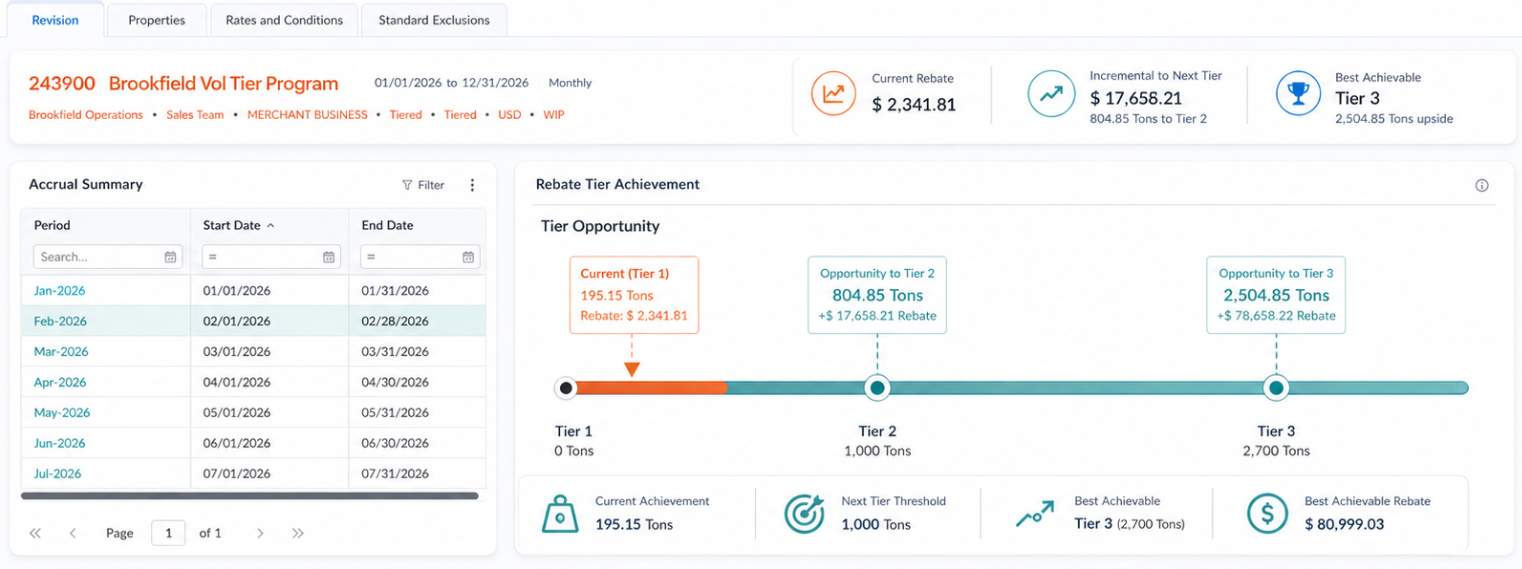
A small change to a tier, threshold, or rate can change rebate liability materially once it applies across thousands of transactions. Strong platforms let teams model a proposed program against the current customer base, see how customers would move across tiers, and project total rebate cost before launch.
Material program changes then route through approval thresholds, so the spend is approved before it is committed rather than discovered at settlement.
2. Automated Calculation Engines
The best rebate management software calculates and tracks accruals and payouts from contract terms, performance metrics, and timelines, so payouts are accurate, consistent, and on time.
It applies tier structures, exclusions, and date rules the same way for every transaction, enforces calculation precedence across programs, and records each calculation in an audit-ready format.
3. Claims Matching and Settlement
Incoming claims, deductions, and chargebacks are matched against eligible programs and the underlying transactions, and discrepancies are flagged for review before payment.
Approved amounts then move through settlement as credit memos or payments, with the agreement, calculations, and claim history retained behind each rebate settlement.
4. Real-Time Analytics and Reporting
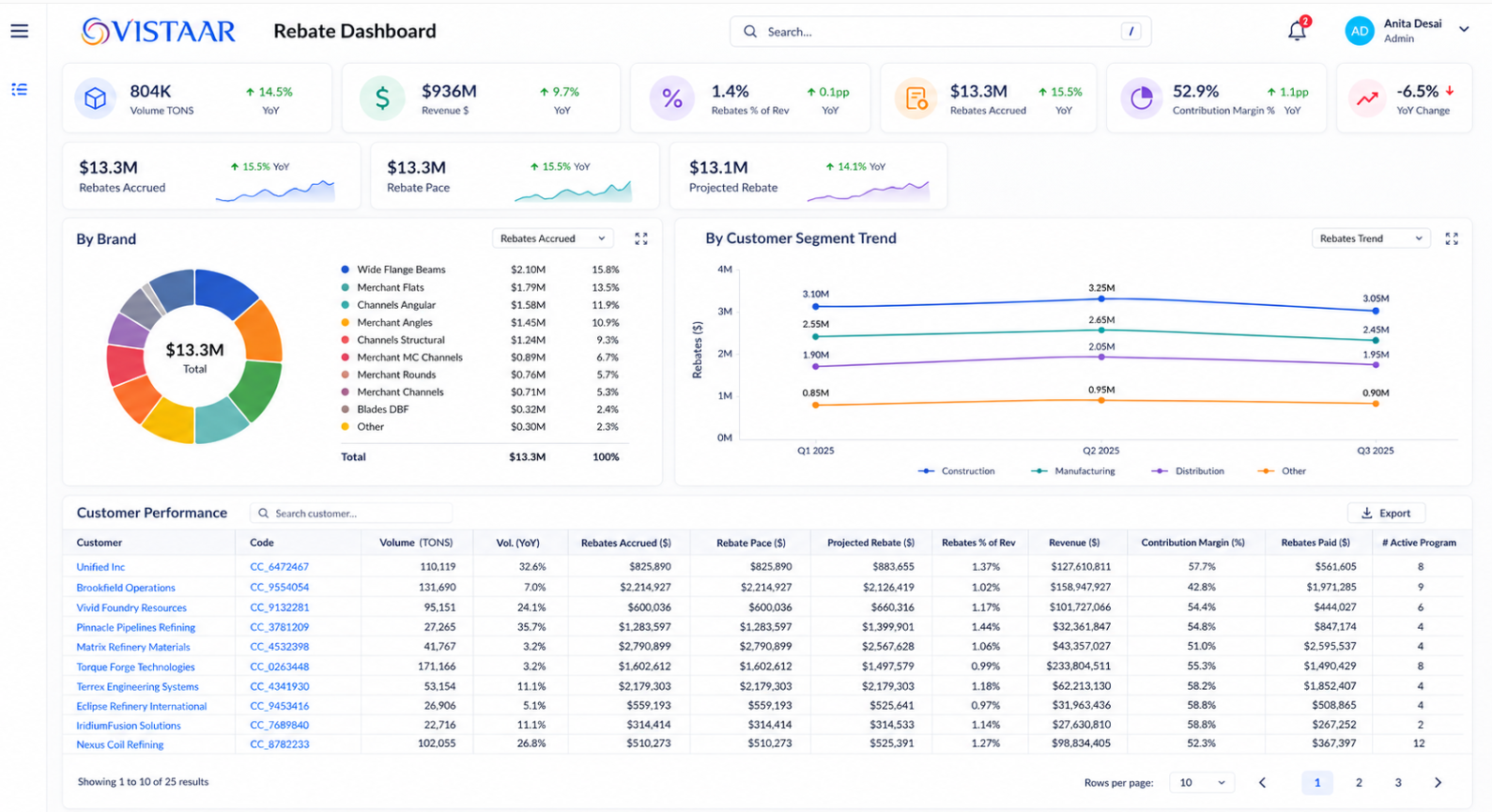
Built-in dashboards show how rebate programs are performing as transactions post. Metrics such as payout accuracy, partner performance, and tier attainment update continuously, so teams can spot issues early and focus spend on the programs that return the most.
Teams also see margin impact, which shows how rebate structures affect profitability across products, customers, and regions.
5. Integration With ERP and CRM Systems
Rebate management software integrates with ERP systems such as SAP, Oracle, and NetSuite, and with CRM platforms such as Salesforce. Pricing software integrations of this kind bring sales data, contract terms, and partner details into one place, which cuts reconciliation work and data silos.
6. Shared Visibility for Partners
Customers and distributors can see their earned rebates, pending settlements, and claim status in one view. This shared visibility reduces misunderstandings, speeds up issue resolution, and lowers the likelihood of disputes.
Rebate Management Software vs. ERP Rebate Modules
Many ERP platforms, including SAP and Microsoft Dynamics 365, include rebate functionality that calculates and settles standard programs. The real question is whether that functionality can manage the full program lifecycle your business runs.
One contrarian point: if your business runs a handful of simple volume rebates with few partners, the ERP module may genuinely be enough, and a dedicated platform adds cost without much return. Dedicated software earns its place when programs multiply, stack, and need modeling, or when rebate accruals keep drifting from what is finally paid.
Benefits of Implementing Rebate Management Software
Rebate management software improves payout accuracy, strengthens partner relationships, supports financial planning, and lets rebate programs grow without adding headcount.
1. Calculation Accuracy and Processing Speed
Automated calculation removes spreadsheet errors from tier application, program stacking, and eligibility checks, which is where most overpayments and underpayments start. It also shortens the cycle from period close to settlement, because accruals are already current when the period ends.
Vistaar reports that a multi-billion-dollar consumer goods company running its rebate programs across more than 500 users and 300 distributors achieved 4% savings on total rebates and 75% savings on man-hours. Results like these depend on program complexity and starting processes, but they show where the value comes from: fewer calculation errors and far less manual reconciliation.
2. Stronger Supplier and Customer Relationships
Timely, transparent rebate management builds trust with suppliers, distributors, and customers. When partners understand how programs work, where they stand against thresholds, and when to expect payment, they commit to growth plans more readily and dispute results less often.
Shared visibility also supports joint business planning and helps both sides put investment into the programs that work.
3. Better Financial Forecasting and Planning
When rebates are managed centrally, finance gets an accurate view of rebate liabilities and their timing. Instead of estimating from historical percentages, the team can forecast liabilities from current performance against contract terms, program mix, and expected partner behavior.
That supports better decisions:
- Liability forecasts: More accurate rebate liability by program and period
- Scenario modeling: The margin impact of pricing or rebate changes before they launch
- Demand planning: Inventory and production plans based on actual attainment trends
- Program review: Clear evidence of which rebates drive growth and which erode margin
4. Scale Without Added Headcount
Rebate programs become more complex as the business adds regions, product lines, and partner types. Platforms built for enterprise volume handle thousands of contracts, multi-level structures, and data from several systems, so the rebate operation grows without a matching growth in analysts.
How to Evaluate Rebate Management Software
Use these criteria when evaluating pricing and rebate software, and test each one against your own programs rather than a generic demo:
Roll out by program family rather than all at once. Start with the programs that carry the most spend or the most disputes, reconcile open accruals before cutover, and add program families once the first set is running cleanly.
Best Practices for Running Rebate Programs Well
Software handles the calculation, and program design still decides whether rebates earn their cost. Leading organizations treat rebates as a commercial instrument that is clearly defined, regularly reviewed, and refined with data.
1. Define Clear Rebate Structures and Agreements
Ambiguous rebate terms are one of the fastest ways to damage partner relationships. Clear, detailed agreements prevent the misunderstandings that cause delayed payments and eligibility disputes.
Every rebate program should explicitly define:
- Eligibility criteria: Who qualifies, stated precisely, such as "customers purchasing 10,000+ units per quarter" instead of "high-value customers"
- Performance thresholds: Exact unit or dollar amounts that trigger each rate
- Payment conditions: What triggers payment (invoice date, payment receipt, or shipment date) and how the rebate is calculated (per unit, percentage, or lump sum)
- Timelines: When periods begin and end, when claims must be submitted, and when payments are made
- Stacking rules: Whether programs add, apply sequentially, or pay only the highest eligible rate
Standardizing these terms across programs creates consistency for internal teams and partners, and configuring them in the software applies them the same way to every transaction.
2. Monitor and Adjust Rebate Terms Regularly
Rebate terms should change as business priorities, partner needs, and market conditions change, and thresholds should stay consistent with pricing strategy and regional tax structures.
For example, analytics may show that some customer segments consistently clear their thresholds while others fall just short. Adjusting tier structures for the near-miss partners can motivate them to buy more, while programs that pay for volume customers would have bought anyway should be redesigned.
Build quarterly program reviews into the process, using accrual rates, attainment trends, program ROI, and partner feedback to make targeted changes.
3. Train Every Stakeholder
Pricing, finance, sales, and operations teams need a shared understanding of how rebate rules work, how the platform applies them, and how to read the analytics. Structured onboarding, clear documentation, and scenario-based training prevent local workarounds, especially when rolling out to new regions or business units.
4. Use Analytics for Continuous Improvement
Analytics show which rebates drive growth, which erode margin, and where adjustments are needed. Retiring programs that give money away and redirecting spend to the ones that change buying behavior is where most of the long-term value sits.
Real-World Applications of Rebate Management Software
Vistaar works as a pricing and rebate partner for enterprises in manufacturing, beverage alcohol, consumer goods, and industrial products, where SmartRebates runs alongside SmartPricing to connect list pricing, deal pricing, rebates, and promotions.
Manufacturing: End-to-End Pricing and Rebate Management
Manufacturers manage complex price structures, channel-specific agreements, and large volume rebate programs that blur margin visibility unless they are governed centrally. Connecting rebate administration to price structures and quoting treats incentives as part of pricing strategy instead of an after-the-fact adjustment.
Global Electrification Products Leader
At the North American business unit of a global electrification products leader with roughly $13 billion in annual revenue, Vistaar's pricing solutions were integrated with SAP order processing and the company's home-grown CRM and order-to-cash systems.
Long Steel Producer
The largest long steel producer in the Americas connected Vistaar to the SAP ERP system at its North American business, bringing pricing and rebate processes onto one platform connected to the system of record.
Why Choose Vistaar's Rebate Management Software
The right rebate management software has a direct effect on revenue, margin, and compliance risk. SmartRebates covers the full rebate lifecycle for complex B2B programs:
- Flexible programs: Volume rebates, billbacks, growth rebates, price supports, lump-sum funds, and ship-and-debit programs, with rates by customer, segment, category, or SKU
- Modeling before launch: Proposed tiers, rates, and qualification rules projected across current customers, with material changes routed through approval workflows
- Nightly accruals: Qualifying transactions matched to active programs and accruals recalculated each night across the life of each agreement
- Claims and settlement: Claims and deductions matched automatically, discrepancies flagged, and settlements generated as credit memos or payment data in multiple currencies
- Partner visibility and reporting: Shared views of earned rebates and claim status, plus effectiveness reporting that identifies programs to retire or redesign
Vistaar is a Leader in the inaugural 2026 Gartner Magic Quadrant for B2B Pricing and Rebate Optimization Software.
See What Your Rebate Programs Really Cost
If your team still calculates stacked rebates in spreadsheets and finds overpayments at settlement, see how SmartRebates models, accrues, and settles complex programs in one platform.
Request a demo
FAQs
1. Can Open Rebate Programs Be Migrated Mid-Year?
Yes. Migrate each program with its year-to-date attainment and open accruals, reconcile those balances against the legacy calculation before cutover, and run both in parallel for one period to confirm the new system matches.
2. Who Should Own Rebate Management Software, Finance or Sales?
Both, with clear roles. Pricing and sales usually own program design and approvals, while finance owns accruals, settlement, and audit. The software should give each team its own workflow on the same data.
3. Does Rebate Software Handle Both Paying and Receiving Rebates?
Many enterprises need both: customer rebates they pay and vendor rebates they collect. Confirm the platform supports supplier and customer programs, because distributors often manage both directions in the same period.
4. How Should Stacking Rules Be Set When Programs Overlap?
Write them into every agreement: additive, sequential, or highest-only. Sequential or highest-only rules usually limit overpayment, while additive stacking should be a deliberate choice for strategic programs rather than a default.

As an experienced pricing solutions partner to some of the biggest names in global business, Vistaar offers a range of services to help our customers reach their maximum potential. Talk to us to see how we can help you create a more profitable future.