




Your rebate programs drive millions in revenue, but spreadsheets can’t keep up. For instance, industry research shows that nearly 88% of accounting spreadsheets contain human errors, and only 4% of manufacturers say they easily manage their rebate programs.
The consequence is predictable: incorrect payouts, inaccurate accruals, month-end disputes, and zero visibility into where revenue is leaking. Modern rebate programs are too complex and too financially significant to run on spreadsheets and siloed systems. Teams lose hours reconciling data across disconnected tools while revenue leaks through calculation errors, missed tier thresholds, and disputed claims.
To manage rebates at scale, enterprises need real-time ERP/CRM connectivity, accurate tier calculations, and AI-driven visibility into revenue leakage. Yet many enterprises still struggle to translate these requirements into a repeatable, scalable process.
This article breaks down how leading enterprises are moving from reactive administration to strategic rebate management that actually scales.
Understanding Rebate Management
Rebate management today goes far beyond tracking simple percentage-based incentives. Enterprises now juggle multiple incentive structures, such as volume tiers, performance metrics, promotional paybacks, group rebates, and multi-layered agreements, spanning various products, partners, and geographies.
As Shashank Misra, director of Solution Consulting at Vistaar Technologies, explains, “Unlike simple price discounts, rebates influence when, where, how, and how much a buyer purchases, adding strategic dimensionality to channel behaviour.”
Here’s where rebate management kicks in:
- Capturing the agreement: Your rebate management system records the exact contract terms, tiers, deadlines, exclusions, and eligible SKUs.
- Tracking performance: As your sales team places orders throughout the quarter, the system tracks real-time progress, like “You’ve reached $920K… $1.2M… $1.49M…”
- Accrual calculations: Instead of waiting until quarter-end, the system automatically calculates expected earnings, such as At $1M: accrual = $50,000, At $1.5M: accrual = $120,000
- Claims and payouts: When the quarter ends, the system generates accurate claim documents and supporting data so the supplier pays you exactly what you’re owed.
Types of Rebates in B2B Enterprises
B2B enterprises rely on multiple rebate structures, each designed to incentivize partner behavior but complicated by diverse data sources, fragmented systems, and high transaction volumes.
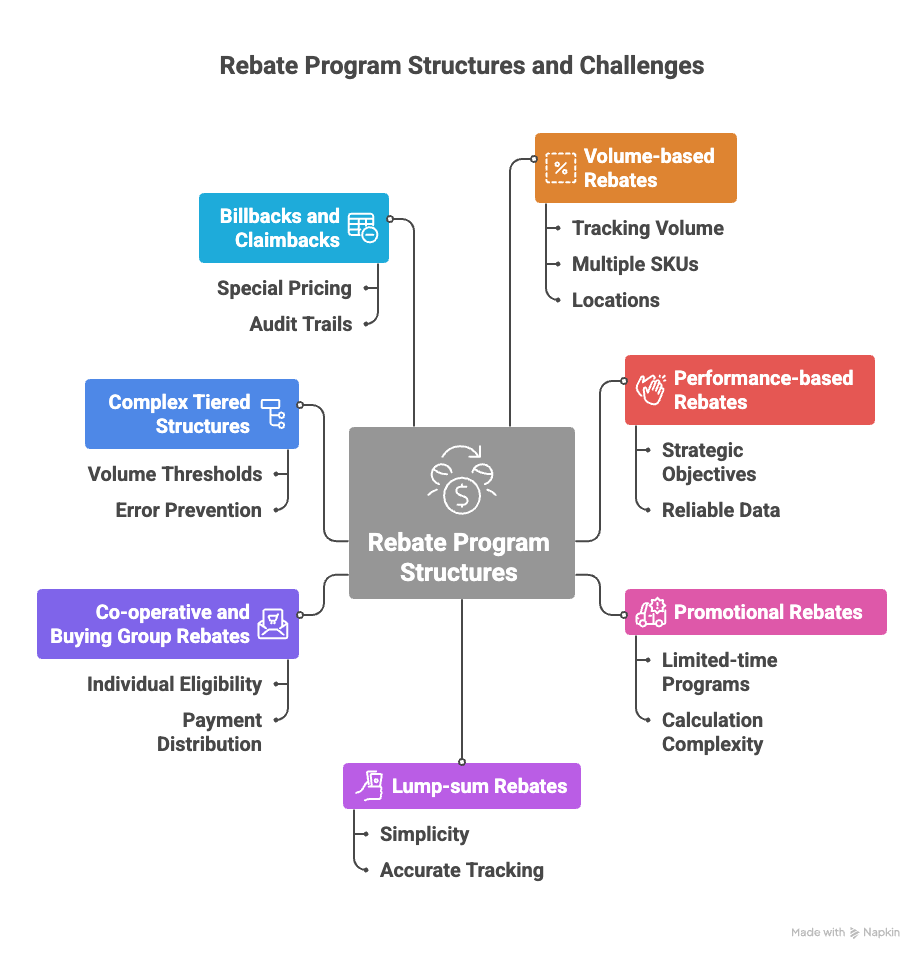
Table displaying all types of rebate programs in B2B enterprises
| Rebate Type | Core Incentive | Key Manual Management Complexity |
|---|---|---|
| Volume-Based | Rewards hitting spend thresholds (tiers). | Aggregating volume across multiple SKUs, product families, and locations; managing rolling periods. |
| Performance-Based | Incentivizes outcomes (market share, sell-through, distribution). | Verifying claims with reliable, external data (slow verification; trust erosion). |
| Promotional Rebates | Temporary boost; frequently stacks on base programs. | Correctly calculating stacked rebates, preventing double-counting (leading to overpayments). |
| Lump-Sum Rebates | Fixed payout for meeting specific conditions (e.g., certification). | Tracking complex qualification criteria and manual verification (audit gaps). |
| Co-Operative / Buying Group | Aggregates purchases from members; proportional payout. | Accurately allocating payments proportionally and managing membership changes. |
| Complex Tiered | Different rates for different spend ranges. | High risk of calculation error by applying the top-tier rate across the total volume (major overpayment). |
| Billbacks / Claimbacks | Reimbursement for offering special end-customer pricing. | Reconciling downstream transactions against contract terms, long claim cycles, and frequent disputes. |
Stakeholders Involved
Rebate management is never a single-team function. It operates at the intersection of sales strategy, financial accuracy, procurement alignment, and technology enablement. For rebate programs to run accurately and deliver the intended business outcomes, multiple stakeholders must be aligned.
| Role / Department | Key Responsibilities | Strategic Impact |
|---|---|---|
| Sales | Negotiating rebate terms, communicating program structures to partners, aligning commitments with internal goals, and forecasting potential rebate earnings or liabilities. | Shapes incentive design with real customer insights and influences achievable tier thresholds. |
| Finance | Owning the accuracy of accruals, validating claims, reconciling liabilities, managing payouts, and maintaining audit-ready compliance. | Safeguards financial integrity and accurate reporting. Requires timely, clean data for tight cross-team coordination. |
| Procurement | Managing supplier-side rebate agreements and negotiating terms to optimize purchasing volume, timing, and product mix. | Ensures supplier rebates are correctly embedded into internal pricing structures, margin forecasts, and purchasing strategy. |
| IT / Systems Teams | Integrating rebate management software with ERP, CRM, and BI systems. Ensuring data flow, maintaining system performance, and supporting the configuration of complex program rules. | Essential for scalability, data governance, and maintaining a single, reliable source of truth as rebate programs grow. |
Core Stakeholders in Enterprise Rebate Management and Their Strategic Roles
Common Challenges in Rebate Management
Rebate programs fail not from poor design but poor execution. Manual workflows, disconnected systems, and delayed insights make it nearly impossible to forecast liabilities, track eligibility, or validate claims in real time. As programs scale across products, partners, and geographies, these operational gaps compound into material financial risk.
Manual Processes Create Compounding Risk
Most enterprises manage rebates in spreadsheets despite programs spanning multiple SKUs, partners, and markets. J.P. Morgan’s 2012 ‘London Whale‘ incident, where a single Excel formula error caused a $6.2 billion trading loss, demonstrates the danger of hidden calculation errors in complex financial models.
Spreadsheet risks include complex formulas breaking with minor edits, file versions drifting into irreconcilable states, volume tier calculations compounding errors, and the inability to defend disputed amounts. This creates overpayments that are impossible to recover, underpayments that erode partner trust, and accrual misstatements that undermine financial reporting accuracy.
Fragmented Data Eliminates Visibility
Rebate data scatters across systems: contracts in shared drives, purchase data in ERPs, forecasts in CRMs, promotional records in separate portals. Teams manually stitch data together, losing real-time visibility into distributor progress toward tiers, year-to-date accruals, and outstanding claims.
Delayed or incorrect payouts restrict partner cash flow, damage relationships, and create unpredictable liabilities. Manual claim validation extends payment cycles by 60-90 days.
Automation Eliminates Structural Limitations
Dedicated rebate management platforms consolidate agreements, transactions, accruals, and claims into single real-time systems. Automation updates calculations with each transaction, accelerates approvals through configured workflows, enables accurate reconciliation without manual intervention, and provides instant visibility into program performance across all partners and products.
Best Practices for Effective Rebate Management
Effective rebate management requires deliberate operational design, not just software deployment. These practices transform rebates from administrative burden into strategic tools that shape partner behavior, protect margins, and drive predictable growth.
Centralize Rebate Governance in a Unified System
Fragmented rebate data across spreadsheets, email contracts, and disconnected systems creates calculation errors, approval delays, and compliance gaps. Centralized governance establishes a single source of truth for all rebate agreements, transaction data, accrual tracking, and payout management.
What this requires:
- All rebate contracts are documented in a structured, searchable format
- Automated transaction data ingestion from ERP systems
- Real-time accrual updates eliminate manual reconciliation
- Role-based access ensures finance, sales, and compliance work from the same data
- Complete audit trails documenting every pricing decision and approval
Platforms like SmartRebates help teams execute this consistently by centralizing agreements, auto-applying configured logic, and updating accruals with each transaction. Changes to agreement terms propagate instantly. Quarter-end close cycles shrink from weeks to days because both sides already have reconciled, auditable data.
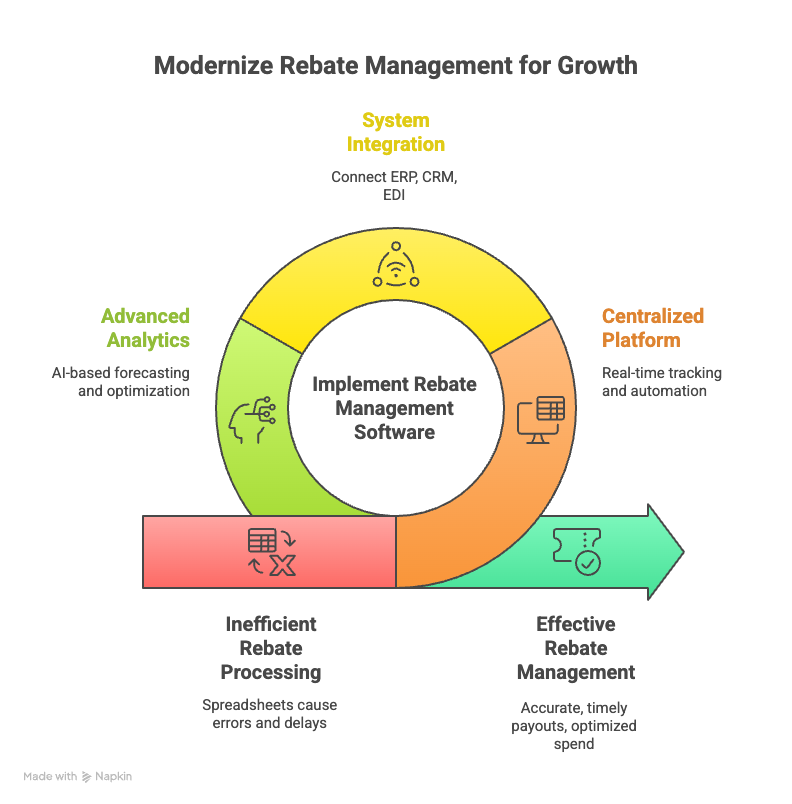
Integrate Rebate Systems with ERP and CRM Platforms
You already generate data required for rebate programs: ERPs log transactions, price adjustments, inventory movements; CRMs track customer relationships, account hierarchies, buying patterns. The question is whether your rebate system pulls this data automatically or teams manually export, transform, and re-enter it.
Integration delivers:
- Automatic data flow eliminates manual work and transcription errors
- Real-time accrual updates as transactions occur
- Instant program adjustments when customer segmentation changes
- Synchronized product hierarchies and SKU rules across systems
- Bidirectional data flow: pull transactions from ERP, push rebate results to finance systems
When a customer moves from the standard to the strategic tier in CRM, the rebate system instantly applies the correct program rules, preventing months of incorrect calculations. Finance teams answer “What’s total rebate exposure?” with a single query showing accruals by customer, program, and period.
Deploy AI-Driven Analytics for Predictive Insights
Quarter-end rebate reviews provide historical data when decisions are already locked. Real-time analytics enable proactive management: forecast outcomes before commitments finalize, identify partners approaching tier thresholds, simulate “what-if” scenarios for volume or margin impact, and detect anomalies that signal calculation errors or program manipulation.
Analytics capabilities enterprises need:
- Machine learning models predicting which partners will cross tier thresholds
- Natural language querying enables commercial teams to ask “Which partner is 5% from the next tier?” and act immediately
- Forecasting rebate spend and profitability before commitments are made
- Insights showing which tiers deliver incremental volume versus margin erosion
- Anomaly detection flagging unusual patterns requiring investigation
Strategic value: Solutions like Vistaar SmartRebates provide real-time dashboards with natural language querying, helping distributors identify missed rebate opportunities and enabling enterprise brands to adjust strategies agilely across channels and geographies as conditions change.
Establish Transparent, Unambiguous Rebate Terms
Rebate disputes originate from unclear contract language. Questions like “Does this purchase qualify?” or “Which time period applies?” signal definitional gaps that become costly later.
Documentation requirements:
- Explicit product qualification criteria (SKUs, product families, exclusions)
- Volume measurement methodology (units, revenue, weight)
- Time period definitions (calendar quarters, rolling 90 days, fiscal years)
- Calculation rounding conventions
- Contingency handling (product discontinuation, business acquisition, force majeure)
When rebate management software forces explicit parameter definition: product categories, measurement periods, tier thresholds, interpretation ambiguity disappears. The platform codifies calculation logic, eliminating disputes about how tiered volume rebates are calculated.
Align Rebate Structures with Strategic Business Objectives
Rebates create value only when they reinforce enterprise goals. Treating them as isolated financial incentives wastes their potential to shape behavior.
Strategic alignment approaches:
- Growth-based tiers incentivizing year-over-year volume increases for market expansion
- Product-mix requirements prioritizing focus SKUs or new launches
- Early-buy rebates smooth demand and production planning
- Market development funds tied to co-marketing activities, expanding brand presence
- Sell-through rebates encourage distributors to move inventory rather than warehouse it
Execution discipline: Platforms like Vistaar SmartRebate translate strategic objectives into configurable program rules, model financial impact before implementation, and ensure execution accuracy through automated calculation and auditability. Clear linkage between objectives, incentive design, and performance measurement ensures rebate spend directly supports enterprise growth priorities.
Implement Regular Review and Optimization Cycles
Rebate programs must evolve with market conditions. Customer behavior shifts, product lifecycles progress, competitors adjust strategies, and macroeconomic conditions alter purchasing patterns. Static rebate structures stop rewarding desired behaviors and start subsidizing unproductive ones.
Review cycle requirements:
- Quarterly assessment of tier thresholds against actual performance data
- Eligibility rule validation, ensuring programs target intended behaviors
- Payout condition analysis confirming margin protection
- Competitive intelligence integration, adjusting positioning as market dynamics shift
- Stale term elimination prevents outdated incentives from persisting
Vistaar automates review cycles with real-time accrual tracking and rule-based validation, ensuring programs remain compliant, financially accurate, and strategically relevant without increasing operational burden. Automated updates eliminate stale terms and streamline reconciliation.
Monitoring and Measuring Program Effectiveness
Set clear KPIs and metrics
Rebate programs only generate value if their impact can be measured. You need clearly defined KPIs that assess financial accuracy, operational performance, and partner impact. Without these metrics, rebate decisions become subjective, reactive, and difficult to defend.
| KPI | What it Measures |
|---|---|
| Rebate payout accuracy | Precision of payments and accruals |
| Program compliance | Adherence to contractual terms |
| Claim processing time | Operational efficiency and internal bottlenecks |
| Partner satisfaction | Relationship strength and rebate credibility |
| Rebate ROI | Net financial contribution to revenue |
Key Performance Indicators (KPIs) for Measuring Rebate Program Effectiveness and Efficiency
Post-Program Reviews
Once a program closes, a structured assessment ensures future rebate strategies improve, such as:
- Revenue lift vs. cost of rebates
- Margin impact at SKU, channel, or partner level
- Behavioral changes (e.g., new product adoption, mix shifts)
- Accuracy of initial forecasts
- Opportunities to optimize tiering or qualification criteria
These reviews ensure rebate programs evolve with market conditions and remain financially sound.
The Role of Technology in Modern Rebate Management
Rebate programs have evolved beyond what manual tools or basic reporting can support. Enterprises now need to start relying on AI to manage multi-market rebate structures, as it provides predictive insights, instant liability visibility, and supports global operations without platform constraints.
AI and Machine Learning Provide Predictive Insights
AI and ML turn rebates, which are backward-looking accounting entries, into forward-looking growth levers. Instead of waiting for quarter-end reports, advanced tools like Vistaar’s AI and ML models analyze transaction histories, purchasing patterns, and partner behavior to forecast tier attainment, flag at-risk programs, and recommend optimization actions in real time.
Real-Time Forecasting and Optimization
Real-time forecasting helps you understand the financial and behavioral impact of incentive changes before they are implemented. Instead of waiting for post-quarter reports, forecasting models simulate how different structures will affect revenue, margin, and partner behavior in real time.
Modern platforms like Vistaar’s SmartRebates model simulate multiple scenarios simultaneously, such as adjusting tier thresholds, incentive mix, or eligibility conditions, to compare outcomes side by side. This empowers you to:
- Predict how volume will shift when incentives change
- See the margin impact of new rebate rules before rollout
- Anticipate which partners will accelerate purchases or delay them
- Identify structural risks, like overspending on tiers that don’t drive incremental growth
- Optimize rebate spend toward programs with the strongest ROI
By combining real-time transactional feeds with forecasting algorithms, enterprises turn rebate design into a controlled, data-led decision. This lets pricing and finance teams refine program rules continuously, adjust to market shifts faster, and protect margins with precision.
Scalability Across Complex Multi-Market Environments
You’re operating across different countries, currencies, tax jurisdictions, and regulatory environments. Your rebate programs need to accommodate these variations while maintaining consistent governance and reporting.
Advanced platforms handle this complexity by design. They support multiple currencies and automatic conversion. They accommodate different tax treatments across jurisdictions. They allow you to define global program templates while enabling local customization where needed.
As your business grows, your rebate management infrastructure needs to scale without requiring complete rebuilds. Modern SaaS platforms like SmartRebates add users, trading partners, and transaction volume without architectural changes.
Modern rebate programs are too complex and valuable to be managed with error-prone spreadsheets, especially when they span multi-tier structures, global partners, and high transaction volumes. Enterprises need an integrated, automated approach that centralizes agreements, real-time tracking, and AI-driven insights into one system.
Ready to turn rebate chaos into a scalable, profit-driving engine?
Talk to Vistaar’s SmartRebates team to see how a unified pricing, quoting, and rebate platform can streamline your entire rebate lifecycle.
Frequently Asked Questions
1. What is Rebate Management?
Rebate management is the process of overseeing financial incentives offered to customers or partners, from program setup to tracking, calculation, and payout. It ensures accurate, timely, and transparent handling of rebates to boost sales and loyalty.
2. Why is Rebate Management Important for Enterprises?
Effective rebate management drives revenue, strengthens partner relationships, and improves margin control by automating manual processes, reducing errors, and providing real-time insights for smarter business decisions.
3. How Does Vistaar’s Solution Help Manage Complex Rebate Programs?
Vistaar’s SmartRebates streamlines the entire rebate lifecycle, using automation, AI-driven insights, and integration with enterprise systems. This reduces errors, ensures compliance, and turns rebates into measurable value drivers for your business.
