



TL;DR
• Rebate management is the full lifecycle of a rebate program: design, contract setup, transaction capture, accrual, attainment tracking, claim validation, settlement, and performance review
• Most rebate leakage comes from execution rather than design: spreadsheet calculations, contract terms that allow two readings, and data split across ERP, CRM, and partner files
• Accruing at the tier a customer has already reached, instead of the tier they are forecast to reach, pushes large catch-up entries into a single period and distorts margin reporting
• A rebate earns its cost only when it changes buying behavior, so every program needs a baseline that separates incremental volume from volume the customer would have bought anyway
• Measure programs on accrual accuracy, incremental volume, rebate cost as a share of revenue, dispute rate, and time to settle, then redesign tiers that pay without moving behavior
Rebate management is the process of designing, tracking, accruing, validating, and paying the rebates a company offers its customers and channel partners. For manufacturers and distributors running hundreds of agreements across thousands of SKUs, it decides how much of each rebate dollar actually buys growth and how much quietly leaks out of margin.
The leak rarely looks dramatic. A tier calculated on the wrong base, an accrual that trails the customer's real run rate, or a claim paid against an expired term each costs a little, and together they add up to incorrect payouts, month-end disputes, and a finance team that cannot say what the company owes its partners today.
Enterprises that get rebates under control treat them as a pricing lever with its own lifecycle, controls, and metrics, instead of an accounting entry settled at quarter end.
What Is Rebate Management?
Rebate management covers every step of a rebate program, from setting tiers and eligibility rules to accruing the liability, validating claims, and settling payment. Today it goes far beyond tracking simple percentage-based incentives, because enterprises run volume tiers, growth targets, promotional paybacks, buying group programs, and billbacks side by side across products, partners, and geographies.
Most enterprises sit on both sides of the process. Manufacturers pay customer and channel rebates, while distributors pay their own customers and also collect vendor rebates from suppliers, so the same control problems show up as a liability on one side and a receivable on the other.
As Shashank Misra, Director of Solution Consulting at Vistaar Technologies, explains, "Unlike simple price discounts, rebates influence when, where, how, and how much a buyer purchases, adding strategic dimensionality to channel behaviour."
Types of Rebates in B2B Enterprises
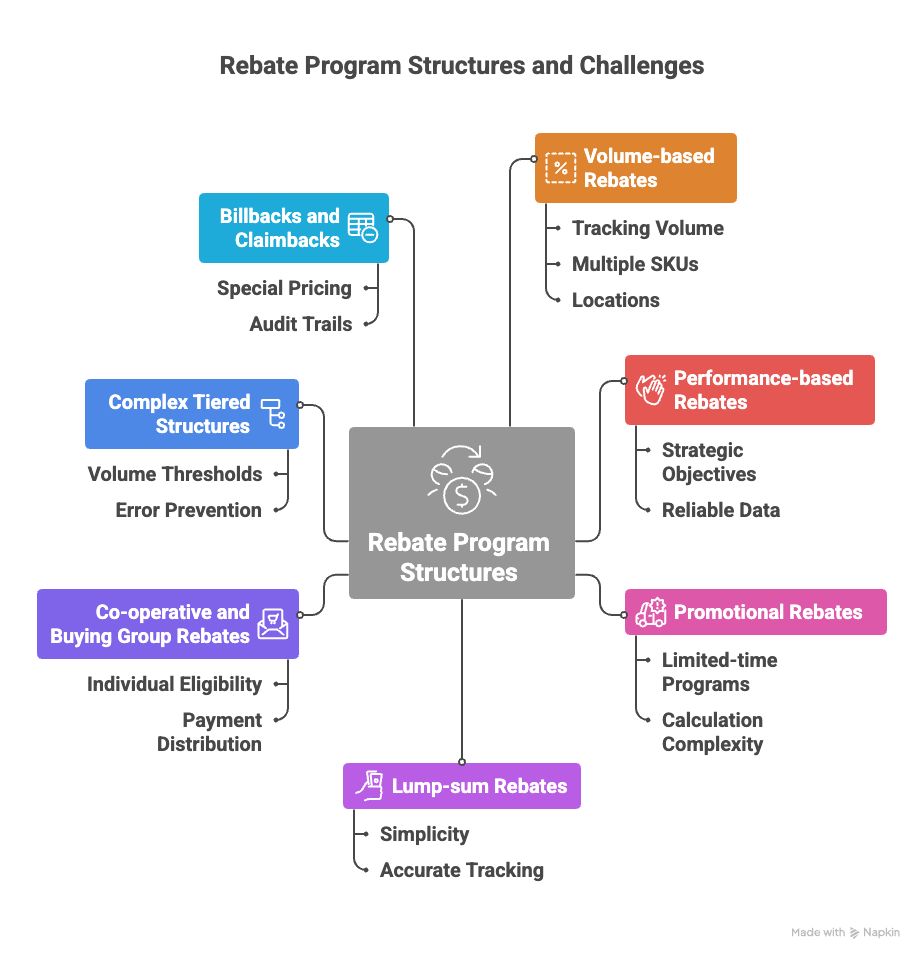
B2B enterprises rely on several rebate program structures, each designed to shape partner behavior and each complicated by diverse data sources, fragmented systems, and high transaction volumes.
Stakeholders Involved
Rebate management is never a single-team function. It sits at the intersection of sales strategy, financial accuracy, procurement, and technology, and each group needs the same data for programs to run accurately.
The Rebate Management Lifecycle, Step by Step
A rebate program moves through eight stages, and each stage hands data to the next. When one stage runs in a spreadsheet or a separate system, the errors it creates surface later as disputes, accrual adjustments, or overpayments.
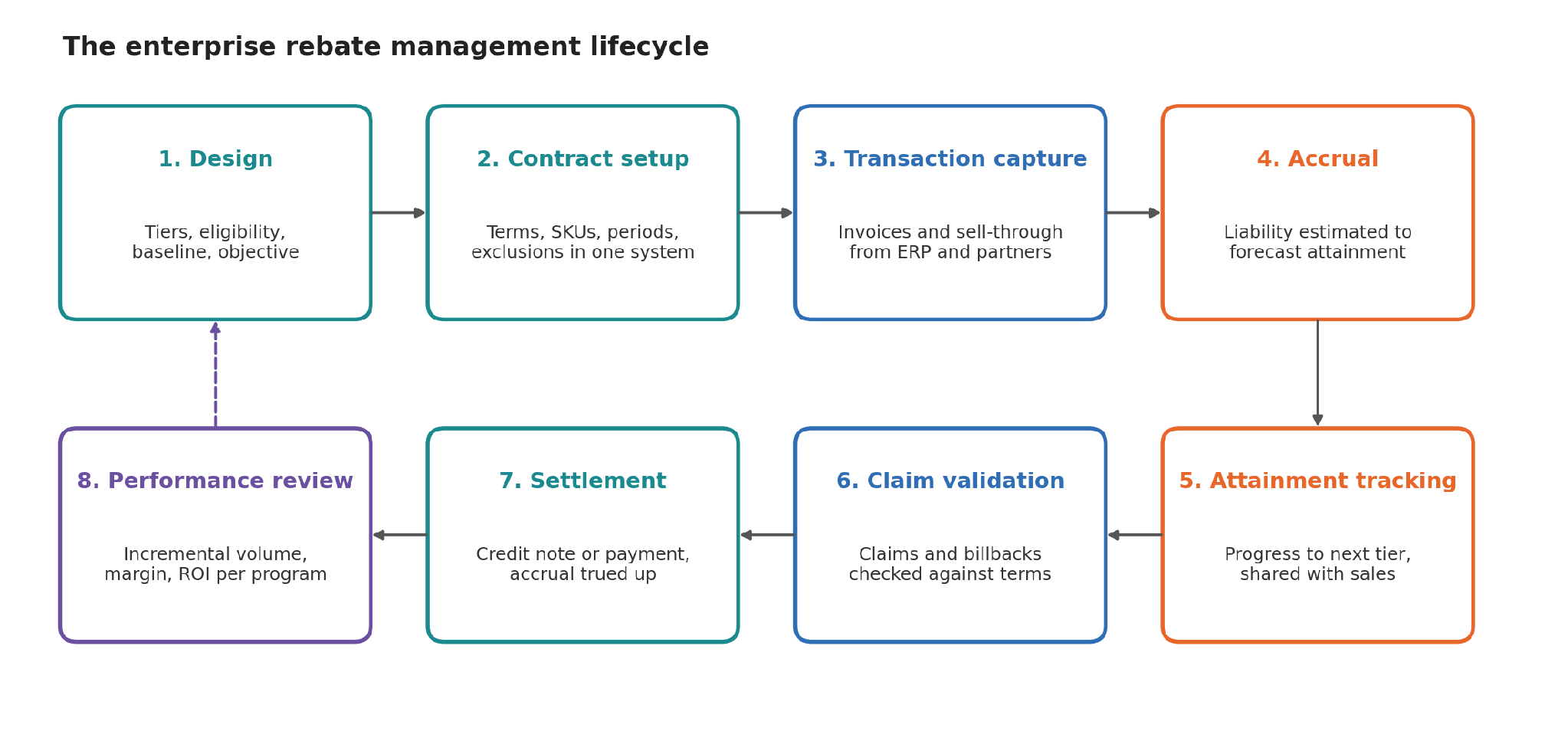
1. Design: Set the objective, baseline, tiers, and eligibility rules; the same tier logic used in a tiered pricing strategy decides whether rates apply retrospectively or only above each threshold
2. Contract setup: Record terms, qualifying SKUs, measurement periods, exclusions, and payment method in one system instead of in email and PDF contracts
3. Transaction capture: Pull invoices, credits, and, where relevant, partner sell-through data into the program as they post
4. Accrual: Estimate the liability each period based on the tier each customer is expected to reach
5. Attainment tracking: Show sales and partners how far each account is from the next tier while there is still time to act
6. Claim validation: Check claims and billbacks against contract terms and transaction data before approval
7. Settlement: Pay by credit note or payment, and true up the accrual to the final amount
8. Performance review: Compare incremental volume and margin with rebate cost, then feed the findings into the next program design
Common Challenges in Rebate Management
Rebate programs usually fail in execution rather than design. Manual workflows, disconnected systems, and delayed insight make it hard to forecast liabilities, track eligibility, or validate claims on time, and as programs scale across products, partners, and geographies, those gaps turn into rebate leakage and financial risk.
Manual Processes Create Compounding Risk
Many enterprises still calculate rebates in spreadsheets, even when programs span multiple SKUs, partners, and markets. Formulas break with minor edits, file versions drift apart, tier calculations compound small errors, and nobody can defend a disputed amount with a clean audit trail.
The results are overpayments that are hard to recover, underpayments that erode partner trust, and accrual misstatements that weaken financial reporting. Moving rebate accruals out of spreadsheets is usually the first control finance asks for.
Fragmented Data Hides Tier Progress
Rebate data scatters across systems: contracts in shared drives, invoices in the ERP, forecasts in the CRM, and promotional records in separate portals. Teams stitch the data together by hand and lose sight of each partner's progress toward its next tier, year-to-date accruals, and outstanding claims.
Late or incorrect payouts squeeze partner cash flow and damage relationships. Unclear visibility also means the supplier cannot warn a customer that it is close to a tier, which is the moment a rebate is most likely to change buying behavior.
Accruals That Trail the Tier
Rebates are variable consideration under ASC 606, so the expected rebate has to be estimated and deducted from revenue as sales occur, not when the tier is finally reached. PwC's accounting guide on variable consideration walks through the expected value and most likely amount methods and the constraint that limits the estimate.
Here is why the method matters. A customer earns 2% on all purchases below $5 million a year and 4% on all purchases once it passes $5 million. By June 30, it has bought $2.6 million and is forecast to finish the year at $5.4 million:
Both approaches end at the same $216,000. The first books half of it late and drops a $100,000 catch-up into one month, which makes that month's margin look worse than the business actually performed.
The fix is forecasting attainment account by account, then reviewing the estimate as volume comes in. A forecast set too high creates the opposite problem, a reversal later in the year, so ASC 606 rebate accounting works best with account-level forecasts that finance and sales both trust. Confirm the specific treatment with your auditors.
Rebates That Pay for Volume You Already Had
A rebate that pays a customer for buying what it would have bought anyway is a price cut with extra paperwork. This happens when tiers are set just above a customer's normal volume, when programs renew year after year without a baseline, or when a growth rebate measures against a weak prior year.
Set a pre-program baseline for each account so the review can isolate incremental volume from base volume, and the performance review should compare rebate cost against the incremental margin it bought, not against total sales.
Regulatory Exposure on Rebate Access
In the US, rebates on physical goods fall under the Robinson-Patman Act alongside discounts. The FTC's case against Southern Glazer's Wine and Spirits alleged that independent retailers were deprived of access to discounts and rebates that large chains received, and the parties moved toward a settlement in mid-2026.
The FTC's case page sets out the allegations. The practical step for rebate owners is to document the cost or competitive basis behind each program and confirm that competing customers can realistically qualify. Treat this as context rather than legal advice, and involve counsel on program design.
Best Practices for Effective Rebate Management
Effective rebate management comes from deliberate operating design as much as from software. These practices turn rebates from an administrative burden into a tool that shapes partner behavior, protects margin, and supports predictable growth.
Centralize Rebate Governance in a Unified System
Rebate data spread across spreadsheets, emailed contracts, and disconnected systems creates calculation errors, approval delays, and compliance gaps. Centralized governance gives every rebate agreement, transaction, accrual, and payout one source of truth.
What this requires:
- Structured contracts: Every rebate agreement documented in a searchable, structured format
- Automated data ingestion: Transaction data pulled from ERP systems without manual exports
- Continuous accruals: Accrual updates with each posted transaction instead of month-end reconciliation
- Role-based access: Finance, sales, and compliance working from the same data
- Audit trails: A record of every term change, calculation, and approval
With terms, transactions, and accruals in one place, quarter-end close becomes a review of reconciled data rather than a hunt for it, and it keeps rebate accruals audit-ready through the year.
Integrate Rebate Systems With ERP and CRM Platforms
The data rebate programs need already exists. ERPs log transactions, price adjustments, and inventory movements, and CRMs track customer relationships, account hierarchies, and buying patterns. The question is whether the rebate system pulls that data automatically or teams export, transform, and re-enter it.
Integration delivers:
- Automatic data flow: No manual transfers or transcription errors
- Current accruals: Accrual updates as transactions post
- Segment-aware rules: Program changes applied as soon as customer segmentation changes
- Shared product data: Product hierarchies and SKU rules synchronized across systems
- Two-way flow: Transactions pulled from the ERP and rebate results pushed back to finance systems
When a customer moves from the standard to the strategic tier in the CRM, the rebate system should apply the new program rules immediately, which is what well-scoped pricing software integrations are built to do. Finance can then answer "What is our total rebate exposure?" with one query that shows accruals by customer, program, and period.
Forecast Tier Attainment With Predictive Analytics
Quarter-end rebate reviews report history after the decisions are locked. Predictive analytics shift that work forward: forecast outcomes before commitments are final, identify partners approaching tier thresholds, test what-if scenarios for volume and margin, and flag anomalies that signal calculation errors or program gaming.
Pricing teams are moving in this direction. In McKinsey's November 2025 survey of 419 B2B pricing executives, 65 to 85 percent expected to adopt gen AI or agentic AI in pricing within one to three years, up from 10 to 30 percent at the time of the survey.
Analytics capabilities enterprises need:
- Attainment forecasts: Models that predict which partners will cross tier thresholds this period
- Spend forecasts: Projected rebate cost and profitability before a program is committed
- Tier effectiveness: Views that show which tiers drive incremental volume and which only add cost
- Anomaly detection: Alerts on unusual patterns that need investigation
Establish Transparent, Unambiguous Rebate Terms
Many rebate disputes start with unclear contract language. Questions such as "Does this purchase qualify?" or "Which period applies?" point to definitional gaps that become expensive at settlement.
Documentation requirements:
- Product qualification: SKUs, product families, and exclusions
- Volume measurement: Units, revenue, or weight, and whether returns are netted out
- Time periods: Calendar quarters, rolling 90 days, or fiscal years
- Calculation rules: Retrospective or incremental tiers, and rounding conventions
- Contingencies: Product discontinuation, acquisitions, and force majeure
When the system requires each parameter to be defined explicitly, interpretation gaps close. The calculation logic is written once and applied the same way for every claim, which removes most disputes about how a tiered volume rebate was calculated.
Align Rebate Structures With Strategic Business Objectives
Rebates create value only when they reinforce a business goal. Treated as isolated financial incentives, they subsidize behavior instead of shaping it.
Strategic alignment approaches:
- Growth-based tiers: Reward year-over-year volume increases in markets you want to expand
- Product-mix requirements: Prioritize focus SKUs or new launches
- Early-buy rebates: Smooth demand and production planning
- Market development funds: Tie payouts to co-marketing activity
- Sell-through rebates: Reward distributors for moving inventory rather than warehousing it
Channel programs follow the same rule, and channel rebates work best when each one is linked to a specific objective, an incentive design, and a performance measure agreed before launch.
Review Programs on a Fixed Cycle
Rebate programs have to evolve with the market. Customer behavior shifts, product lifecycles move on, competitors adjust, and purchasing patterns change, so a static structure eventually stops rewarding the behavior it was designed for and starts subsidizing behavior nobody asked for.
Review cycle requirements:
- Threshold checks: Quarterly comparison of tier thresholds with actual performance
- Eligibility validation: Confirmation that programs still target the intended behavior
- Payout analysis: A check that payout conditions still protect margin
- Market adjustments: Changes to positioning as competitive dynamics shift
- Sunset rules: Retirement of stale terms before they renew by default
How to Measure Rebate Program Effectiveness
Rebate programs generate value only if their impact can be measured. Clear KPIs across financial accuracy, behavioral impact, and operational performance make rebate decisions defensible instead of subjective.
Rebate cost also has to be read in the context of total deductions. Tracking it inside gross-to-net shows whether rebates are growing faster than the revenue they are supposed to drive.
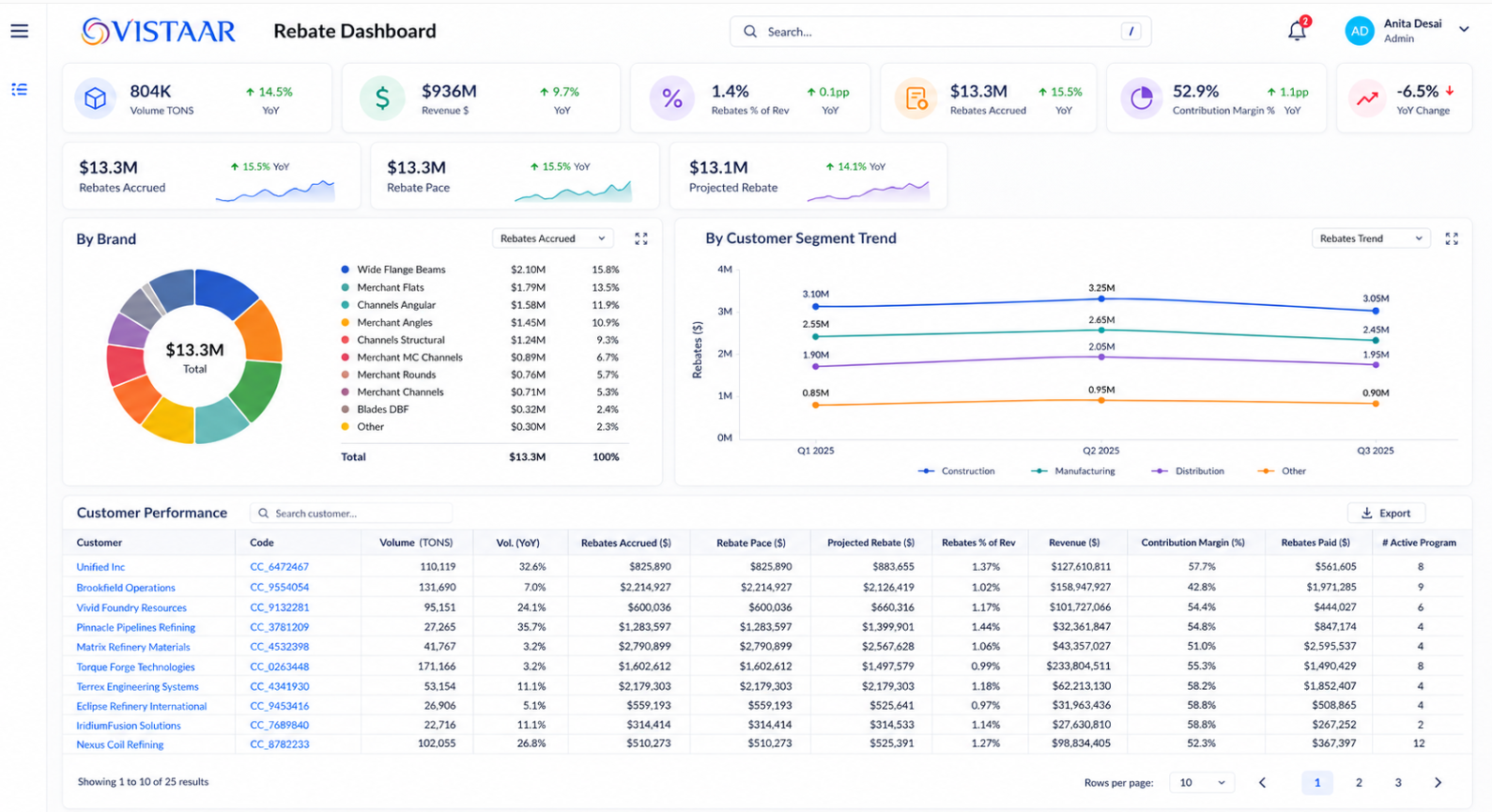
Once a program closes, a structured post-program review improves the next one. Cover these points:
- Revenue lift vs. cost: Incremental revenue compared with total rebate paid
- Margin impact: Effect by SKU, channel, and partner
- Behavior change: New product adoption, mix shifts, or earlier ordering
- Forecast accuracy: How close the initial accrual forecast came to the final amount
- Design changes: Tiers or qualification rules to adjust next time
What to Look for in Rebate Management Software
Rebate management software should cover the full lifecycle above and connect to the pricing decisions that rebates affect. Use these criteria when evaluating platforms:
How Vistaar SmartRebates Supports the Rebate Lifecycle
Vistaar treats rebates as part of the pricing decision, not a separate accounting process, so the same platform that sets prices and quotes deals also runs rebate programs. For manufacturers, distributors, and beverage alcohol suppliers with complex programs, that covers:
- Program setup: SmartRebates centralizes volume, growth, tiered, and channel-specific rebate rules and terms in one system
- Accrual and payout automation: Accruals and payouts are calculated automatically, with a full audit trail from transaction to settlement
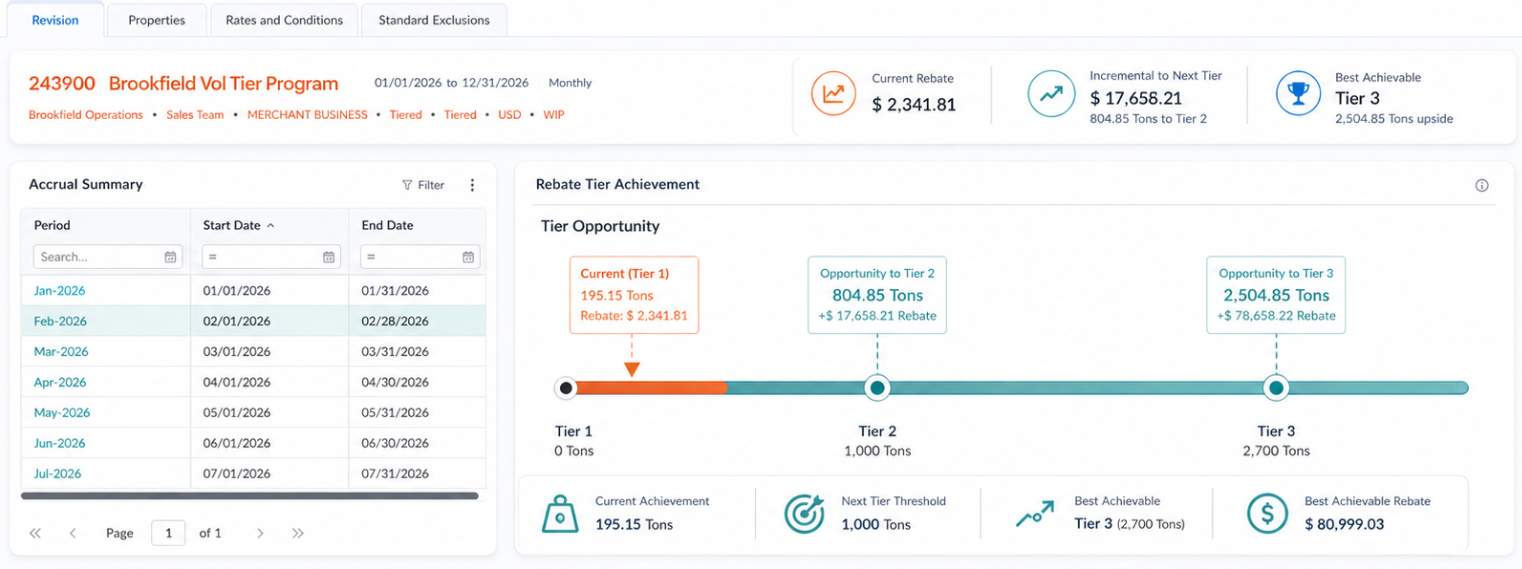
- Tier progress visibility: Program views show each customer's current tier, the volume needed for the next one, and the rebate at stake
- Effectiveness analysis: Rebate performance and margin contribution are broken down by product, region, and partner
- Connected pricing: Rebate logic is shared with SmartQuote, so deal pricing reflects the rebates a customer will earn
Vistaar is a Leader in the inaugural 2026 Gartner Magic Quadrant for B2B Pricing and Rebate Optimization Software and in the IDC MarketScape for Worldwide B2B Revenue and Profit Optimization Platforms 2025 to 2026.
Conclusion: Manage Rebates Like a Pricing Decision
Rebate programs rarely lose money in one visible mistake. They lose it through accruals that trail attainment, tiers that pay for volume the customer was already buying, and claims validated against the wrong version of a contract.
Before renewing any program, test it against three questions:
1. Incrementality: Does the program have a baseline, and did it buy volume or margin above it?
2. Accuracy: Did the accrual track the final payout closely enough that no period absorbed a large catch-up?
3. Control: Could finance trace every payment back to contract terms and transactions without opening a spreadsheet?
A program that passes all three is working as a pricing lever. A program that fails one needs redesign before it renews.
See Where Your Rebate Programs Leak
If your team still reconciles rebate accruals in spreadsheets and finds tier errors only at settlement, see how Vistaar connects rebate setup, accruals, tier tracking, and deal pricing in one platform.
Request a demo
FAQs
1. What Is the Difference Between a Rebate and a Chargeback?
A rebate is paid to the buyer after it meets program conditions, such as a volume tier. A chargeback reimburses a distributor for selling to a specific end customer below its acquisition cost under a contract price.
2. Should Rebates Be Paid as Credit Notes or Cash?
Credit notes keep funds inside the trading relationship and simplify reconciliation against open invoices. Cash payments suit partners with irregular order patterns. The contract should name the method, because switching mid-program complicates accrual true-ups.
3. What Happens to a Rebate Program When a Customer Is Acquired?
The contract's contingency clause should decide whether volumes combine, the program transfers, or it closes with a pro-rated settlement. Without that clause, the acquirer often claims the combined volume at the higher tier.
4. How Often Should Rebate Accruals Be Updated?
At minimum monthly, aligned with the close. High-volume programs benefit from updating with each posted transaction, which keeps the liability current and prevents large adjustments when a customer crosses a tier late in the period.

As an experienced pricing solutions partner to some of the biggest names in global business, Vistaar offers a range of services to help our customers reach their maximum potential. Talk to us to see how we can help you create a more profitable future.