




Key Takeaways
- CPQ stands for Configure, Price, Quote. It is the category of software that automates how sales teams build accurate, compliant proposals for complex B2B deals.
- The real value of CPQ lives in the "C" and "P" (configuration logic and pricing rules), not the "Q" (document generation). Most people confuse CPQ with proposal tools. It is not the same thing.
- CPQ applies pricing rules that humans set. It does not determine what the optimal price should be. This distinction matters more than most vendors will admit.
- Organizations with 500+ SKUs, customer-specific pricing, and multi-level discount structures see the fastest ROI from CPQ, while s
Here is a scene that plays out at B2B companies every single day. A sales rep gets a Request for Quote (RFQ) from a high-value prospect. She opens Excel, pulls up the most recent price list (last updated three months ago), and starts building the quote.
She emails engineering to validate a product configuration and waits two days. Types the proposal in Word, send it, and the customer signs.
This is not a rare occurrence. According to LinkedIn's State of Sales Report, B2B sales reps spend only 28 to 35 percent of their time on actual selling activities. The rest disappears into administrative work like pricing lookups, quote formatting, approval chasing, and re-work from errors that should not have happened in the first place.
This is the problem CPQ was built to solve. "CPQ" stands for Configure, Price, Quote, and it refers to both a process and a category of software. In short, CPQ automates how sales teams assemble accurate quotes by enforcing product configuration rules, applying the correct pricing for each deal, and generating professional proposals.
If your organization sells configurable products, manages customer-specific pricing, or deals with multi-tier discount structures, CPQ is the system designed to bring order to that complexity.
For a broader look at how pricing models work across different industries, that context helps frame why CPQ has become essential for growing B2B organizations.
What Does CPQ Stand For?
CPQ stands for Configure, Price, Quote. Each word represents a distinct stage in the sales quoting process, and each stage carries its own complexity.
Configure means selecting the right product, options, features, or bundle for the customer's requirements. In a CPQ system, configuration rules prevent invalid combinations automatically. If a customer requests a pump with a titanium housing and a seal type that is incompatible with titanium, the system flags it before the quote goes out. No more "we sold something we cannot build" moments.
Price means applying the correct pricing based on that specific deal's context: the customer's contract, their volume tier, geography, channel, and any active promotions or discounts. This is where most of the value (and most of the complexity) lives. Pricing rules can involve dozens of variables, and getting them wrong costs real money.
Quote means generating a professional, branded proposal document that the buyer can review, approve, and sign. This includes accurate line items, terms and conditions, and often electronic signature integration.
A common misconception is that CPQ is just fancy proposal generation software. Tools like PandaDoc or Proposify handle the "Q" well, but they do not touch the "C" or the "P." The configuration and pricing logic is what separates CPQ from document tools. In practice, sales teams often call it their "quoting tool" or "pricing system."
The industry term is CPQ, but the underlying need is the same: get the right product at the right price into the customer's hands before a competitor does. Enterprise CPQ platforms take this further by embedding pricing intelligence directly into the quoting workflow.
How Does CPQ Work? The Three-Stage Process
CPQ follows a straightforward three-step workflow. Each step builds on the previous one, and the entire process can compress what used to take days into minutes for standard deals.
Step 1: Configure: Building the Right Solution
Product configuration is where CPQ earns its keep for companies with complex catalogs. A manufacturer of industrial pumps might have 200+ configurable attributes: material, size, motor type, seal configuration, coating. Without CPQ, an engineer reviews every quote manually to ensure the combination is physically valid. With CPQ, configuration rules handle that validation automatically.
The better CPQ systems also support guided selling. Instead of requiring reps to know every product option by heart, the system walks them through a needs-based questionnaire. "What environment will this operate in? What flow rate does the customer need?" The answers narrow down valid configurations without the rep ever needing to memorize a 300-page product catalog.
Step 2: Price: Applying the Right Price for This Deal
Once the product is configured, CPQ applies pricing rules: list prices, customer-specific rates, volume discounts, contracted pricing, promotional offers, geographic adjustments. If a deal exceeds pre-set discount thresholds, the system routes it to the appropriate manager for approval. Deals within guardrails get auto-approved.
Here is the critical nuance that most "What is CPQ" articles skip entirely. CPQ applies pricing rules. It does not determine what the optimal price should be. The prices and discount logic must be configured by humans, or by a separate pricing optimization system. This means CPQ is a pricing execution tool, not a pricing intelligence tool. If the prices loaded into CPQ are wrong, CPQ will enforce wrong prices consistently and at scale. More on that later.
Think of it as stopping reps from "giving away the farm." The system enforces floor prices and maximum discount limits so every deal protects a minimum margin. That is valuable. It is also only half the picture.
Step 3: Quote: Generating and Delivering the Proposal
The final stage produces a branded, accurate proposal document. Line items reflect exactly what was configured and priced. Terms and conditions are auto-populated. The quote is delivered electronically, often with e-signature integration for faster close.
According to Gartner's research on the B2B buying journey, 77 percent of B2B buyers describe their most recent purchase as very complex or difficult. For the buyer, a fast, accurate, professionally formatted quote is not a nice-to-have. It signals that the vendor is organized enough to deliver on their promises.
A Simple CPQ Example: What It Looks Like in Practice
Let us walk through a concrete scenario. A distributor with 10,000 SKUs receives an RFQ from a long-standing customer. The customer wants a custom bundle: 500 units of Product A (with a specific coating), 200 units of Product B, and volume-based pricing based on their annual contract.
Without CPQ: The rep opens a spreadsheet. Checks the price list (last updated three months ago). Emails the pricing team to confirm the customer's contracted rate. Emails engineering to validate the coating option for Product A. Waits two days. Types the quote in Word. Sends it. Discovers a pricing error two weeks later during invoicing. The customer disputes the invoice. Finance gets involved. Three people spend a day sorting it out.
With CPQ: The rep opens the quoting tool within their CRM. Selects Product A. The system automatically shows valid coating options and flags incompatible ones. Prices auto-populate based on the customer's contracted rates and volume tier. The system calculates the blended discount, confirms it falls within approval limits, and generates the quote. Sent in 20 minutes. Price is accurate because it pulled from a single source of truth.
The value is not just speed. It is accuracy, consistency, and the elimination of the "only Dave knows the price" dependency. When a company manages thousands of special pricing agreements across its customer base, this kind of centralized logic becomes non-negotiable.
Why Do Sales Teams Rely on CPQ? Five Problems It Solves
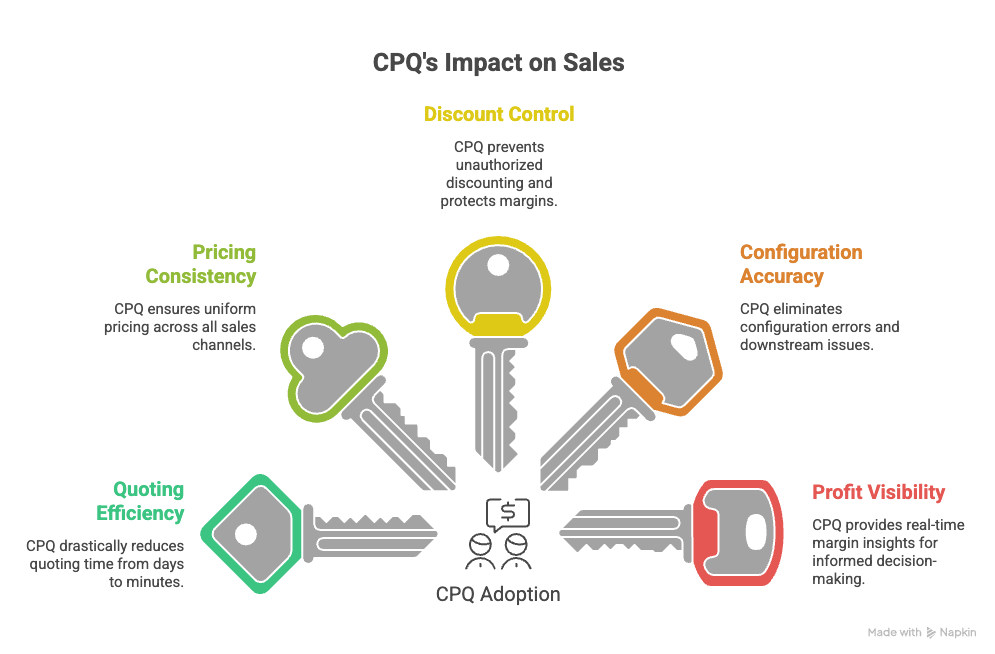
CPQ adoption has grown steadily because it addresses five specific pain points that manual quoting creates. Each of these problems compounds over time, and each costs real revenue.
1. Quoting Takes Days Instead of Hours
Manual quoting involves pricing lookups, engineering reviews, manager approvals, and document formatting. Each step adds hours. For complex deals with configurable products, the cycle can stretch to a week or more. CPQ compresses multi-day cycles into minutes for standard deals and hours for complex ones. The rep never leaves the CRM to build the quote, and the system handles the pricing math automatically.
2. Pricing Is Inconsistent Across Reps, Regions, and Channels
When every rep maintains their own spreadsheet, pricing inconsistency is inevitable. The Chicago rep quotes $45 per unit. The Dallas rep quotes $52 per unit for the same product, same customer segment. That is not a quoting problem. It is a credibility problem. CPQ enforces one centralized pricing system for pricing across the entire sales organization.
3. Unauthorized Discounting Erodes Margins Silently
Without guardrails, reps default to the floor price on every deal because there is no guidance on what price each deal should command. CPQ solves this with discount guardrails and approval routing. Deals within approved thresholds go through. Exceptions require review.
The stakes here are significant. According to the Simon-Kucher Global Pricing Study, a 1 percent improvement in price realization yields an 8 to 11 percent improvement in operating profit. Pricing is the single most powerful profit driver, more impactful than volume growth or cost reduction. Effective pricing analysis paired with CPQ enforcement turns that insight into daily operational discipline.
4. Configuration Errors Create Downstream Chaos
Invalid product combinations, mismatched specs, orders that cannot be fulfilled as quoted. These errors cascade through operations: returns, change orders, support tickets, and strained customer relationships. CPQ's configuration rules eliminate "we sold something we cannot build" scenarios at the point of sale, not after the contract is signed.
5. Lack of Visibility Into Deal-Level Profitability
Without CPQ, finance discovers margin problems after the deal closes. By then, the contract is signed and the damage is done. CPQ provides real-time margin visibility at the point of quoting. Reps and managers can see exactly how much margin they are giving away on every deal, and make informed trade-offs before committing to a price.
CPQ vs. CRM vs. ERP Pricing: What's the Difference?
One of the most common questions about CPQ is how it differs from the CRM system sales teams already use or the ERP system finance relies on. The short answer: they do different things, and CPQ sits between them.
CPQ sits between CRM and ERP. It takes the customer context from CRM and the pricing and product data from ERP, and creates the bridge: a quoted deal the customer can accept and the back office can fulfill.
Many companies try to use their CRM's built-in quoting feature or their ERP's pricing module as a CPQ substitute. For simple businesses with a short product catalog and flat pricing, that can work. For companies with complex configurations, customer-specific pricing, or multi-tier discount structures, it breaks down quickly. Enterprise price management platforms are specifically designed to handle this level of complexity, while CRM and ERP pricing modules are not.
If you are a 20-person company with three pricing tiers, your CRM's native quoting feature is probably sufficient. CPQ becomes necessary when your pricing complexity outgrows what a CRM can handle.
Who Needs CPQ? (And Who Doesn't Yet)
You Likely Need CPQ If...
Your organization sells configurable products or services with dependencies between options. Your sales team has more than five reps quoting independently. Your product catalog exceeds 500 SKUs with customer-specific or volume-based pricing. Reps regularly email the pricing team to confirm rates before quoting. Discount approval requires multi-level manager review. You have experienced invoicing errors traced back to incorrect quotes. Your industry has regulatory pricing requirements like minimum pricing laws, excise taxes, or multi-jurisdictional compliance.
You May Not Need CPQ Yet If...
You have fewer than 50 SKUs with uniform pricing. Your sales team is under five people who all report to the same manager. Your pricing rarely changes (fewer than two updates per year). All your deals follow the same structure with no configuration variability. In that case, a well-structured spreadsheet, a CRM-native quoting feature, or a proposal tool like PandaDoc is likely sufficient.
The In-Between: Signs You're Outgrowing Manual Processes
You have started building "quote calculators" in Excel with macros. New reps take three or more months to learn your pricing well enough to quote independently. Your pricing team spends more time answering rep questions than doing strategic pricing work. Customers have complained about pricing inconsistencies between quotes. If you are managing multiple pricing tiers and structures across different customer segments, the manual approach is probably costing you more than you realize.
The global CPQ software market was valued at approximately $3.3 billion in 2024 and is projected to reach $8.5 to $9.5 billion by 2030, growing at a CAGR of roughly 17 percent (Grand View Research, 2026). The market is expanding because more organizations are reaching the complexity threshold where manual quoting becomes untenable.
CPQ by Industry: Where It Creates the Most Impact
CPQ is not a one-size-fits-all solution. Its value depends on the type of complexity your industry creates. Here is where CPQ delivers the highest return.
Manufacturing
Manufacturing is the original CPQ use case. Configuration complexity (200+ attributes, BOM dependencies, engineered-to-order products), volatile input costs that require frequent price updates, and multi-region pricing with different currencies and duties all create the exact conditions CPQ was designed to address. An industrial pump manufacturer, for example, can reduce quote turnaround from three days to two hours by automating configuration validation and pricing lookups. Manufacturing pricing solutions that integrate CPQ with price optimization go further by ensuring those fast quotes also carry the right margin.
Distribution
Distributors face a different flavor of complexity. Customer-specific pricing across thousands of accounts is the norm, not the exception. As one user in an online sales forum put it: "Every one of our 500 customers has negotiated different pricing. Our reps memorize prices for their top 20 customers and guess on everything else." Multi-tier discount structures (manufacturer to distributor to retailer) and rebate program complexity layered on top of base pricing make distribution pricing management an ideal CPQ application.
CPG and Consumer Goods
Trade promotion pricing, scanbacks, and chargebacks create unique quoting challenges. Channel-specific pricing (modern trade, traditional trade, eCommerce) and seasonal promotions that must coordinate across hundreds of retail partners demand the kind of rule-based automation CPQ provides.
Beverage Alcohol, Tobacco, and Regulated Industries
Multi-jurisdictional tax compliance (excise duties, VAT, minimum unit pricing), three-tier distribution networks, and regulatory pricing constraints make manual quoting genuinely risky. In regulated industries, a pricing error is not just a margin problem. It is a compliance violation. Global price management for beverage alcohol requires CPQ systems that embed regulatory logic directly into the quoting workflow.
CPQ Doesn't Fix Pricing. It Freezes It.
The conventional wisdom says that CPQ improves pricing accuracy and consistency, which increases revenue and protects margins. That is true as far as it goes. The uncomfortable truth goes further: CPQ codifies your existing pricing into automated rules. For most companies, existing pricing is already suboptimal. It was built on outdated cost-plus models, undocumented exceptions, and gut-feel discounts that accumulated over years. By encoding those prices into an automated system, CPQ can actually lock in margin leakage at scale.
Instead of one rep giving a bad discount on one deal, the entire sales team is now quoting at suboptimal prices with machine-like efficiency.
This plays out consistently across CPQ deployments. User review platforms surface the same pattern consistently. Teams report: "We automated our quoting process but the prices themselves are still whatever was in the spreadsheet we migrated from. CPQ made us faster at generating quotes, not smarter at pricing." A recurring theme in sales operations communities echoes this: "We implemented CPQ and our quote turnaround improved by 60 percent, but our average discount percentage did not change at all. We are just losing margin faster."
McKinsey's research on B2B pricing science reinforces this: pricing errors and suboptimal pricing execution cost B2B companies 1 to 5 percent of annual revenue, with most organizations unable to capture 20 to 30 percent of potential pricing upside.
The key distinction is between pricing execution (applying the prices someone already decided on, which is what CPQ does) and pricing optimization (determining what the right prices and discount structures should be using data, elasticity analysis, and competitive intelligence, which is a separate discipline that CPQ does not address).
Before investing in CPQ, audit your pricing. If your prices are already optimized, CPQ will amplify that advantage. If they are not, CPQ will automate mediocre pricing at scale. The most effective CPQ implementations are fed by intelligent pricing optimization systems, not by migrated spreadsheets.
Tools like Vistaar's SmartOptimizer use predictive modeling and elasticity analysis to determine optimal price points, which then feed directly into CPQ rules. The result is that every quote is fast, compliant, and actually optimized for the deal context.
What to Know Before You Buy CPQ: Readiness Factors Most Vendors Won't Mention
The sales pitch for CPQ sounds great. The implementation reality is often messier than anyone expected. Here is what to prepare for.
Is Your Product Catalog CPQ-Ready?
The number one cause of CPQ implementation failure, rarely discussed in vendor demos, is product catalog chaos. Undocumented SKUs, informal pricing exceptions, configurations that "only Dave in accounting knows about." Companies with 5,000+ SKUs routinely discover that 20 to 40 percent of their catalog is redundant, obsolete, or undocumented once they begin a CPQ project.
Review platforms surface the same complaint repeatedly: "We spent three months on CPQ implementation and nine months on data cleanup before we could even start configuring rules." Before evaluating CPQ vendors, audit your product catalog.
Can you list every active SKU, its valid configurations, and its current pricing logic? If not, plan for a catalog rationalization project before or in parallel with CPQ implementation. Understanding your pricing segmentation before you begin is not optional. It is foundational.
Do You Have Pricing Logic Documented, or Is It Tribal Knowledge?
CPQ forces companies to formalize pricing rules that previously existed only in people's heads or in undocumented spreadsheets. This is simultaneously the biggest pain and the biggest hidden benefit of CPQ. The implementation process itself forces pricing hygiene. Think of CPQ implementation as a pricing audit you are forced to do, with the bonus of automation at the end.
The Hidden Ongoing Cost: Pricing Rule Maintenance
Every time marketing launches a new bundle, or finance changes discount tiers, or you enter a new geography, someone has to update CPQ rules. Many companies have essentially created a full-time job that did not exist before. Review platforms across multiple CPQ vendors surface this repeatedly as an unexpected cost. Pricing rule maintenance is a structural, permanent expense that is rarely included in total cost of ownership calculations. For pricing managers, this means strategic pricing work gets crowded out by CPQ rule administration.
Sales Rep Adoption: The Make-or-Break Factor
If the tool slows reps down by even 30 seconds per quote, they will find workarounds. Reviews across multiple CPQ platforms report adoption dropping to 40 to 60 percent within three months of launch when the UX does not match reps' existing workflow. When reps bypass CPQ, they bypass pricing guardrails, recreating exactly the unauthorized discounting and pricing inconsistencies the tool was supposed to eliminate.
During vendor evaluation, involve two or three front-line reps in UX testing. Their buy-in during the selection process predicts adoption post-launch. This is not a nice-to-have. It is the single best predictor of whether your CPQ investment will succeed or become expensive shelfware.
CPQ and the Full Quote-to-Cash Lifecycle
CPQ is the front end of a larger process: Quote, Order, Fulfill, Invoice, Collect, Recognize Revenue. Most content about CPQ focuses on initial quote generation, but that is not where the real complexity lives. Mid-contract amendments, renewals, upsells, and co-terming are where things get messy. As one sales operations leader put it: "Our biggest pain is not creating new quotes. It is handling mid-term add-ons and co-terming subscriptions."
Fewer than 15 percent of B2B organizations have achieved full end-to-end automation of their quote-to-cash process, according to Gartner's research on quote-to-cash application strategy (2023 to 2024). Most rely on manual handoffs between CPQ, contract management, billing, and revenue recognition.
The integration between CPQ and back-office systems breaks more often than vendors admit. When your CPQ-to-ERP sync fails, orders get stuck, customers get invoiced incorrectly, and revenue gets booked to the wrong period. For organizations managing complex rebate programs, this integration challenge compounds further because rebate accruals depend on accurate deal data flowing from CPQ through to finance.
How to Evaluate CPQ Software: A Practical Framework
If you have read this far and decided CPQ is right for your organization, here is what to look for during the evaluation process.
Integration Depth
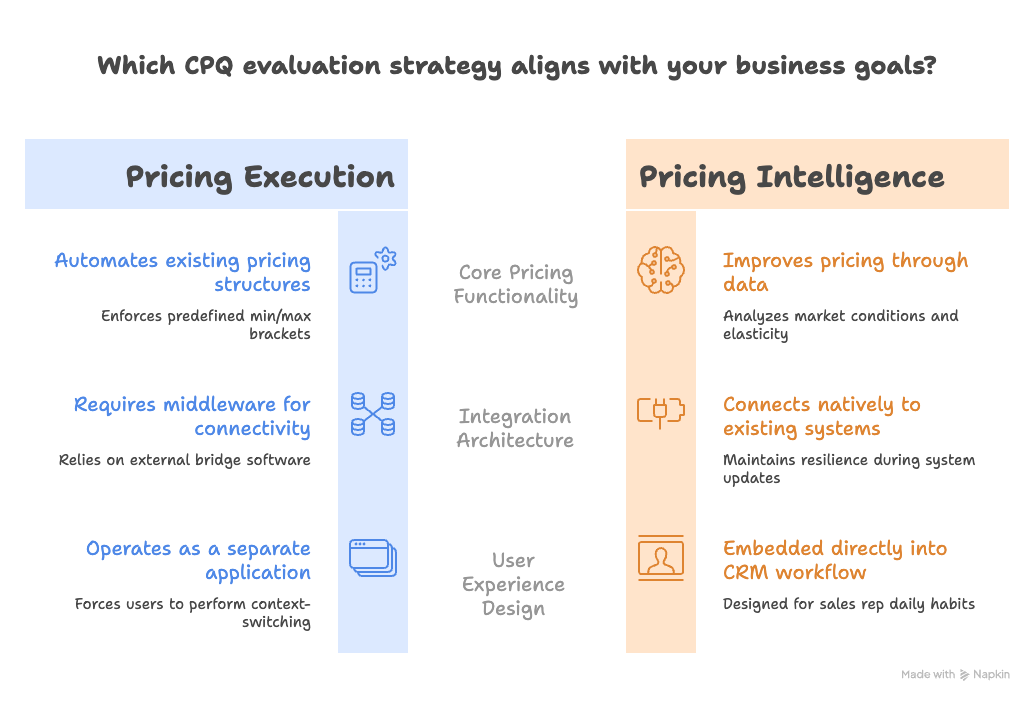
How does it connect to your CRM, ERP, and billing systems? Does it require middleware, or does it integrate natively? How resilient is the integration during system updates? Ask vendors for specific examples of how their CPQ handles a pricing data sync failure.
Pricing Intelligence vs. Pricing Execution
Does the CPQ just apply prices, or does it provide AI-driven price guidance on what the price should be? Can it account for real-time market conditions, customer-specific elasticity, and competitive context? Or is it just enforcing min/max brackets? This is the difference between automating your current pricing (which may be suboptimal) and actually improving it.
Configuration Complexity Support
Can it handle your specific product architecture? BOM-based, attribute-based, subscription, usage-based, hybrid? How does it handle mid-contract changes and amendments? Ask to see a demo using a product configuration comparable to your most complex offering, not the vendor's simplest example.
Total Cost of Ownership
License fees are the starting point, not the total. Factor in implementation services, ongoing admin headcount, integration maintenance, and training. Ask vendors for customer references at your complexity level, not their simplest customer success story.
Adoption Design
Is the UX designed for sales reps who live in CRM all day, or is it a separate application that requires context-switching? Mobile accessibility matters for field sales teams. If the tool does not fit the rep's daily workflow, adoption will suffer regardless of how powerful the features are.
Building a Quoting Process That Actually Protects Margin
CPQ solves a real, measurable problem. Manual quoting is slow, error-prone, and leaks margin in ways most organizations cannot even quantify. A well-implemented CPQ system compresses quote cycles, enforces pricing consistency, and gives sales leaders visibility into deal-level profitability before the contract is signed.
It solves a specific problem, not every problem. The companies that get the most from CPQ are those that prepare their product catalog and pricing logic before implementation, invest in pricing intelligence alongside pricing execution, and design for rep adoption from day one. Skip any of those three, and you are paying for software that automates your current problems instead of solving them.
As B2B buying complexity increases and pricing becomes the most powerful profit driver for most organizations, CPQ is evolving from a sales productivity tool into a strategic pricing platform. The next generation does not just automate quoting. It embeds intelligence into every pricing decision.
For organizations where pricing complexity, regulatory compliance, and margin protection demand more than a standard quoting tool, platforms like Vistaar unify pricing optimization, CPQ, and rebate management into a single system, ensuring every quote is fast, compliant, and priced to win.
Ready to see CPQ with built-in pricing intelligence? Explore Vistaar SmartQuote.
Frequently Asked Questions About CPQ
What Does CPQ Stand For?
CPQ stands for Configure, Price, Quote. It refers to the process and software used to configure products or services to a customer's requirements, apply accurate pricing based on the deal's context, and generate a professional quote document for the buyer.
How Much Does CPQ Software Cost?
CPQ pricing varies widely. Entry-level cloud tools may start at $30 to $75 per user per month. Enterprise implementations with complex integrations typically involve six-figure annual investments when factoring in licensing, implementation services, and ongoing administration.
What Is the Difference Between CPQ and a CRM?
A CRM manages customer relationships and the sales pipeline. CPQ manages the configure-price-quote process that turns a sales opportunity into an accurate, approved proposal. CPQ integrates with CRM, pulling deal context and pushing completed quotes back, but they serve different functions.
Can CPQ Integrate With ERP Systems?
Yes. Most CPQ platforms integrate with major ERP systems like SAP, Oracle, and NetSuite to sync product catalogs, pricing data, and completed orders. Integration depth and reliability vary by vendor and depend on whether you use the CPQ vendor's native ERP or a third-party system.
How Long Does CPQ Implementation Take?
Realistic timelines range from 2 to 3 months for simple deployments to 6 to 12 months for enterprise implementations. The most common bottleneck is not the CPQ software itself but the data cleanup and pricing rule documentation required before configuration begins.
Does CPQ Optimize Pricing or Just Apply It?
Most CPQ tools apply pricing rules that humans configure. They do not independently determine optimal prices. For pricing optimization (elasticity analysis, predictive pricing, AI-driven guidance), organizations need pricing intelligence capabilities built into their CPQ or integrated from a dedicated optimization platform.

As an experienced pricing solutions partner to some of the biggest names in global business, Vistaar offers a range of services to help our customers reach their maximum potential. Talk to us to see how we can help you create a more profitable future.