




Key Takeaways
- Price sensitivity measures how much a customer's willingness to buy changes when price changes. High sensitivity means small price increases cause large demand drops. Low sensitivity means buyers absorb price increases without significantly changing behavior.
- Price elasticity of demand is the mathematical expression of price sensitivity. A product with elasticity of -2.0 loses 2% of volume for every 1% price increase. Understanding elasticity by product and segment is the foundation of any serious pricing strategy.
- Price sensitivity varies by customer, product, purchase context, and competitive environment. The same buyer can be highly sensitive in one category and completely insensitive in another.
- Businesses that measure price sensitivity systematically capture more margin than those that assume sensitivity without evidence. Most companies overestimate how price-sensitive their customers are, which leads to unnecessary discounting.
Price sensitivity is the variable that determines whether a pricing decision produces the outcome it was designed for. A company can have the right cost structure, the right value proposition, and the right competitive position, yet still leave significant margin on the table because it does not understand how its customers respond to price changes.
Most organizations treat price sensitivity as a gut feeling: "our customers are price-sensitive" or "we have pricing power in this segment." Neither observation is useful without measurement. This guide covers what price sensitivity actually means, how it is calculated, what drives it, how to measure it with the tools available to most pricing teams, and how to use those insights to make better pricing decisions. It also covers the most common mistake: treating sensitivity as fixed when it is one of the most manageable variables in pricing strategy.
Where your customers sit on the sensitivity spectrum shapes every downstream decision: list price, discount policy, and rebate program design.
What Is Price Sensitivity?
Price sensitivity defined: Price sensitivity measures how much a customer's purchasing behavior changes when price changes.
A highly price-sensitive customer reduces purchases significantly when prices rise or switches to a cheaper alternative. A price-insensitive customer absorbs price increases with little change in behavior.
The formal economic expression of price sensitivity is price elasticity of demand. It is calculated as:
Price Elasticity of Demand = % Change in Quantity Demanded / % Change in Price
If a 10% price increase causes a 20% drop in volume, the price elasticity is -2.0. The negative sign reflects the inverse relationship between price and demand: higher prices, lower demand.
An elasticity of -1.0 is called "unit elastic" (price and demand move in equal proportions). Below -1.0 is "inelastic" (demand changes less than price). Above -1.0 in absolute value is "elastic" (demand changes more than price).
Quick reference:
Why Price Sensitivity Matters More Than Most Companies Realize
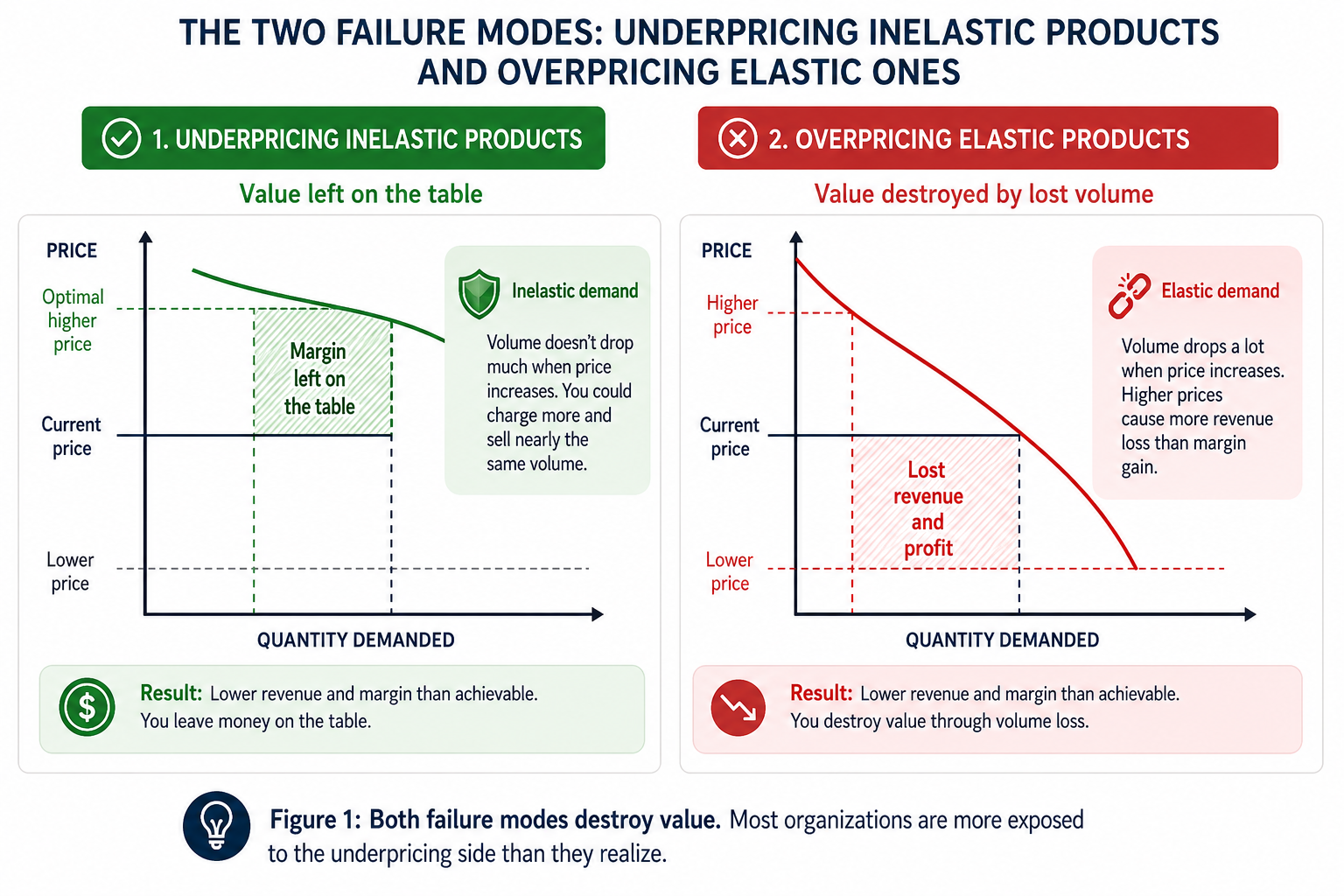
Pricing decisions made without understanding price sensitivity produce one of two outcomes: leaving money on the table (underpricing inelastic products) or destroying volume (overpricing elastic ones). Both are expensive, and both are common.
The underpricing problem is what most organizations miss. Companies systematically overestimate how price-sensitive their customers are. A sales team that hears pricing objections during deal negotiation concludes that customers are price-sensitive. What they are often observing is negotiating behavior, not genuine sensitivity.
A customer who objects to a price and then agrees to a 3% discount was never going to walk away. The objection was theater. The company gave away 3% of margin to close a deal it had already won.
The flip side: genuinely elastic products priced above the sensitivity ceiling will show volume erosion that looks like a market problem, a product problem, or a competitive problem before anyone considers whether the price itself is the cause. According to McKinsey, a 1% improvement in price realization drives an 11% improvement in operating profit on average. That asymmetry makes sensitivity measurement one of the highest-ROI activities a pricing team can pursue. Effective pricing analysis that separates price-driven losses from other causes is the only reliable way to tell which is which.
Eight Factors That Drive Price Sensitivity
Price sensitivity is not a fixed attribute of a product or customer. It shifts as these eight variables shift. Understanding which factors are at play in each customer segment is the starting point for managing sensitivity rather than reacting to it.
How to Measure Price Sensitivity
Most companies make pricing decisions without measuring price sensitivity at all. The ones that measure it consistently outperform those that guess. These methods range from zero additional budget (using data you already have) to formal research investments for high-stakes decisions.
Method 1: Price Elasticity From Transaction Data
If you have historical transaction data showing prices and volumes over time, you can calculate elasticity directly. Compare periods where prices changed (due to list price updates, promotional pricing, or contract renegotiations) with the volume response in the same period. Control for seasonality and market conditions where possible.
The limitation: this method requires meaningful price variation in the historical data. Companies that rarely change prices have thin elasticity data. Price optimization platforms that maintain transaction-level pricing history make this calculation continuous and portfolio-wide rather than a periodic manual exercise.
Method 2: Win-Loss Analysis by Price Band
Segment your won and lost deals by price point over the past 12 months. Plot win rates against price levels. Where does the win rate begin to decline materially? That inflection point is your price sensitivity ceiling for that segment. This method works without formal research investment, using deal data already in your CRM.
The limitation: CRM deal data often lacks clean price band information, and loss reasons are self-reported by reps who often attribute losses to price even when other factors drove the outcome. Competitive price intelligence adds external context that helps separate price-driven losses from other causes.
Note
Win-loss analysis consistently reveals that sales teams overattribute losses to price. Studies of B2B deal data typically show that 20 to 30% of deals marked "lost on price" in the CRM were actually lost due to relationship, capability, or timing factors. This overattribution leads to unnecessary discounting: reps who believe they are losing on price will discount preemptively, even when the customer was not price-sensitive enough to require it.
Method 3: Van Westendorp Price Sensitivity Meter
The Van Westendorp method uses four survey questions to identify acceptable price ranges:
- "At what price would this product be so cheap you would question its quality?"
- "At what price would this product seem like a bargain?"
- "At what price would this product start to seem expensive?"
- "At what price would this product be too expensive to consider?"
Plotting the cumulative response curves for each question reveals the acceptable price range and the optimal price point. The method is inexpensive (a short survey to existing customers or prospects), produces directionally reliable results, and works well for new product pricing where no transaction data exists.
The limitation: stated preferences in surveys diverge from revealed preferences in actual purchases. Customers say they would pay $X but then balk at $X in practice. Van Westendorp is useful for establishing a range, not a specific price point.
Method 4: Conjoint Analysis
Conjoint analysis presents buyers with product configurations at different price points and asks them to choose among options. By analyzing choices across many scenarios, the method calculates how much value buyers place on each attribute, including price, and produces precise willingness-to-pay estimates by segment.
This is the gold standard for price sensitivity research. It produces segment-level elasticity estimates, identifies which product attributes most affect price sensitivity, and reveals which customer types are most and least price-sensitive. It is also expensive: a rigorous conjoint study typically costs $50,000 to $200,000 depending on scope.
Method 5: Price Testing (A/B Pricing)
This method presents different prices to comparable customer groups and measures conversion and volume response directly. It is the most reliable approach (revealed preference, not stated preference) and the most common in e-commerce and SaaS.
The ethical and practical constraints are significant in B2B: offering the same product at different prices to competing buyers creates legal risk under the Robinson-Patman Act and damages relationships if discovered.
A safer B2B application: price testing across geographic markets or product segments that do not interact directly. A manufacturer can test different price points for the same product in two non-overlapping regional markets and compare volume response.
At a glance:
Figure 2: Method selection depends on what data you have and the stakes of the decision.
How to Reduce Price Sensitivity (And Why Most Companies Never Try)
Price sensitivity is often treated as a fixed characteristic of a market. It is not. It shifts as the buyer's perception of value, alternatives, and switching costs changes. Organizations that actively manage these variables reduce price sensitivity over time, expanding their pricing power without requiring product changes.
Increase Perceived Differentiation
When buyers perceive your product as equivalent to alternatives, price becomes the primary decision variable. When they perceive it as meaningfully better, price recedes in importance. The key word is perceived: a product can be technically superior and still lose on price if the buyer does not understand or value the difference. Equipping sales teams with quantified value arguments (not feature lists) reduces price sensitivity by giving buyers a non-price reason to choose. Value-based pricing is the systematic application of this principle.
Increase Switching Costs
Customers deeply integrated with your systems, processes, or workflows are less sensitive to price increases, because switching means disruption, retraining, and uncertainty.
Deep integration is not manipulation: it reflects genuine value delivered.
A pricing platform connected to a customer's ERP, CRM, and quoting systems is harder to replace than one that stands alone. That switching cost is real value for the customer, and reduced price sensitivity for the vendor.
Reframe the Price Reference Point
Buyers evaluate price relative to a reference point. If the reference is a cheaper competitor, sensitivity is high. If the reference is the cost of the problem your product solves, sensitivity drops dramatically. A $45,000 annual software contract feels expensive when compared to a $20,000 alternative. It feels like a bargain when compared to the $800,000 in annual downtime costs it eliminates. Changing the reference point in the buyer's mind is the most direct way to reduce price sensitivity without changing the price.
Segment and Serve the Less Sensitive Customers First
Not all customers are equally price-sensitive. In most B2B portfolios, 20 to 30% of accounts have low price sensitivity: large buyers with high switching costs, urgent-need buyers, and buyers with complex integration. Another 20 to 30% are highly sensitive: spot buyers, budget-constrained buyers, and buyers with readily available alternatives.
Customer segmentation that maps sensitivity levels by account type allows pricing teams to focus margin expansion efforts on the low-sensitivity segments. The high-sensitivity segments are managed with appropriate pricing structures (volume rebates, tiered pricing, contract incentives) that address their constraints without applying those concessions to the full customer base.
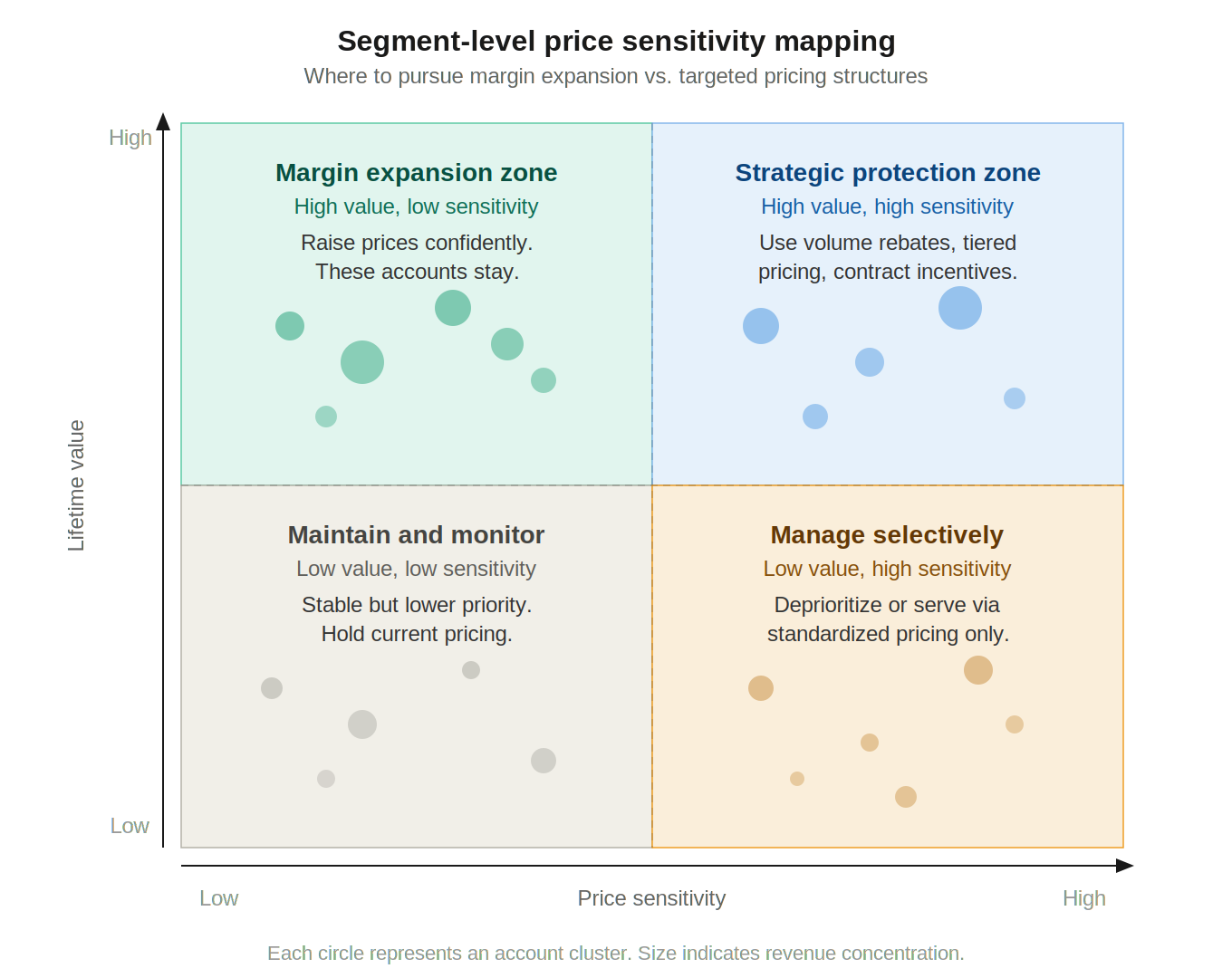
Figure 3: Segment-level sensitivity mapping shows where to pursue margin expansion and where to use targeted pricing structures instead.
Turning Price Sensitivity Insights Into Pricing Decisions
Measuring price sensitivity is only useful if the insights change how prices are set and managed. Here is how sensitivity data translates into specific pricing decisions.
Set segment-level prices, not one-size-fits-all list prices: If your analysis shows that Segment A is inelastic and Segment B is elastic, a single price point undercharges Segment A and loses Segment B. Tiered pricing structures that reflect segment-level sensitivity capture more of the available margin without forcing volume losses in sensitive segments.
Set discount guardrails based on measured elasticity, not intuition: If the transaction data shows that a customer segment is inelastic up to 15% above the current price, discount authority for that segment should reflect that ceiling. Allowing reps to discount freely in inelastic segments gives away margin the customer would have paid. Quoting platforms that embed segment-specific price floors enforce this without requiring rep judgment on every deal.
Identify which products have pricing headroom before raising prices: A portfolio-wide price increase affects inelastic and elastic products equally. A targeted increase on inelastic products and a hold (or value-add) on elastic products captures the same revenue improvement with far less volume risk. Price optimization at the SKU level makes this targeting operationally feasible.
Use sensitivity data in competitive response decisions: When a competitor cuts prices in a high-sensitivity segment, matching may be necessary. When they cut prices in a low-sensitivity segment (one where your customers have high switching costs and strong integration), matching is unnecessary margin leakage vistaar. Sensitivity data makes this distinction clear and keeps competitive responses targeted rather than reflexive.
Price Sensitivity Is Measurable. Use the Measurement.
Every pricing decision is implicitly a bet on price sensitivity. Set a price too high in an elastic market and the volume loss outweighs the margin gain. Set it too low in an inelastic one and the margin opportunity goes uncaptured. Most companies make these bets without the data that would tell them which situation they are in.
The methods for measuring price sensitivity range from free (transaction data analysis, win-loss by price band) to high-investment (conjoint studies, A/B testing). Even the low-cost methods produce insights that change pricing decisions.
The most important insight is often the simplest: your customers are probably less price-sensitive than your sales team believes, in more segments than you think, by more than your current data would suggest.
Vistaar's SmartOptimizer applies continuous elasticity modeling at the segment and SKU level, surfacing where pricing headroom exists and where it does not. The result is pricing decisions grounded in evidence rather than assumption, and margin improvement that compounds as the measurement gets more precise over time.
See how Vistaar measures and applies price sensitivity at enterprise scale. Request a demo
Frequently Asked Questions About Price Sensitivity
What Is Price Sensitivity?
Price sensitivity measures how much a customer's purchasing behavior changes when price changes. High sensitivity means demand drops significantly when prices rise. Low sensitivity (inelastic demand) means buyers absorb price increases without materially changing behavior.
What Is the Formula for Price Elasticity of Demand?
Price Elasticity of Demand = % Change in Quantity Demanded divided by % Change in Price. An elasticity of -2.0 means a 1% price increase causes a 2% volume decline. Values between 0 and -1 indicate inelastic demand. Values below -1 indicate elastic demand.
What Makes Customers Less Price-Sensitive?
High switching costs, limited alternatives, urgent need, strong perceived differentiation, and when the product represents a small fraction of the buyer's total spend. Understanding these factors helps businesses deliberately reduce price sensitivity rather than accepting it as fixed.
How Do You Measure Price Sensitivity Without Expensive Research?
Two low-cost methods: calculate price elasticity from historical transaction data (price changes versus volume response over time), and analyze win-loss rates by price band from CRM data. Both use existing data and produce directionally reliable sensitivity estimates without additional research investment.
Is Price Sensitivity Different Across Customer Segments?
Yes, significantly. The same product can have very different elasticity in different segments. Contract customers with high switching costs may be far less sensitive than spot buyers with multiple alternatives. Segment-level sensitivity analysis is more useful than portfolio-wide averages.
Can You Reduce Price Sensitivity Over Time?
Yes. Increasing perceived differentiation, deepening product integration (raising switching costs), reframing price against the cost of the problem solved (changing the reference point), and focusing on customer success outcomes all measurably reduce price sensitivity over time.
How Does Price Sensitivity Affect Pricing Strategy?
It determines where pricing headroom exists. Inelastic segments support price increases and margin expansion. Elastic segments require competitive pricing or value repackaging. A pricing strategy that ignores sensitivity applies the same logic to both, undercharging the first and overcharging the second.

As an experienced pricing solutions partner to some of the biggest names in global business, Vistaar offers a range of services to help our customers reach their maximum potential. Talk to us to see how we can help you create a more profitable future.