




You raise list prices by 5% across your portfolio. The board nods.
Six months later, the margin is flat. Finance pulls the data and finds that stacked rebates, freight allowances, and distributor chargebacks eroded most of the gain before it reached your pocket. That's a target pricing strategy problem. When prices aren't anchored to specific business outcomes, increases become guesswork and margin leakage becomes structural.
This guide breaks down what a target pricing strategy is, how it differs from the models you're probably already using, and how to build one.
TL;DR
- A target pricing strategy starts with your business outcome, and reverse-engineers the price to get there, rather than adding a markup to costs
- In B2B, "price" means pocket price: what you keep after rebates, chargebacks, freight allowances, and promotional deductions
- Target pricing sets the strategic guardrails within which value-based or competitive pricing operate
- Successful implementation follows five steps: define objectives, research the market, calculate target price and cost, align cross-functional teams, then execute and monitor
- Without governance structures and purpose-built pricing technology, target prices become starting points for negotiation, and margin leakage compounds quietly
- Vistaar operationalizes target pricing at enterprise scale, with SmartPricing, SmartQuote, and SmartRebates built on 20+ years of domain expertise and pricing intelligence across ~$1 trillion in client revenues
What Is a Target Pricing Strategy?
A target pricing strategy is a market-driven approach in which you first determine the price your customers are willing to pay, based on competitive benchmarking and demand analysis. Then, you reverse-engineer your costs and margins to ensure the business goal is achievable at that price point.
The target pricing formula
The core formula is straightforward:
Target Price = Cost of Production + Desired Profit Margin
Flip it for the cost perspective:
Target Cost = Market-Driven Target Price − Desired Profit Margin
Let’s consider an example. If market research says customers will pay $150/unit and you need a 25% gross margin, your target cost is $112.50. If your current production cost is $120, you have a $7.50 gap to close, either through cost reduction, mix management, or a pricing adjustment.
Target pricing vs. target costing
These two terms are often confused.
Target costing is the internal cost management discipline that makes target pricing achievable: it's the "how do we get costs to fit?" question. On the other hand, target pricing is the strategic starting point: what price do we need to achieve our business objective, and what does that require of us operationally?
What "cost" means in B2B
In B2B, "cost" extends well beyond production. Your pocket price: the revenue you actually keep after all deductions, is eroded by on-invoice discounts, volume rebates, freight allowances, promotional funds, chargebacks, and payment term concessions.
A target price set against the list or invoice price is functionally meaningless if pocket price erosion isn't modeled in.
When you're managing thousands of SKUs across regions with varying rebate structures, setting a price to meet a goal stops being a strategic exercise and becomes an operational one.
Why Target Pricing Matters for B2B Enterprises
The macroeconomic case for disciplined pricing has never been sharper, and neither has the penalty for getting it wrong.
Cost inflation stabilized in 2024, but Bain's 2025 Commercial Excellence Survey found that companies are now worried about maintaining margin-enhancing pricing strategies without inflation as cover. The easy justification for price increases is gone. What's left is the need to price with precision.
The execution gap is the real problem
Execution is typically a constraint. Blue Ridge Partners surveyed 100 C-suite executives at US industrial firms and found that nearly 90% failed to fully capture their planned 2024 price increases. Poor customer communication, inadequate sales enablement, and weak price enforcement were the dominant failure modes, not bad pricing decisions.
Target pricing sets the right price, and creates the governance structure and operational discipline needed to capture it.
Why is it especially critical by industry?
- Manufacturing: Multi-tiered distribution, complex rebate programs, and regional price variation mean list prices are rarely what you collect. Target pricing forces you to account for the full pocket price waterfall from the outset
- Consumer goods and beverage alcohol: Regulatory pricing constraints, promotional pricing layers, and value chain complexity create conditions where a single unmanaged discount band can erase an entire quarter of margin improvement
- Retail: Omnichannel pricing consistency, competitive price matching, and category margin protection require target prices that hold across both direct and indirect channels
The cost of not having one
Most enterprises don't lose margin in one bad decision. They lose it deal by deal, through a "strategic" discount that never gets reviewed, a distributor channel getting better terms than direct, rebate accruals drifting from actuals with no one reconciling them in real time.
Each deviation feels like a one-off, but together, they become your new floor. Without a target pricing strategy, there's no mechanism to catch any of it before it compounds. It's a margin leakage problem hiding in plain sight.
How Target Pricing Differs from Other Pricing Strategies
Understanding where target pricing sits relative to other models helps you position it correctly as the orchestration layer.
A Step-by-Step Framework for Implementing Target Pricing
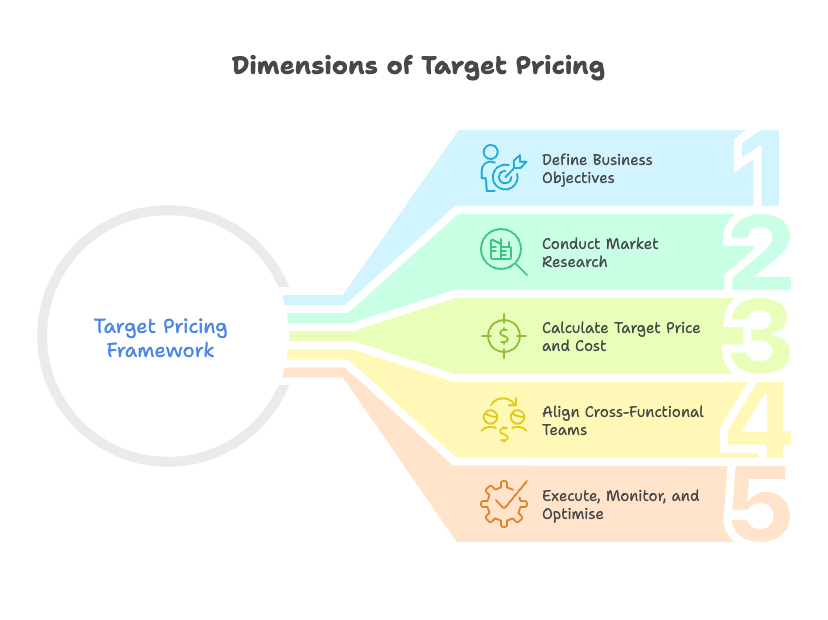
This is where strategy becomes operational. Each step builds on the previous one; skip or compress any of them, and the framework loses its ability to hold up at scale.
Step 1: Define your business objectives
Target pricing begins with clarity on what you are solving for. Margin improvement, volume growth, market share expansion, customer retention, and competitive repositioning all require different price structures, even for the same product.
In enterprise environments, you are rarely solving for one objective. A key account may require you to grow volume while holding margin. A new channel may require penetration pricing in one region and premium positioning in another.
Document your objectives by product line, customer segment, and region before you set a single number. That matrix is the foundation everything else rests on.
Step 2: Conduct market and competitive research
You cannot reverse-engineer a price without knowing what the market will bear. That means customer willingness-to-pay analysis, competitive benchmarking, and price elasticity analysis at the segment level.
In B2B, this extends beyond end-customer pricing. You need to understand:
- Distributor margin expectations and channel partner economics
- How your pricing compares across tiers and geographies
- Where competitors are pricing and what segments they are targeting
- Customer sensitivity to price changes by product category and deal size
Modern pricing platforms accelerate this significantly; processing transaction history, competitive signals, and demand data simultaneously to surface optimal price points by segment in hours.
Step 3: Calculate your target price and target cost
With objectives defined and market data in hand, run the formula from the market-driven direction: what will this segment pay, and what margin do you need to hit your objective at that price?
A concrete example: a manufacturer's research shows customers in Segment A will pay $150/unit for Product X. Your business objective requires a 25% gross margin.
Therefore, the target cost is $150 x (1 - 0.25) = $112.50. Your current fully-loaded production cost is $120. You have a $7.50 gap to close, whether through operational cost reduction, product mix optimization, or a pricing adjustment in that segment.
Critically, "cost" in this calculation must include all off-invoice elements: volume rebates, chargebacks, freight absorptions, promotional allowances, and payment term concessions.
If you calculate target cost against your invoice price rather than your pocket price, you will consistently set prices that look profitable on paper and underperform in practice.
Step 4: Align cross-functional teams
Target pricing is not a pricing team exercise. It requires sales, finance, marketing, operations, and supply chain to work from the same set of objectives and constraints. Each function has a distinct role:
- Sales needs deal guidance that reflects target prices with clear approval thresholds for exceptions
- Finance needs visibility into how rebate accruals and off-invoice deductions will affect margin attainment
- Operations needs cost-reduction targets if the gap analysis in Step 3 reveals structural cost problems
Governance structures matter here. Delegation-of-authority frameworks define who can approve exceptions, at what discount band, and under what conditions. Without them, target prices become starting points for negotiation rather than enforceable guardrails.
Suggested read: Rebate Management Software Guide: Automate & Optimize Incentives
Step 5: Execute, monitor, and optimize
Implementation means embedding target prices into quoting systems, price lists, CPQ tools, and deal management workflows. A target price that lives in a spreadsheet, but not in the system your sales team quotes from will be ignored within a quarter.
Real-time monitoring is where the strategy proves its value. Platforms like Vistaar embed this into the pricing infrastructure, so deviations trigger approval workflows rather than slip through undetected. Track these at the deal level on an ongoing basis:
- Which transactions are closing below target pocket margin
- Which segments are showing consistent deviation patterns
- What is driving the gap (discount creep, rebate drift, or channel-specific pricing erosion)
- Whether exception rates are rising, which signals either overly rigid targets or deteriorating price discipline
For optimization, build a formal review cadence. Quarterly works as a baseline for most B2B environments, with trigger-based reviews when input costs shift materially, a competitor reprices, or a key segment shows sustained underperformance.
Common Mistakes When Implementing Target Pricing (And How to Avoid Them)
Most target pricing implementations fail almost always in the same ways: target prices set against invoice rather than pocket price, uniform pricing pushed across segments with different willingness-to-pay, and sales teams incentivized on volume while the strategy optimizes for margin.
The mistakes are predictable, but so are the fixes.
Deciding target prices without modeling the pocket price
The list price hits the margin target. The pocket price, after rebates and chargebacks, doesn't. This is the single most common failure mode, stemming from calculating target prices against the wrong denominator.
Fix: Include every off-invoice element in your target cost calculation before the price is set.
Using a single target price across all segments and channels
Willingness-to-pay varies by customer segment, geography, channel, and deal size. A uniform target price will be too high for some segments and too low for others, leaving money on the table in one direction and killing deals in the other.
Fix: Build segment-specific and channel-specific target prices into the framework from Step 1.
Setting target prices once and not revisiting them
Market conditions, input costs, and competitive dynamics shift constantly. A target price set in Q1 may be structurally wrong by Q3 if costs have moved or a competitor has repriced.
Fix: Establish a quarterly review cadence with defined data triggers: cost changes above a threshold, significant competitive moves, or material demand shifts that initiate an out-of-cycle review.
Failing to align sales incentives with pricing objectives
If your sales team is compensated on volume and your target pricing strategy is optimized for margin, misalignment is structural. Reps will consistently trade margin for volume because that's what they're rewarded for.
Fix: Align commission structures to margin attainment, so that pricing discipline becomes commercially rational for the people executing it.
Relying on spreadsheets for target price management
A spreadsheet can hold a target price. However, it cannot enforce it across 5,000 SKUs, 50 sales reps, and 12 regions while simultaneously tracking rebate accruals and flagging deviations in pocket margins.
The complexity of multi-dimensional pricing makes manual management a liability at scale.
Fix: Invest in purpose-built pricing technology that embeds target prices into quoting workflows, automates exception handling, and surfaces margin performance in real time.
Avoiding these mistakes gets you consistent execution. Knowing whether that execution is actually working requires a different discipline entirely.
How to Measure the Success of Your Target Pricing Strategy
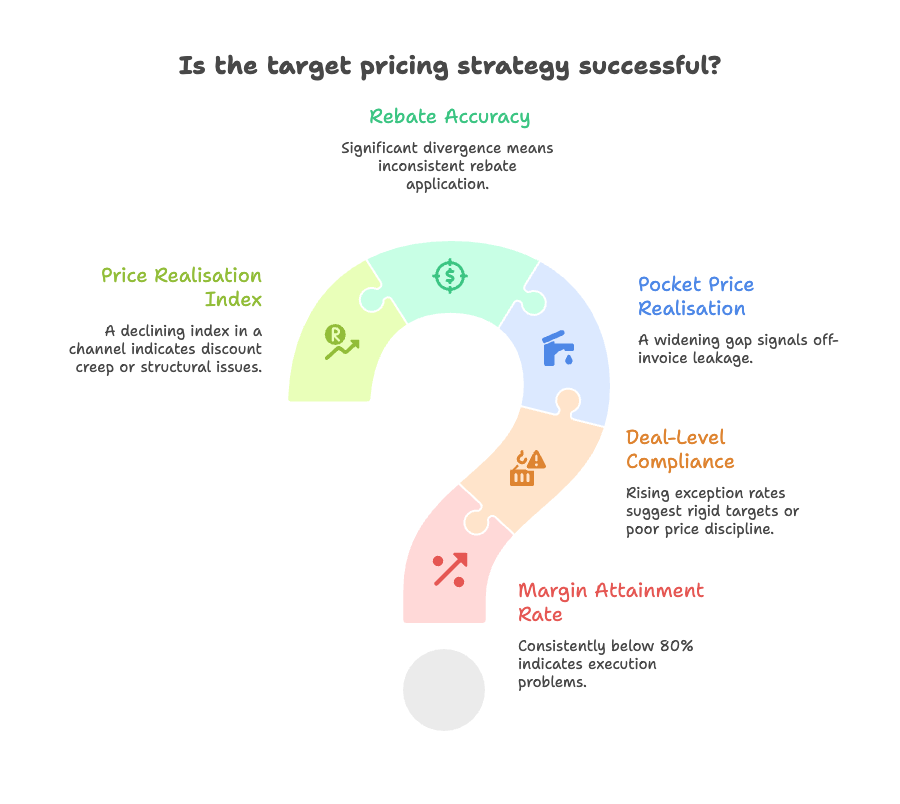
You can't manage what you don't measure. Five metrics tell you whether your target pricing strategy is working:
- Margin attainment rate: The percentage of deals closing at or above the target pocket margin. This is your primary indicator. Consistently below 80% signals an execution problem
- Deal-level compliance vs. target: What percentage of quotes fall within approved deviation bands? Rising exception rates signal either overly rigid targets or deteriorating price discipline
- Pocket price realization: The ratio of actual pocket price to target pocket price. A widening gap signals growing off-invoice leakage
- Rebate accuracy: Variance between accrued rebate liability and settled payments. Significant divergence usually means that rebate structures are being applied inconsistently
- Price realization index: The ratio of average transaction price to list price, tracked by segment and channel. A declining index in a specific channel signals discount creep or a structural pricing problem in that route-to-market
Achieve Your Target Pricing Goals with Vistaar
A target pricing strategy is only as strong as your ability to execute it. For B2B enterprises managing thousands of SKUs, multi-tiered rebate programs, and regional pricing variation, that execution cannot live in spreadsheets. The complexity is simply too high, and the margin cost of getting it wrong is too significant.
Vistaar's end-to-end pricing platform is purpose-built for this:
- SmartPricing sets target prices grounded in market reality using AI-driven optimization and elasticity modeling
- SmartQuote embeds those targets into guided deal management, with built-in approval workflows for exceptions
- SmartRebates automates rebate execution and tracks accruals in real time, so pocket price calculations stay accurate as conditions change
Backed by 20+ years of pricing domain expertise and built on intelligence from ~$1 trillion in client revenues, Vistaar gives pricing leaders the visibility and governance to translate target prices into actual margin outcomes at enterprise scale.
Ready to close the gap between your pricing strategy and your margin results? Schedule a demo to see how Vistaar operationalizes target pricing for your business.
Frequently Asked Questions
What is the target pricing strategy formula?
The target pricing strategy formula is:
Target Price = Cost of Production + Desired Profit Margin.
From the market-driven direction:
Target Cost = Market-Driven Target Price − Desired Profit Margin.
What is the difference between target pricing and target costing?
Target pricing sets the price based on your business objective and market dynamics. On the other hand, target costing is the internal discipline of managing costs to fit within that price. They work in sequence: target pricing sets the destination, target costing figures out how to get there.
How does target pricing work in B2B vs. B2C?
In B2C, target pricing is relatively straightforward: set a retail price the market will bear, then manage costs to hit the margin. In B2B, the complexity multiplies: multi-tiered distribution, segment-specific rebates, channel-specific pricing, and off-invoice deductions mean you need to model pocket price to know if a target is achievable.
Can target pricing be automated?
Yes, modern pricing platforms like Vistaar automate price optimization, deal guidance, exception approval workflows, rebate accrual tracking, and real-time margin monitoring. However, automation doesn't replace pricing judgment. It gives pricing leaders the visibility and enforcement infrastructure to execute their strategy consistently at scale.
What industries benefit most from target pricing?
Manufacturing, consumer goods, beverage alcohol, and retail benefit most, specifically enterprises managing high SKU counts, multi-tier distribution, complex rebate structures, or regulatory pricing constraints. The more dimensions your pricing has, the more critical a structured target pricing approach becomes.
How often should target prices be reviewed and updated?
A quarterly review cadence is a practical baseline for most B2B environments. Target prices that have remained static for 12+ months in volatile markets are effectively no longer targets.

As an experienced pricing solutions partner to some of the biggest names in global business, Vistaar offers a range of services to help our customers reach their maximum potential. Talk to us to see how we can help you create a more profitable future.