



TL;DR
- Your U&C price directly impacts PBM reimbursement, not just cash pricing
- Reactive, one-size-fits-all pricing leaves margin on the table
- Effective pharmacy pricing strategies balance insured, cash, and discount card prescriptions
- Real-time visibility into reimbursement and MAC changes is essential
- AI-powered pricing enables faster, data-driven decisions at scale
Your U&C price is not just a cash price. It directly affects how PBMs reimburse insured prescriptions and often determines whether a pharmacy receives its full contracted rate or gets paid less.
Yet, many pharmacies still set U&C reactively, matching competitors or applying a standard markup, without realizing how these choices impact their largest source of revenue.
A modern pharmacy pricing strategy has to balance competing pressures at the same time. Pharmacies must maximize PBM reimbursement on insured volume, stay competitive for cash and uninsured patients, and protect margins as discount cards continue to erode pricing power.
Managing these forces with manual, drug-by-drug decisions creates blind spots and trade-offs that are difficult to see, resulting in fragmented tactics instead of a cohesive strategy.
This article outlines a pharmacy pricing strategy that connects U&C decisions directly to reimbursement outcomes. It explains the pricing benchmarks that matter, how PBM reimbursement models work, and where margins are quietly lost.
Foundation of Pharmacy Pricing Strategy: Understanding Key Benchmarks
Pharmacy pricing benchmarks are more than industry reference points. They directly shape reimbursement outcomes, margin performance, and pricing decisions across insured, cash, and discount card prescriptions.
Understanding how each benchmark interacts with PBM contracts is essential to setting U&C prices that protect profitability rather than unintentionally erode it.
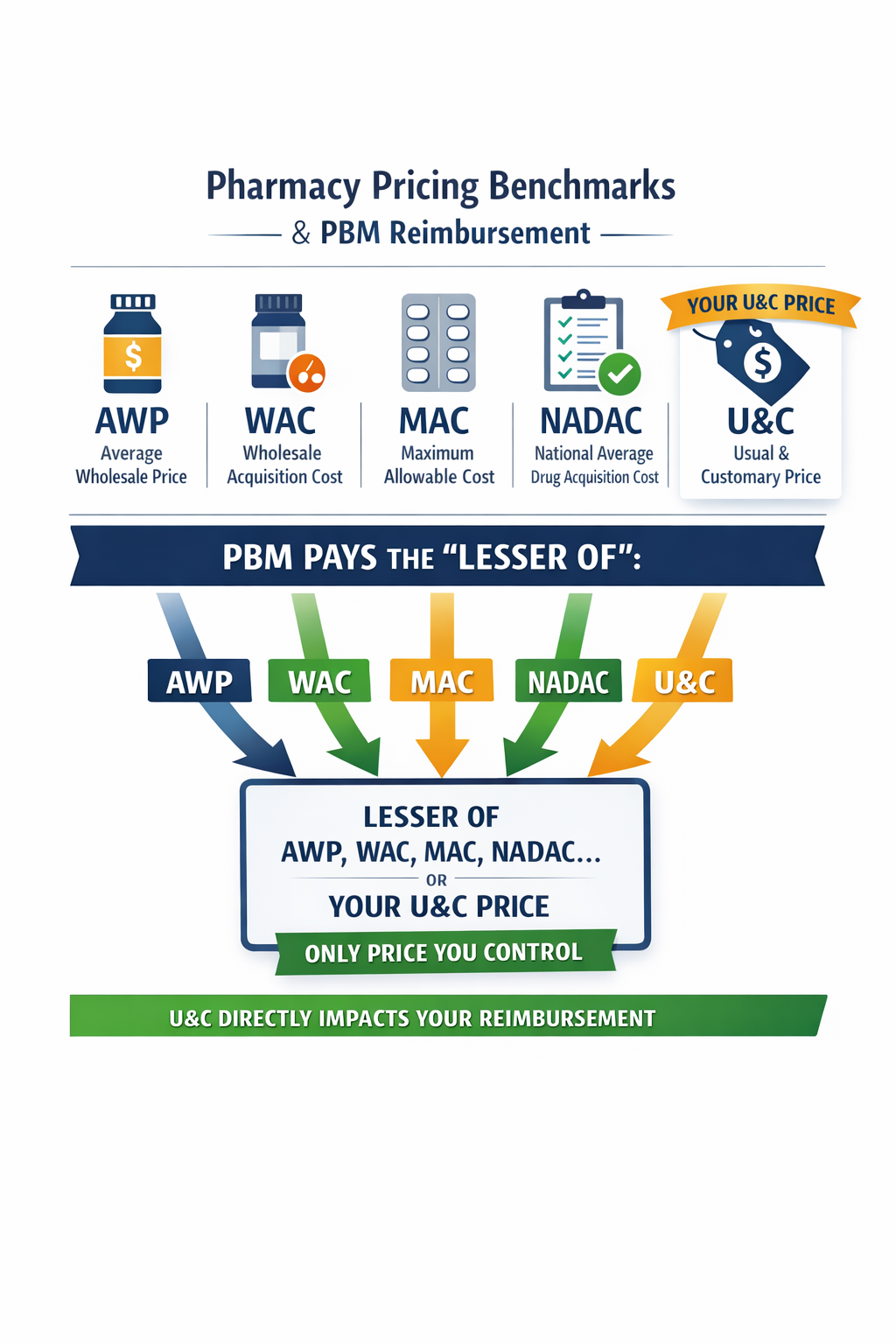
At a high level, these benchmarks determine how much a pharmacy should be paid. In practice, they also determine how much a pharmacy actually gets paid.
Key pharmacy pricing benchmarks and why they matter:
The reimbursement rule that changes everything
Most PBM contracts reimburse pharmacies based on the lesser of three values: AWP minus a contracted percentage plus a dispensing fee, MAC plus a dispensing fee, or the pharmacy’s U&C price. This means U&C pricing is not just a cash decision. It is often the ceiling on what a pharmacy is paid for insured prescriptions.
When U&C is set below what a PBM would otherwise reimburse, the pharmacy voluntarily reduces its own reimbursement. When U&C is set too high, cash and uninsured patients are pushed toward competitors and discount cards. A sustainable pharmacy pricing strategy must find the balance point where U&C protects reimbursement while remaining competitive for price-sensitive patients.
This benchmark interaction is why pricing decisions cannot be made in isolation. U&C pricing, PBM reimbursement models, and acquisition costs are tightly linked, and optimizing one without considering the others almost always leads to margin leakage.
Building Your Pharmacy Pricing Plan: 5 Actionable Strategies
A pharmacy pricing strategy only works if it can be executed consistently and measured clearly. That starts with visibility. Before adjusting U&C prices or reacting to PBM changes, pharmacies need to understand how reimbursement is actually happening today. Without that insight, pricing decisions are based on assumptions rather than outcomes.
Here are some strategies that you can start with right away:
Strategy #1- Track reimbursement patterns to find hidden margin leaks
Reimbursement patterns show whether prescriptions are paid at contracted rates, capped by MAC, or limited by U&C. When pharmacies track these patterns consistently, they can identify where U&C pricing is unintentionally reducing reimbursement or where drugs are being dispensed below cost.
The core problem is visibility. Most pharmacies do not know which claims are reimbursed at U&C versus the contracted PBM rate. As a result, U&C prices are adjusted blindly, often lowering reimbursement on insured prescriptions without improving cash competitiveness.
To fix this, pharmacies should track a focused set of metrics that directly connect pricing decisions to margin outcomes:
- Claims paid at U&C: These indicate that U&C is set below the contracted reimbursement rate, creating an opportunity to raise prices without affecting insured volume
- Underwater prescriptions: Claims reimbursed below acquisition cost that erode margin on every fill
- Reimbursement trends by PBM contract: Differences in payment behavior across PBMs often reveal contract-specific pricing risks
- Margin by payment type: Clear separation of insured, cash, and discount card performance highlights where the pricing strategy is misaligned
The most immediate strategic action is to pull reports showing prescriptions paid at U&C. These claims represent near-term margin recovery opportunities. In many cases, U&C prices can be increased on these drugs with minimal impact on volume, because reimbursement is already constrained by contract terms rather than patient price sensitivity.
This level of visibility is difficult to maintain manually. Vistaar’s RPO – Pharmacy Solution provides real-time insight into reimbursement behavior across all payment types, allowing pharmacies to identify margin leaks early and adjust pricing with confidence rather than guesswork.
Strategy #2- Segment pricing by patient payment type
Patient segments behave differently at the point of sale, and each has a different impact on reimbursement and margin. A single U&C price applied across all patients forces trade-offs. Segmenting pricing allows pharmacies to protect PBM reimbursement while remaining competitive where patients are most price-sensitive.
The key insight is that not all prescriptions should be priced the same way. Insured patients are largely insulated from U&C changes as long as prices do not cap reimbursement.
Cash and uninsured patients, by contrast, are highly price-aware and willing to shop around. Discount card transactions introduce another layer of complexity, often benefiting PBMs more than pharmacies.
A segment-specific pricing strategy aligns U&C decisions with both reimbursement mechanics and patient behavior:
The strategic action is to analyze prescription volume by payment type, then identify the top fifty drugs in each segment. These drugs drive the majority of revenue and margin impact. Pricing should be optimized differently for each group rather than averaged across the entire book of business.
Interestingly, this approach reflects Vistaar’s perspective on pricing execution: define impact areas based on patient spending patterns, then set prices that protect patient retention while supporting broader business objectives. When pricing is segmented intentionally, pharmacies stop sacrificing margin in one area to compete in another.
Strategy #3- Monitor MAC changes across PBMs in real time
MAC pricing is one of the most unpredictable drivers of pharmacy margin. Each PBM maintains its own MAC list, updates prices frequently, and applies different reimbursement logic across contracts. At the same time, acquisition costs fluctuate due to market volatility, shortages, and supplier changes. Without real-time visibility, pharmacies often discover MAC compression only after the margin has already been lost.
The operational challenge is scale. Say, for example, a pharmacy working with five PBM contracts and carrying two thousand SKUs must effectively track more than ten thousand MAC data points. Manual spreadsheets and periodic reviews cannot keep pace with the speed of change, leaving pharmacies reactive rather than proactive.
A strategic response starts with continuous monitoring across all contracted PBMs. Pharmacies should compare MAC prices to current acquisition cost on a daily basis to identify drugs where reimbursement has dropped below cost. These drugs require immediate attention, either through targeted U&C adjustments, formal MAC appeals where permitted, or inventory decisions for medications that remain chronically underwater.
The most effective pricing strategies also prioritize effort. Rather than attempting to review every drug manually, pharmacies should focus on high-volume prescriptions where MAC-to-cost compression creates the greatest financial risk. Automated alerts allow teams to intervene quickly while reserving human review for decisions that require judgment.
The strategic action is to implement automated MAC tracking and alerting as part of the pricing workflow. When MAC changes are surfaced in real time, pharmacies can respond before losses accumulate, protect margins on insured volume, and prevent operational fire drills caused by unexpected reimbursement shortfalls.
Strategy #4- Use competitive intelligence to protect cash business
Cash pricing is no longer shaped only by local competitors. National chains promote low-cost generic programs, discount cards advertise aggressively online, and digital pharmacies expand patient choice beyond geography.
As a result, cash and uninsured patients are increasingly price-aware and more willing to shop across multiple options.
This competitive landscape creates a real risk for pharmacies that price blindly. Competing on every drug leads to margin erosion, while ignoring price signals entirely pushes patients toward discount cards and chains. A sustainable pharmacy pricing strategy requires knowing where price truly matters and where service, access, and trust can justify a premium.
The strategic response begins with understanding the local market. Pharmacies should regularly review chain pricing, discount card prices, and commonly searched medications in their trade area.
With that insight, pricing decisions can be intentional rather than reactive:
- Compete on price for high-visibility, frequently searched generic drugs
- Protect margin on lower-visibility medications where patients are less likely to compare prices
- Decide explicitly where service, convenience, or relationships are the differentiator
Some pharmacies consider offering their own discount programs to retain cash patients. When doing so, accurate U&C reporting is critical. Discounted prices must be reflected correctly in U&C calculations. Failure to report these prices consistently can create compliance risk and potential fraud exposure.
From a Vistaar perspective, discount cards do more than compress margins. They erode patient trust in local pharmacies by reframing price as the primary value signal. A strong pharmacy pricing strategy must address this threat directly, using competitive intelligence to protect cash volume without sacrificing long-term profitability.
Strategy #5- Deploy AI-powered pricing for scale and speed
The strategies above only work if they can be executed consistently and quickly. That is where most pharmacies struggle. Pricing teams often spend two to six or more hours each week reviewing prices, pulling reports, and reacting to PBM or competitor changes. Even with that effort, human analysis cannot process all the variables that influence pricing outcomes.
Manual pricing creates structural limits. PBM contracts, MAC lists, competitor prices, patient segments, and acquisition costs all change independently and frequently. Reviewing these inputs drug by drug leads to reactive decisions that leave margin on the table. Pricing becomes tactical, not strategic.
AI-powered pricing removes those constraints by analyzing all pricing inputs simultaneously. Instead of reacting after margins erode, pharmacies can adjust pricing proactively based on real-time signals:
- Continuous analysis across insured, cash, and discount card prescriptions
- Dynamic U&C optimization tied directly to reimbursement behavior
- Automated MAC monitoring with alerts when reimbursement drops below cost
- Competitive pricing intelligence without constant manual checks
- Segment-specific pricing recommendations aligned to patient behavior
The impact is measurable. Research shows pharmacies using AI-driven pricing achieve gross profit margins of approximately 54%, compared to an industry average closer to 21%. The difference is not effort. It is execution at scale.
This is where Vistaar’s RPO – Pharmacy Solution fits naturally into the pricing workflow. The platform leverages machine learning and price science to help retail pharmacies make patient-centric, strategy-focused, data-driven pricing decisions across all payment types.
By automating analysis and surfacing clear actions, AI enables pharmacies to turn pricing strategy into repeatable results rather than one-off adjustments.
Measuring Your Pharmacy Pricing Strategy Performance
Pricing improvements only matter if they translate into measurable reimbursement gains and operational efficiency. Tracking the right KPIs allows pharmacies to move beyond anecdotal feedback and evaluate whether pricing decisions are improving margins, reducing risk, and supporting sustainable growth.
The most effective measurement frameworks separate reimbursement performance from operational execution. Together, these metrics show whether the pricing strategy is aligned with both financial outcomes and day-to-day workflows.
Reimbursement KPIs to monitor
These metrics reveal whether U&C pricing is supporting reimbursement or silently limiting it. A rising U&C reimbursement rate or underwater prescription percentage is an early warning sign that pricing adjustments are needed.
Operational KPIs to monitor
Operational KPIs confirm whether the pricing strategy is scalable. When analysis time decreases and update frequency increases, pricing decisions become more proactive and less reactive.
Together, reimbursement and operational KPIs provide a clear view of whether the pharmacy pricing strategy is delivering both margin protection and execution efficiency.
Transform Your Pharmacy Pricing Strategy with Vistaar
Most pharmacy pricing is still reactive. U&C prices are adjusted after a competitor lowers prices or a PBM flags an issue, often after margins have already been lost.
A true pharmacy pricing strategy is proactive. It starts with visibility into reimbursement patterns before prices are set, applies segment-specific pricing across insured, cash, and discount card prescriptions, and responds to MAC changes in real time. Competitive intelligence informs decisions without dictating them, while AI-powered optimization ensures strategy is executed consistently at scale.
The stakes continue to rise. PBMs now control nearly eighty percent of prescription volume, and reimbursement pressure from MAC compression, DIR fees, and discount cards shows no sign of easing. In this environment, reactive pricing leaves pharmacies exposed. A data-driven pharmacy pricing strategy is essential to protect margins, retain patients, and sustain long-term viability.
For more than ten years, Vistaar has partnered with retail pharmacies to build pricing strategies that counter PBM actions and optimize profitability. Vistaar’s RPO – Pharmacy Solution delivers visibility across all payment types, real-time reimbursement tracking, and AI-powered pricing recommendations that scale with complexity and change.
Ready to move from reactive to strategic pricing? Request a demo to see how Vistaar’s RPO – Pharmacy Solution can transform your pharmacy pricing strategy.

As an experienced pricing solutions partner to some of the biggest names in global business, Vistaar offers a range of services to help our customers reach their maximum potential. Talk to us to see how we can help you create a more profitable future.