




TL;DR
- Pharmacy profitability depends on clear visibility into pricing, costs, and reimbursements
- Margin leakages happen when pricing decisions rely on manual processes and limited data
- Price transparency helps identify where profit is created, lost, or left unoptimized
- Competitive benchmarking protects margins without sacrificing volume
- Automation enables faster pricing decisions, tighter control, and more accurate ROI predictions
Independent pharmacies are losing the profitability battle to Pharmacy Benefits Managers (PBMs), and the numbers prove it. A recent ASPE report revealed that pharmacy margins were just 3.2% (earning $12.2 billion) in 2022, while PBM margins were 31.2% (earning $60.6 billion). The gap is staggering. The supply chain is capturing value, while pharmacies’ margins get squeezed.
To reverse this trend, pharmacies need two major levers:
- Pricing transparency: Complete visibility into one's own pricing structure
- Competitor intelligence: Systematic visibility into what GoodRx, Amazon, and local competitors charge
This article explains why pharmacy profitability continues to erode, what drives this trend, and the practical strategies pharmacies can use to protect their margins and reverse the erosion.
Why Pharmacy Profitability Is Under Pressure
Independent pharmacy margins are at a breaking point. According to the ASPE data, net margins have compressed to just 3.2%, while PBMs maintain margins of 31.2%. That's nearly ten times higher; you can't cut costs your way to profitability when your margins are 3%.
Moreover, the pressure gets compounded by information asymmetry. A pharmacy’s U&C price isn't private, with discount platforms like GoodRx and RxSaver publishing them for consumers to compare. Yet most pharmacies have little to no systematic way of monitoring what competitors charge for the same medications.
PBMs, meanwhile, see everything:
- Pricing patterns across their entire network
- Reimbursement trends, and
- Market dynamics in real time
That leaves pharmacies at a structural imbalance, as their competitors know more about their pricing than they do about theirs.
Regulatory pressure adds another layer. HHS rules effective October 2025 require real-time medication pricing information. State laws (Iowa, California, Arkansas) are pushing NADAC-based reimbursement and fee transparency. The same data regulators demand can also power smarter pricing decisions for pharmacies that use it well.
Understanding the pressure is step one. The question now is where pharmacies actually have control and how to use it to improve profitability.
Key Drivers of Pharmacy Profitability

Pharmacy profitability comes down to four controllable drivers: pricing strategy, reimbursement management, payer and channel mix, and cost control. Understanding them helps you focus efforts where they will have the most impact:
1. Pricing strategy
Pricing is one of the most underutilized profitability levers in pharmacy. In reality, profitability is concentrated in a small subset of drugs. A recent report shows that brand drugs represented 71% of sales but just 4% of margin, while generics accounted for 29% of sales and 96% of margins. That means pricing decisions on key impact SKUs have an outsized impact on profits.
Yet most pharmacies fall into the U&C trap: price too high, and discount cards highlight “savings,” making the pharmacy appear expensive and driving volume elsewhere. Price too low, and PBMs use that U&C as a reimbursement ceiling, locking in lower payments.
Most pharmacies review pricing annually. Market conditions change weekly. That lag quietly leaks margin.
2. Reimbursement management
PBM reimbursement directly determines whether a prescription is profitable or a loss. PBMs use MAC (Maximum Allowable Cost) lists that vary by PBM and change frequently, often without any notice. These shifts can quickly push prescriptions below acquisition cost, eroding margin on every affected transaction.
Pharmacies can’t control PBM rates, but they can monitor reimbursements, flag underpayments early, and adjust pricing before losses compound.
3. Payer and channel mix
Not all transactions contribute equally to profitability. There's a clear margin hierarchy with commercial insurance delivering higher margins than Medicare, Medicaid, cash, or discount card transactions.
Meanwhile, discount card share is growing and typically generates lower margins than insured prescriptions. Understanding the payers and channels mix allows pharmacies to channel their pricing actions where margin opportunity is greatest and limit focus on unprofitable transactions.
4. Cost control
Operational factors like drug acquisition cost, GPO (Group Purchasing Organization) compliance, and inventory management still matter. But operational savings have diminishing returns. As the ASPE data shows, with margins hovering at 3%, there’s a limit to how much expenses can be cut. Smart optimizer, by contrast, offers margin upside that cost-cutting alone can’t match.
How Price Transparency Improves Profitability
Price transparency means clear visibility into your own pricing structure and margins. It allows pharmacies to see exactly how pricing decisions translate into profit. It also reveals where profit is created, where it leaks, and where to act first. Without that visibility, pricing decisions are based on instinct rather than evidence.
The pricing waterfall
Every prescription follows a path from cost to margin, known as the pricing waterfall. It starts with the drug acquisition cost, U&C price, PBM reimbursement, and net margin. At each step, the margin either builds or erodes.
Margin leakage can occur at each step of the waterfall:
- At acquisition: Poor GPO compliance or missed manufacturer rebates inflate costs unnecessarily
- At U&C: Prices set too high invite discount card arbitrage, while prices set too low become reimbursement ceilings for PBMs
- At reimbursement: MAC list changes, spread pricing, and underpayments that go unnoticed also erode margins
- At payouts: Discount card transactions further compress margins compared to insured prescriptions
Without visibility into this pricing waterfall by SKU and by store, pharmacies would only be guessing, making it impossible to pinpoint exactly where margin disappears.
Measuring what matters
Price transparency only helps when the right metrics are tracked. Focus on a few core indicators for reactive pharmacy profitability management:
- Gross margin by segment (drug category, payer type, store) reveals where profitability concentrates and where it's at risk
- The below-cost dispensing rate shows the percentage of transactions where reimbursement falls below acquisition cost. Pharmacies should aim for low single digits, since a rising share signals contracting or pricing issues
- Discount card transaction share measures how much low-margin volume is flowing through your business
Knowing what to measure is one part; attribution is the challenging side.
For example, a pharmacy adjusts its prices across 500 SKUs, and its overall margin improves by 0.5%. Was that improvement driven by pricing decisions or by lower acquisition costs, PBM reimbursement shifts, or changes in payer mix?
That’s why pharmacies need analytics that separate actual pricing impact from market noise, so they can prove ROI and repeat what works.
How Competitor Intelligence Protects Margins
Without visibility into competitor prices, pharmacies are forced to price blindly. Competitor intelligence systematically tracks what others charge across channels and markets, turning pricing from reactive to strategic.
Why competitor visibility matters
Consumer behavior has fundamentally shifted. High prescription drug costs and tight budgets are forcing patients to shop around for the best price using tools that make comparisons instant.
Patients now check GoodRx before deciding where to fill. Your U&C signals whether you're "expensive" or "competitive.”
This creates a pricing dilemma. As mentioned earlier, when prices are set too HIGH, discount cards will flag it as “huge savings”, making your pharmacy appear overpriced and driving away cash-pay volume. On the other hand, when prices are set too LOW, PBMs exploit your U&C as a reimbursement ceiling, locking in lower payments and leaving margin on the table.
Using competitor data
Competitor pricing data is available through multiple sources: GoodRx's public displays, Amazon Pharmacy's transparent pricing, competitor websites, and other third-party data providers.
Here's how to use competitor data strategically:
- Identify where you're overpriced versus competitors. These SKUs carry volume risk as patients shop around
- Identify where you're underpriced; these provide immediate margin recovery opportunities
- Then prioritize adjustments on high-volume and high-margin SKUs where pricing changes have the biggest impact on revenue
However, pharmacies manage thousands of SKUs across multiple locations, so manual price checks are impossible to maintain. Even checking the top 100 drugs weekly would consume hours that pharmacy staff don't have.
That's where automation comes in. With solutions like Vistaar, competitor monitoring, and pricing responses are automatically handled at scale.
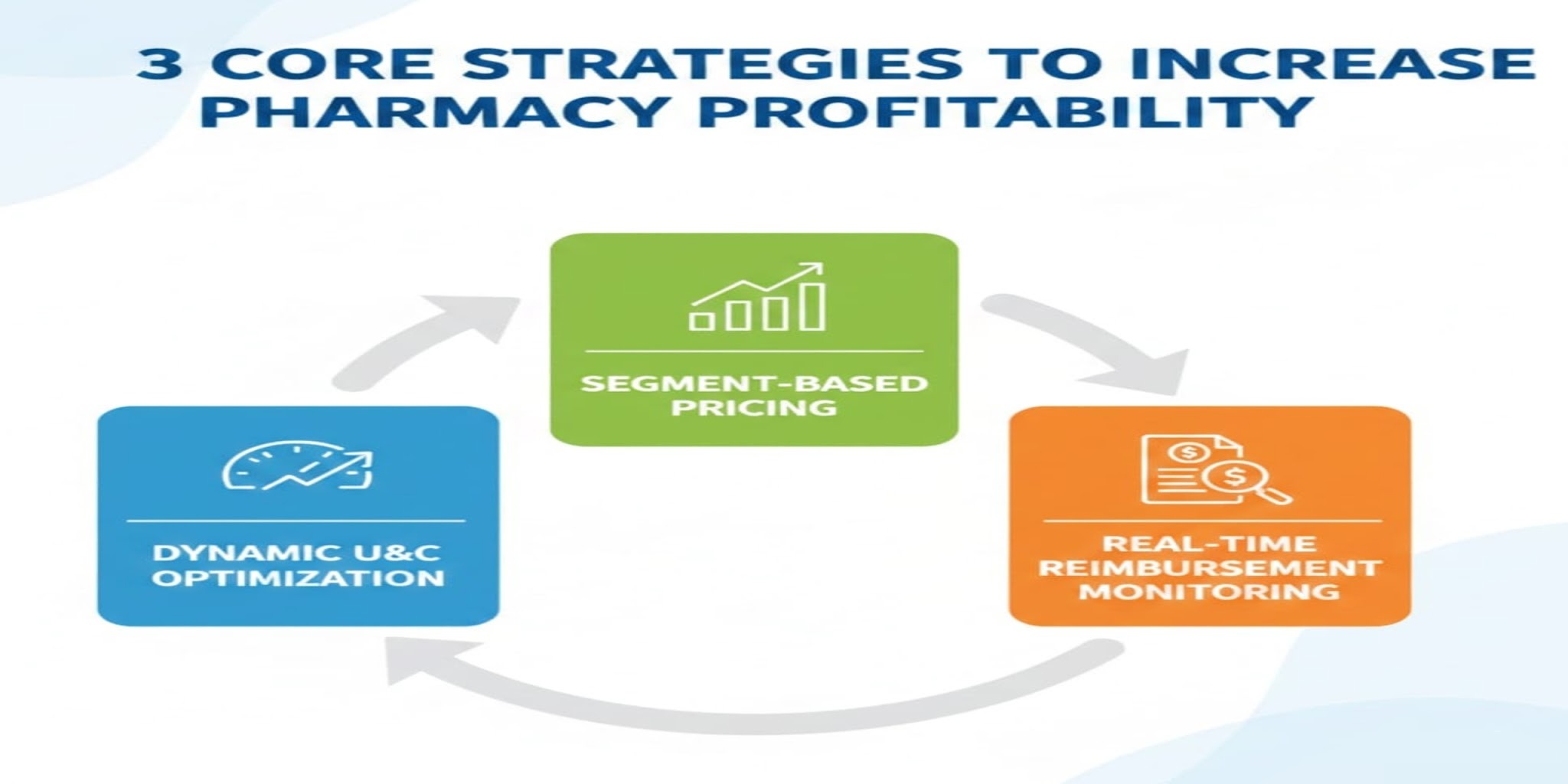
3 Core Strategies to Increase Pharmacy Profitability
Caption:
(ALT: )
Understanding what drives pharmacy profitability is only the first step. Change comes from acting on those drivers consistently and at scale. Here are three strategies that help protect margin and reduce revenue leakage:
1. Dynamic U&C optimization
Most pharmacies set U&C annually based on AWP markup formulas. The problem is that market conditions aren't static. They change weekly due to fluctuations in competitor pricing, PBM MAC lists, and demand patterns. Hence, the need for flexible U&C pricing to increase pharmacy profitability without triggering reimbursement penalties.
Here's a dynamic approach for adjusting U&C based on real-time market signals:
- Monitor competitor moves: Raise prices when competitors raise theirs. Evaluate carefully when they drop (are they bleeding margin, or do they know something you don't?)
- Set margin targets: Protect high-impact drugs’ profitability by adjusting pricing to maintain target margins
- Monitor demand signals: Volume trends reveal price sensitivity. If volume drops after a price increase, that's a signal
- Track PBM reimbursement ceilings to avoid triggering lower-of-U&C payment reductions
To successfully impact pharmacy business profitability, the goal is balance. Find prices that are not so high they invite discount card arbitrage, and not so low they lock in poor reimbursement. Practically, you're to review the top 500 SKUs weekly, refresh the full portfolio monthly, and rely on real-time alerts to flag exceptions.
2. Segment-based pricing
Not all SKUs should be priced the same way. They have different acquisition costs, market demand, and margin targets. Price them based on their strategic role, rather than applying blanket markup formulas.
It is one of the fastest ways to increase pharmacy profitability because it protects volume where there's intense competition and captures profit margins.
That means:
- Basket drivers: These are high-volume, price-sensitive drugs such as atorvastatin and metformin that patients shop for. They should be priced COMPETITIVELY to protect volume and patient loyalty
- Margin recovery: These are lower-volume drugs where pharmacies have full pricing power, and margins can be optimized to fund overall profitability
- Loss leaders: These are prescriptions with consistently low PBM reimbursement costs. Pharmacies should minimize the exposure of such drugs and consider whether they can avoid stocking them
Simply put, setting blanket pricing across all drugs leaves money on the table. However, segment-based pricing captures margin where pharmacies have leverage and protects volume where they don’t.
3. Real-time reimbursement monitoring
PBMs update MAC lists frequently, often without advance notice. Many pharmacies discover reimbursement cuts weeks or months later, after they've dispensed dozens or hundreds of affected prescriptions at a loss.
Need to monitor these indicators continuously:
- MAC list changes by PBM, especially on high-volume generics, where reimbursement cuts have an immediate impact
- Effective versus contract reimbursement rates to identify when actual payments diverge from agreed terms
- Below-cost dispensing alerts that flag transactions where reimbursement falls below your acquisition cost
- Contract compliance exceptions that indicate systematic underpayment patterns
The key objective of real-time reimbursement monitoring is to catch margin erosion before it compounds. A single month of undetected underpayment is a margin that cannot be recovered.
How Vistaar Enables Profitable Pharmacy Pricing
Pharmacy profitability is under relentless pressure from PBMs, discount cards, and information asymmetry. The pharmacies that thrive are those with complete visibility into their own margins and the competitive landscape.
But building that visibility manually is impossible at scale. Monitoring thousands of SKUs across competitors, tracking MAC changes weekly, and proving pricing ROI all demand automation. Vistaar Retail Pharmacy Solution provides price transparency and competitor intelligence at scale, helping pharmacies increase pharmacy business profitability by acting on pricing data continuously instead of reacting after margins have eroded.
For more than a decade, Vistaar’s SmartPricing seamlessly enabled all three strategies outlined above: dynamic U&C optimization, segment-based pricing, and real-time reimbursement monitoring.
Here's how Vistaar addresses core pharmacy challenges
Ready to protect margins and increase pharmacy profitability through price transparency and competitor intelligence?
Schedule a demo to see how Vistaar's Retail Pharmacy Solution helps pharmacies optimize pricing, monitor competitors, and reverse margin erosion at scale.
FAQs
1. How does price transparency improve pharmacy profitability?
Price transparency improves pharmacy profitability by providing clear visibility into how prices translate into margin across drugs, payers, and stores. It highlights where profit is created, where it leaks (such as below-cost dispensing or unfavorable reimbursement), and where pricing adjustments will have the greatest impact.
2. What is competitor intelligence in pharmacy pricing?
Competitor intelligence is the systematic monitoring of what other pharmacies charge for the same medications. It helps pharmacies avoid pricing too high (which drives volume loss) or too low (which caps reimbursement and erodes margin), enabling more strategic, market-aligned pricing decisions.
3. What gross profit margin should a pharmacy target?
Retail pharmacies should aim to maintain a gross profit margin above 20% on average to protect their margins. Anything below this level limits the pharmacy’s ability to absorb reimbursement cuts, rising acquisition costs, and operational expenses, thereby making pricing discipline and margin visibility critical.
4. What's the difference between pricing impact and non-pricing factors?
Pricing impact refers to margin changes directly caused by pricing decisions, such as adjusting U&C prices or changing the discount card strategy. Non-pricing factors include changes in drug acquisition costs, PBM reimbursement rates, payer mix, or volume shifts.

As an experienced pricing solutions partner to some of the biggest names in global business, Vistaar offers a range of services to help our customers reach their maximum potential. Talk to us to see how we can help you create a more profitable future.