




Key Takeaways
Pricing automation software sets and updates prices by logic instead of by hand. That logic is rule-based, AI-based, or a combination of both.
Rules are transparent, controllable, and predictable. AI finds patterns and optimizes at scale but needs clean data and can be hard to explain.
The strongest setup is not one or the other. AI recommends the price; rules guardrail it, so intelligence operates inside policy.
In B2B, explainability is a requirement, not a nice-to-have. A price a rep cannot justify to a customer is a liability.
How to choose comes down to your data maturity, your need for control, and how negotiated your pricing is, not which vendor has the most AI.
Most companies know their pricing could be better. In a Bain survey of more than 1,700 B2B business leaders,
This guide is about that choice. It explains how rule-based and AI-based pricing automation each work, where each is strong and weak, why the best answer is usually both, and the one requirement B2B buyers cannot skip: explainability. It closes with the features to look for and a framework for deciding. For the underlying concept of automating pricing at all, the guide to pricing automation covers the operating-model shift; this article is about the software that runs it.
What Pricing Automation Software Does
Pricing automation software sets, updates, and publishes prices using defined logic rather than manual calculation. When a cost, a competitor price, or a customer term changes, the software recalculates the affected prices and pushes them to the systems that sell, without a person editing a spreadsheet. The difference between tools comes down to how that logic is built: with explicit rules, with machine learning, or with both.
That distinction is not a marketing detail; it changes what the software can and cannot do. A rule-based tool does exactly what you tell it. An AI-based tool learns what to do from data. Understanding how each behaves is the foundation of any sensible evaluation, and it maps directly onto the broader question of what a pricing model should encode.
Rule-Based Pricing Automation: How It Works
Rule-based pricing automation applies explicit, conditional logic that a person defines. A rule is an "if this, then that" instruction: if cost rises, raise price to hold margin; if a customer's volume passes a threshold, apply the tier discount; never price below the margin floor. The software executes those rules exactly and consistently across every product and customer.
The strengths of rules are control and clarity. You know precisely why a price is what it is, because you wrote the rule that produced it. That transparency makes rules the natural home for policy, margin floors, minimum advertised price, contract rates, and compliance constraints that must hold no matter what. Rules also work with little or no historical data, so they deliver value immediately.
The limit is that rules do not learn. They apply the same logic to a bestseller with years of history and a new product with none, and they cannot discover a better price than the one the rule implies. Across a large, varied catalog, a single rule leaves profit on the table because it cannot differentiate finely enough, which is where the case for adding intelligence begins.
AI-Based Pricing Automation: How It Works
AI-based pricing automation uses machine learning to recommend prices from data rather than from explicit rules. It analyzes transaction history, demand patterns, and market signals, estimates how demand responds to price, and proposes the price that best meets an objective like margin or revenue. Instead of following an instruction, it learns the relationship between price and outcome and optimizes within it.
The strength of AI is that it finds what rules cannot. It models price elasticity at a granular level, processes far more variables than a person could, and improves as it sees more data. For a large assortment where demand varies by product, segment, and season, that optimization can capture profit a rule would miss entirely.
The trade-offs are real, though. AI needs clean, sufficient historical data; on thin or messy data it produces unreliable recommendations. A model can also be a black box, producing a number without a clear reason, which is a problem the moment someone has to justify the price. That is why grounding AI in a company's own transaction data and keeping it explainable matters as much as the algorithm itself, the standard a serious AI pricing approach is held to.
Rules vs AI: A Side-by-Side Comparison
Set the two approaches next to each other and the trade-offs are clear. Neither is universally better; each fits different needs, which is why the comparison matters more than a verdict.
The pattern the comparison reveals is that rules and AI are strong in opposite places. Rules own control and policy; AI owns optimization and scale. That complementarity is the reason the real answer is rarely one or the other.
Why the Best Answer Is Usually Both
The industry has largely settled the rules-versus-AI debate, and the answer is a hybrid. Machine learning handles the prediction and optimization; rules enforce the guardrails. The two are not competitors fighting for the same job; they are layers, each doing what it does best.
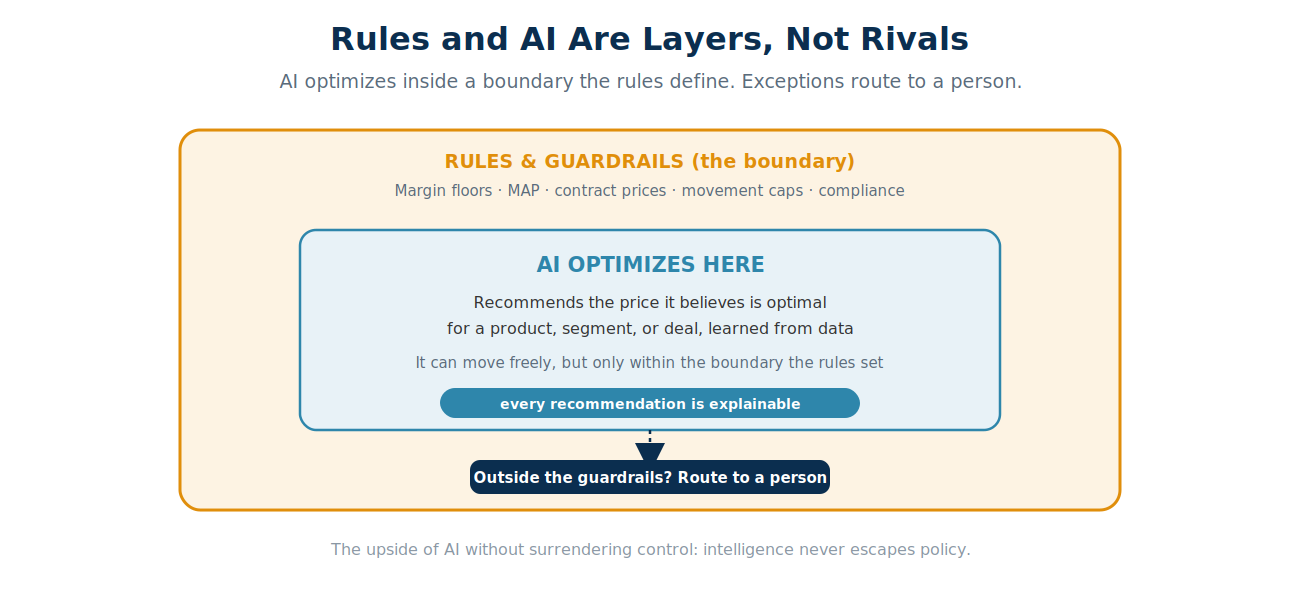
In practice the layers stack cleanly. AI recommends a price it believes is optimal for a product, segment, or deal. Rules then act as the boundary that recommendation cannot cross: a margin floor it must respect, a MAP constraint it cannot breach, a contract price that overrides it, a movement cap that limits how far it can swing. The AI optimizes inside the space the rules define, so you get the upside of learning without surrendering control. When something falls outside the guardrails, it routes to a person rather than publishing blindly.
This is why the buying question is not "rules or AI" but "does the software let me run both, cleanly." A tool that only executes rules cannot optimize; a tool that only runs AI cannot be trusted with policy. The platforms worth considering combine the two, which is the same governed structure a durable price optimization capability depends on.
The Explainability Requirement in B2B
There is one requirement that matters far more in B2B than in retail, and that most tool comparisons underplay: explainability. In retail, an automated price appears on a listing and few people ask why. In B2B, a salesperson has to defend that price to a customer across the negotiating table, and finance and auditors may need to understand how it was set.
That changes what "good AI" means. A model that produces a precise number with no reason attached is not an asset in a B2B deal; it is a liability, because the rep cannot justify it and the customer will push back. Value-based and negotiated pricing only holds when every recommended price comes with the logic behind it, the rule that applied, the data that drove it, the margin it protects. Explainable automation is what lets a sales team act on a price with confidence, and it is inseparable from the governance that keeps rebate and discount economics defensible. When evaluating any AI-based tool for B2B, the question to press is simple: can it show, in plain terms, why it recommended this price?
Key Features to Look For
Beyond the rules-versus-AI question, a capable pricing automation platform shares a set of features. Judge them against your own pricing, not a demo.
- A configurable rules engine: rules a pricing manager can set and change in plain language, without a developer, covering margin floors, discounts, and policy constraints.
- Data-grounded optimization: AI recommendations built on your own transaction history, with the reasoning shown, not a generic model applied blind.
- Guardrails and exception routing: hard limits every automated price must respect, and a path that sends anything outside them to human review.
- Integration with ERP and CRM: clean connection to the systems that hold cost and customer data and where quotes are built, so prices reach the point of sale.
- Audit trail: a full record of every change, the rule or model behind it, and the result, so any price can be explained and traced.
- Simulation: the ability to model a rule or price change and see its margin and revenue impact before it goes live.
The feature that separates B2B-ready tools from retail-first ones is the combination of explainable optimization and an enforceable rules engine in the same platform. A tool strong on one but weak on the other will disappoint, which is what disciplined pricing analysis during the evaluation is meant to catch.
How to Choose Pricing Automation Software
The choice is less about picking rules or AI and more about matching the balance to your situation. A few questions decide where the weight should sit.
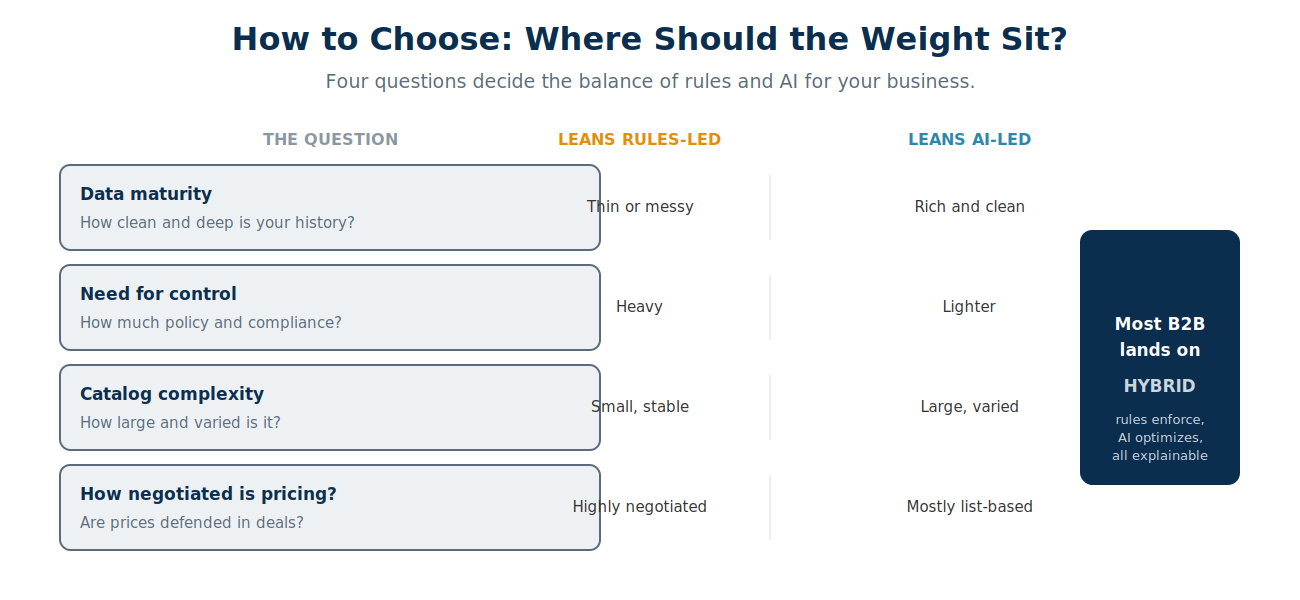
Work through these, honestly, before shortlisting a tool:
- How mature is your data? Thin or messy history points toward rules first, with AI added as the data improves. Rich, clean history supports AI-led optimization now.
- How much control do you need? Heavy policy, compliance, or contract constraints put rules at the center, with AI operating inside them.
- How varied is your catalog? A large, differentiated assortment rewards AI optimization; a small, stable one may not need it.
- How negotiated is your pricing? The more your prices are defended in deals, the more explainability and governance outweigh raw optimization power.
For most B2B manufacturers and distributors, the answer lands in the same place: a hybrid platform where rules enforce policy, AI optimizes within it, every recommendation is explainable, and non-standard cases route to a person. Match the balance to your data and your deals rather than to the vendor with the loudest AI claims, and the shortlist narrows to the tools that fit how you actually price, the same principle behind any sound pricing strategy.
How Vistaar Combines Rules and AI With Governance
Vistaar is built as the hybrid described above, rules for control, AI for optimization, and governance holding both, which fits the customer-specific, negotiated pricing of B2B manufacturing and distribution.
Against the framework here, the pieces line up:
- Configurable rules engine: margin floors, discount logic, and policy constraints a pricing team can set and change directly.
- Explainable optimization: AI-driven price and deal guidance grounded in a company's own transaction data, with the reasoning attached so a rep can defend the number.
- Guardrails and routing: hard limits every automated price respects, with exceptions routed to approval rather than published blindly.
- Full audit trail: every change traceable to its rule or model and result, keeping pricing defensible to finance.
- One connected platform: pricing, quoting, and rebates on a single system that integrates with enterprise tools like SAP, so automated prices reach the quote intact.
That balance, AI optimizing inside enforced rules, with every price explainable, is what turns automation into an advantage rather than a black box, and it is reflected in Vistaar's standing as a Leader in the 2026 Gartner Magic Quadrant for B2B Pricing and Rebate Optimization Software. The more useful test for any buyer, though, is a reference customer in their own industry. To see rules and explainable AI work together on your own data, a short walkthrough is the fastest test.
Conclusion
Choosing pricing automation software is less a contest between rules and AI than a matter of combining them so each does what it does best. Rules handle control, policy, and compliance; AI handles optimization across a catalog too large and varied for any rule to price finely. The strongest platforms run AI inside a boundary of rules, so intelligence never escapes policy, and route the exceptions to a person.
For B2B especially, one requirement sits above the rest: every automated price has to be explainable, because a price a rep cannot defend is worse than no automation at all. Weigh your data maturity, your need for control, and how negotiated your pricing is, and the right balance becomes clear. Get it right, and pricing automation software closes the gap Bain identified, the one between knowing pricing could be better and finally having the tools to make it so. To see that balance on your own numbers, a short walkthrough is the fastest way to judge the fit.
Frequently Asked Questions
What is pricing automation software?
Pricing automation software sets, updates, and publishes prices using defined logic instead of manual calculation. When a cost or term changes, it recalculates affected prices and pushes them to the systems that sell. The logic is rule-based, AI-based, or a combination of both.
What is the difference between rule-based and AI pricing automation?
Rule-based automation applies explicit "if this, then that" logic a person defines, transparent and controllable but unable to learn. AI-based automation recommends prices from data and optimizes at scale, powerful but reliant on clean data and harder to explain. Most platforms combine both.
Is AI or rule-based pricing better?
Neither on its own. Rules are better for control, policy, and compliance; AI is better for optimizing across a large, varied catalog. The strongest approach is hybrid: AI recommends the price, rules guardrail it, so optimization happens inside enforced policy.
Why does explainability matter in B2B pricing automation?
Because a B2B rep has to defend the price to a customer, and finance may need to audit it. An AI price with no reason attached cannot be justified and invites pushback. Explainable automation is a requirement, not a nice-to-have.
How do I choose pricing automation software?
Weigh your data maturity, need for control, catalog complexity, and how negotiated your pricing is. Thin data and heavy policy favor rules; rich data and a large catalog favor AI. Most B2B teams need a hybrid with explainable AI and an enforceable rules engine.

As an experienced pricing solutions partner to some of the biggest names in global business, Vistaar offers a range of services to help our customers reach their maximum potential. Talk to us to see how we can help you create a more profitable future.