




Key Takeaways
Pricing automation replaces the manual work of calculating, updating, and publishing prices, so the routine happens by rule instead of by spreadsheet.
It is an operating-model change, not an AI story. The value comes from consistency and speed, and only later from intelligence layered on top.
The most important decision is the automation boundary: automate the routine, keep strategy and high-risk exceptions with people.
Guardrails, margin floors, approval routing, exception queues, and an audit trail, are what make automation safe at scale.
Automating a flawed pricing rule just applies the mistake faster, so governance matters more as automation grows, not less.
A regional distributor once ran its entire pricing operation out of spreadsheets for more than two decades. Every dealer had a unique multiplier, and every cost change meant opening the master file, rebuilding each dealer's price sheet by hand, and emailing them out one at a time. By the time the new prices landed, the input costs had often moved again. The prices were not wrong because anyone was careless; they were wrong because the process could not keep up. That gap, between how fast prices need to change and how fast a manual process can change them, is the problem pricing automation exists to close.
This guide explains what pricing automation actually is for a B2B team, how it works, and the decision that matters most: what to automate and what to keep human. It covers the guardrails that make automation safe, the real benefits, and a realistic way to start. The focus throughout is B2B, where pricing is customer-specific, negotiated, and complex, and where automation done without governance does more harm than good.
What Pricing Automation Is
Pricing automation is the use of software to set, update, and publish prices by rule, replacing the manual steps of calculating each price and pushing it to where it is sold. Instead of a person recalculating a price list when a cost changes, the system applies the defined logic and updates every affected price automatically.
It is worth separating pricing automation from dynamic or competitive repricing, because they get conflated. Repricing reacts to competitor moves, adjusting your price to match theirs. Pricing automation is broader: it automates the whole routine of pricing, list maintenance, cost pass-through, discount application, and quote pricing, of which reacting to competitors is only one part. In B2B, most of the value is not in chasing a rival's price at all; it is in keeping thousands of customer-specific prices accurate and consistent as costs and terms change, which is where a governed price optimization approach proves its worth.
Why Pricing Automation Matters for B2B Now
The case for pricing automation is best understood as an operating-model problem, not a technology trend. Manual pricing fails in predictable ways, and those failures compound as a business grows. The distributor in the introduction is the pattern, not the exception.
Four failure modes recur wherever pricing runs on spreadsheets:
- Errors: the wrong formula, the wrong cell, the version of the file that never got forwarded. A single misplaced decimal can cost real margin or overcharge a customer.
- Slowness: an update that ripples across thousands of products takes days to propagate by hand, and by the time it lands, the input cost has shifted again.
- Inconsistency: different reps quote different prices to similar customers because no one is working from the same reference version.
- Margin leakage: discounts given without governance are rarely clawed back, so the list-to-pocket gap widens quietly over time.
These pressures have intensified because customers now compare prices across distributors, marketplaces, and direct channels in near real time. A pricing process that depends on spreadsheet refreshes and inbox approvals is reacting late by default. Automation is what lets a team respond at the speed the market now moves, the same urgency that makes dynamic pricing a live topic for B2B rather than a retail-only one.
How Pricing Automation Works
A pricing automation system runs a consistent sequence: it collects data, applies rules to it, calculates the resulting price, and publishes the output. The cycle runs on a schedule or in response to a change, and repeats whenever an input moves.
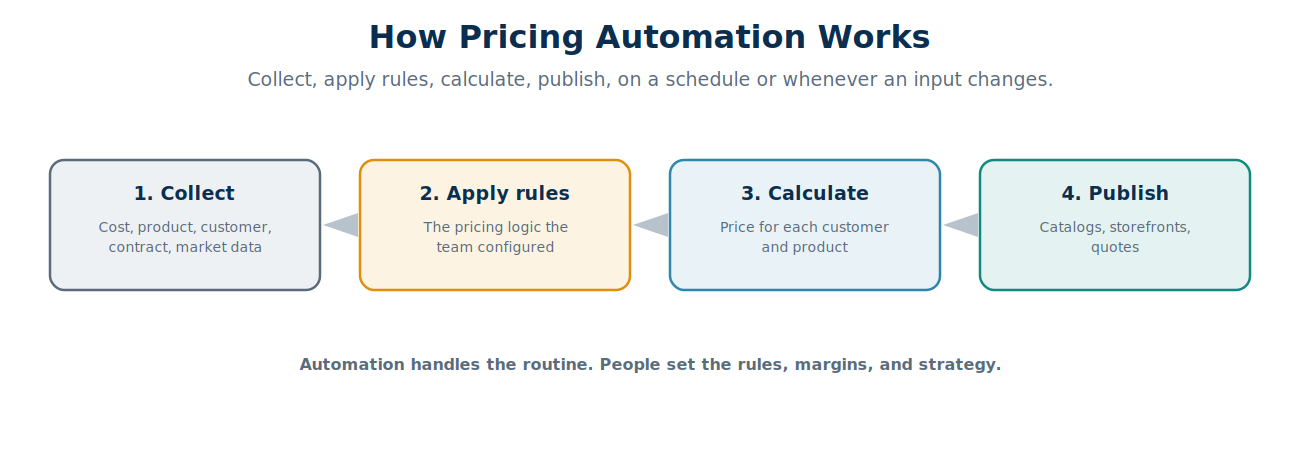
In practice the four stages work like this. The system collects data from connected sources, cost from the ERP, product data from the PIM, customer and contract terms, and market signals. It analyzes that data against the pricing rules a team has configured. It calculates the resulting price for each customer and product combination. Then it pushes the output into the places selling happens: catalogs, storefronts, and quote documents.
What automation handles is the routine calculation and distribution. What it leaves to people is the strategy: which rules to set, which margins to protect, and which segments to treat differently, the judgment that a clear pricing model is built to encode.
A pricing engine then executes that logic at scale, applying the rules the team sets across every price.
What to Automate, and What to Keep Human
Here is the decision most guides skip and the one that determines whether pricing automation helps or hurts: the automation boundary. Not every pricing decision should be automated, and knowing where to draw the line is the difference between a force multiplier and a liability.
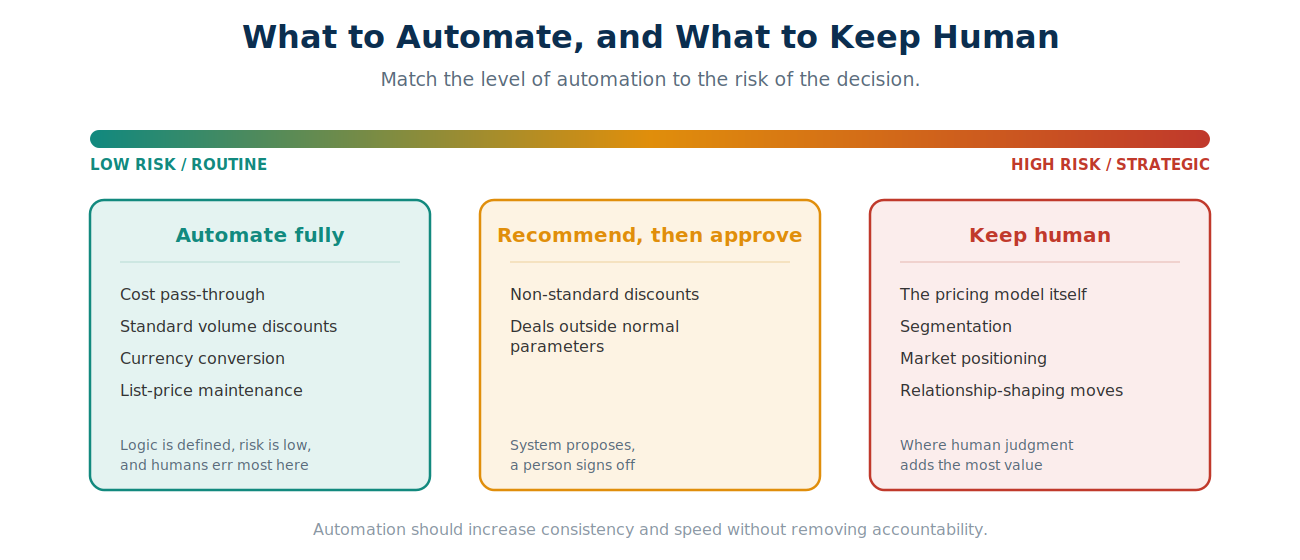
A useful way to think about it is a spectrum of control, from fully automated to fully human, matched to the risk of the decision:
- Automate fully: routine, rules-clear calculations like cost pass-through, standard volume discounts, currency conversion, and list-price maintenance, where the logic is defined and the risk is low.
- Recommend, then approve: mid-risk changes where the system proposes a price and a person signs off, such as a non-standard discount or a deal outside normal parameters.
- Keep human: strategy and high-risk decisions, what the pricing model should be, how to segment, how to position against the market, and any change large enough to reshape customer relationships.
The principle is that automation should increase consistency and speed without removing accountability. The routine work that consumes a pricing team, and where humans make the most errors, is exactly what should be automated. The strategic work, where human judgment adds the most value, is exactly what should not. Drawing that line well is what turns automation into an advantage rather than a risk, and it is the heart of sound pricing analysis.
The Guardrails That Make Automation Safe
Automation amplifies whatever logic it is given, including a mistake. A flawed rule applied by hand affects a few prices before someone notices; the same rule automated applies instantly across thousands of prices and channels. That is why guardrails are not an optional extra but the precondition for trusting automation at all.
Four guardrails do most of the work:
- Margin floors and price bounds: hard limits that no automated price can cross, so a rule chasing a competitor or applying a discount can never sell below the profitability threshold.
- Exception routing: when an input looks wrong, a corrupted competitor feed, a cost that moved implausibly, the change is blocked and routed for human review rather than published blindly.
- Approval workflows: a defined path for the changes that fall outside standard parameters, so the routine flows automatically while the unusual gets a human decision.
- Audit trail: a full record of every change, which rule fired, when, and what the result was, so any price can be explained and any anomaly traced.
Consider what guardrails prevent. A competitor's price feed briefly returns a corrupted, near-zero value; a matching rule tries to follow it down; the margin floor blocks the change and routes it for review instead of publishing a broken price to every customer at once. Without that safety net, a business either keeps a person checking every automated change, which defeats the purpose, or accepts the risk of a single bad input propagating everywhere. Guardrails are what let a team hand the routine to automation while keeping control of the outcome, the same discipline that keeps rebate and discount economics defensible.
The Benefits of Pricing Automation
When automation is scoped to the routine and protected by guardrails, the benefits are concrete rather than promotional. Each one traces back to a failure mode of the manual process it replaces.
- Speed: a cost change propagates across the whole catalog in minutes instead of days, so prices reflect current reality rather than last week's.
- Consistency: every customer and channel prices from the same logic, so two similar customers no longer pay different prices because of who quoted them.
- Fewer errors: the manual mistakes, the wrong cell, the stale formula, are removed from the routine calculation entirely.
- Protected margin: guardrails stop discounts and price moves from crossing the floor, closing the quiet leakage that manual discounting allows.
- Freed capacity: a pricing team that spent most of its time on manual updates can shift to the strategic work that actually moves margin.
That last benefit is the one that compounds. Automation does not replace the pricing team; it moves them from operating the machinery to setting its direction, which is where a strong pricing strategy comes from in the first place.
How to Get Started With Pricing Automation
Pricing automation does not have to be a multi-quarter project, and starting narrow is usually wiser than starting broad. A staged path lowers risk and builds the team's confidence in the system before it takes on more.
- Audit the current process: map how prices are set today, where the manual bottlenecks are, and where errors and leakage actually occur.
- Formalize the rules: move pricing logic out of the pricing manager's head and the spreadsheet into explicit, documented rules, the most important step, since the rules determine the output.
- Connect the data: integrate the sources that feed pricing, cost from the ERP, product data, and customer terms, and confirm the source data is clean.
- Start with one segment: automate a single product category or customer group first, prove it, then expand.
- Set the guardrails before you scale: put margin floors, exception routing, and approvals in place from the start, not after the first bad price.
The order matters. Formalizing the rules and setting guardrails before scaling is what separates an automation project that protects margin from one that automates a flawed model faster. Grounding the whole effort in a clear view of how you price is what keeps it on track.
How Vistaar Approaches Governed Pricing Automation
Vistaar is built for the governed end of pricing automation, where the routine is automated and the guardrails are built in, which fits the customer-specific, negotiated pricing that defines B2B manufacturing and distribution.
Against the framework above, the pieces line up:
- Rule-based automation: list prices, customer-specific prices, and discounts calculated and updated automatically as costs and terms change.
- A clear automation boundary: routine pricing runs automatically, while non-standard deals route to approval and strategy stays with the team.
- Built-in guardrails: margin floors, price bounds, approval workflows, and exception routing that hold every automated price inside policy.
- Full audit trail: every change traceable to its rule and result, so pricing stays defensible to finance.
- One connected platform: pricing, quoting, and rebates on a single system that integrates with enterprise tools like SAP, so automated prices reach the quote and order workflow intact.
That combination, automating the routine while governing the outcome, is what turns pricing automation from a risk into an advantage, and it is reflected in Vistaar's standing as a Leader in the 2026 Gartner Magic Quadrant for B2B Pricing and Rebate Optimization Software. The more useful test for any buyer, though, is a reference customer in their own industry. To see governed pricing automation on your own data, a short walkthrough is the fastest test.
Conclusion
Pricing automation is best understood as an operating-model shift rather than an AI story. It replaces the manual, error-prone routine of calculating and publishing prices with a governed system, so a team stops rebuilding spreadsheets and starts directing pricing. The distributor from the introduction did not have a pricing problem so much as a process problem, and that is what automation solves: the gap between how fast prices need to move and how fast people can move them by hand.
The decisions that make it work are the automation boundary, automate the routine, keep strategy human, and the guardrails that hold every automated price inside policy. Get those right, and automation becomes a force multiplier for the pricing team rather than a way to make mistakes faster. Get them wrong, and you have simply automated the old problem. To see where the boundary and the guardrails should sit for your own pricing, a short walkthrough is the fastest way to judge the fit.
Frequently Asked Questions
What is pricing automation?
Pricing automation is the use of software to set, update, and publish prices by rule, replacing the manual work of calculating each price and pushing it to where it sells. It automates the routine, list maintenance, cost pass-through, discounts, so people can focus on strategy.
Is pricing automation the same as dynamic pricing?
No. Dynamic or competitive repricing reacts to competitor moves. Pricing automation is broader: it automates the whole pricing routine, of which reacting to competitors is one part. In B2B, most of the value is keeping customer-specific prices accurate as costs and terms change.
What should you automate versus keep human in pricing?
Automate routine, low-risk calculations like cost pass-through and standard discounts. Route mid-risk changes for approval. Keep strategy and high-risk decisions, the pricing model, segmentation, and market positioning, with people. The boundary should match the risk of each decision.
Why are guardrails important in pricing automation?
Because automation applies a flawed rule instantly across thousands of prices. Guardrails, margin floors, exception routing, approval workflows, and an audit trail, block bad prices before they publish and keep automated pricing inside policy, which is what makes automation safe to trust.
How do you start with pricing automation?
Audit the current process, formalize your pricing rules, connect clean data from the ERP and other sources, automate one segment first, and set guardrails before scaling. Starting narrow with guardrails in place beats a broad rollout that automates an unproven model.

As an experienced pricing solutions partner to some of the biggest names in global business, Vistaar offers a range of services to help our customers reach their maximum potential. Talk to us to see how we can help you create a more profitable future.