




Key Takeaways
Retail pricing strategies anchor to one of four things: cost, competition, the customer's perceived value, or the moment.
Everyday low pricing and high-low pricing are the two macro models a retailer builds on. Walmart built on the first; JCPenney was hurt abandoning the second.
Psychological pricing (charm prices, anchoring, bundling) shapes how a price is perceived, and layers on top of any base strategy.
No single strategy fits a whole catalog. The strongest retailers assign different strategies to different products by role.
The right strategy depends on the product, the shopper, and the goal, not on copying what a big-box competitor does.
In 2011, JCPenney tried to replace its endless coupons and sales with one honest "fair and square" everyday price. Shoppers hated it. Sales fell about 25% in a year, and the strategy was reversed. The prices were arguably better, yet the retailer had removed the thrill of the deal its customers were trained to chase. That expensive lesson is the whole subject in miniature: a retail pricing strategy is not just the number on the tag, it is how that number fits the product, the shopper, and the moment.
This guide lays out the strategies retailers actually use, grouped by what each one anchors to, cost, competition, value, or timing, with real examples of each. It then covers the psychological tactics that shape how any price is read, and finishes with the part most guides skip: how a single retailer assigns different strategies across the same catalog, because no one approach fits every product on the shelf.
What Is a Retail Pricing Strategy?
A retail pricing strategy is the method a store uses to decide what to charge, a long-term approach based on business goals, shopper demand, market conditions, and competitor positioning. It is distinct from a pricing tactic, which is a short-term action like a specific discount or promotion. The strategy is the standing logic; the tactic is a single move within it.
Every strategy anchors to one of four reference points: your cost, your competitors, the customer's perceived value, or the moment of sale. Those four anchors are the simplest way to make sense of the long list of named strategies, because each named strategy is really just one of these four anchors applied a particular way. The sections below group them accordingly, and a clear pricing model underneath makes any of them work at scale.
Cost-Anchored Strategies
Cost-anchored strategies start from what a product costs you and build the price up from there. They are the simplest to run and the easiest to defend internally, which is exactly why they are also the easiest place to leave money on the table.
Cost-plus pricing adds a fixed markup to the unit cost. A product that costs $60 with a target 40% margin is priced at $100. It is transparent and quick, and it works well for private-label and staple items where cost is the honest basis. Its weakness is that it ignores what the shopper would actually pay, so it under-prices strong products and over-prices weak ones.
Keystone pricing is the retail shorthand of simply doubling the wholesale cost. It is a fast rule of thumb, still common in some categories, but too blunt for a competitive catalog where margins and demand vary widely by item.
Competition-Anchored Strategies
Competition-anchored strategies set price relative to what rivals charge rather than to your own cost. They keep you aligned with the market, which matters most on the items shoppers actively compare.
Competitive pricing benchmarks against competitors and positions at, just below, or deliberately above the market price. It is effective on known-value items where shoppers notice a gap, but chasing the lowest price erodes margin and can start a price war, so it works best paired with margin floors.
Penetration pricing sets a deliberately low entry price to win share fast when entering a market or launching a product, then raises it once a customer base is established. It buys volume and trial, at the cost of early margin, and risks training customers to expect the low price.
Loss-leader pricing prices a few items below cost to drive traffic, betting that shoppers fill the rest of the basket at full margin. A grocery chain pricing milk or rotisserie chicken at a loss to pull people into the store is the classic case. It only works if the basket math holds.
Value-Anchored Strategies
Value-anchored strategies set price by what the product is worth to the customer, not by cost or competitors. They capture the most margin when the product is genuinely differentiated, and fall apart when it is not.
Value-based pricing sets the price on the customer's perceived value, which can sit well above cost for a product people want and trust. It is the highest-margin approach for differentiated goods, and it depends on actually understanding what the shopper values, which is where disciplined value-based pricing earns its returns.
Premium pricing deliberately sets a high price to signal quality and exclusivity. For aspirational and luxury goods, the high price is part of the product; a lower price would weaken the very positioning that sells it. It only holds where the brand and the experience support it.
Timing-Anchored Strategies
Timing-anchored strategies change the price based on the moment, demand, inventory, season, or how close a deadline is. They extract the most from products whose value shifts over time.
Dynamic pricing adjusts the price in near real time as demand, competitor prices, and inventory move. It is powerful for volatile categories and online retail, where conditions change by the hour, but it has to stay on the right side of customer trust, especially when it tips into surge pricing during demand spikes, which the guide to dynamic pricing covers in depth.
Markdown pricing is the planned reduction of price to clear seasonal, perishable, or end-of-life inventory before a sell-through deadline. The trade-off is timing: cut too early and you give away margin, cut too late and you are left with unsellable stock. Done well, it recovers the most value from inventory that has to move.
Price skimming launches a product high to capture the customers who will pay most, then lowers the price over time to reach the rest of the market. It is common in consumer electronics, where early adopters absorb the premium before the price steps down.
The Two Macro Models: EDLP and High-Low
Above the individual strategies sit two overall models that shape a retailer's entire price image, and most stores build on one of them.
alt text: Comparison of everyday low pricing and high-low pricing: EDLP holds steady low prices and builds trust; high-low uses a higher base with frequent promotions and the thrill of the deal
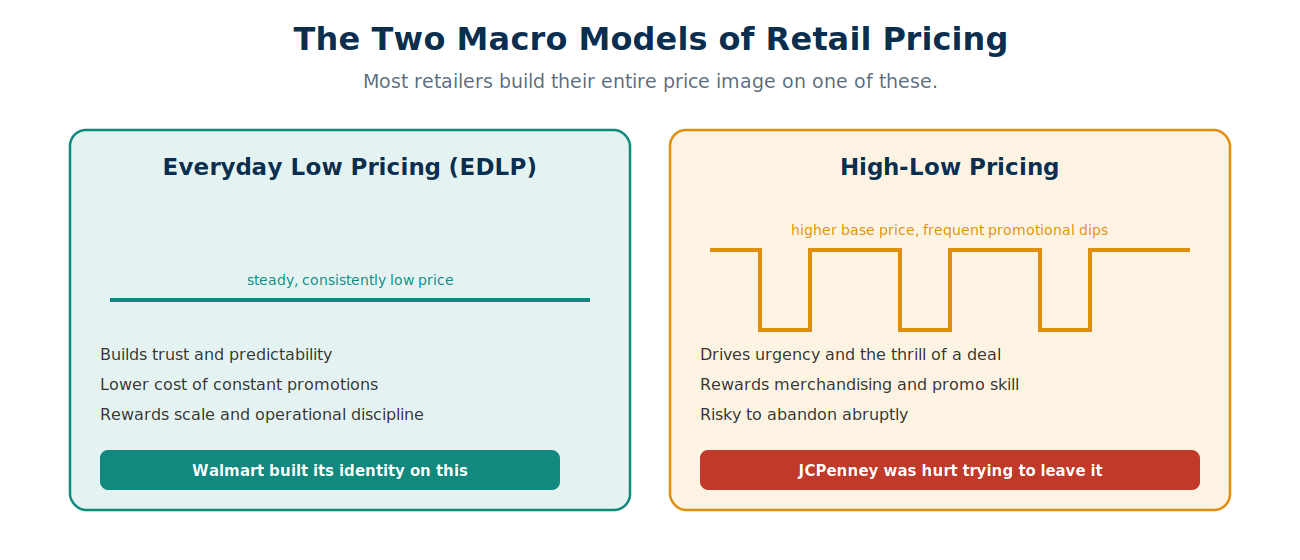
Everyday low pricing (EDLP) holds prices consistently low rather than swinging between full price and sale. It builds trust and predictability and reduces the operational cost of constant promotions. Walmart built its entire identity on EDLP, and its scale and supplier bargaining power make the low prices sustainable.
High-low pricing sets a higher regular price and runs frequent promotions and sales off it, so shoppers feel they are winning a deal. It drives urgency and traffic, and it suits categories where the hunt for a bargain is part of the experience. The risk is in abandoning it abruptly, which is exactly the JCPenney lesson from the introduction: the customers were there for the deal, and removing it removed them.
Neither model is universally right. EDLP rewards scale and operational discipline; high-low rewards merchandising and promotional skill. The choice shapes everything downstream, from margin structure to how often prices change.
Psychological Pricing Tactics
Layered on top of any base strategy are the tactics that shape how a price is perceived rather than what it fundamentally is. They work because shoppers react to how a price looks, not only to what it adds up to.
- Charm pricing: ending a price in .99 or .95, so $9.99 reads as meaningfully less than $10 even though the difference is a cent.
- Price anchoring: showing a higher "regular" price or suggested retail price next to the sale price, so the lower number looks like a clear win.
- Bundling: grouping products at a combined price that feels better than buying each separately, which also lifts average basket size.
- Decoy pricing: adding a deliberately less attractive option that makes the target choice look like better value.
These tactics are not strategies on their own; they are the finish applied to one. A value-based premium product still uses charm pricing on the shelf tag, and an EDLP retailer still bundles. Used with restraint they help; overused, they read as manipulation and erode the trust a pricing strategy depends on.
How Retailers Assign Strategies by Product Role
The part most guides skip is the one that actually matters: no single strategy fits a whole catalog. The same aisle holds known-value items shoppers price-check, differentiated lines they buy on trust, and a long tail they barely notice, and each wants a different approach. The strongest retailers do not pick one strategy; they assign strategies by the role a product plays.
In practice, a well-run retailer maps the catalog something like this:
This is why "we match the market and add our margin" is a reflex, not a strategy. It applies one anchor to a catalog that needs several. Assigning the right approach to each product role is what separates a retailer that protects margin across the whole assortment from one that quietly leaks it on thousands of items at once, and doing that at scale is what price optimization tools are built for.
The companion guide to choosing retail pricing software covers how that assignment gets operationalized across an assortment.
How to Choose the Right Retail Pricing Strategy
Choosing is less about picking one winner than about matching each part of the catalog to the anchor that fits it. A few questions guide the call:
- What role does the product play? A traffic-driving KVI, a margin-earning differentiated line, and a clearance item each want a different anchor.
- How price-sensitive is the shopper for it? High sensitivity points to competitive or EDLP; low sensitivity opens room for value-based or premium.
- How fast do its conditions change? Volatile cost or demand favors dynamic pricing; stable products do not need it.
- What is the goal? Winning share favors penetration; protecting brand favors premium; clearing stock favors markdown.
Answer those per product group rather than for the whole store, informed by ongoing pricing analysis, and the strategy assigns itself. The mistake is copying a big-box competitor wholesale, since a strategy that works on Walmart's scale or a luxury brand's positioning may be wrong for yours.
Grounding the choice in a clear pricing strategy built for your own catalog is what makes it hold up over time.
Conclusion
Retail pricing rewards discipline over the search for one perfect strategy. The work is matching each product to the right anchor, cost, competition, value, or timing, and knowing which macro model, everyday low or high-low, your price image is built on. The named strategies are just those anchors applied in specific ways, and the psychological tactics are the finish on top. The retailers that win are the ones that stop pricing the whole catalog one way and start pricing each part for the role it plays.
Put your pricing strategy into practice.
Assigning the right strategy to every product role across thousands of SKUs is more than a spreadsheet can hold. Vistaar's retail pricing platform manages base price, promotions, and markdowns on one governed, explainable system, so each part of the catalog gets the strategy it needs while margin and price image stay protected.
See it on your own assortment with a short walkthrough.
Frequently Asked Questions
What are the main types of retail pricing strategies?
They group by what they anchor to: cost (cost-plus, keystone), competition (competitive, penetration, loss-leader), customer value (value-based, premium), and timing (dynamic, markdown, skimming). Above them sit two macro models, everyday low pricing and high-low pricing.
What is the difference between EDLP and high-low pricing?
Everyday low pricing holds prices consistently low and builds trust, as Walmart does. High-low pricing sets a higher base price and runs frequent promotions off it, so shoppers feel they are winning a deal. Each suits different categories and operating models.
What is psychological pricing in retail?
Tactics that shape how a price is perceived rather than what it fundamentally is: charm prices ending in .99, anchoring a sale price against a higher regular price, bundling, and decoy options. They layer on top of a base strategy rather than replacing it.
Can a retailer use more than one pricing strategy?
Yes, and the strongest ones do. A single catalog holds known-value items, differentiated lines, and clearance stock that each want a different anchor. Retailers assign competitive pricing to KVIs, cost-plus to staples, value-based to premium lines, and markdown to clearance.
How do I choose a retail pricing strategy?
Decide per product group, not per store. Weigh the product's role, how price-sensitive the shopper is, how fast conditions change, and the goal. A traffic-driving item wants competitive pricing; a differentiated line wants value-based; clearance wants markdown.

As an experienced pricing solutions partner to some of the biggest names in global business, Vistaar offers a range of services to help our customers reach their maximum potential. Talk to us to see how we can help you create a more profitable future.