




Key Takeaways
Competitive pricing software is broader than price monitoring. Monitoring watches competitors; competitive pricing software watches, matches, applies rules, and reprices.
Match accuracy on your own catalog matters more than refresh speed. A wrong product match produces a confidently wrong price.
The most revealing evaluation question is how competitor data reaches the repricing workflow. An export-and-sync handoff is a different product from a live loop.
The tools fall into distinct categories, from monitoring-only to enterprise pricing that uses competitive signals. Match the type to your problem, not the feature count.
Guardrails and an audit trail decide whether the software survives real use. A price you cannot explain is a price you cannot keep.
Competitive pricing software gets bought after a specific kind of surprise: a product that sold well last week stalls, and the cause turns out to be a competitor price change nobody caught in time. The category exists to close that blind spot. The difficulty is that the market is crowded, every vendor's language is nearly identical, and the differences between platforms only become visible after the contract is signed.
This guide is built to surface those differences before you buy. It starts with what the category actually covers, because "competitive pricing software" is often confused with plain price monitoring, then works through the tool types, the features that matter, the demo questions that break the sales script, and the red flags worth walking away from. If you are still deciding whether you need automated pricing at all, the broader guide to dynamic pricing gives the context; this article is for teams already evaluating tools.
What Competitive Pricing Software Does
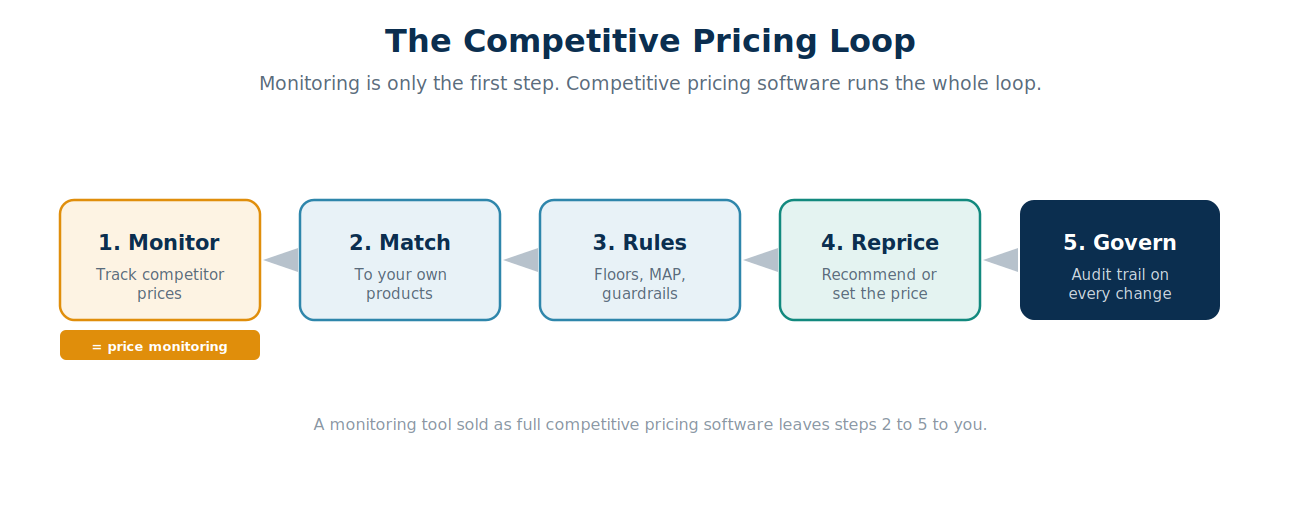
Competitive pricing software uses competitor price data to inform and adjust your own prices, so your pricing responds to the market rather than sitting fixed while competitors move. At its fullest, it runs a loop: monitor competitor prices, match them to your products, apply your pricing rules, recommend or set a new price, and record what changed.
The common confusion is with price monitoring, which is only the first step of that loop. Monitoring tells you what competitors charge; it does not decide or change anything. Competitive pricing software includes monitoring but adds the parts that turn a competitor's move into your priced response. Knowing which of the two a vendor actually sells is the first thing to establish, because a monitoring tool priced and pitched as full competitive pricing software leaves the hardest part, acting on the data, to you.
The Types of Competitive Pricing Tools
The category is not one kind of product. It spans several tool types that solve different parts of the problem, and matching the type to your situation matters more than comparing features across mismatched tools. The table below sorts the market by category, not by ranking.
The right type depends on how you sell. A marketplace seller living on buy-box speed needs a repricer; a manufacturer that uses competitive data as one input among cost, segment, and margin needs an enterprise platform where competitive signals feed a broader price optimization engine.
Fast, rules-based repricing operates much like dynamic pricing software, while governed enterprise pricing is a different discipline. Buying across categories, a repricer when you needed governance, or an enterprise suite when you needed marketplace speed, is the most common and costly mismatch in this space.
Key Features to Look For
Within whichever type fits, a few capabilities separate software that delivers from software that just adds a dashboard. Evaluate these against your own data, not a polished demo catalog.
Match Accuracy on Your Catalog
Everything rests on matching your product to the right competitor listing. A wrong match produces a confidently wrong price, which is worse than no data. Vendors show flawless matching in demos because demo catalogs are pre-verified. What matters is accuracy on your products, with your naming, bundles, and variants. Ask for a proof-of-concept match on a sample of your own items and review the results yourself, and check that ambiguous matches are flagged for review rather than silently accepted. Because this feature quietly decides whether everything downstream works, it is worth understanding in its own right, which the next section covers.
Refresh Frequency on the Items That Move
Vendors quote a catalog-wide refresh rate. What matters is the refresh cycle on your high-velocity items, the ones where a competitor move in the next few hours affects sales today. A daily average across the whole catalog is not the same as a fast refresh on your hero products, however similar it sounds in a sales call. Judge refresh where speed actually changes the outcome.
Rules and Guardrails
Competitive data is only useful inside your commercial policy. The software should let you set margin floors, competitor position targets, MAP compliance, and movement caps, and enforce them automatically on every price. A tool that reprices toward a competitor with no floor will chase a rival to the bottom. Guardrails are what keep a competitive response from becoming a margin loss, and they are a core part of any disciplined pricing model.
The Repricing Integration
This is the most revealing feature in any evaluation: how does competitor data reach the repricing workflow? If the answer involves an export, a CSV, or a daily sync, the monitoring and repricing are separate systems joined by a handoff, and your real response time is capped by the sync schedule. A live loop, where a competitor change immediately triggers rule evaluation, is a fundamentally different product. Ask exactly how the data moves, and what happens when a sync fails.
Governance and Audit Trail
Every price change should trace to a signal, a rule, and an approval, logged by default. When margin dips or a customer questions a price, someone has to explain it, and "the tool did it" is not an answer. An audit trail a finance team can read is what separates software that earns trust over time from a tool switched off after the first unexplained move, the same standard sound pricing analysis holds any number to.
How Product Matching Works, and Why It Fails
Product matching is the invisible layer under every competitive pricing decision, and it is where most platforms quietly fail in production even after a flawless demo. It is worth understanding what the software is actually doing when it claims a 95% or 99% match rate. Those numbers mean very different things depending on your catalog.
Matching has to handle four kinds of relationship between your product and a competitor listing, and they get progressively harder:
- Identical products: same manufacturer, model, and barcode, listed under different names. The task is mostly data hygiene, making sure each side has the right identifier.
- Variants: the same item in a different size, color, or capacity. A 128GB and a 256GB phone are separate listings that must be told apart, not merged.
- Equivalents: interchangeable but not identical, like a generic case versus a branded one. There is no shared identifier, so the match rests on attributes, images, and price.
- Bundles and multipacks: a machine sold alone versus the same machine bundled with accessories, or a single unit versus a pack. The per-unit math has to be unwound before any comparison is valid.
Underneath, platforms use one or more of four methods, and the honest ones use a blend. Exact identifier matching on EAN, UPC, GTIN, or MPN is the most reliable when the identifier is present and shared, but marketplaces often strip or corrupt identifiers, so it rarely covers a full catalog on its own. Fuzzy text matching compares titles, which breaks when a listing is reworded. Attribute matching compares structured specs, which needs clean data on both sides. AI ensemble matching combines text, attributes, and images with a confidence score, which is what messy, multi-source catalogs actually require.
What a bad match actually costs: a consumer-electronics retailer sees a competitor selling "their" phone 20% cheaper and cuts price to compete. The matched listing was the 128GB variant against their 256GB model. The comparison was never valid, so they gave away margin for nothing, and if the repricer is automated, it did it without anyone deciding to. This single failure mode, a variant or bundle matched as identical, is the most common and most expensive error in the category.
Two practical tests separate real matching from demo matching. First, ask what the same match set looks like six months later. Listings drift, titles change, and identifiers get corrupted, so a match that was clean at signing decays without maintenance. Second, run the pilot on your hardest products, the variant-heavy, bundle-heavy, identifier-poor part of your catalog, not the clean branded items that match themselves. Matching that holds up there is matching you can build pricing on, and it is the foundation any credible
Questions to Ask in a Demo
Demos are choreographed. These questions force a vendor off the prepared path and onto your data and your constraints. Take the same set to every vendor so the answers compare.
- Match my products live. Run a match on a sample of my own catalog now, and show me the accuracy and the ambiguous cases.
- What is the refresh cycle on my high-velocity items, not the catalog average?
- How does competitor data reach the repricing step? Show me whether it is a live loop or an export and sync.
- How are guardrails enforced? Are margin floors and MAP hard constraints, or optional settings a rule can override?
- Where does the audit trail live, and what does it show when finance asks why a price changed on a given day?
- Which of your customers sells the way we do? Same channel mix, same catalog scale, and what did they stop doing once the tool was live?
How comfortably a vendor handles these tells you as much as the answers. Specific, confident replies signal a real product; vague or deflecting ones signal a demo built to impress rather than to fit.
Red Flags to Walk Away From
A few signals reliably predict disappointment, and they show up before you sign. Treat each as a reason to slow down.
- Resistance to matching your own products: if a vendor will not demonstrate on your catalog during evaluation, assume the demo accuracy will not hold in production.
- Guardrails as optional settings: MAP and margin floors should be enforced constraints, not toggles a rule can quietly override.
- Alert noise instead of decisions: if every competitor change fires an alert, you have noise, not signal. Look for threshold-based exception routing.
- No clear audit trail: if the tool cannot connect a price change to its signal, rule, and approver, it will not survive a finance review.
None of these is subtle once you know to look. The pattern behind them is a tool that demos well but does not hold up in a real pricing operation, which is what a disciplined evaluation exists to catch.
The Compliance Layer: MAP and Pricing Law
Competitive pricing does not happen in a legal vacuum, and this is the layer most buyer guides skip entirely. If you sell branded goods or operate across the US and Europe, the software has to respect pricing rules that differ sharply by region, and getting this wrong is a legal risk, not just a margin one.
MAP Versus MSRP
A minimum advertised price, or MAP, is the lowest price a brand allows a reseller to advertise, not the lowest price the reseller can sell for. That distinction drives everything. A recommended retail price, or MSRP, is a non-binding suggestion with no consequences; MAP is an enforced floor on the advertised price. A reseller can often sell below MAP in a private transaction or a cart-only price. MAP governs advertising, not the checkout, unless the policy is written to say otherwise.
The Rules Differ by Region
Where you sell changes what is even legal, and a platform used across regions has to reflect that:
- United States: a properly structured, unilateral MAP policy is generally lawful. It has to be a one-sided announcement the brand can change at will, dated and versioned, and enforced consistently across resellers.
- EU and UK: advertised-price floors are treated as resale price maintenance, a hardcore restriction under EU competition rules and the UK Competition Act. Brands there use genuinely non-binding recommended prices instead, and achieve consistency through distribution structure rather than enforcement.
- EU Omnibus Directive: when advertising a discount, the reference price must be the lowest price charged in the prior 30 days, which constrains how a competitive repricing move can be presented to shoppers.
A tool that enforces a US-style MAP rule into an EU channel is not just misconfigured; it can put the brand on the wrong side of competition law. Ask any vendor how the platform handles region-specific pricing rules, and treat a blank look as an answer.
Marketplaces Do Not Enforce MAP for You
One expectation worth correcting early: marketplaces like Amazon do not enforce a brand's MAP policy. The buy box rewards the lowest price. A seller advertising below MAP is a brand-reseller matter, not a marketplace violation, unless a separate issue like counterfeit or IP applies. Enforcement runs through reseller agreements and distribution control, and the software's job is to surface the violations, not to police the marketplace.
The Violations Now Hide One Layer Down
The obvious breach, a listed price below the floor, is the easy case and increasingly the minority. In 2026 the damaging violations sit one layer beneath the sticker price. A compliant listing carrying a coupon that drops the effective price under MAP, a subscribe-and-save discount, bundle pricing whose per-unit math undercuts the floor, or a cart-only price shown before checkout. Whether each of those breaches a policy depends entirely on how that policy defined "advertised price." Competitive pricing software earns its place here by catching the effective price after coupons and bundles, not just the headline number, which is exactly where manual monitoring and weaker tools go blind.
How to Run the Evaluation
A good evaluation does not need four months. It needs the right tests in the right order, run on your own data rather than the vendor's sample.
- Demos with hard questions first: take the six questions above to every vendor and compare the specifics of the answers.
- A match-accuracy pilot: have each shortlisted vendor match a sample of your own catalog, and review the results yourself.
- A live integration test: confirm how competitor data actually reaches repricing, and whether the loop is live or a scheduled handoff.
- Customer references: speak to a customer who sells the way you do, and ask what changed after go-live.
Run in that sequence, and the decision rests on evidence from your own data, not a slide deck. Weight match accuracy and the integration model most heavily, since those are the two that quietly decide whether the software works in production.
How Vistaar Uses Competitive Signals in a Governed System
Vistaar sits at the enterprise end of this market. It is not a standalone marketplace repricer but a governed pricing platform that treats competitive intelligence as one input among cost, segment, demand, and margin, which fits manufacturers, distributors, and large retailers more than pure ecommerce crawling.
Against the features above, the pieces line up for that use case. Competitive signals feed recommendations while noise is filtered out, so prices respond to real threats rather than every transient move. Rules and guardrails enforce margin floors, MAP, and price-image constraints on every action, and every change carries an audit trail a finance team can read.
Because it runs on one platform spanning list price, promotions, and approvals, a competitive response stays consistent with the rest of a company's pricing rather than becoming a separate, unpredictable layer, which is the direction a modern AI-driven pricing stack keeps moving toward.
To judge the fit against your own catalog and channels, a short walkthrough is the fastest test.
Conclusion
Choosing competitive pricing software starts with naming what you actually need: monitoring to see the market, a repricer to move at marketplace speed, optimization to protect margin, or an enterprise platform to govern all of it. The types solve different problems, and the costly mistakes are category mismatches, not feature gaps. Matching the tool to your pricing strategy is what avoids them. Once the type is right, the decision comes down to match accuracy on your own catalog, how competitor data reaches repricing, whether guardrails are enforced, and whether every change is explainable.
Evaluate on your own data, take the same hard questions to every vendor, and weight the two features that decide production performance: matching and integration. The tool worth buying is the one that fits how you sell and that your team and finance function can both trust. To see governed competitive pricing on your own numbers, a short walkthrough is the fastest way to judge the fit.
Frequently Asked Questions
What is competitive pricing software?
Competitive pricing software uses competitor price data to inform and adjust your own prices. At its fullest it monitors competitor prices, matches them to your products, applies your pricing rules, and reprices, rather than just reporting what competitors charge.
What is the difference between competitive pricing software and price monitoring?
Price monitoring is the first step: it tracks and reports competitor prices but changes nothing. Competitive pricing software includes monitoring and adds matching, rules, and repricing, turning a competitor's move into your priced response. Monitoring alone leaves the acting to you.
What features matter most in competitive pricing software?
Match accuracy on your own catalog, refresh frequency on high-velocity items, enforced guardrails like margin floors and MAP, a live path from competitor data to repricing, and an audit trail on every change. Matching and integration decide production performance.
What should you ask in a competitive pricing software demo?
Ask the vendor to match your own products live, state the refresh cycle on your fast-moving items, show how data reaches repricing, confirm guardrails are enforced not optional, and name a customer who sells the way you do. Take the same questions to every vendor.
Is competitive pricing software only for ecommerce?
No. Marketplace and ecommerce sellers use fast repricers, but manufacturers, distributors, and large retailers use enterprise platforms that treat competitive signals as one input alongside cost, segment, and margin, inside governed pricing rather than automated public repricing.

As an experienced pricing solutions partner to some of the biggest names in global business, Vistaar offers a range of services to help our customers reach their maximum potential. Talk to us to see how we can help you create a more profitable future.