



Key Takeaways
- Dynamic pricing means adjusting a price as conditions change, but it runs on a spectrum from crude competitor-matching to governed, AI-guided pricing.
- Where a business sits on that spectrum matters more than whether it "does dynamic pricing" at all.
- There is a hard line between dynamic pricing, which varies by market conditions, and personalized pricing, which varies by the individual. One builds trust; the other breaks it.
- The famous examples, Uber, Amazon, and airlines, work because of specific conditions that do not transfer to every business.
- In B2B, dynamic pricing looks nothing like surge pricing. It is real-time price guidance inside guardrails, built for negotiated deals rather than public price tags.
The useful way to understand dynamic pricing is as a spectrum. At one end is crude, reactive price-chasing. At the other is governed, data-driven pricing with guardrails and a clear reason behind every move. This guide covers what dynamic pricing is, how it works, the main strategies, and the real examples and why they work. It also covers the trust line no business should cross, and how it looks in B2B, which differs from the retail version most guides describe.
What Is Dynamic Pricing?
Dynamic pricing is the practice of changing a price in response to current conditions, rather than holding one fixed price for weeks or months. The inputs vary by business, but they usually include demand, available supply or inventory, timing, and what competitors are charging. When those inputs move, the price moves with them.
The idea is simple; the execution is where businesses differ enormously. A hardware store nudging a price up when a supplier's cost rises is doing dynamic pricing. So is an airline running algorithms across millions of fares. Both change prices as conditions change, but they sit at opposite ends of a spectrum of sophistication. Treating them as the same thing leads to bad decisions about tools and strategy.
The Levels of Dynamic Pricing, From Basic to Advanced
The single most useful thing to understand about dynamic pricing is that it is not binary. Businesses do not simply turn it on. They operate somewhere along a range that runs from reactive and crude to governed and sophisticated, and knowing where you sit tells you far more than the label does.
Here is the spectrum, from least to most mature:
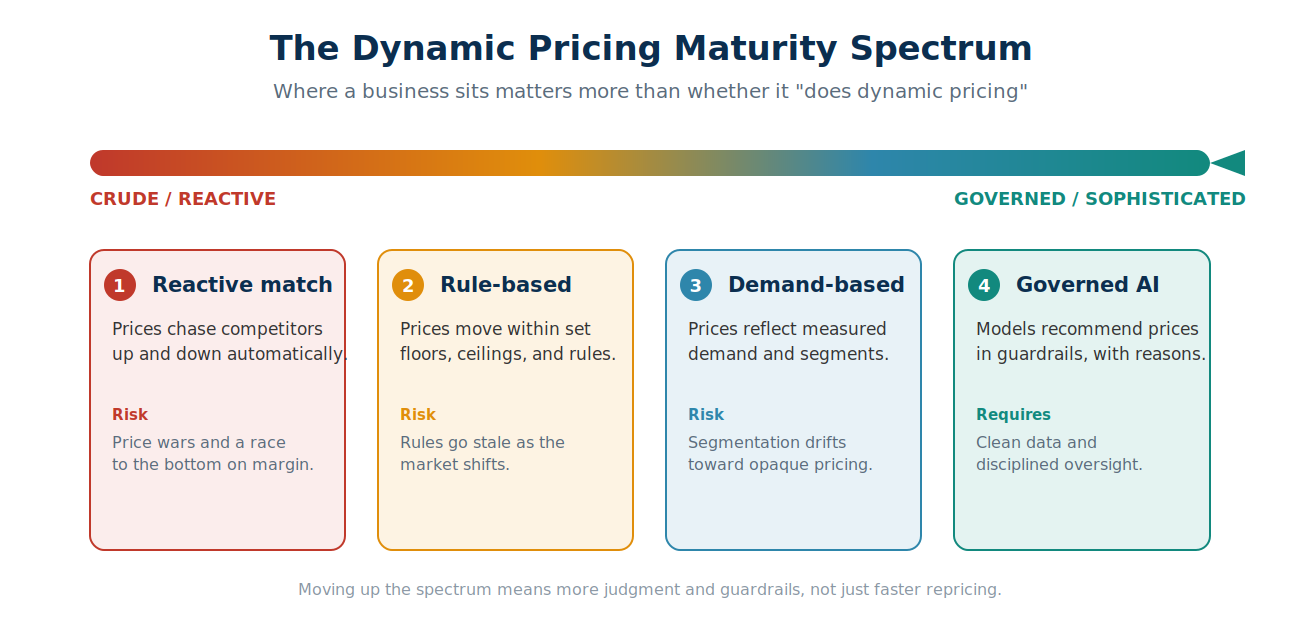
Most guides describe only the crude end and call it dynamic pricing. The reactive level is where the horror stories come from. A competitor drops a price, your software matches it, theirs matches yours, and both of you erode margin for no gain. Moving up the spectrum has little to do with changing prices faster. It means changing them with more judgment, more guardrails, and a clearer reason each time, which is what separates dynamic pricing that protects margin from the kind that destroys it. This is the same discipline a broader pricing strategy applies to every price a business sets.
How Dynamic Pricing Works
Underneath the spectrum, the mechanism is consistent. Dynamic pricing works by feeding current data into a set of rules or models, which then produce a price. Three parts have to be in place for it to function at all.
- Data: the signals the price responds to, such as demand, inventory, timing, cost, and competitor prices. The quality of this data sets the ceiling on how good the pricing can be.
- Rules or models: the logic that turns data into a price, from simple floors and ceilings to elasticity models and AI. This is where judgment lives.
- Automation: the software that applies the logic across a catalog continuously, so prices update without someone editing a spreadsheet each time.
The gap between a crude setup and a sophisticated one is almost entirely in the middle layer. Reactive pricing uses one input, the competitor's price, and one rule, match it. Governed pricing weighs many signals, respects margin floors, and explains its reasoning. The data and the automation look similar at both ends; the intelligence in the rules is what changes, which is exactly what modern AI pricing is built to strengthen.
The Main Dynamic Pricing Strategies
Within dynamic pricing sit several distinct strategies. They are often listed as if a business picks one, but most mature setups blend them, and each answers a different question about why a price should move.
- Demand-based pricing: the price rises when demand is high and falls when it is soft. Surge pricing and event tickets are the clearest cases.
- Time-based pricing: the price changes by time of day, season, or how close a deadline is, common in travel and hospitality.
- Competitor-based pricing: the price is set relative to rivals, matching, undercutting, or holding a deliberate premium.
- Segment-based pricing: different customer groups see different prices based on measurable, defensible differences such as volume or channel.
- Cost-based dynamic pricing: the price adjusts as input, freight, or commodity costs move, protecting margin against volatility.
The strategy that fits depends on what actually drives a business's economics. A rideshare app lives on demand, a distributor on cost volatility, a software company on segment and value. The mistake is copying a strategy because a famous company uses it. The better move is choosing the one that matches your own demand and cost signals, which is where sound pricing analysis earns its place.
Dynamic Pricing Examples
The same three examples appear in every guide. It is worth looking past the label to why each one works, because the conditions rarely transfer cleanly to other businesses.
Each of these works for a specific reason:
- Uber surge pricing: works because supply and demand are both live and local, and higher prices actually pull more drivers onto the road, which resolves the shortage. Surge is a supply mechanism, not just a revenue one.
- Airlines: work because a seat is perishable and worthless once the plane leaves, so charging different prices to fill the plane is close to pure yield management on fixed, expiring inventory.
- Amazon: works because the catalog and the competition are enormous and public, so continuous repricing is the only way to stay competitive across millions of items where a human never could.
The lesson is not "do what Uber does." It is that each of these depends on conditions, live supply, perishable inventory, or a vast public catalog, that most businesses do not share. Copying the tactic without the conditions is how dynamic pricing goes wrong, and it is why the trust question below matters so much.
Dynamic Pricing vs Personalized Pricing
This is the part most explainers skip, and it is the most important. There is a bright line between dynamic pricing and personalized pricing, and crossing it is where businesses lose customer trust and invite regulatory attention.
The difference is what the price varies by:
- Dynamic pricing: the price varies by market-level conditions that apply consistently to comparable buyers, such as demand, timing, and inventory. Two similar customers at the same moment see the same price.
- Personalized pricing: the price varies by the individual, using their behavior, browsing history, device, or personal attributes. Two similar customers can see different prices for the same thing at the same moment.
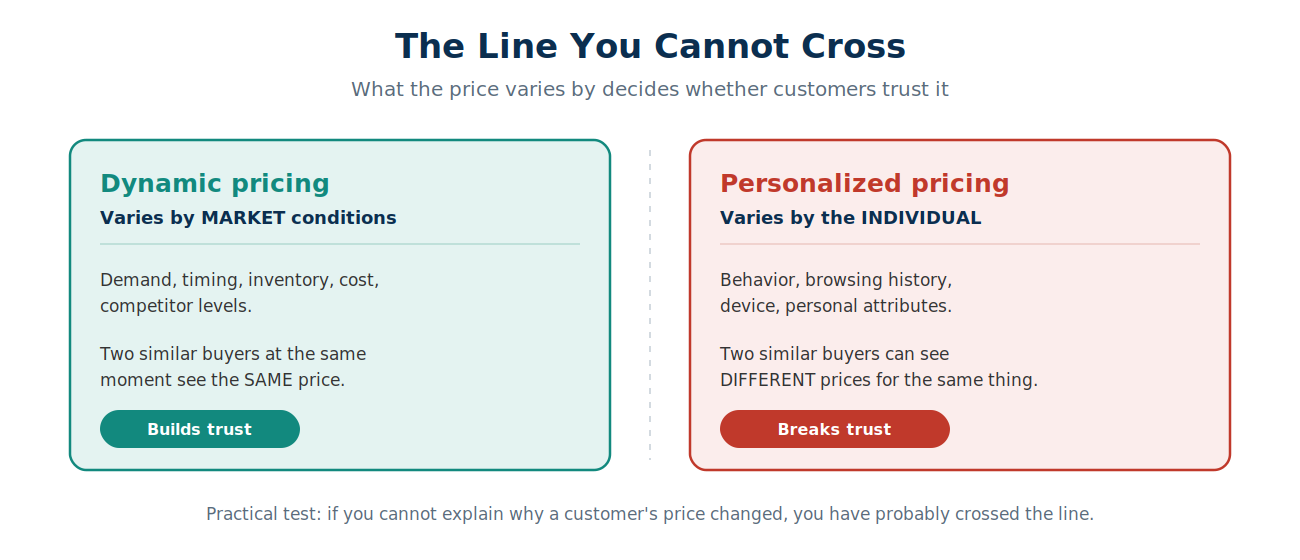
The practical rule: if you cannot explain to a customer why their price changed, you have probably crossed from dynamic into personalized pricing. Market conditions are defensible. "Because of who you are" is not.
Staying on the safe side of that line is not just an ethics point; it is a commercial one. Trust is expensive to rebuild, and a pricing model that saves a few points of margin while training customers to distrust your prices is a bad trade. A
How Dynamic Pricing Works in B2B
Almost every dynamic pricing guide describes the retail version: public prices on a website, changing by the hour, driven by competitor tracking. B2B dynamic pricing is a genuinely different discipline, and confusing the two leads companies to buy the wrong tools.
In B2B, prices are usually negotiated, customer-specific, and tied to contracts, so "dynamic" does not describe a public tag that flickers. Instead, it means the right price guidance reaching a salesperson in real time as they build a quote, reflecting current cost, the customer's segment and volume, and margin rules, all inside guardrails. The change happens at the point of the deal, not on a shelf.
Two differences matter most:
- Governed, not automatic: a B2B price rarely changes on its own in front of a customer. It is recommended to a seller with a floor, target, and ceiling, and a person still owns the decision.
- Explainable by design: because deals are negotiated, a rep has to justify the number, so the reasoning behind a recommended price matters as much as the price itself.
This is why surge pricing is the wrong mental model for a manufacturer or distributor. The better model is disciplined, real-time guidance that protects margin without surprising anyone, which is exactly what price optimization software is built to deliver in a negotiated setting.
Benefits and Risks of Dynamic Pricing
Dynamic pricing is neither a magic revenue lever nor a trust-destroying trap. It is a capability with a real upside and real failure modes, and the outcome depends on where on the spectrum a business operates.
The pattern is consistent: the benefits show up at the governed end of the spectrum, and the risks show up at the crude end. That is the real decision in dynamic pricing: not whether to do it, but how much judgment and governance to put behind it. The market is moving toward more automation here. McKinsey's April 2026 research surveyed more than 400 B2B pricing leaders, and the share expecting to adopt generative or agentic AI in pricing within one to three years rises from 10 to 30% today to 65 to 85%. The capability is becoming standard, which makes doing it with discipline more important, not less.
How to Improve Your Dynamic Pricing Approach
If dynamic pricing is a spectrum, the useful question is how to move up it without tipping into the failure modes. The progression is less about buying faster software and more about adding judgment at each step.
- Start with guardrails: set margin floors and ceilings before you automate anything, so no rule can price below what you can afford.
- Add real signals: move beyond competitor price alone to demand, cost, and segment data, so prices reflect more than one input.
- Make it explainable: require a reason for every price move, which both improves the logic and keeps you on the right side of the trust line.
- Close the loop: feed outcomes back in, so the system learns which moves worked and the pricing improves over time.
Each step adds governance rather than just speed, and that is the point. A business that reprices slowly but wisely beats one that reprices instantly and crudely, which is the case for grounding any dynamic approach in the fundamentals of a sound pricing model.
How Vistaar Approaches Dynamic Pricing for B2B
Vistaar sits at the governed end of the spectrum, built for the B2B version of dynamic pricing rather than retail surge. The approach is real-time price guidance inside guardrails, not automated public price changes, which fits how manufacturers and distributors actually sell.
In practice, that means a few things working together. Prices and deal guidance reflect current cost, demand signals, and customer segment, but they move within margin floors and ceilings the business sets. Recommendations reach the seller with the reasoning attached, so a rep can act on and defend the number, and every move stays explainable rather than opaque. This runs on the same platform that governs list prices, agreements, and rebates. A dynamic recommendation stays consistent with the rest of a company's pricing rather than becoming a separate, unpredictable layer. That is dynamic pricing kept on the safe side of the trust line, which is where a modern B2B pricing capability has to live.
Conclusion
Dynamic pricing is best understood as a spectrum rather than a single tactic. It runs from crude competitor-chasing that starts price wars to governed, explainable pricing that protects margin and trust. The famous examples work because of specific conditions, live supply, perishable inventory, vast public catalogs, that most businesses do not share. The lesson is to match the approach to your own economics rather than copy a tactic. The line that matters most is between dynamic pricing, which varies by market conditions everyone can understand, and personalized pricing, which varies by the individual and quietly destroys trust.
The right goal is to reprice with more judgment, more guardrails, and a clear reason behind every move, not simply to reprice faster. That matters most in B2B, where a price has to be explained to the person across the table. To see governed, real-time price guidance that protects margin without crossing the trust line, a short walkthrough is the fastest way to see what disciplined dynamic pricing looks like.
Frequently Asked Questions
What is dynamic pricing?
Dynamic pricing is the practice of changing a price in response to current conditions such as demand, inventory, timing, and competitor prices, rather than holding one fixed price. It ranges from crude competitor-matching to governed, AI-guided pricing with margin guardrails.
What is the difference between dynamic and personalized pricing?
Dynamic pricing varies by market conditions that apply to comparable buyers, so two similar customers see the same price. Personalized pricing varies by the individual's data or behavior, so they can see different prices. Customers accept the first and resent the second.
What are the main dynamic pricing strategies?
Demand-based, time-based, competitor-based, segment-based, and cost-based pricing. Each answers a different question about why a price should move, and mature setups usually blend several rather than relying on one.
Is dynamic pricing legal?
Dynamic pricing based on market conditions is generally legal and widely used. Personalized or "surveillance" pricing based on individual data raises privacy and fairness concerns and is under increasing regulatory scrutiny in several jurisdictions. The distinction matters legally, not just ethically.
How is dynamic pricing different in B2B?
In B2B, dynamic pricing rarely means automated public price changes. It is real-time price guidance to a salesperson inside margin guardrails, reflecting current cost, segment, and volume, with a person still owning the negotiated decision and the reasoning attached.

As an experienced pricing solutions partner to some of the biggest names in global business, Vistaar offers a range of services to help our customers reach their maximum potential. Talk to us to see how we can help you create a more profitable future.