




Key Takeaways
Every dynamic pricing demo looks clean. The features that decide success are the ones vendors show last: data quality, rule transparency, and auditability.
Data quality matters more than refresh speed. A price updated every hour against the wrong input is confidently wrong.
Every price change should trace to a signal, a rule, and an approval, logged by default, not sold as an add-on.
Retail and B2B need different tools. Retail runs on competitor feeds and automation; B2B runs on guardrails and seller guidance.
Time to first live price is the truest signal of fit. A six-month runway means an enterprise project, whatever the pricing page says.
Buying dynamic pricing software looks simple until you are three demos in. Every vendor shows the same clean screens: a live price chart, a competitor feed, a rule builder. The interface is always tidier in the demo than in production, and the response time is always faster on the sample data than on your real catalog. The features that actually decide whether a tool works are rarely the ones on the opening slide.
This guide focuses on those features, and on the questions worth asking before you sign. It covers the data layer, the rules engine, auditability, and deployment. It also covers where retail and B2B needs part ways, a demo checklist you can take into any vendor call, and how to judge fit. If you are still deciding whether dynamic pricing is right for you at all, start with the guide to how dynamic pricing works; this article assumes you are already evaluating tools.
Start With the Data Layer
Before any algorithm can help, the inputs have to be right. This is the part most buyers rush, and it is where the expensive mistakes hide. A pricing engine is only as good as the data feeding it, so the data layer is the first thing to test, not the last.
Two questions matter more than the rest:
- How accurate is the data, not just how fresh? A tool that refreshes competitor prices every hour but matches the wrong product is worse than no data at all. Ask about match accuracy on your own catalog, including product variants, bundles, and listing inconsistencies, and ask to see a sample report before you commit.
- Can it handle your own data honestly? Optimization models learn from price variation in your sales history. If your prices barely moved for two years, no model can infer demand response from that. A credible vendor says so and shows how it handles thin-data items. A vendor promising optimal prices from day one on any catalog is a warning sign.
The pattern to watch for is a vendor who talks about speed and dashboards but goes quiet on where the numbers come from. Sound pricing analysis depends on trustworthy inputs, and no interface makes up for bad data underneath.
Evaluate the Rules Engine
The rules engine is where the daily work of a pricing tool actually happens, and where the gap between the demo and production is widest. A clean rule builder in a sales call tells you little; the questions below tell you how it behaves under real conditions.
Who Can Configure a Rule?
If changing a rule needs a developer, a support ticket, or a call with the vendor's team, that rule will not keep pace with the market. Rules should be configurable in plain language by the people who own pricing, margin floors, competitor targets, movement caps, without waiting on IT. The demo question is simple: can a category manager or pricing manager change a floor themselves, live, while you watch.
What Happens When Rules Conflict?
When two rules apply to the same product and disagree, what does the software do? A strong platform has a defined priority order, shows the conflict, and logs which rule won and why. A weak one applies the wrong rule silently or hands the problem back to a person with no context. Ask the vendor to trigger a deliberate conflict in the demo and show you the result.
Can Rules Be Scoped by Risk?
Blanket rules across a whole catalog are a blunt instrument. The useful capability is scoping: tight automation on low-risk, long-tail items, while high-visibility or strategic products route to human review. The ability to set different levels of autonomy by product, segment, or confidence is what makes a rules engine work at scale rather than just in a demo.
Rule transparency is the thread through all three. A rules engine you can read, scope, and reason about is what lets a team trust the automation, which is the same standard a broader price optimization approach has to meet.
Insist on a Real Audit Trail
Auditability comes up later in most evaluations than it should. The audit trail, who changed what, why, and when, is what makes pricing software survivable once real money runs through it. It is not a reporting nicety; it is the feature that keeps the tool switched on after the first surprise.
The reason is practical. When a margin variance shows up in the monthly report, someone has to explain it. When a customer questions a price, the account owner needs a defensible answer. When finance asks why a product sold below cost last week, "the algorithm did it" is not an acceptable response. Every price change should trace to a signal, a rule, and an approval, logged by default rather than sold as an add-on or buried in an export.
This is also the feature that separates dynamic pricing software that earns trust over time from tools that get turned off after the first unexplained price move. The same discipline that keeps rebate and deal economics defensible applies here: a price you cannot explain is a price you cannot keep.
Test Deployment Realism and Time to First Live Price
The question most teams ask last should come first: how long until the first live price? This single number tells you more about fit than any feature list, because it reveals whether you are buying a tool or signing up for a project.
Enterprise dynamic pricing platforms can run six months or more from contract to a live price. For a lean team, that is six months of manual pricing gaps compounding while the implementation drags. The questions that expose the real timeline are concrete:
- Does onboarding start with a file upload or a systems-integration project? One takes days; the other takes quarters.
- Are there native connectors to your systems, or is every integration custom API work?
- Can you start with one category and expand, or must the whole catalog be onboarded before anything goes live?
A platform that needs a systems integrator and a long runway is an enterprise tool no matter how the pricing page reads. Match the deployment model to your team's size and urgency, and treat a vague answer on timeline as an answer in itself.
Retail and B2B Need Different Dynamic Pricing Software
Most dynamic pricing guides, and most vendors, assume retail: public prices on a website, competitor feeds, marketplace listings, automated changes by the hour. B2B pricing is a different problem, and buying a retail tool for a B2B business, or the reverse, is one of the most common and expensive mismatches in this category.
The difference comes down to how a price reaches the customer:
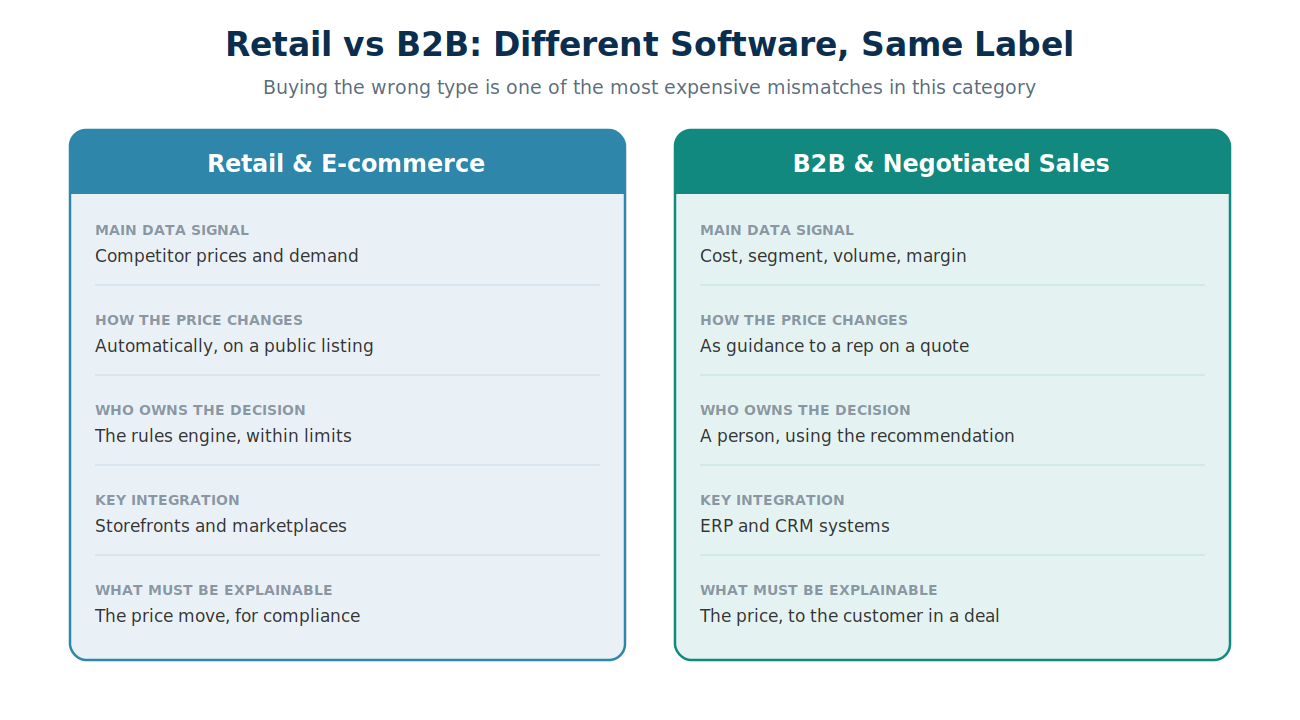
If you sell through negotiated deals, the retail checklist of competitor-feed accuracy and marketplace connectors mostly misses the point. What matters instead is whether the software delivers the right price into the quote at the moment a rep needs it, inside margin guardrails, with the reasoning attached. That distinction runs right back to the wider category of pricing software, where B2B and retail have always been different disciplines wearing the same label.
Extra Features That Matter for B2B Buyers
If your evaluation is for a B2B business, a few capabilities that rarely appear on a retail feature list become the ones that decide fit. They are worth adding to any demo where deals are negotiated rather than posted.
- Guardrails, not just automation: floors, ceilings, and margin rules that bound every recommendation, so a dynamic price can never quietly fall below what you can afford.
- Seller-facing guidance: a floor, target, and ceiling delivered to the rep with the reasoning, since a B2B price has to be defended to the buyer, not just applied.
- ERP and CRM integration: the price has to reach the quote and order systems where selling happens, not sit in a separate pricing dashboard.
- Consistency with the rest of pricing: a dynamic recommendation should agree with list prices, agreements, and approvals, not become an unpredictable layer beside them.
These are the features that make dynamic pricing safe in a negotiated setting, where an unexplained or unbounded price change costs a relationship, not just a sale. This is the point where AI pricing has to be governed rather than autonomous.
The Dynamic Pricing Software Demo Checklist
Before you finish any vendor demo, run these questions. How the sales team handles them tells you as much as the answers, because comfort with hard questions is itself a signal.
- Show me one price recommendation and explain every input behind it. If they cannot break it down, neither will your team.
- What happens when two rules conflict on the same product? Watch for a defined priority order and a visible log.
- How long did your last comparable customer take to reach a first live price? Push for a real number, not a range.
- Where does the audit trail live and what does it show? It should be on by default and traceable to a signal, rule, and approval.
- How are low-confidence items handled differently from high-confidence ones? This reveals whether autonomy can be scoped.
- For B2B: how does a recommended price reach the seller and stay inside guardrails? This separates governed tools from retail automation.
Take the same six questions to every vendor. Consistent questions across demos are the only way to compare tools that all look good in isolation.
How to Choose the Right Dynamic Pricing Software
Pulling it together, the teams that get the most from dynamic pricing software are not the ones that bought the most features. They are the ones that bought the right fit: a tool their pricing owners actually use, that deploys in a realistic timeframe, and that can explain every decision well enough to survive a finance review.
The evaluation reduces to a few honest questions about your own business. Is your problem retail automation or B2B guidance? Can your team configure and trust the rules without the vendor in the loop? Will every price stand up to scrutiny months later? Can you be live before the value leaks away while you wait? Answer those, and the shortlist narrows itself, the same way it does when choosing any pricing capability that has to hold up in practice.
How Vistaar Fits a B2B Dynamic Pricing Evaluation
For a B2B business running this evaluation, Vistaar is built for the governed end of dynamic pricing rather than retail automation. It delivers real-time price guidance into the quote, inside guardrails, rather than changing public prices on a listing.
Against the criteria above, that means a few things line up by design. Recommendations draw on cost, segment, volume, and margin rules, and every one arrives with a floor, target, and ceiling and the reasoning a rep can defend. Because it runs on one platform with list pricing, agreements, and rebates, a dynamic recommendation stays consistent with the rest of a company's pricing. Every change is traceable for the audit and finance review that follow. It integrates with enterprise systems such as SAP, so the price reaches the quote and order workflow rather than a separate screen. The result is dynamic pricing a sales team can actually use and a finance team can actually defend, which is the standard any B2B tool in this category should be held to. To see it against your own criteria, a short walkthrough is the fastest way to judge the fit.
Frequently Asked Questions
What features should dynamic pricing software have?
Accurate data inputs, a transparent rules engine that non-technical owners can configure, conflict resolution, scoped autonomy, and an audit trail on by default. B2B buyers also need margin guardrails, seller-facing guidance, and ERP or CRM integration.
How do you evaluate a dynamic pricing vendor?
Test the data layer on your own catalog, watch the rules engine handle a live conflict, confirm the audit trail is default and traceable, and ask how long a comparable customer took to reach a first live price. Bring the same questions to every demo.
What is the most overlooked feature in dynamic pricing software?
The audit trail. It comes up late in most evaluations but decides whether the tool survives real use. Every price change should trace to a signal, a rule, and an approval, logged by default rather than sold as an add-on.
Is dynamic pricing software different for B2B and retail?
Yes. Retail tools run on competitor feeds and automate public prices. B2B tools deliver guidance to a salesperson inside margin guardrails on a negotiated quote and integrate with ERP and CRM. Buying the wrong type is a common, costly mismatch.
How long should dynamic pricing software take to deploy?
It varies widely. Some tools reach a first live price in days from a file upload; enterprise platforms can take six months or more. Match the deployment model to your team's size and urgency, and treat time to first live price as a core criterion.

As an experienced pricing solutions partner to some of the biggest names in global business, Vistaar offers a range of services to help our customers reach their maximum potential. Talk to us to see how we can help you create a more profitable future.