




Key Takeaways
• One uniform global price and full local autonomy both fail. The answer sits between them: a global reference price that local markets adjust within set rules.
• A global reference is the anchor. Each country prices around it inside a permitted band, so local teams flex without drifting out of line.
• Guardrails do the governing. A local price that moves outside its allowed range triggers a warning instead of waiting for a manual review to catch it.
• Currency and tax are the hard part, because a price that looks aligned in local terms can be far apart once duties, VAT, and exchange rates are stripped out.
• The goal is to enforce objectives and constraints, not to approve every local price by hand. Set the rules once and let the system hold the line.
A pricing manager at a global manufacturer pulls up the price book for a single product and sees it selling at a different number in every country it ships to. None of those prices look wrong on its own. Each was set locally for a real reason: a tougher competitor, a weaker currency, a higher duty.
Put side by side, the numbers no longer tell a story anyone at headquarters can defend. One market sits 30% above its neighbor for reasons no one recorded, and a global customer buying in both has just asked why. Standardizing pricing across countries has to close that gap between local logic and global coherence, without erasing the local reasons that were valid in the first place.
Set one uniform global price and half those markets turn uncompetitive or unprofitable overnight. Hand each country full control and the global picture fractures. The workable answer sits between them: a structure that anchors every market to a common reference while giving each room to move within rules the center sets.
Why a Single Global Price Fails, and So Does Full Local Control
The two obvious approaches sit at opposite ends, and each breaks in its own way. Seeing them side by side shows why the answer has to be a structure between them.
A single worldwide price lands too high in markets with weaker purchasing power and leaves margin on the table in markets that would bear more. Full autonomy fails the other way: two neighboring markets end up 30% apart for reasons no one recorded, and once a global customer or a reseller spots the gap, that spread becomes a problem the center has to explain and unwind.
Unexplained price differences across countries carry more than a financial cost. They create a defensibility risk, since prices offered across markets have to hold up as fair and consistent when a global customer or a regulator asks why one country pays more than another. A disciplined value-based approach gives every price a reason on record, which is exactly what divergence without an anchor cannot do.
The way out avoids picking a side. The workable structure has the center set the anchor and the rules, while local markets make the calls that only they can make well. This is a different problem from harmonizing prices across internal business units or regions inside one market, which turns on pricing governance rather than on currency and tax. Here the variables are national.
Set a Global Reference Price as the Anchor
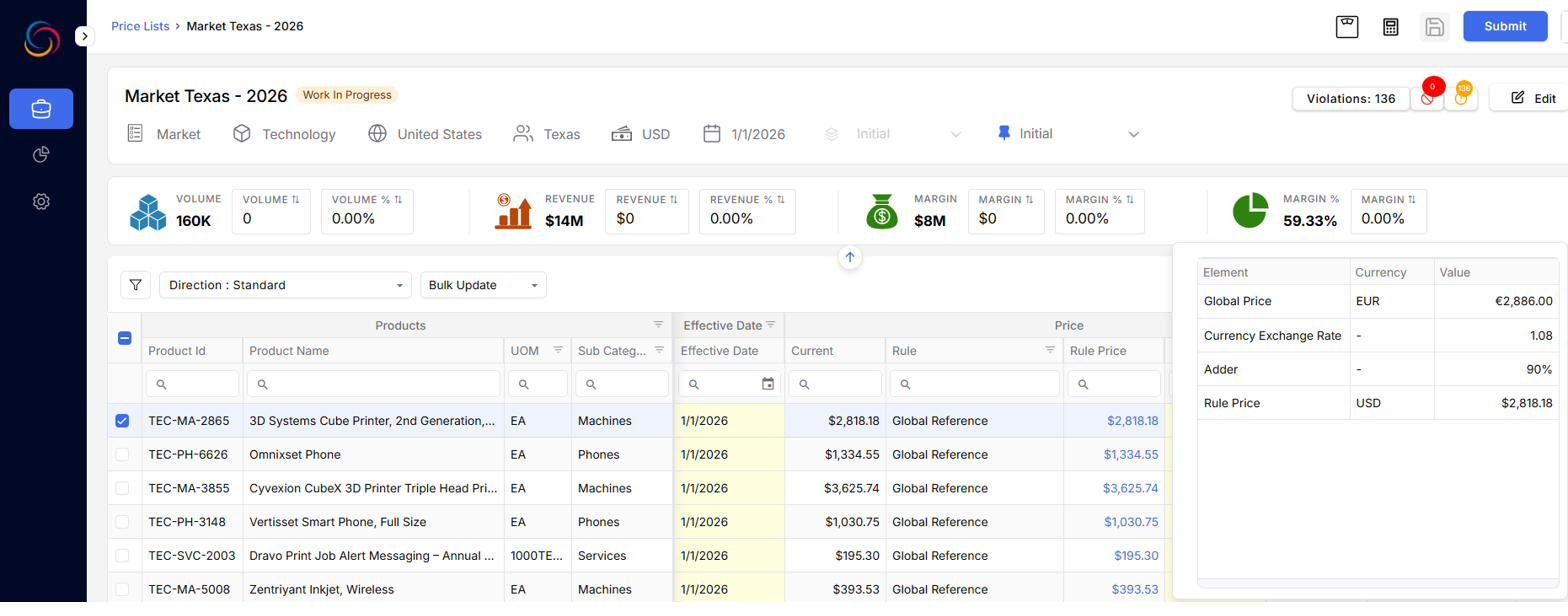
The foundation of cross-country standardization is a single global reference price for each product, set centrally and used as the benchmark every market prices against. No customer ever pays it. The reference works as the anchor that keeps local prices related to one another instead of drifting independently.
A global reference works because three roles are clear from the start:
- Who sets it: the global product or manufacturing group, where full visibility of cost and global strategy sits.
- Who prices around it: each local market, moving up or down to reflect its own conditions.
- What it gives everyone: a common starting point, so a price in one country reads against the same benchmark as a price in another.
Apple's App Store runs exactly this model. A developer sets one base price, and Apple automatically generates the prices for 174 other storefronts, adjusting for local exchange rates and taxes so every market stays equalized with the base. When rates or taxes shift, Apple re-derives the affected prices from the same reference rather than letting each storefront drift on its own.
Let Local Markets Adjust Prices Within Set Rules
A reference price only works if local markets can move away from it, because the conditions that justify a different price are real and specific to each country. The task is to permit that movement without letting it become a free-for-all, and that means defining the rules that local flexibility operates within.
What Local Markets Can Adjust For
Local teams hold knowledge the center does not, and the reference price is meant to bend to it. Five factors legitimately move a market's price off the global anchor:
- Competitive position. What rival products cost in that specific market, which can differ sharply from the global picture.
- Willingness to pay. What local customers will actually bear, shaped by income levels and price sensitivity.
- Country margin objective. The margin target the business has set for that market, which may run higher or lower than the global average.
- Transfer-pricing rules. The structural terms governing how value moves between the central organization and the local entity.
- Margin-sharing policies. How margin is split between the center and the local market, which varies by country and is set, not negotiated deal by deal.
A product might be positioned as a premium option in one market and a value option in another, and the price has to follow that position. The first two factors are commercial calls the local team makes; the last three are structural rules the center sets. Together they define the legitimate distance a local price can sit from the reference.
Set Deviation Bands Around the Reference Price
Freedom to adjust is not freedom to set any price. The center defines how far a local price may travel from the reference before it needs a second look, usually as a permitted band expressed in percentage terms, in effect a price corridor around the reference. A rule such as a local price may not sit more than a set percentage above or below the global reference turns a vague expectation into an enforceable boundary.
The band is where central control and local judgment meet. Inside it, a market moves freely and no one at the center needs to weigh in. Outside it, the price becomes an exception that has to be justified. That single distinction is what lets a global team govern thousands of prices without touching most of them, an approach that sound price optimization depends on.
Use Guardrails to Flag Out-of-Range Prices
The mechanism that makes governed flexibility practical is the guardrail: a rule the system checks automatically, so a price that breaks it is flagged the moment it is entered rather than discovered later. Instead of a central team reviewing every local price, the system watches every price against its band and raises only the ones that cross the line.
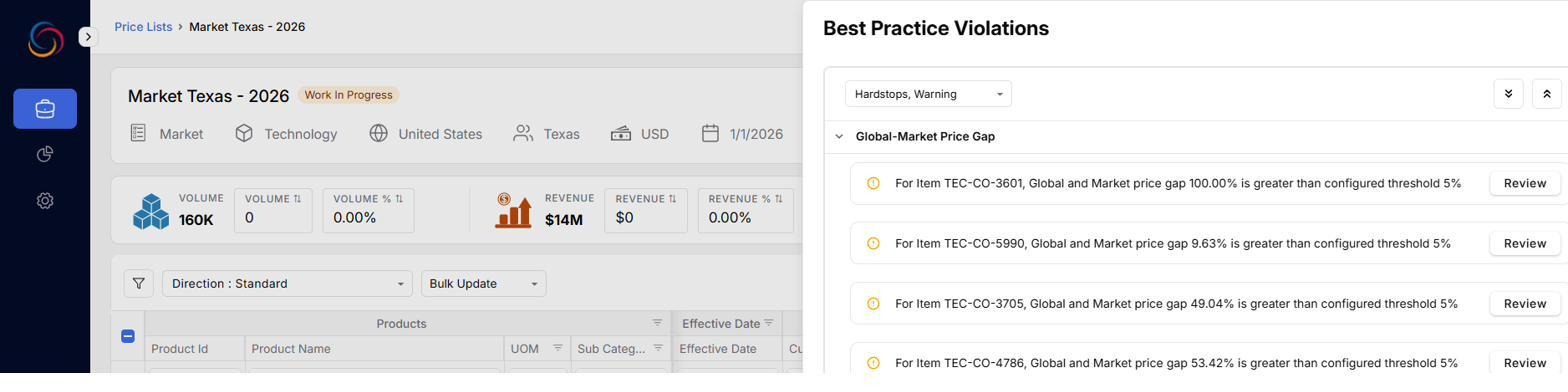
When a local market proposes a price that falls outside its permitted range, the system triggers a best-practice warning at the point of entry. The local team sees immediately that the price sits beyond the agreed boundary, and the exception routes for review rather than slipping through unnoticed. Nothing is blocked outright, since a price outside the band may still be the right call. What changes is that the deviation is now visible and has to be accounted for.
An alternative to a single deviation band is a per-country margin target. Instead of policing distance from a reference price, the center sets the margin each market is expected to hold, higher in a strong market, lower in a competitive one, and the system checks local prices against that country's target. A market told to hold a certain margin has clear room to price as it sees fit, as long as the outcome lands where the business needs it.
Either way, the center governs by rule rather than by review. This is the shift that makes standardization scale: a global pricing team stops approving prices one at a time and starts setting the constraints that thousands of prices are checked against, an idea at the core of AI-driven pricing.
Practical Tip: Set deviation bands wider for markets with volatile costs or fast-moving competition, and tighter for stable, mature markets. A uniform band across every country either constrains the volatile markets too much or lets the stable ones drift too far.
Handle Currency and Tax Differences Between Countries
The hardest part of cross-country pricing is that a price which looks aligned on the surface can be far apart underneath, once currency and tax are accounted for. Two markets can show the same figure in local currency and still deliver very different pocket margins to the business, because what the company keeps depends on exchange rates, duties, and local taxes that sit between the list price and the pocket price.
Convert Local Prices to a Common Currency Before Comparing
A price band means nothing if the prices inside it are measured in different currencies against a reference in another. To govern across countries, local prices have to be converted to a common basis before they are compared, so the band is checked on like-for-like terms.
Take one line. A local price looks 5% above the reference in its own currency, which seems fine. Convert it, and it is actually 15% below. Only the converted view tells the truth about where it sits.
Exchange rates also move, which means a price that sat inside its band last quarter can fall outside it this quarter without anyone changing a number. Standardization across currencies is therefore not a one-time setup but a standing comparison that has to refresh as rates shift, the same discipline that good pricing analysis applies within a single market.
Build Tax and Duty Into Each Local Price
Excise duties, VAT, and tariffs change what a price means from one country to the next, and they change on their own schedule. A duty increase or a new tariff can move a market's real margin without any pricing decision at all, which is why tax cannot sit outside the pricing logic as an afterthought. It has to be part of how each local price is derived from the reference.
When tax and duty are built into the structure, a change in a country's rate flows through to the prices that reference it, and the markets affected surface for review. The alternative, tracking rates in a separate spreadsheet and hoping someone reconciles them, is how a market quietly slips out of alignment. Recent trade volatility has made this sharper. In Deloitte's late-2025 CFO survey, 86% of finance chiefs said pricing would become more important to their performance over the next year, with the US effective tariff rate at its highest level since 1934. In a multi-country structure, those cost and tax shocks do not arrive everywhere at once, so the adjustment has to run per market.
Manage by Rules Instead of Approving Every Price
Everything above points to one operating principle: the center's job is to set objectives, constraints, and business rules, not to approve each local price by hand. Manual approval does not scale across dozens of countries and thousands of products, and it puts the central team in the way of decisions local markets are better placed to make.
The working model is to define the rules once and let the system enforce them continuously. The center sets four things and then steps back:
- The global reference price each market anchors to.
- The deviation bands or per-country margin targets that define allowed movement.
- The currency basis of every local price is converted to before it is checked.
- The tax and duty logic that shapes how each price derives from the reference.
From there the system holds every local price against those rules and surfaces only what breaks them. This is what a platform like Vistaar's SmartPricing is built to do: hold a global reference, apply country-specific bands and margin targets, convert to a common currency basis, and raise a warning when a local price steps outside its rule, so the central team manages the exceptions instead of the entire book.
Standardization, done this way, stops being a fight between headquarters and the field. The center governs the structure and the markets govern their prices inside it, and a single pricing platform keeps both views reconciled. What headquarters gets is not control over every price but confidence that every price sits inside a rule it can defend.
Conclusion
Standardizing pricing across countries comes down to deciding what the center owns and what the markets own, then encoding that split into rules a system can hold. Forcing one price on the world does not work, and neither does letting every market invent its own. The center owns the global reference, the deviation bands, the currency basis, and the tax logic. Each market owns its price inside those boundaries. When the rules do the governing, a global team can oversee thousands of prices across dozens of currencies and tax regimes without reviewing them one by one, and every price that results is one the business can explain. For a closer look at the internal side of this problem, harmonizing prices across business units and regions within a market, the same governance thinking applies.
Request a demo to see how a global reference, deviation bands, and per-country margin targets work against your own multi-country price book.
Frequently Asked Questions
What is a global reference price?
A global reference price is a central benchmark set for each product, used as the anchor that local markets price against. It is not the price customers pay, but the common point every country's price is measured from.
How do you allow local pricing flexibility without losing control?
Define a permitted deviation band or a per-country margin target around the global reference. Local markets price freely within it, and any price that falls outside triggers a warning and routes for review as an exception.
How does currency affect cross-country price standardization?
Local prices must be converted to a common basis before comparing them to the reference, since the same local figure can mean different margins. Exchange rates also shift, so a compliant price can drift out of its band without any change.
How should taxes and duties be handled in global pricing?
Build excise duties, VAT, and tariffs into how each local price derives from the reference, rather than tracking them separately. A rate change then flows through automatically and surfaces the affected markets for review.

As an experienced pricing solutions partner to some of the biggest names in global business, Vistaar offers a range of services to help our customers reach their maximum potential. Talk to us to see how we can help you create a more profitable future.