




Key Takeaways
• The hard part of rebate management is calculating accruals accurately as transactions keep arriving, not creating the programs themselves.
• Spreadsheets break because every new transaction has to be matched to the right program, and growth-based rebates need cumulative totals, not single lines.
• Automated accrual ingests transactions and recalculates every program nightly, so accrued and payable amounts are current each morning.
• Manual accrual can only run monthly at best, which means the numbers are always looking backward and cannot influence a live deal.
• Real-time accrual turns rebates into a growth lever: you can tell a customer they are 100 units from the next tier while it still matters.
Setting up a rebate program takes an afternoon. Keeping its accruals correct takes the rest of the year. That is the part no one warns you about, and it is where the spreadsheets start to buckle. Every sale has to be matched to the right program. It has to be added to the right running total. Then it has to be checked against tiers that may depend on everything the customer has bought since January.
Doing that by hand works until it does not, and the point it stops working arrives faster than most teams expect. Automating rebate accruals replaces that manual reconciliation. A system recalculates every program as transactions land. The accrued number is right every day, instead of roughly right once a month.
Why Accrual Is the Hard Part of Rebate Management
Most people think rebate management is about designing programs. Setup is the easy part, and you do it once. The work that consumes a finance team is accrual. It means working out how much rebate each incoming transaction has earned, across every active program, again and again.
The difficulty scales with two things at once: the number of programs and the flow of transactions. A company can run a hundred rebate programs across different customers and buying groups. Every sale that arrives has to be matched to whichever programs apply. That matching is not a lookup; it depends on the program type and on what the customer has already bought.
Different program structures make this harder in different ways, which is why a single formula never covers them:
- Tiered rebates: The rate depends on which volume band the customer has reached, so the accrual changes as they climb.
- Growth-based rebates: Eligibility depends on cumulative purchases since the period began, not on the single transaction in front of you.
- Billbacks and claimbacks: Each transaction has to be checked for eligibility before any amount can be claimed or paid.
This sits at the center of rebate management, and the cost of getting it wrong lands in margin. An accrual that is too high overpromises money to the customer. One that is too low leaves the books under-reserved.
Why Spreadsheets Break Down at Scale
Spreadsheets handle a handful of simple rebates fine, which is exactly why teams keep using them long past the point they should. The break happens quietly as programs and transaction volume grow. The monthly reconciliation turns into a multi-day job. It is still error-prone when it finishes.
The growth-based rebate is where the spreadsheet model really fails. You cannot judge a single transaction on its own. You have to pull the customer's total purchases since the period began. Then you test that total against the threshold. Doing that across thousands of transactions and dozens of programs with lookups and manual matching is slow, fragile, and nearly impossible to audit.
Two costs follow from the manual approach, and both are structural rather than a matter of working harder:
- Frequency: manual reconciliation can realistically run once a month, so the accrued number is always weeks out of date.
- Error: manual matching means a missed transaction or a mistyped total is not just possible but expected, and each one distorts the accrual.
The scale of what is at stake here is easy to underestimate. Rebates and other off-invoice allowances can be a large share of gross sales in distribution and manufacturing. An accrual that runs late or slightly wrong is not a rounding error. It moves reported margin. Simon-Kucher reports that companies realize less than half of their intended price increases. Mismanaged back-end incentives are part of that same leakage. A rebate paid on ineligible volume gives back the price that was won up front.
The deeper problem with a monthly cycle is timing. By the time the spreadsheet is reconciled, the month is over, and any chance to act on what the accrual showed is already gone. Sound pricing analysis depends on current numbers, and a month-old accrual will always be looking at the past.
How Automated Accrual Actually Works
Automated accrual replaces the manual matching with a system that ingests transactions and calculates accruals on its own, on a schedule. Once a program is live, the system takes over the repetitive work. It matches transactions, totals them, and tests them against thresholds, the work that used to fill the spreadsheet.
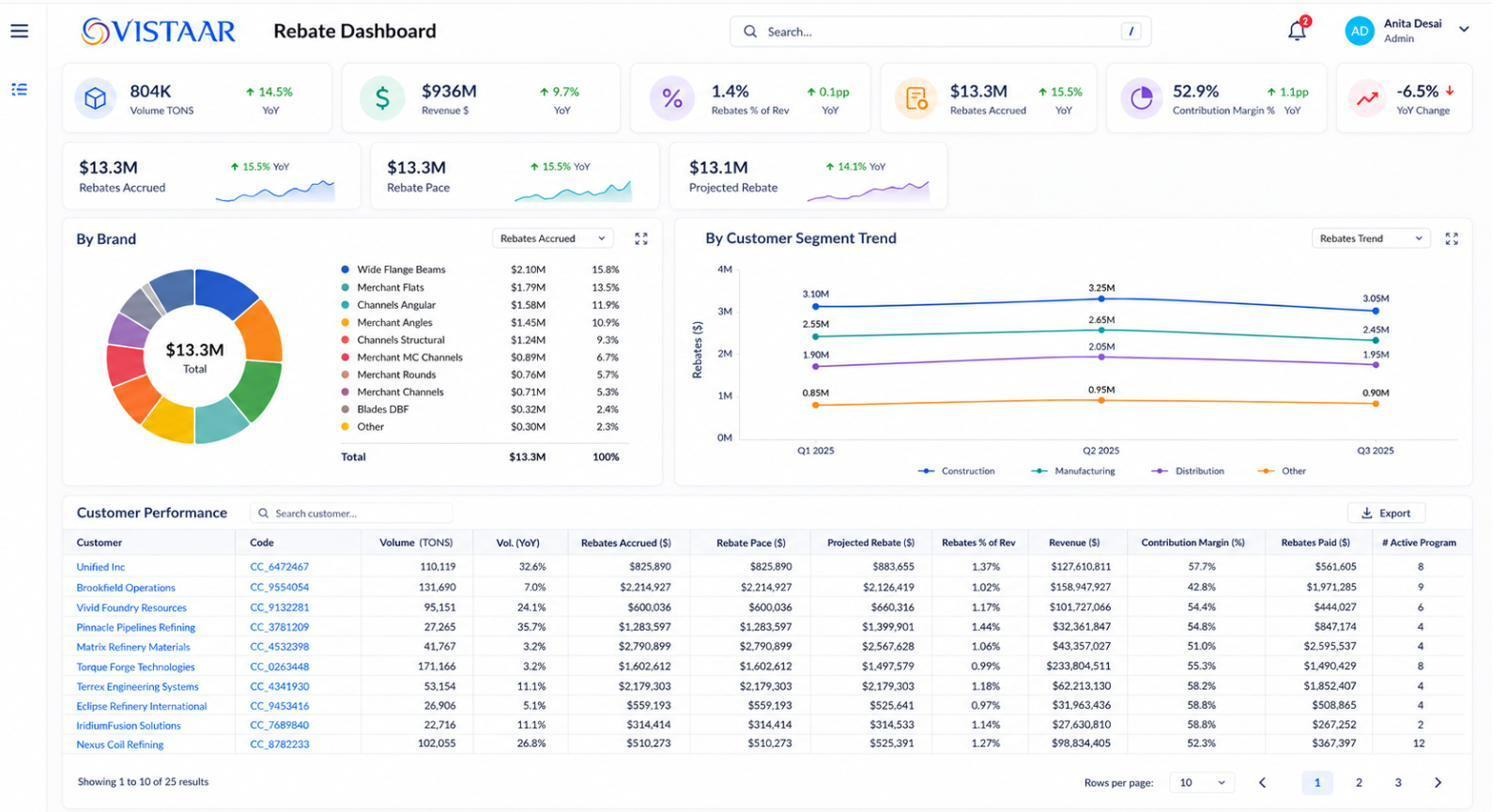
The cycle is simple to describe and runs without anyone driving it:
- Ingest: the system pulls in sales transactions, including historical data when a program first goes live.
- Match and calculate: each transaction is matched to the programs that apply and its accrual is computed, cumulative totals included.
- Recalculate nightly: the whole book is recomputed on a schedule, typically overnight, across the full life of each program.
- Review in the morning: users open the system to current accrued and payable amounts, ready to check rather than build.
The change in the user's job is the point. Instead of spending the month assembling accruals, the team reviews numbers the system already produced and investigates the exceptions. The team moves from calculating to reviewing. That frees them to do analysis instead of arithmetic, much as a well-run pricing platform frees a pricing team.
Why Transaction-Level Accrual Is Easier to Audit
Automation does more than speed accrual up; it changes what the accrued number can prove. A spreadsheet shows a total, and a total is hard to defend when an auditor or a customer questions it. A system that built the number transaction by transaction can show its work.
Every accrual is built from individual transactions. That means the total can be opened up to show which sales contributed, at what rate, and under which program. That drill-down is what makes an accrual defensible: a discrepancy can be traced to the transaction that caused it rather than argued about at the summary level.
System-generated accrual also removes the quiet errors manual matching invites, like a transaction skipped or counted twice. The calculation runs the same way every night, across every program. The result is an accrual that is both current and provable, which is the foundation any audit-ready pricing and incentive process needs.
From Monthly Lookback to Daily Visibility
The most important thing automation changes is not effort but timing. A manual process produces a number once a month, looking backward. An automated one produces a current number every day, which is a different kind of tool entirely.
Daily visibility means that on any morning, the team can see how much has accrued for each customer and program. They can also see what the payable amount would be if the period closed today. Audit and finance reporting need that standing accuracy. The accrual can be verified whenever it is asked for, not only after a reconciliation. It also removes the month-end scramble, because there is no backlog to clear when the numbers were never allowed to fall behind.
The daily number is worth more than the monthly one for a reason beyond accuracy. A current accrual can still change behavior. A month-old accrual can only record it. That difference moves rebate tracking from a reporting task toward the live decision-making of AI-driven pricing.
What to Look for When You Move Off Spreadsheets
Not every rebate tool handles accrual the same way, and the differences are exactly where a spreadsheet replacement succeeds or disappoints. The point of switching is to fix the accrual problem. So the capabilities that matter are the ones that keep the number current, correct, and provable.
Four things separate a real accrual engine from a fancier spreadsheet:
- Automatic ingestion: transactions flow in from source systems without manual export and import each cycle.
- Cumulative logic: the tool handles growth-based and tiered programs on running totals, not single transactions.
- Scheduled recalculation: accruals recompute on their own, nightly, across every program at once.
- Transaction-level detail: every total drills down to the sales that built it, for review and audit.
A tool that covers those turns accrual from a monthly project into a background process, which is the whole reason to leave spreadsheets behind. It is the same shift that broader price management software brings to pricing: the repetitive calculation moves to the system, and the people move to judgment.
When Rebate Accrual Becomes a Growth Lever
The payoff of daily accrual visibility is that rebates stop being a backward-looking cost and start driving revenue. When you can see mid-period exactly where a customer sits against their next tier, you can act on it while the customer can still respond.
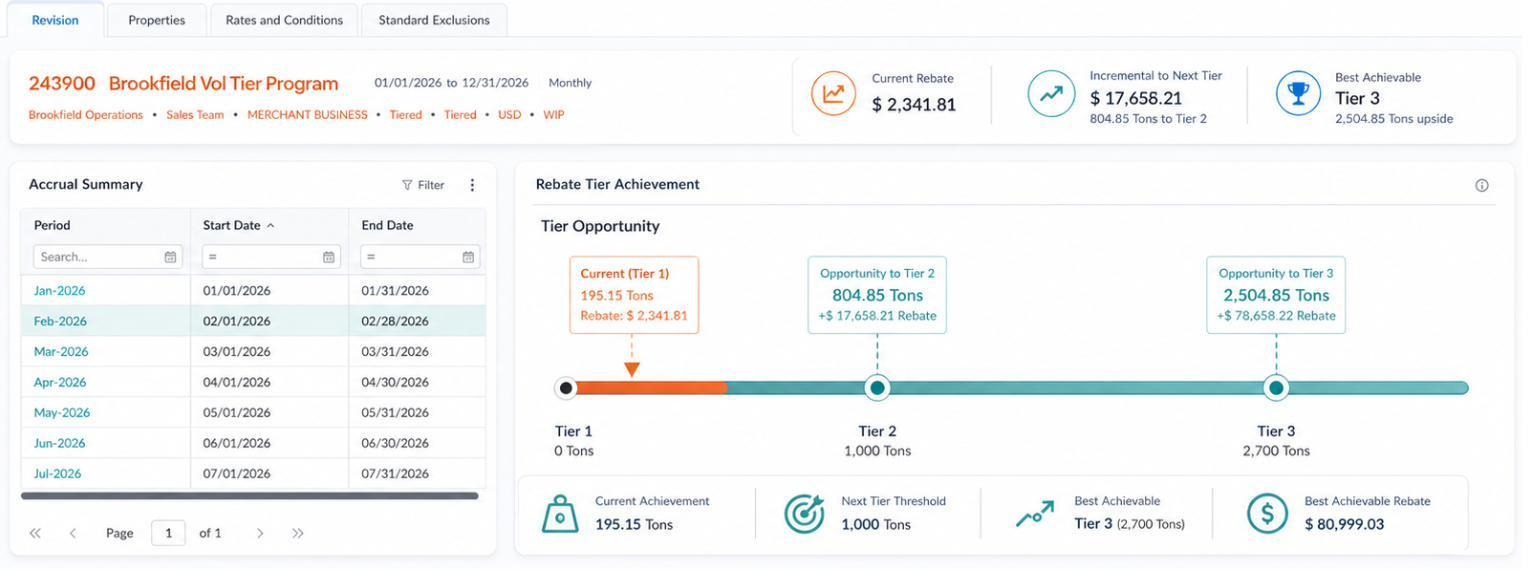
Consider a customer who has bought 900 of the 1,000 units needed to reach the next rebate tier. With a monthly spreadsheet, no one would notice until the period closed and the chance was gone. With daily accrual, the account team can see it now and tell the customer plainly: one hundred more units unlocks the higher rebate. That conversation is good for the customer, who earns more, and good for the business, which sells more.
This is the difference between knowing a number and using it. A rebate program that only reports at month-end is an accounting entry. A rebate program visible in real time is a reason to call a customer, which is where a disciplined pricing strategy and rebate management start to reinforce each other. Vistaar's SmartRebates runs these accruals automatically each night and shows tier progress for each customer. The team sees the 900-of-1,000 situation in time to act on it, instead of reading about it later.
Conclusion
Two things separate an automated rebate process from a manual one, and neither is the amount of work.
- Accuracy that holds: nightly, transaction-level calculation means the accrued number is right every day, and it can be audited down to the transaction whenever finance asks.
- Timing that pays: a current accrual can still change a customer's behavior, while a month-old one can only report what already happened.
See automated accruals on your own programs. Request a demo to see nightly accrual calculation and customer-level tier tracking in one system.
Frequently Asked Questions
What does it mean to automate rebate accruals?
A system takes in sales transactions and calculates each program's accrual automatically, usually nightly. No one matches transactions to programs by hand in a spreadsheet. Accrued and payable amounts stay current instead of being rebuilt monthly.
Why are growth-based rebates hard to track in spreadsheets?
Because eligibility depends on cumulative purchases since the period began, not a single transaction. Each new sale requires pulling the customer's running total and testing it against the threshold, which is slow and error-prone across many programs.
How often should rebate accruals be calculated?
As often as transactions arrive, in practice daily. Nightly recalculation keeps accrued and payable amounts current, which manual monthly reconciliation cannot match and which is what makes mid-period customer conversations possible.
Does automated accrual help with audits?
Yes. Yes. Every accrual is built from individual transactions, so the number traces down to the transaction on demand. That makes the process easy to audit and reconcile at any point.

As an experienced pricing solutions partner to some of the biggest names in global business, Vistaar offers a range of services to help our customers reach their maximum potential. Talk to us to see how we can help you create a more profitable future.