



.png)
Key Takeaways
• Everyday low pricing (EDLP) is a strategy where businesses set consistently low prices permanently, with no reliance on promotional sales cycles or temporary discounts.
• EDLP simplifies operations and builds customer trust, but it only works when backed by genuine cost advantages: supply chain efficiency, scale, or structural cost control.
• JCPenney's 2012 switch to EDLP caused a 25% revenue collapse in a single year, showing that customer habits around promotions cannot be overridden by strategy alone.
• For manufacturers and distributors, EDLP creates demand planning predictability but compresses margin headroom and limits the ability to respond to competitive moves.
• Most successful EDLP businesses pair low prices with structural cost discipline, known at Walmart as Everyday Low Cost (EDLC), not just a pricing decision.
Pricing strategy divides retail and commercial markets into two camps. In one, companies set high prices and run frequent promotions. In the other, they set low prices and hold them consistently. The second approach has a name most pricing professionals recognize immediately: everyday low pricing, or EDLP.
Walmart built the world's largest retailer on it. JCPenney nearly collapsed trying to adopt it. Aldi turned it into a global expansion engine. The strategy sounds simple: charge a consistently low price and let customers trust that they are always getting fair value. The execution is anything but simple.
This guide explains what EDLP is, how it compares to high-low pricing, the operational conditions required to sustain it, and the strategic considerations that determine whether it works for a given business model.
What Is Everyday Low Pricing (EDLP)?
Everyday low pricing is a pricing strategy in which a business commits to consistently low prices across its product range without relying on promotional sales events, limited-time discounts, or coupon campaigns. The price a customer sees today is the price they will see next week, next month, and next quarter, provided underlying costs remain stable.
The core promise is predictability. Customers do not need to time their purchases around sales cycles, clip coupons, or wonder whether waiting a week will yield a better price. The price is the price, and it is always designed to be competitive.
EDLP is most commonly associated with retail, but the underlying logic applies across industries: any business that commits to consistent pricing rather than cyclical promotion is operating on some version of this model.
It is worth distinguishing EDLP from simply having low prices. A business that prices low occasionally is not running EDLP. A business running EDLP has structured its entire commercial model around the permanent delivery of competitive prices, with no promotional escape valve when volume softens.
EDLP vs. High-Low Pricing
The contrast between EDLP and high-low pricing is fundamental. High-low pricing sets products at a higher base price and generates purchase behavior through periodic discounts, sale events, and promotional campaigns. The customer pays a premium at regular price and is rewarded for timing or attentiveness.
High-low pricing has a psychological dimension that EDLP lacks. The perception of getting a deal, watching a price drop from $120 to $60, activates a different consumer response than simply seeing a stable $60 price tag. Research in consumer psychology consistently finds that sale signs trigger stronger purchase motivation than equivalent stable low prices.
The practical implication is significant. High-low pricing creates a customer who waits. Over time, those customers never buy at full price because they have learned that the discount always comes. EDLP avoids this trap by removing the promotional cycle entirely. There is no higher price to wait out.
This also affects how margins are managed. High-low pricing gives commercial teams room to maneuver: full-price sales subsidize promotional events. EDLP compresses that headroom permanently. Every product is sold at a low price. There is no recovery mechanism when volume disappoints.
Worth Knowing
A 2025 SimplyCodes analysis found that high-low retailers mark products up 40 to 70% and discount them repeatedly, while EDLP stores maintain consistently low prices without promotional cycles. The two strategies attract fundamentally different customer types and cannot easily be switched without customer backlash. Source: SimplyCodes, High-Low Pricing vs. EDLP, 2025.
Benefits of Everyday Low Pricing
When the operational conditions are right, EDLP offers genuine strategic advantages. These are not simply the absence of promotional complexity. They are structural benefits that compound over time.
Builds customer trust and purchase frequency
When customers know that the price they see is the best available price, the decision to buy becomes simpler. There is no calculation about whether to wait, no comparison between this week's price and last week's, no regret about purchasing before the sale.
This simplicity drives purchase frequency. Customers who trust a retailer's pricing tend to consolidate their shopping there rather than split baskets across multiple stores in search of the best deal on each category.
Smooths demand and simplifies operations
High-low pricing creates demand spikes around promotional events and troughs between them. These swings complicate inventory management, staffing, logistics, and supplier negotiations. EDLP flattens that curve.
Stable demand means:
- More accurate inventory forecasting: no need to plan for surge and recovery cycles
- Fewer stockout events: replenishment follows predictable consumption patterns
- More efficient supply chain operations: consistent order flow allows better supplier terms
- Lower waste and shrink: especially relevant in perishables and short-cycle goods
Reduces marketing and administrative costs
Running promotional pricing is expensive. It requires designing promotional campaigns, training staff, coordinating with suppliers, updating systems, managing promotional compliance, and measuring uplift. None of that exists in an EDLP model.
The marketing spend that would have gone into promotional communication can instead be invested in brand building, store experience, or product quality. For businesses with thin margins, eliminating promotional overhead is a meaningful cost reduction in itself.
Attracts and retains price-sensitive customers
Price-sensitive customers, those who actively compare options before purchasing, are reliably attracted to EDLP because the value proposition is transparent. No math is required. No timing is needed. The low price is always there.
According to a 2024 consumer behavior survey by Intelligence Node, two in three shoppers actively hunt for discounts or more competitively priced alternatives in response to financial pressure. For that segment, an EDLP retailer reduces search cost and becomes the default destination. This is the same dynamic that powers value-based pricing from the customer's side: the perceived value of predictably low prices is high for buyers who cannot afford to make pricing mistakes.
Did You Know
Walmart's fiscal year 2025 revenue reached $660.4 billion, a 5.7% increase year-over-year, built almost entirely on the EDLP model. Despite a net margin of approximately 2.4%, the volume generated by consistent low pricing creates profitability at a scale that higher-margin competitors cannot replicate. Source: Walmart SWOT Analysis, MatrixBCG, 2025.
Challenges and Risks of Everyday Low Pricing
EDLP is not a strategy that any business can simply adopt. It carries structural requirements and meaningful risks that most organizations underestimate when they first consider it.
Thin margins leave no room for error
The most immediate challenge of EDLP is margin compression. By committing to permanently low prices, a business removes its ability to earn higher margins during normal trading periods. Every unit is sold at a low price. Profitability depends entirely on volume, cost efficiency, and scale.
Walmart's gross margin sits at approximately 24%. Specialty retailers typically operate at 45 to 60% gross margin. Costco, which runs one of the purest EDLP models in retail, operates at roughly 12% gross margin and offsets it with membership fee revenue. These businesses can sustain EDLP because their cost structures are engineered for it. A business with conventional cost levels cannot simply lower its prices and expect the model to work.
Removes pricing flexibility as a competitive response
High-low pricing gives commercial teams a response mechanism: when a competitor cuts prices or runs an aggressive promotion, a temporary price match or counter-promotion is available. EDLP takes that tool away.
A business committed to EDLP cannot suddenly run a sale without undermining the core promise. If the everyday price is the best price, what does it mean when you offer something lower? This is precisely the trap that erodes pricing strategy integrity over time. Every exception teaches customers to wait for a better price.
Customer habits around promotions are deeply embedded
Perhaps the most underestimated challenge of EDLP is behavioral. A significant proportion of retail customers are not simply price-sensitive. They are deal-sensitive. They enjoy the process of finding discounts, using coupons, and experiencing the satisfaction of getting something at a reduced price.
These customers do not respond to EDLP as a benefit. They experience it as the removal of something they valued. The JCPenney case is the clearest evidence of this.
Volume dependency creates breakeven fragility
EDLP businesses reach profitability through volume, not margin. That model is inherently fragile when volume softens. A business that earns 2% net margin on $10 billion in revenue and loses 10% of that volume faces an existential problem that a higher-margin business can absorb more easily.
This is why EDLP is most sustainable at genuine scale. The larger the volume base, the more stable the margin math becomes. For smaller businesses operating EDLP without the infrastructure to sustain it, a demand shock has disproportionate consequences.
Why JCPenney's EDLP Strategy Failed
No case study in pricing strategy is more instructive than JCPenney's 2012 attempt to switch from high-low pricing to a model the company called Fair and Square Everyday Pricing. It ended in catastrophe and offers clear lessons for any business considering EDLP.
What happened
In 2012, JCPenney's CEO Ron Johnson, fresh from building Apple's retail experience, concluded that the retailer's promotional model was dishonest. Prices were inflated to create room for discounts that customers expected but that served no real purpose. The solution seemed logical: eliminate the artificial inflation and the fake discounts, and simply offer fair prices every day.
The execution was swift and total. JCPenney eliminated coupons, ended promotional events, scrapped the famous mailers, and adopted a simplified three-tier pricing structure. The theory was sound. The reality was not.
The outcome
- Sales fell 25% in the first full year, annual revenue dropped from $17.3 billion to $13 billion
- A $4.3 billion revenue decline in a single year, one of the worst on record for a major US retailer
- The company lost nearly $1 billion per quarter through 2012 as customer traffic collapsed
- Johnson was fired in April 2013, less than two years into the role
- The prior pricing model was reinstated but many customers never returned
Why it failed
JCPenney's customer base was built on the promotional experience. Coupons and sales were not irritants to be eliminated. They were central to the brand's emotional contract with its shoppers. When Johnson removed them, he did not simplify the shopping experience. He removed the thing JCPenney customers came for.
The lesson is not that EDLP is a bad strategy. It is that EDLP cannot be retrofitted onto a customer base built on high-low pricing. The strategy has to be foundational, not a transformation.
Walmart and Aldi succeeded with EDLP because they built their entire value proposition, supply chain, cost culture, and customer relationship on it from the beginning. JCPenney tried to import the pricing model without the commercial infrastructure that makes it viable. For any business evaluating its own pricing strategy, this distinction matters more than the strategy name itself.
Common Mistake
Switching from high-low pricing to EDLP without changing the entire commercial model is the most common EDLP failure. The pricing structure is the visible part. The cost discipline, supply chain, and customer expectation management are the structural requirements. Without them, lower prices simply mean lower revenue.
Everyday Low Pricing Examples: Who Does It and How
Walmart
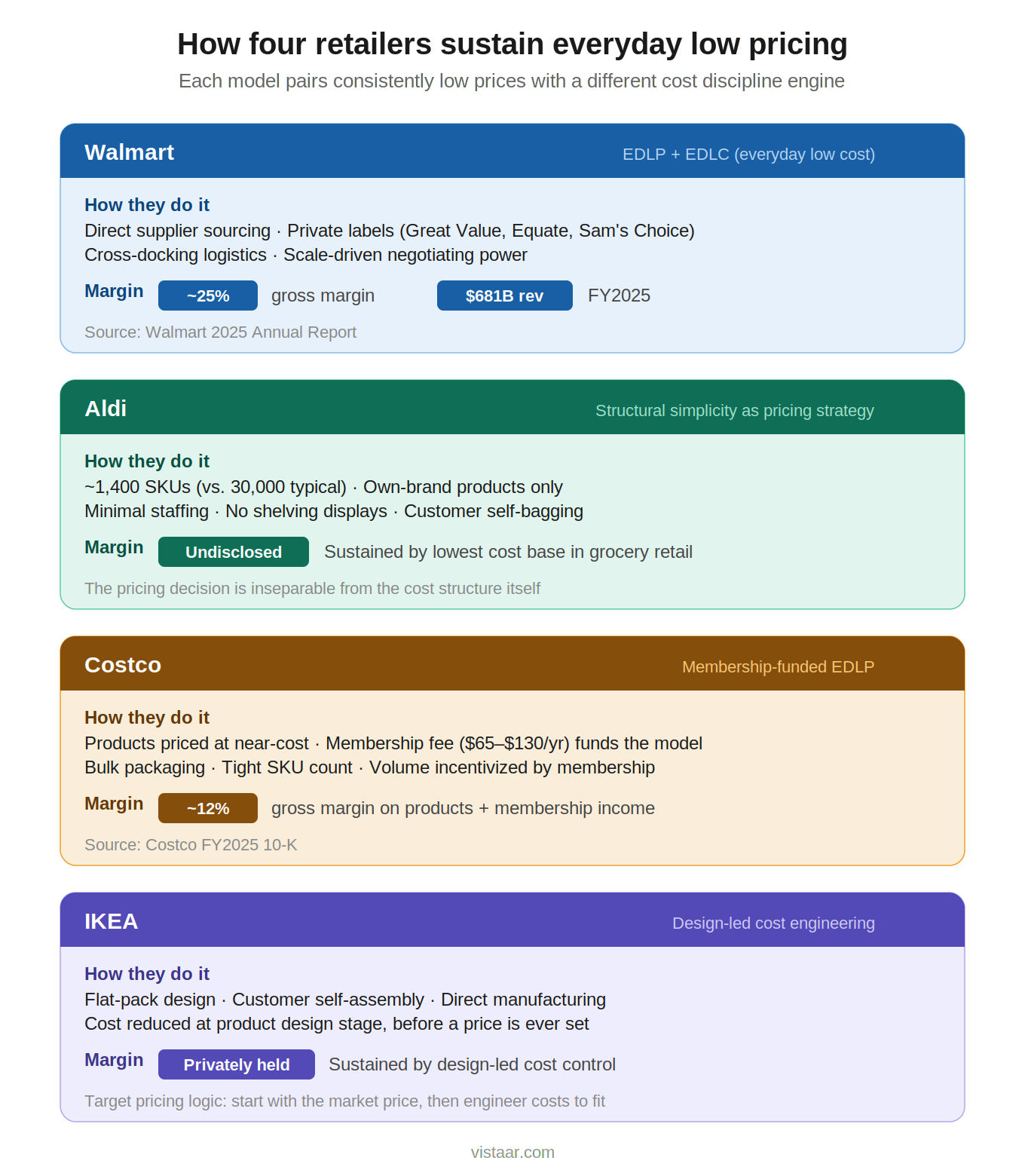
Walmart is the defining EDLP case. Founded in 1962 on the promise of everyday low prices, Walmart has never deviated from the strategy. Its commercial model is built around what the company calls EDLP paired with EDLC: Everyday Low Cost. The logic is explicit: to consistently offer low prices, you must consistently control costs.
How Walmart sustains EDLP:
- Direct supplier negotiations: bypassing distributors to buy directly from manufacturers at lower cost
- Private label brands: Great Value, Equate, and Sam's Choice allow higher margin on lower-price items
- Cross-docking logistics: products move from supplier trucks directly to store trucks without warehouse storage
- Scale-driven negotiating power: $660 billion in annual revenue creates supplier influence no competitor can match
Walmart's gross margin of 24% sounds thin. The volume means that 24% applied to $680 billion generates significant absolute profit. EDLC is what makes EDLP viable at that scale.
Aldi
Aldi takes EDLP further than almost any other retailer. Its model strips out the complexity that most retailers accept as fixed cost. Limited SKU ranges (roughly 1,400 compared to 30,000 at a typical supermarket), own-brand products, minimal store staffing, no shelving displays, and customers bagging their own groceries. Every structural choice is in service of cost reduction, which in turn enables permanently low prices.
Aldi's EDLP works because it is inseparable from its operational identity. It is not a pricing decision sitting on top of a conventional cost structure. It is the cost structure itself.
Costco
Costco runs an EDLP model with a structural twist: membership fees. By charging customers an annual fee for access, Costco can sustain a gross margin of approximately 12% on products, far below most retailers, because the membership revenue funds the business model. Customers who pay the membership fee have an incentive to shop frequently enough to justify it, which drives the volume that makes the thin margins work.
This hybrid model illustrates an important point: EDLP does not require a single revenue stream. The low price on products can be offset by a separate, predictable revenue source that does not depend on margin per unit.
IKEA
IKEA applies EDLP principles to furniture and home goods through a combination of flat-pack design, customer self-assembly, and direct manufacturing relationships. The model is built on cost reduction at the product design stage rather than the pricing stage. Products are designed to be cheap to manufacture and ship before a price is ever set. The permanently low price is the result of that design discipline, not a pricing decision imposed on top of a conventional product.
When EDLP Works and When It Doesn't
EDLP is not universally appropriate. Whether it fits a business depends on a specific set of structural, competitive, and customer-related conditions.
For enterprise manufacturers and distributors, the EDLP question often surfaces in a different form: whether to set stable list prices across customer segments rather than relying on promotional pricing cycles. The same logic applies. Stable pricing requires a cost structure and supply chain that can support it, and a customer base that values predictability over the excitement of periodic deals. Effective pricing analysis at the account and segment level is the starting point for any business evaluating this question.
EDLP, Margin Impact, and Long-Term Profitability
The margin implications of EDLP are the most important strategic consideration for any business evaluating the approach. Getting this wrong is what collapses businesses that adopt EDLP without the right foundation.
The margin math of EDLP
Under a high-low model, a business earns higher margins on full-price sales and accepts lower margins on promotional sales. The blended margin across the year reflects a mix of both. Under EDLP, there is no blended margin. Every unit is sold at the low price.
This means the sustainable price floor under EDLP must be set above the full cost of goods, operations, and capital, with enough margin to fund investment and absorb volatility. There is no promotional price above it to compensate. The math has to work at the EDLP price, permanently.
Volume as the profitability mechanism
EDLP businesses offset thin unit margins with volume. The higher the volume, the better the unit economics: supplier negotiations improve, logistics become more efficient, fixed costs spread over more units, and scale advantages compound.
This creates a virtuous cycle when it works. Low prices drive traffic. Traffic drives volume. Volume improves cost structure. Better cost structure enables even lower prices. Walmart is the purest expression of this loop running at scale.
It also creates a fragile loop when volume softens. A 10% volume decline on a 2% net margin business is not a 10% profit reduction. It can be a 100% profit elimination, or worse.
Customer expectations become a structural constraint
Once a business establishes EDLP with its customer base, prices become very difficult to raise. Customers who have organized their purchasing behavior around the expectation of permanently low prices respond poorly to price increases. Unlike promotional retailers, who can simply end a sale and return to the higher base price, EDLP businesses face customer attrition when they raise prices. This is why pricing strategy decisions made at the start of an EDLP commitment are so consequential. The initial price level becomes the ceiling, not the floor.
Practical Tip
Before committing to EDLP, run a margin scenario at the intended low price point across three volume assumptions: plan, plan minus 10%, and plan minus 25%. If any scenario produces negative operating profit, the cost structure is not ready for EDLP. The pricing decision and the cost transformation must happen together, or the strategy will not hold.
Strategic Considerations Before Adopting EDLP
These are the questions any business must answer before committing to an everyday low pricing model.
For most businesses evaluating their pricing approach, the choice is rarely between pure EDLP and pure high-low pricing. The more common question is where on the spectrum between the two extremes the right balance sits, and what operational capabilities are required to hold that position consistently.
In manufacturing and distribution, this often means setting stable base prices with defined and governed discount structures, rather than cycling prices up and down to generate perceived value. The discipline of price optimization techniques at the customer and segment level gives commercial teams the analytical foundation to answer these questions with data rather than intuition.
For retailers, the question often connects directly to how promotional spend is managed. Whether a business runs EDLP or high-low pricing, the need for dynamic pricing strategy capabilities that can respond to market conditions remains constant.
Pricing Intelligence for Businesses Managing Price Consistency
Whether a business operates on EDLP principles or a more promotional model, the underlying requirement is the same: pricing decisions must be grounded in cost visibility, competitive intelligence, and demand data. Committing to consistent low prices without that infrastructure is not a strategy. It is a bet.
SmartPricing gives manufacturers and distributors a centralized price management layer that enforces pricing rules consistently across customer segments, channels, and geographies. For businesses operating closer to the EDLP model, this means pricing governance that prevents exceptions and maintains the consistency the strategy requires.
SmartOptimizer provides the demand elasticity and scenario modeling that any business needs before committing to a price point permanently. If you are going to set a price and hold it, you need to know with confidence that the volume and margin math holds across a range of market conditions.
For businesses in CPG, retail, or distribution evaluating how their pricing model compares to competitors, competitive price intelligence is the foundation. EDLP is only viable if the prices you set are genuinely competitive. Without real-time market visibility, 'everyday low' can drift to 'everyday average' without the business noticing until traffic and volume have already declined.
For manufacturers and distributors managing pricing across channels, the consistency discipline that EDLP requires at the retail level often has supply chain counterparts: stable list prices, governed discount structures, and rebate programs tied to volume growth rather than promotional cycles. Rebate management that rewards consistent volume rather than promotional spikes is one of the more direct B2B analogues to EDLP thinking.
EDLP Is a Business Model, Not Just a Pricing Decision
Everyday low pricing is one of the most misunderstood strategies in commercial pricing. From the outside, it looks like a simple decision to charge less. From the inside, it is a total commercial commitment that requires cost discipline, supply chain efficiency, volume scale, and the right customer base.
Walmart built the world's largest retailer on it. JCPenney nearly destroyed itself trying to adopt it without the underlying infrastructure. The difference between those two outcomes is not the pricing strategy. It is whether the rest of the business was built to support it.
For any pricing or commercial leader evaluating EDLP, the right starting question is not whether low prices are better or worse than promotional prices. It is whether your cost structure, customer base, and competitive position can sustain a commitment to consistently low prices permanently. If the answer is yes, EDLP offers genuine strategic advantages. If the answer is unclear, the risk of JCPenney's outcome is real.
Frequently Asked Questions
What does EDLP stand for?
EDLP stands for Everyday Low Pricing. It refers to a strategy where a business sets consistently low prices permanently, without relying on promotional sales events, coupons, or temporary discounts to drive purchase behavior.
What is the difference between EDLP and high-low pricing?
EDLP maintains stable low prices throughout the year. High-low pricing sets higher base prices and drives purchases through periodic discounts and promotions. EDLP attracts value-seeking customers; high-low attracts deal-seeking customers who respond to the psychology of getting a reduced price.
Why did JCPenney's EDLP strategy fail?
JCPenney's customer base was built on promotional pricing. When the company eliminated coupons and sales in 2012, it removed what those customers came for. Revenue fell 25% in one year. EDLP requires a customer base and cost structure built for it from the start, not retrofitted onto an existing promotional model.
What are the main benefits of everyday low pricing?
The main benefits include consistent customer trust, simplified demand planning, lower marketing costs, reduced operational complexity, and the ability to attract price-sensitive customers who consolidate their spending with reliable low-price retailers.
What are the risks of EDLP for manufacturers and distributors?
The main risks are margin compression, removal of pricing flexibility as a competitive response tool, dependency on volume for profitability, difficulty raising prices once EDLP expectations are established, and exposure to cost shocks without a promotional price lever to offset them.
Can small businesses use EDLP effectively?
EDLP is most sustainable at scale. Without the volume, cost discipline, or supply chain advantages of large retailers, small businesses adopting EDLP risk margin destruction. A focused version, stable competitive pricing in a defined category, can work but requires careful cost management.
How does EDLP affect inventory and supply chain operations?
EDLP smooths demand by eliminating promotional spikes and troughs. This makes forecasting more accurate, reduces stockout risk, enables consistent supplier terms, and lowers the logistics complexity associated with surge-and-recovery inventory cycles common in high-low pricing models.

As an experienced pricing solutions partner to some of the biggest names in global business, Vistaar offers a range of services to help our customers reach their maximum potential. Talk to us to see how we can help you create a more profitable future.