




Key Takeaways
• A country-specific price list is more than a translated number. It carries its own currency, tax logic, effective dates, and local rules.
• Multi-currency pricing starts from a base price in one currency, converted by an exchange-rate factor, then adjusted locally to a final price.
• Exchange rates move, so a price set once drifts unless conversion refreshes on a schedule rather than at a single point in time.
• Local tax and duty belong inside how each price is built, not tracked in a side spreadsheet that someone has to remember to reconcile.
• Consolidated reporting rolls every market back into one reporting currency, so leadership can compare countries on a single basis.
A regional finance lead exports the price lists for eight countries into one view and the totals will not reconcile. Each list is correct in its own currency, but one was built on last quarter's exchange rate, another applies a duty that changed in March, and a third quotes prices before tax while the rest quote after. Nothing is technically wrong, yet the numbers cannot be compared, and the quarterly review is tomorrow.
Managing multi-currency and country-specific price lists is the work of keeping all of those moving parts aligned: the currency each price is set in, the taxes and duties layered on top, the dates each version takes effect, and the single reporting view that has to make them comparable. Handle those four well and a global price book stays coherent. Miss any one and it quietly falls out of sync.
What a Country-Specific Price List Actually Contains
A country-specific price list is a full pricing structure for one market, not a currency swap on a global list. The price is only the visible layer. Underneath sit the rules that make the number mean something in that country, and those rules differ from market to market.
Four things travel with every country's list, and each one can pull it out of alignment with the others if it is handled loosely:
- Currency: the currency the price is set and transacted in, which determines how it converts back to a global view.
- Tax and duty: the VAT, excise, or import duty that applies locally, which changes what the price means before and after tax.
- Effective dates: the date each price version takes effect and expires, so the right price applies on the right day.
- Local rules: regulatory constraints specific to the market, from minimum pricing to rounding conventions.
Handled as one number, a price list looks simple. Handled as these four layers, it becomes clear why the same product needs a genuinely different list in each country rather than a single sheet with a currency column. This is a step beyond deciding how to standardize pricing across those markets, because here the question is operational rather than strategic.
Take one product sold in Germany and the United Kingdom. The German list runs in euros with 19% VAT and a January effective date; the UK list runs in pounds with 20% VAT and a different review cycle. The base product is identical, yet the two lists share almost none of their operational detail. Treat them as one sheet with a swapped currency symbol and the VAT, the effective dates, and the local rounding all fall out of place at once.
That gap is why country lists are maintained as distinct structures that reference a common product, not as regional copies of a master sheet. The shared thread is the product and its base price. Everything layered on top is local, and each layer needs its own owner and its own update cadence.
How Multi-Currency Pricing Is Built From a Base Price
There are two ways to run country price lists, and the choice comes first. Manage each market independently, setting and maintaining its prices on their own, or derive every market from a common global reference price. Independent pricing suits markets that share little; global reference pricing suits a portfolio meant to hold together.
Under global reference pricing, every local price is calculated from a single base price rather than set on its own. The base price lives in one currency, and each market's price is built from it, which keeps the whole book anchored to one reference instead of drifting into unrelated numbers.
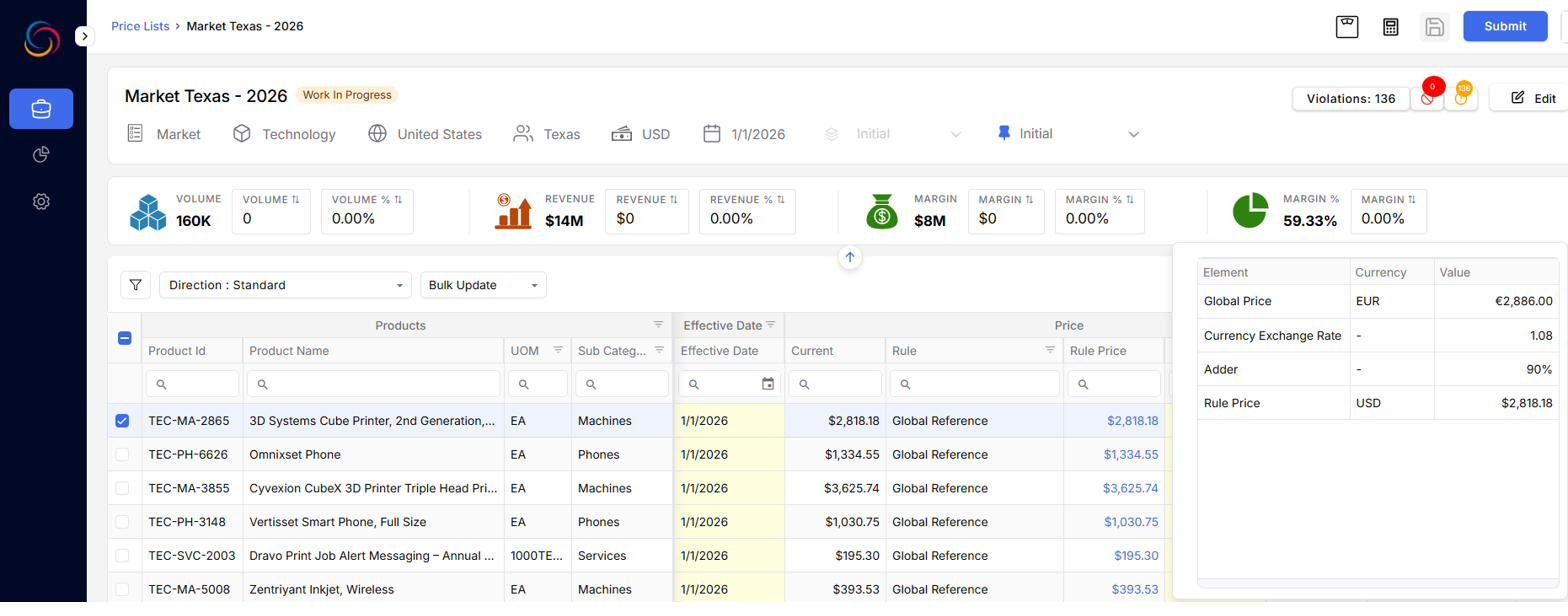
The calculation moves through a clear set of layers, each one adding to the price built so far:
- Global base price: the starting figure in its home currency.
- Exchange-rate factor: the conversion into the local currency, including any market index.
- Local adjustment: the adder or discount that reflects volume or market conditions.
- Final local price: the number the market actually uses.
Because every local price traces back to the same base through a recorded set of steps, the reason for any difference between two markets is visible rather than guessed at. When leadership asks why one country sits higher than another, the answer is in the conversion and the adder, not in someone's memory. The same discipline underpins broader price optimization, where every number needs a traceable basis.
Take a global base price of 100 euros, sold into a US market with enough volume to earn a local discount. The steps play out like this:
Every step of the distance from the base to the final US price is on record. The number was not set by hand, so it does not have to be defended from memory when a global account questions why the US price differs from the European one.
Keep Exchange Rates Current So Prices Do Not Drift
The weakness in any multi-currency setup is that exchange rates move after prices are set. A price converted at last quarter's rate is already wrong this quarter, and if the conversion only ran once, no one may notice until a margin looks off. Currency management is therefore a standing process, not a one-time calculation.
The practical fix is to refresh conversions on a defined schedule and let every dependent price update when the underlying rate changes. A rate feed that updates the factor, and prices that recalculate from it, keeps the book current without a manual pass across every market. Recent volatility has raised the stakes here: the Simon-Kucher Global Pricing Study 2025 found that 80% of companies passed cost increases through to customers, over half of them through automatic indexing rather than manual adjustment. Currency is one more input that indexing has to cover.
A second decision sits underneath the schedule: which rate to use. The two options trade predictability against margin protection.
Most global teams set a rate at the start of a period and revisit it on a defined cadence, which balances the two. The point is to make that choice deliberately, not to inherit whatever rate happened to be loaded when the list was built.
Left manual, currency drift is the kind of error that hides for a full quarter. Automated, it becomes a number that corrects itself the moment the rate feed moves, which is the difference a working pricing analysis process depends on.
Build Local Tax and Duty Into Each Price
Tax and duty change what a price means from one country to the next, and they change on their own timetable. A VAT revision or a new import duty can move a market's real margin without any pricing decision, so tax cannot sit outside the price as a separate calculation. It has to be part of how each local list is built.
Common Mistake: Treating currency conversion and tax as one step. A price can be converted correctly and still be wrong, because the local tax or duty was applied at an outdated rate. Keep the two as separate, individually maintained layers.
Use Effective Dates to Control When Each Price Applies
Effective dates decide which version of a price is live on any given day, and in a multi-country book they rarely line up. One market may raise prices in January, another in April, and a third may run a temporary regulated price for a fixed window. Without dated versions, a price change either goes live everywhere at once or gets managed by hand, market by market.
Dated price lists let each market schedule its own changes in advance while the system serves the correct version on the correct day. Three behaviors do the work:
- Scheduled activation: a future price sits ready and goes live on its start date without overwriting the current one.
- Automatic expiry: a temporary or regulated price rolls off on its own when its window closes, with no manual swap.
- Point-in-time accuracy: the price on any given day reflects the version in force that day, which is what makes a past quarter reconcile.
This matters most where currency and tax collide. A VAT change and a price update often take effect on different dates, and a duty revision may land mid-cycle. When each carries its own effective date, the markets never fall into the trap of applying tomorrow's tax to today's price.
Consolidate Every Market Into One Reporting View
The payoff of a disciplined multi-currency structure is that every market can be rolled back into a single reporting currency for comparison. Whether the lists are derived from a global reference or managed independently, each one can carry its own currency while the reporting layer normalizes them into one currency you choose. Prices are set and transacted locally, but leadership needs to see all of them on one basis to judge where margin is strong, where it is thin, and where a market has drifted.
Consolidated reporting converts each local figure back to the chosen reporting currency using the same recorded rates, so the comparison is consistent rather than approximate. That single view is what turns a stack of country lists into something a global team can actually manage, since a difference between two markets is only meaningful once both are expressed on the same basis. A unified pricing platform keeps the local detail and the consolidated view reconciled, so the report and the price lists never tell two different stories.
This is also where multi-currency management connects back to governance. Once every market reports on one basis, the work of standardizing prices across countries while keeping local flexibility inside a global structure becomes possible.
A system like Vistaar's SmartPricing holds the base price, applies per-country conversion, tax, and effective dates, and rolls the result into one reporting currency, so the same structure that runs the price lists also produces the view leadership reviews. That is the bridge from running the lists to managing prices across every country from one place.
Conclusion
Managing multi-currency and country-specific price lists comes down to keeping four layers aligned: the currency each price is set in, the tax and duty applied locally, the dates each version takes effect, and the consolidated view that makes markets comparable. Handled in separate spreadsheets, those layers drift apart and the errors hide until a review or an audit surfaces them. Handled in one structure, where conversion refreshes on a schedule, tax lives inside each list, and every market rolls into a single reporting currency, the price book stays accurate and comparable without a manual reconciliation every quarter. The goal is a system that keeps local detail and the global picture telling the same story.
See it on your own price book. Request a demo to see how a base price, per-country conversion and tax, and one consolidated reporting currency work across your markets.
Frequently Asked Questions
What is a country-specific price list?
It is a complete pricing structure for one market, carrying its own currency, tax and duty logic, effective dates, and local regulatory rules. It differs from a global list with a currency column, because each layer can vary by country.
How does multi-currency pricing handle exchange rates?
A base price in one currency is converted using an exchange-rate factor, then adjusted locally. Rates should refresh on a schedule so prices recalculate when the rate moves, rather than staying fixed at the value set when the list was first built.
Should tax be part of the price list or handled separately?
Tax and duty should live inside the price list so a rate change flows through automatically and flags the affected markets. A separate tax spreadsheet reconciled by hand is where a market quietly falls out of alignment.
How do you compare prices across different currencies?
Convert every local price back to one reporting currency using consistent recorded rates. Consolidated reporting on a single basis is the only way a difference between two markets becomes meaningful rather than an artifact of the currency.

As an experienced pricing solutions partner to some of the biggest names in global business, Vistaar offers a range of services to help our customers reach their maximum potential. Talk to us to see how we can help you create a more profitable future.