



Key Takeaways
- Markup is profit divided by cost, and selling price equals cost multiplied by one plus the markup
- A markup always produces a smaller margin percentage, so a 33.3% markup yields a 25% gross margin
- What a seller keeps of a markup depends on the cost it is applied to and on deductions paid after the invoice
- When costs rise, holding the markup percentage protects margin, while holding the dollar profit lets the margin percentage slip
- Markups multiply through a channel, so a 50% manufacturer markup followed by 35% at the distributor and 25% at the dealer lands 153% above the original cost
A markup calculator turns a unit cost and a markup percentage into a selling price. It also works in reverse, showing the markup and gross margin behind a price you already charge.
The math takes one line. The harder part in B2B selling is choosing the right cost to mark up and accounting for the money that leaves after the invoice, such as rebates and freight.
The calculator below handles the core formulas and the pocket adjustments. The sections after it walk through each formula with a single worked product, an industrial valve, so every number can be checked by hand.
Markup Calculator
Choose the values you already know, and the calculator returns the rest. The optional fields show how much of the markup survives once post-invoice costs are paid.
For the valve used throughout this article, a landed cost of $72.00 and a 35% markup return these results:
The Markup Formula
Markup expresses profit as a share of cost. Three versions of the same formula cover almost every pricing question a seller asks:
The denominator is what separates the two measures. Markup divides profit by cost, while gross margin divides the same profit by the selling price, which is always the larger number.
How to Calculate Markup: A Worked Example
Take a distributor buying a brass ball valve from a supplier at $64.00 and applying a standard 35% markup. The price and margin come from four steps:
- Convert the markup to a decimal: 35% becomes 0.35
- Multiply cost by one plus the markup: $64.00 × 1.35 = $86.40 selling price
- Subtract cost to find gross profit: $86.40 minus $64.00 = $22.40 per valve
- Divide profit by price for margin: $22.40 ÷ $86.40 = 25.9% gross margin
Running the steps backward checks the work. Dividing $22.40 by the $64.00 cost returns the original 35% markup.
The same steps sit underneath cost-plus pricing, where a standard markup is applied across a product line.
Markup to Margin Conversion Table
Sales teams often quote markup while finance reports margin, and the two numbers drift apart as they grow. The first table converts a markup into the margin it produces:
The second table works the other way, starting from the margin a business wants to hold:
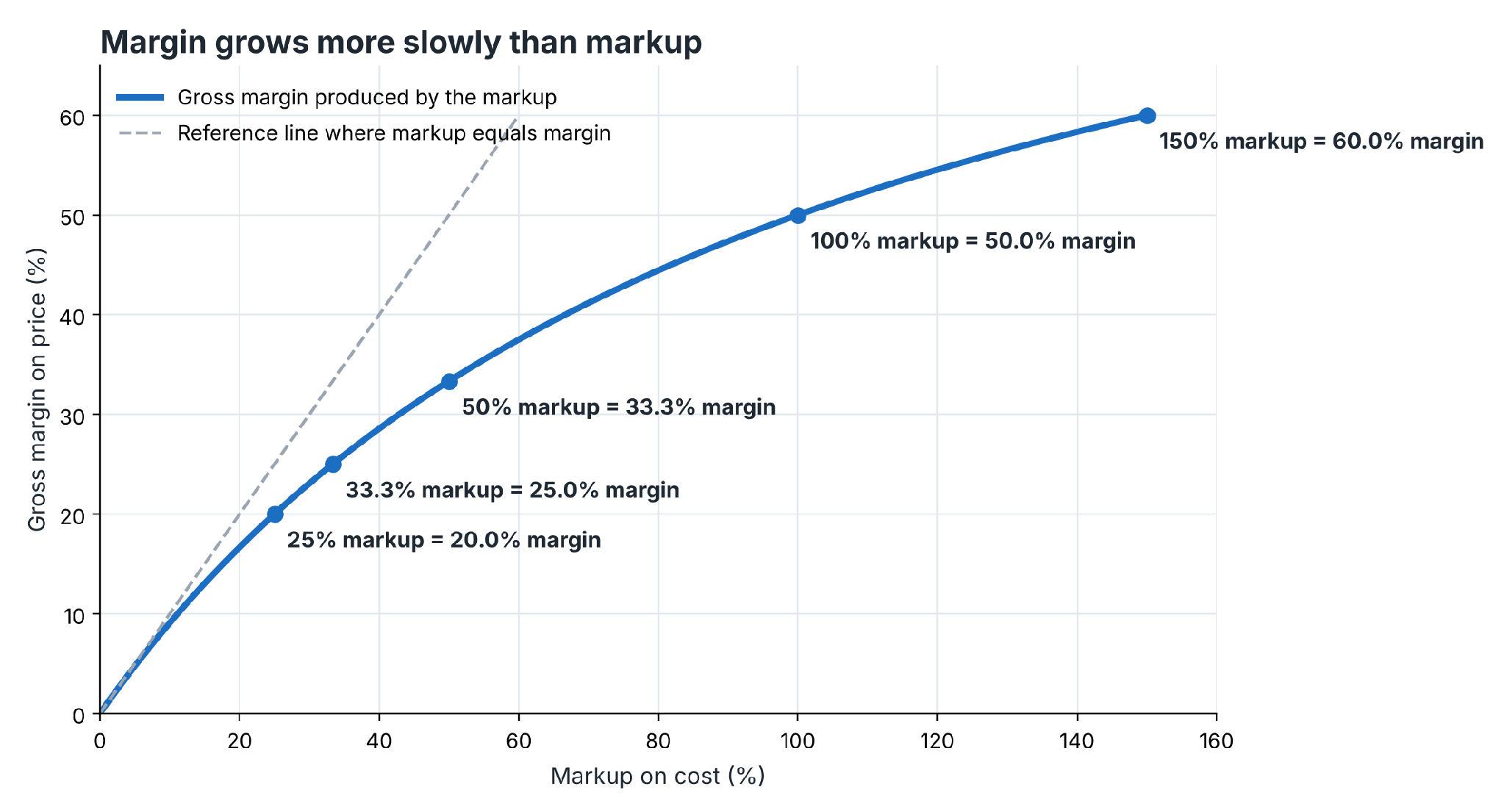
A margin can approach 100% but never reach it, whereas markup has no ceiling. Any quote tool that mixes the two will misstate profit on high-markup items first.
Markup vs. Margin: Which to Use When
For building a price, markup is the natural measure, since cost is the number on hand when a quote starts. Margin is the better measure for reporting, because it ties directly to revenue on the income statement.
- Use markup for price building: Quote desks and cost-plus contracts start from cost, so a markup converts straight into a price
- Use margin for reporting: Profit and loss statements express profit against revenue, so margin lines up with how results are judged
- Use both for approvals: A floor stated as margin and converted to markup lets reps see the limit in the terms they quote
Trouble starts when a team sets targets in one measure and quotes in the other. A sales manager asking for 30% on a deal and a rep hearing a 30% markup will land almost seven margin points apart.
Which Cost Should the Markup Use
Every markup is only as accurate as the cost it multiplies. Three cost bases show up in B2B pricing, and each one produces a different price for the same valve:
- Supplier invoice cost: The purchase price alone, $64.00 for the valve, which leaves out every cost of getting it to the warehouse
- Landed cost: Purchase price plus inbound freight and duty, here $64.00 plus $3.20 freight and $4.80 duty for $72.00
- Cost to serve: Adds the handling and support a specific customer requires on top of landed cost
Applying 35% to the $64.00 invoice cost gives an $86.40 price. Measured against the true landed cost of $72.00, that price carries a markup of only 20.0%.
The fix is to load freight and duty into the cost record before the markup runs. For accounts with heavy service demands, cost to serve adds a further layer worth pricing in.
Invoice Markup vs. Pocket Markup
An invoice price is only the starting point for what a seller collects. Rebates and outbound freight come out afterward along with payment terms, and none of them appear on the quote.
Using the landed cost of $72.00 and the 35% markup, the valve invoices at $97.20. Three post-invoice items then reduce it:
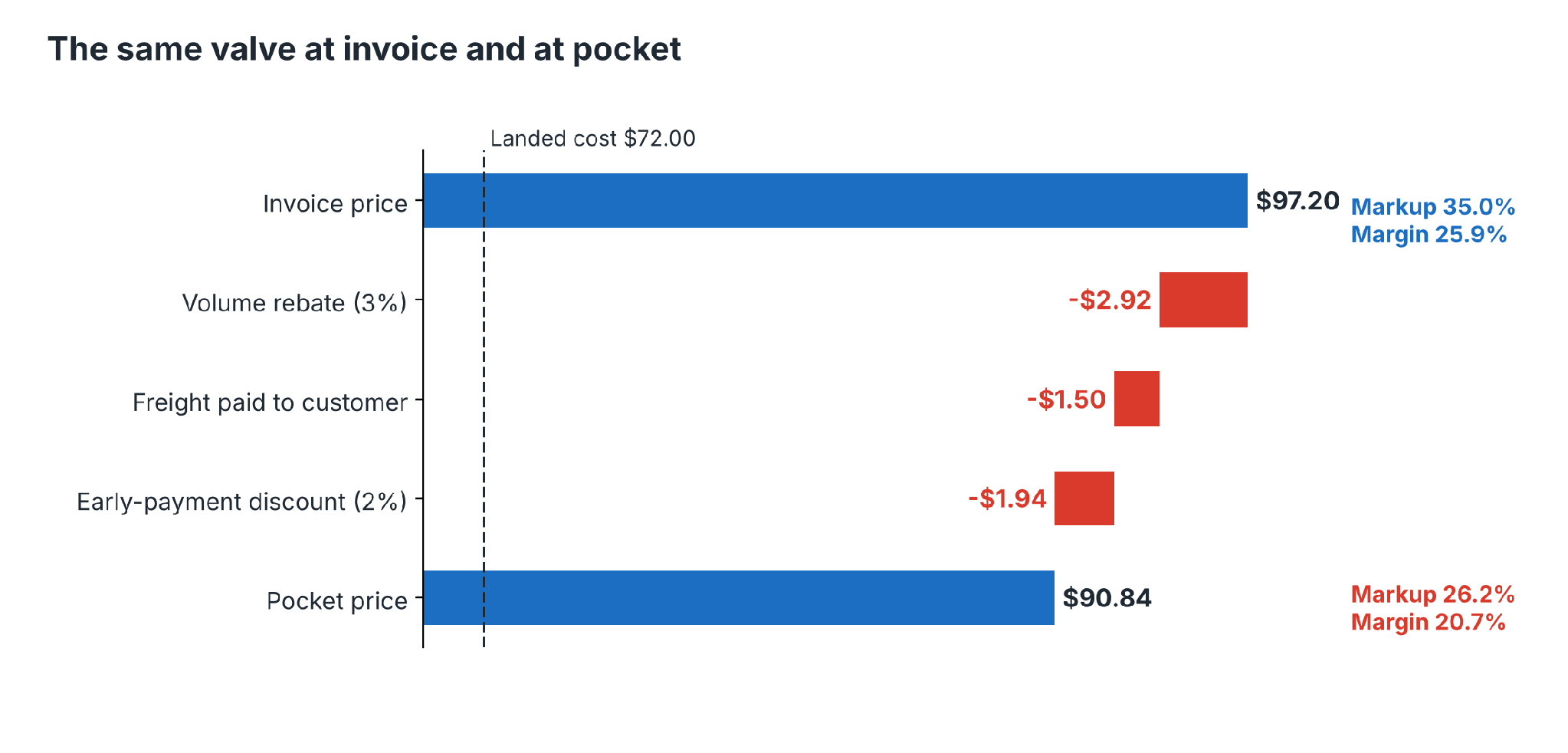
The 35% markup on the quote becomes 26.2% in the seller's pocket, and margin drops from 25.9% to 20.7%. Calculating the pocket price for each customer shows which accounts carry the markup the price list promised.
The full sequence of deductions is called a price waterfall. Mapping it once per customer segment is usually enough to show where the largest deductions sit.
How to Reprice When Costs Rise
Cost increases test whether a markup policy protects profit. The National Association of Manufacturers reported in June 2026 that manufacturers expect raw material and other input costs to rise 5.8%.
Pass-through is partial for many firms. A Cleveland Fed brief from June 2026 found that firms expect to pass through only 60 percent of the cost increases they anticipate in 2026 by raising prices.
Suppose the valve's landed cost rises 8%, from $72.00 to $77.76. A seller has three ways to respond:
Holding the markup keeps the margin percentage intact and grows dollar profit with cost. Holding dollars feels fair to customers, though it trims margin by about 1.4 points on every unit sold.
Partial pass-through is the most common outcome and the most costly, removing over three points of margin. Firms facing tariff-driven increases can find a fuller playbook in how tariffs disrupt pricing strategy.
How Markups Stack Across a Channel
When a product moves from manufacturer to distributor to dealer, each tier applies its own markup to the price it paid. The markups multiply instead of adding together:
The three markups sum to 110%, though the end price sits 153.1% above the manufacturer's cost. Manufacturers setting a suggested resale price need that compounded figure to judge where the product will land on the shelf.
Each tier also earns a different channel margin, which shapes how hard partners will push a product line.
Working backward is often more useful. If the dealer's shelf price must stay at $95.00, dividing by 1.25 and then by 1.35 shows the distributor must buy at $56.30, which leaves the manufacturer a 40.7% markup on its $40.00 cost.
What a Discount Does to Markup
A discount comes straight out of gross profit, so a small price cut removes a large share of the markup. Starting from the valve at $97.20 with $25.20 of profit:
A 10% discount needs almost two-thirds more volume just to earn the same profit. Tying approval levels to discount depth keeps the deepest cuts in front of someone accountable for margin.
How to Set Different Markups by Customer Segment
A single markup treats a contract customer ordering 500 units a month the same way as a one-time buyer. Segmenting markups by order profile lets a distributor charge for the service each customer consumes.
The ranges should come from transaction history. Comparing pocket markup by segment over the past 12 months shows whether the small-order premium covers the extra handling it was meant to pay for.
Moving past one flat percentage is the first step away from pure cost-plus logic, covered in more depth in how to move beyond cost-plus pricing.
Common Markup Mistakes in B2B Pricing
- Dividing by the wrong number: Setting price as cost ÷ (1 minus markup) produces a margin-based price, so a 35% entry on the $72.00 valve yields $110.77 in place of $97.20
- Using stale standard costs: A cost record updated once a year will understate landed cost after every mid-year supplier increase
- One markup for every customer: Applying the same percentage to a strategic account and a one-time buyer ignores differences in volume and service cost
- Ignoring post-invoice deductions: A price that clears the target markup on the invoice can fall below it once rebates accrue
- Rounding after each step: Rounding the price before calculating margin compounds small errors across thousands of SKUs
The first mistake causes the most confusion, since many spreadsheets were built by someone who meant margin and labeled it markup. Checking one known product against the formulas above settles which logic a sheet uses.
From a Calculator to a Price List With Vistaar
A calculator answers the question for one valve. A distributor with 40,000 SKUs needs the same logic applied to every item, every time a supplier changes a cost, with the pocket deductions included.
The screenshot below comes from Vistaar's price guidance view. Its constraint table sets a 25% minimum margin on a 3D printer, which by the conversion table above equals a 33.3% markup floor on cost.
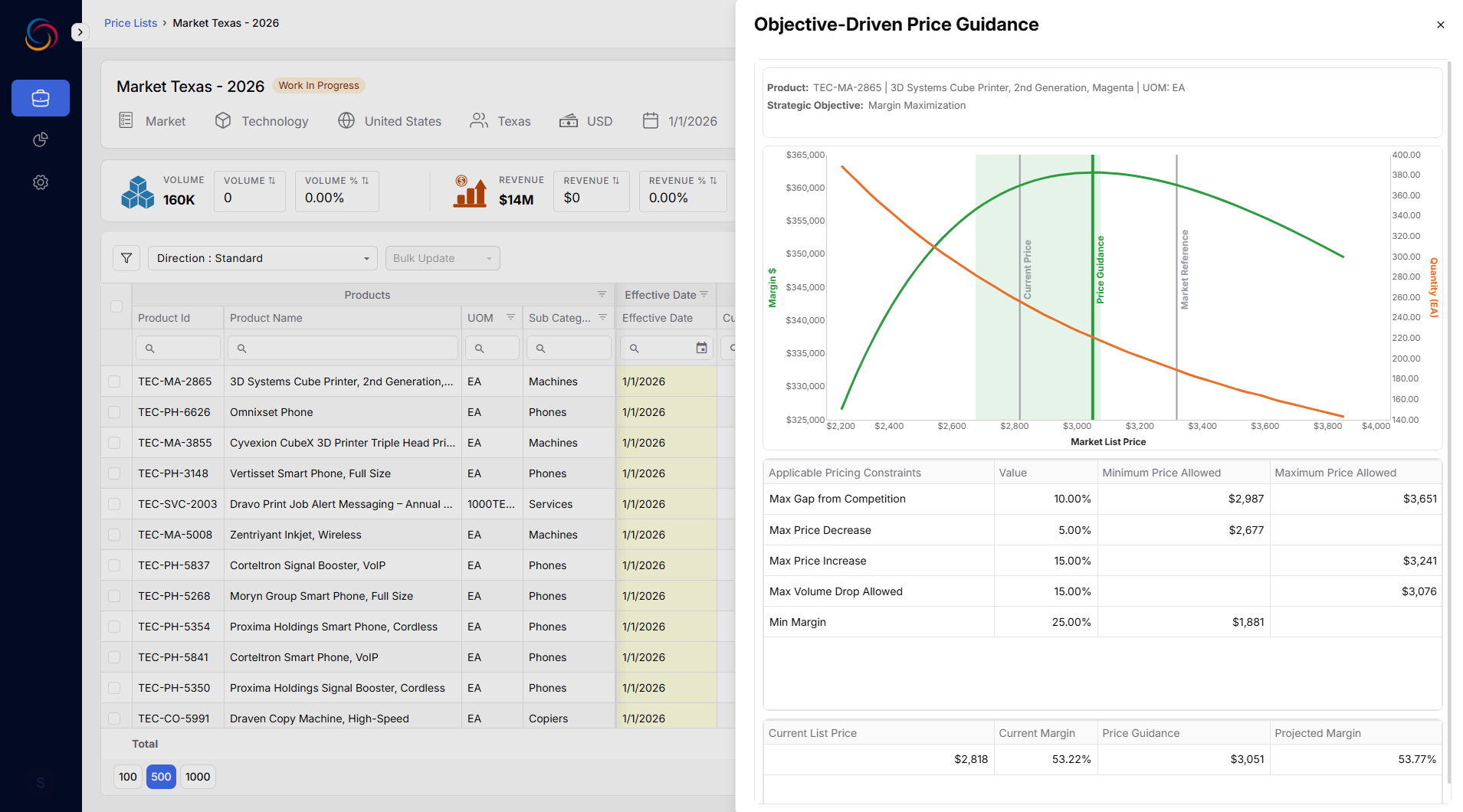
In Vistaar SmartPricing, minimum margins and price floors are set by category or segment, and scenario planning shows how a cost movement will affect margin before new prices go live. Approved prices then sync to connected business systems such as ERP and CPQ, so every channel quotes from the same list.
At the deal level, Vistaar SmartQuote shows the net margin on a quote while the rep builds it and routes approvals based on discount depth or margin impact.
For distributors with large catalogs, the distribution solution brings price list governance and deal-level margin checks together.
Apply your markup rules across every SKU
See how Vistaar sets margin floors by segment and updates prices when costs move.
See the Vistaar Platform
Price From the Cost You Actually Carry
The markup formula is simple, and the calculator above handles the arithmetic. The accuracy of the result depends on two choices: marking up landed cost instead of supplier cost, and checking the markup again at the pocket price.
Sellers who track both will catch the valve that quotes at 35% and collects at 26%. Those figures are the starting point for a margin leakage review, and for deciding which customers need a different markup altogether.
Turn markup rules into governed prices
Talk to Vistaar about pricing every SKU from current costs with margin floors built in.
Request a demo
Frequently Asked Questions
How do you calculate markup percentage?
Subtract cost from selling price and divide the result by cost, then multiply by 100. A product costing $80 and selling for $100 has a 25% markup, since $20 of profit divided by $80 of cost equals 0.25.
What markup gives a 30% margin?
A 42.9% markup produces a 30% gross margin. The formula is margin ÷ (1 minus margin), so 0.30 ÷ 0.70 equals 0.429.
Is a 50% markup the same as a 50% margin?
They differ. A 50% markup on a $100 cost gives a $150 price and a 33.3% margin, while a 50% margin requires a 100% markup.
What is a typical markup for distributors?
Markups vary widely by category and order size, as well as by customer. Commodity items often carry thin markups while specialty parts and small orders carry far higher ones, so a single industry average says little about any one SKU.
Should markup be calculated on landed cost?
Yes, for most physical goods. Landed cost includes inbound freight and duty, so a markup applied to it reflects what the product actually cost to stock.

As an experienced pricing solutions partner to some of the biggest names in global business, Vistaar offers a range of services to help our customers reach their maximum potential. Talk to us to see how we can help you create a more profitable future.