



Key Takeaways
- Trade promotion management covers how a manufacturer plans and funds promotions with retailers and distributors, then settles and measures them
- Gross lift overstates results, because forward buying and cannibalization pull volume from other weeks and other SKUs
- A promotion can lift volume 60% and still lose money once the discount on baseline volume is counted
- Deductions and settlement decide whether trade spend matches what was agreed, which makes them a gross-to-net issue as much as a marketing one
- Promotion decisions work best when they sit inside the same system as list prices and rebate programs
Trade promotion management (TPM) is the process manufacturers use to plan and fund promotions with retailers and distributors, then settle and measure them. It spans the promotion mechanics themselves and the allowances that fund them.
For consumer goods and beverage suppliers, trade spend is often one of the largest lines between gross and net revenue. Pressure on it is rising, since NielsenIQ reports that one in four FMCG units in Western Europe now sells on promotion.
This guide covers the promotion lifecycle and the main promotion types, then the math that separates a promotion that paid back from one that only moved volume.
What Trade Promotion Management Covers
Every promotion passes through six stages from budget to post-event review. Each stage has an owner, and handoffs between commercial and finance teams are where most of the cost hides.
A shared promotion calendar ties the stages together. Without one, two account teams can promote the same SKU to competing retailers in the same week and split the lift between them.
How to Set the Annual Trade Budget
Trade budgets often start from last year's spend plus a growth factor, which locks in whatever worked or failed before. A stronger starting point is incremental profit by account and mechanic from the previous year.
- Fund by evidence: Give more of the budget to accounts and mechanics that produced incremental profit, and less to those that only produced lift
- Pay for performance: Tie a defined share of each account's funds to verified execution, such as display compliance or scanned volume
- Hold back a reserve: Keep a set share of the budget, for example 10%, unallocated for competitive responses during the year
- Cap frequency: Limit how many weeks each SKU can be promoted per account to protect the regular-price baseline
Set this way, trade spend becomes a portfolio decision.
Finance can then compare each account's planned spend with its expected trade spend ROI before the year starts.
How to Build a Trade Promotion Calendar
The calendar turns the budget into dated events by account and SKU. Built well, it also enforces the guardrails the budget set:
- One line per account and SKU: Show each event with its mechanic and depth, so overlaps are visible at a glance
- Frequency caps: Flag any SKU promoted more often than the agreed number of weeks per account
- Depth guardrails: Highlight discounts deeper than the floor set for that brand or pack size
- Filing deadlines: Mark price-posting dates for regulated markets so alcohol promotions are filed on time
- Rival accounts: Show events at rival accounts during overlapping weeks, since a shared shopper base splits the lift
Reviewing the calendar monthly against actual results keeps it honest. Events that underperformed get reworked before they repeat, and strong events earn a second slot in the year.
Types of Trade Promotions and Where Margin Leaks
Promotion mechanics differ in who receives the money and when it is paid. Each type has a typical point where spend drifts away from what the agreement intended.
Off-invoice deductions are the easiest to administer and the hardest to control, since the discount applies to every case shipped in the window.
A scan-back ties payment to units sold to shoppers, which limits forward buying at the cost of more data reconciliation.
How to Measure Whether a Promotion Paid Back
Promotion profit equals the margin earned on truly incremental volume, minus everything the promotion cost. The hard part is defining incremental volume honestly.
- Set the baseline: Estimate what the SKU would have sold in the same weeks without the promotion
- Measure gross lift: Subtract the baseline from actual promoted volume
- Remove borrowed volume: Deduct the post-promotion dip caused by retailer and shopper stockpiling
- Remove cannibalized volume: Deduct sales lost by sister SKUs that shoppers would otherwise have bought
- Count every cost: Include the discount on baseline volume plus any fixed fees
Baselines come from two data sources that rarely agree. Shipment data shows what retailers bought, while point-of-sale data shows what shoppers took home, and the difference between them during an event is the clearest measure of forward buying.
Promotion depth and frequency
Depth and frequency shape results as much as the mechanic does. A deeper temporary price reduction lifts volume more during the event, while it also widens the discount on every baseline case.
Frequency works on a longer clock. Promoting the same SKU every few weeks resets the shopper's reference price toward the deal price, which raises cannibalization between promoted and regular weeks over the course of a year.
A worked promotion P&L
Consider a beverage supplier running a four-week promotion on a 12-pack that normally sells 10,000 cases a week. The regular net price is $24 per case with $9 of gross margin, and the promotion offers $2 off every case plus a $15,000 display fee.
Promoted volume reaches 16,000 cases a week, a 60% lift and 24,000 extra cases over the event. The account team reports a strong result, and on volume alone it looks like one.
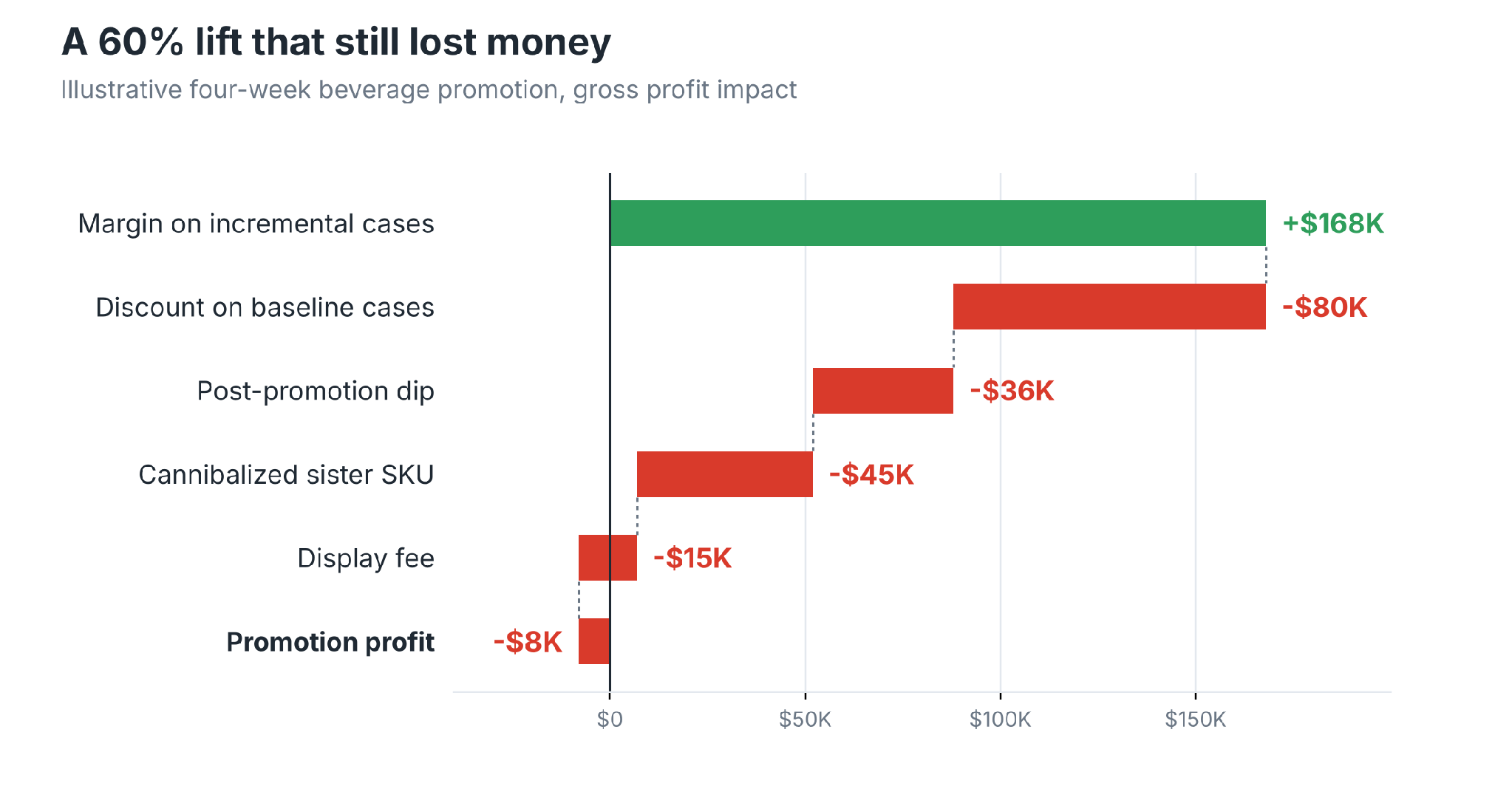
The promotion spent $143,000 in trade funds and lost $8,000 of gross profit. The largest single cost was the $80,000 discount on cases that would have sold anyway, which no lift report shows.
The mechanic is where to look first. A shallower discount or a scan-back paid only on shopper purchases changes the baseline cost line most, so those options deserve a test before the event repeats.
Why Promotional Lift Overstates Results
Lift measures volume during the event window, while profit depends on volume across the whole year and the whole portfolio. Lift and profit usually diverge for four reasons:
- Forward buying: Retailers and distributors buy extra cases at the promoted price and sell them after the event ends
- Shopper stockpiling: Households buy ahead, which creates the post-promotion dip
- Cannibalization: Shoppers switch from a sister SKU or pack size to the promoted item
- Baseline erosion: Frequent promotions train shoppers to wait for the deal, lowering regular-price volume over time
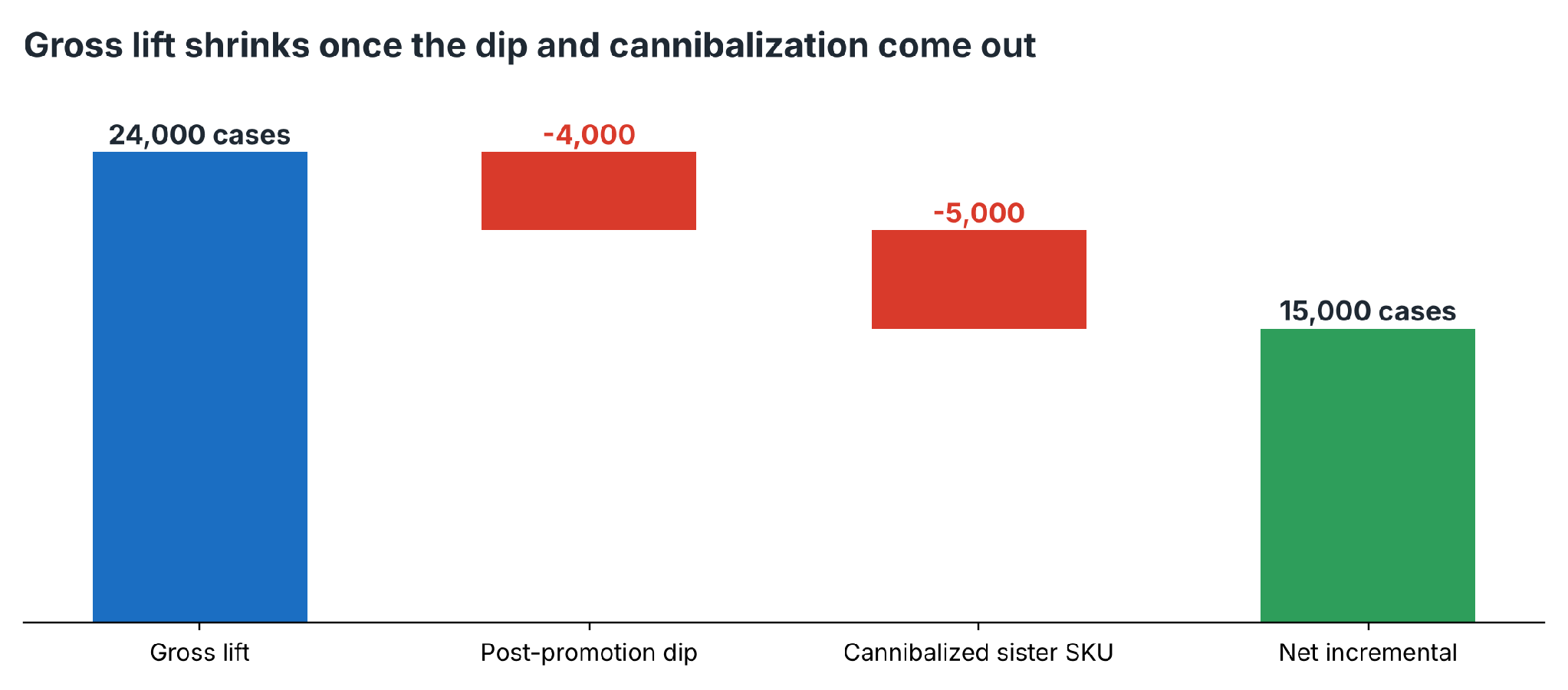
Baseline erosion is the slowest and most expensive effect. NielsenIQ notes that promotional reliance is rising across most FMCG categories in Western Europe, which makes clean baselines harder to find each year.
Volume pressure makes the habit hard to break. Circana's 2026 food and beverage outlook expects US volume to stay flat or dip slightly, with dollar growth coming from price and mix, and promotions are the quickest lever for buying volume back.
Measurement windows matter as well. A review that stops at the last promoted week misses the dip entirely, so the post-event window should run at least as long as the event itself.
Promotional lift remains a useful first read. The decision to repeat an event should rest on incremental profit, measured after the dip and cannibalization come out.
Deductions, Settlement, and Gross-to-Net
Settlement is where agreed trade spend turns into actual cost. Retailers often take deductions from payments before claims are validated, and unmatched deductions sit in accounts receivable until someone researches them. Aged deductions also distort accruals, since finance keeps each event open until every claim is resolved.
Each unresolved deduction either becomes a write-off or a dispute that strains the account relationship. A chargeback process with clear documentation rules shortens that cycle.
Trade spend also needs to reconcile with the price waterfall. Teams that calculate gross-to-net across deductions can see how much of list price survives promotions and rebates combined.
A disciplined resolution process follows five steps:
- Capture: Log every deduction the day it appears on a remittance, with the retailer's reference number
- Match: Link the deduction to a promotion agreement and the event dates
- Validate: Check the amount against agreed rates and proof of performance
- Resolve: Approve valid deductions and dispute the rest with documentation attached
- Report: Track open deductions by account and age so recurring issues reach the account team
Worth Knowing
A single SKU can carry an off-invoice allowance and a volume rebate in the same month, so trade spend per case is only visible when both sit in one view.
Trade Promotions in Beverage Alcohol and Regulated Categories
Beverage alcohol adds rules that change how promotions are designed and paid. In the US three-tier system, suppliers sell to distributors who then sell to retailers, and promotional funding has to follow that structure.
Suppliers often fund distributors through a depletion allowance, paid on cases the distributor sells through to retailers.
In states that require price filings, a post-off has to be filed in advance, which fixes promotion timing weeks before the event. Filing rules also limit how quickly a supplier can answer a competitor's promotion, which raises the value of planning further ahead.
Those constraints make the promotion calendar a compliance document as well as a planning tool.
Vistaar's beverage alcohol pricing solution applies market-specific pricing regulations from one configuration across markets.
Trade Promotion Management vs. Trade Promotion Optimization
The two terms describe different layers of the same work, and teams often need both.
The optimization layer, known as trade promotion optimization, depends on clean post-event data from the management layer. A team that settles promotions accurately builds the history that makes optimization trustworthy.
Questions to Ask When Evaluating Trade Promotion Software
Software evaluations go faster with a fixed set of questions. The table pairs each question with how Vistaar SmartPromotions addresses it, based on the current product page.
SmartPromotions runs on the same Vistaar Platform as Vistaar's pricing and rebate products. A multi-billion-dollar convenience retailer with roughly 12,000 stores reports a 10x productivity improvement, as cited on the product page.
Settlement scope varies widely across trade promotion tools, so ask every vendor to demonstrate one deduction matched to its agreement from start to finish. That single walkthrough shows more about day-to-day fit than a feature checklist.
Model the next promotion before it is funded
Vistaar SmartPromotions estimates revenue and margin impact before spend is committed, so weak events can be reworked early.
See SmartPromotions
Run the Next Promotion Review on Incremental Profit
Promotion programs pay off when every event is judged on incremental profit after the dip and cannibalization. Gross lift and spend-to-budget reports describe activity, while the promotion P&L describes results. Rebuilding that P&L for the largest events is often the fastest way to find trade dollars worth redirecting.
A useful starting point is to rebuild the P&L for your ten largest promotions from last year using the five steps above. The events that lost money usually share a mechanic or a depth, and that pattern sets the agenda for next year's trade plan.
Connect promotions to pricing and rebates
Talk to Vistaar about planning promotions alongside list prices and rebate programs on one platform.
Request a demo
Frequently Asked Questions
These answers cover common questions about trade promotion management.
What is the difference between trade promotion and consumer promotion?
Manufacturers pay trade promotions to retailers or distributors, for example as allowances or display fees. Consumer promotions such as coupons go directly to shoppers and are usually funded from marketing budgets.
How is trade spend ROI calculated?
Trade spend ROI divides incremental gross profit by total trade spend for the event. Incremental profit should exclude the discount on baseline volume and any dip or cannibalization the promotion caused.
What is a good promotion baseline?
A good baseline estimates regular-price sales for the same weeks, adjusted for seasonality and distribution changes, and built from weeks free of other promotions.
Why do retailers take deductions before claims are approved?
Retailers often deduct agreed promotional funds from invoice payments to speed recovery. Manufacturers then match each deduction to an agreement and dispute those without support.
Who should own trade promotion management?
Key account teams usually own planning and negotiation, while finance owns settlement. Revenue management owns post-event analysis and the rules that feed next year's plan.

As an experienced pricing solutions partner to some of the biggest names in global business, Vistaar offers a range of services to help our customers reach their maximum potential. Talk to us to see how we can help you create a more profitable future.