



Key Takeaways
- A CPQ implementation succeeds when reps quote through the tool by default, so go-live marks the midpoint of the project
- Pricing logic usually takes more design time than product configuration, because legacy discount tables carry years of exceptions
- Approval rules belong on paper before the build starts, with each discount band tied to a named approver
- ERP should stay the system of record for orders and invoices, while CPQ owns the quote and its price guidance
- Quote turnaround time and the share of quotes created in the new tool show whether the rollout worked within 90 days
A CPQ implementation puts configure, price, quote software into production for a sales team. The work covers the rules the tool enforces and the CRM and ERP connections it depends on, and it finishes when reps quote through the tool by default.
Product configuration tends to dominate project plans. For manufacturers and distributors, the harder layer is pricing, where thousands of customer-specific agreements have piled up over years of quoting from spreadsheets.
This guide follows the order a pricing-heavy B2B rollout needs, starting with the pricing decisions teams usually leave for later.
What a CPQ Implementation Includes
Every CPQ project runs six workstreams at once. Each one needs an owner from the business side as well as someone from the implementation team.
Configuration rules decide what a rep can sell together, while pricing rules decide what that combination costs the customer. The two workstreams should be designed by different people who meet weekly, since a change on one side often breaks an assumption on the other.
Who Belongs on the CPQ Implementation Team
Teams staffed only with IT and a systems integrator tend to automate current pricing without questioning it. A balanced core team keeps business decisions moving at the pace the build needs.
The field reps matter more than their time commitment suggests. Reps who helped test the tool become the colleagues others ask first after launch.
Why Pricing Logic Is the Hardest Part of CPQ
Implementation guides usually treat pricing as a data load. In B2B, it behaves more like a cleanup project, because the pricing that exists today was never designed to be automated.
Take a distributor with 14,000 customer-specific price agreements in its ERP. A review before the build might show 3,000 of them expired and another 2,000 duplicating a newer agreement for the same customer.
Loading those agreements unchanged into CPQ makes today's inconsistencies faster to quote. The better sequence is to retire expired agreements and consolidate discount codes into a few bands before configuration starts.
Common Mistake
Copying the ERP discount table into CPQ as-is carries every outdated exception into the new system, where reps will apply them faster than before.
Pricing decisions to settle before configuration
Five decisions shape the pricing build, and each one takes longer to change after configuration than before it:
- Price bands by segment: Set a target and a price corridor for each customer segment so reps negotiate inside a defined range
- Agreement cleanup: Retire expired customer agreements and merge duplicates before migration
- Discount structure: Replace legacy discount codes with a small number of bands that the approval matrix can reference
- Floor basis: Decide whether floors sit on list price or on contribution, since the choice changes every approval route
- Exception policy: Agree which customers keep special terms and who owns their renewal
Vistaar's guide to why pricing software implementations fail covers the readiness checks that keep this cleanup on schedule.
How to Plan CPQ Data Migration
Migration decides how much of the old mess reaches the new tool. Each data set needs a source and a cleanup rule agreed before anyone loads it.
Approval history rarely gets migrated, and it is the most useful data set on the list. Twelve months of approved discounts show where the real decision points sit, which makes the threshold discussion with sales leadership far shorter.
Units of measure cause more test failures than any pricing rule. A product sold by the coil in one region and by the pound in another needs a single conversion rule before the first quote runs.
CPQ Implementation Phases and Timeline
Timelines depend on scope far more than on the software. Vistaar's implementation timeline guide puts a focused single module at 8 to 16 weeks, with broader multi-module programs running considerably longer.
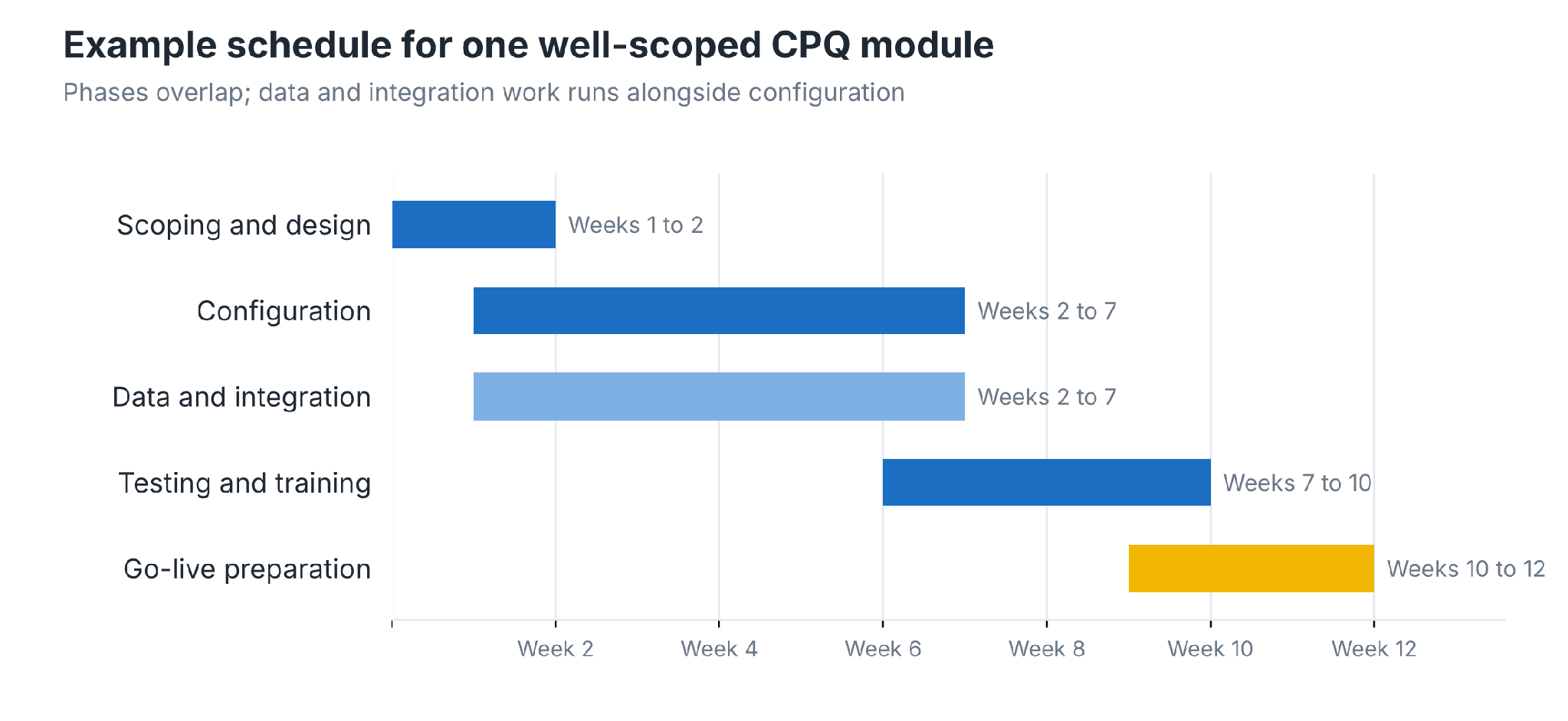
The phases overlap, and each one has a characteristic way of slipping:
Scope is the lever teams control. Launching with one product family in one region, then expanding, usually beats a single global cutover that waits for every exception to be configured.
Choosing the pilot group
A pilot of 15 to 25 reps in one region gives enough quote volume to surface problems without exposing the whole sales force. Pick a region with a cooperative sales manager and a representative product mix, since a pilot built around the easiest products hides the hardest rules.
Set an exit test before the pilot starts, such as two weeks with every quote created in CPQ and matching invoice prices on every converted order. Expansion to the next region waits until the pilot passes it.
How to Design Discount and Approval Rules Before the Build
The approval design decides how fast quotes move and how much margin survives negotiation. Writing it down before configuration keeps the build from encoding whatever the loudest stakeholder prefers.
A workable approval hierarchy ties each discount band to one approver, with deal size as the second dimension:
The thresholds above are illustrative, and the right levels come from a review of last year's approved deals. A discount approval workflow built this way sends routine quotes straight through and reserves review time for the deals that move margin.
Floors hold up better when they reflect contribution instead of list price. A floor set on contribution margin accounts for freight and commission on each deal, which a list-price discount limit misses.
How to Integrate CPQ With CRM and ERP
Integration design starts with one question for every data object: which system owns it. Two systems that both believe they own the price list will drift apart within a quarter.
The weakest point is usually the handoff from approved quote to ERP order. When the order re-prices in ERP using older condition records, the customer receives an invoice that differs from the quote, which erodes trust faster than a late delivery.
Price publishing frequency
How often prices move from the pricing system into CPQ matters as much as the connection itself. A weekly batch works for stable catalogs, while commodity-linked products may need same-day updates so quotes reflect current costs. Agree the schedule with finance as well, since contract price changes often take effect on the first of the month.
Teams planning the technical side can review how pricing software integrations handle price publishing and order handoff in an enterprise stack.
How to Test CPQ With Real Quotes
Test scripts written from requirements miss the quotes that actually cause trouble. A stronger test set comes from the sales history itself:
- Historical replay: Rebuild 50 recent quotes in CPQ and compare each price and approval route with the original
- Edge cases: Include multi-site accounts and orders that mix contract and spot pricing
- Approval paths: Push at least one quote through every route in the approval matrix
- ERP round trip: Convert approved quotes to orders and confirm the invoice price matches the quote
- Rep walkthroughs: Have reps from different regions quote their own live deals during user acceptance testing
Any historical quote that CPQ prices differently becomes a decision. Either the old price was an exception worth keeping, or CPQ has just caught a leak. Both answers belong in the pricing team's log before go-live.
Check margin before the quote goes out
Vistaar shows net margin on every quote line during testing and after launch, so pricing teams see where CPQ and historical prices differ.
See deal-level margin visibility
How to Drive CPQ Adoption After Go-Live
Go-live marks the midpoint of a CPQ implementation. Reps who keep a spreadsheet open next to the new tool will drift back to it unless the tool is faster and the old route closes.
Buyer expectations add pressure to get this right. In a Gartner survey of 646 B2B buyers, 67% said they prefer a rep-free buying experience.
Large orders are moving online as well. In McKinsey's 2026 B2B survey, 73% of decision-makers said they were comfortable placing orders over $50,000 online, so pricing rules built for reps increasingly need to hold in self-service channels too.
Review these metrics weekly for the first three months. Rising CPQ usage with stable discount depth means the rollout is working, while rising usage with deepening discounts means the price guidance needs another look.
Quote turnaround time usually improves first, often within weeks. Discount depth takes longer to move, because reps need a few negotiation cycles before they trust the guidance.
Training that sticks
Short, role-based sessions work better than a single launch-day demo. A 30-minute session per region, built around each rep's own open opportunities, gives reps a real quote to finish before they leave the room.
A named champion in each region handles first-line questions for the first month. Weekly office hours with the pricing team catch patterns early, such as reps overriding the same price band for the same customer type.
What a SmartQuote Rollout Looked Like at a Fortune 500 Manufacturer
One of Vistaar's industrial manufacturing customers, a Fortune 500 company with more than 15,000 customers, faced the pricing problem this guide describes. Its catalog held millions of configurable and made-to-order products, and reps set discounts largely on instinct across several sales channels.
The company deployed Vistaar SmartQuote alongside SmartOptimization. Price corridors gave reps a negotiation range for each segment, and estimated price elasticity by customer and product segment fed simulations of pricing impact.
Integration ran in real time with the company's distributor quote management system and its in-house CRM. Approvals moved to a configurable multi-level workflow based on deviation from the recommended price and on estimated margin, with automated price publishing and audit tracking behind it.
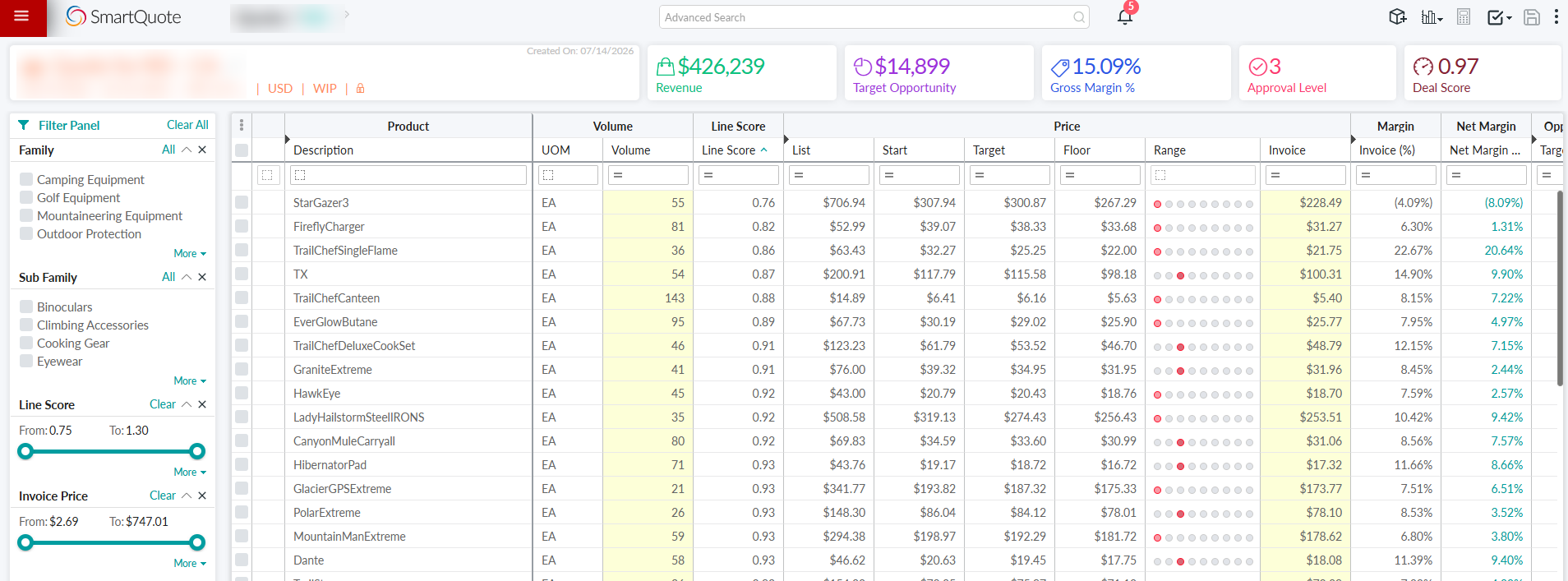
The full manufacturing case study describes the rollout in more detail. SmartQuote also connects to Salesforce and other major CRM platforms, so reps can quote from the opportunity they already work in.
Start the CPQ Implementation With Pricing, Then Configure
CPQ implementations that succeed with complex B2B pricing share one trait: the pricing decisions were made before the build. Clean agreements and an approval matrix on paper shorten every later phase. Teams that skip that work usually find the same issues during testing, when changes cost the most.
A practical first step is a pricing readiness review of your top 200 customer agreements and your current discount codes. The findings set the scope for configuration and give the project team a realistic timeline before contracts are signed.
Plan a CPQ rollout around your pricing
Talk to Vistaar about scoping a SmartQuote implementation around your price agreements and approval rules.
Request a demo
Frequently Asked Questions
These answers cover practical questions that come up during CPQ planning.
Who should own a CPQ implementation?
A business owner from sales or pricing should own scope and decisions, with IT owning integrations. Ownership on the business side keeps pricing policy questions from stalling the build.
Can CPQ replace ERP pricing?
CPQ can own quote prices and price guidance, while ERP stays the system of record for orders and invoices. The integration design decides which system holds each price and how changes flow between them.
Should CPQ handle rebates?
Rebate terms should be visible in the quote so net margin is accurate. Accrual and settlement usually belong in a rebate management system connected to CPQ.
What does a CPQ implementation cost?
Cost depends on scope and the implementation model. Ask vendors for a fixed-scope estimate tied to one product family and region, which makes proposals comparable.
When should a company replace its existing CPQ?
Replacement makes sense when pricing logic lives outside the tool in spreadsheets, or when approvals run through email because the current system falls short on modeling them.

As an experienced pricing solutions partner to some of the biggest names in global business, Vistaar offers a range of services to help our customers reach their maximum potential. Talk to us to see how we can help you create a more profitable future.