



Key Takeaways
- In B2B, revenue management sets the price for each customer and contract term, then confirms that price reaches the invoice
- Airline revenue management prices fixed seats, while B2B revenue slips through contract exceptions and off-invoice rebates
- Pricing should own the rules and floors, with sales negotiating within those boundaries
- Price realization and a price-volume-mix bridge show what actually moved revenue, since average selling price can climb as every customer pays less
- Tighter execution on prices you already set usually recovers more revenue than a more sophisticated pricing model
Revenue management is the discipline of setting what each customer pays and on what terms, then confirming that price reaches the invoice and the P&L. Airlines and hotels practice it on fixed capacity, such as the seats on a 7 a.m. flight. Manufacturers and distributors practice it on price realization across thousands of customer price lists and rebate agreements.
Suppose a $2 billion industrial distributor hires its first revenue management lead. List prices come from the pricing team and rebate programs from finance, while discount authority sits with regional sales directors and surcharge logic lives in SAP condition tables a consultant wrote in 2019.
Revenue slips in the handoffs between those groups, because each one answers to a different leader. The sections below translate the discipline from airlines to B2B, then walk through how a pricing team runs it day to day.
How B2B Revenue Management Differs From the Airline and Hotel Model
Airlines created the discipline to sell a fixed number of seats before departure. B2B companies borrowed the name and some of the math, while the economics underneath work very differently.
Vistaar's revenue optimization glossary records that classic definition: allocating existing capacity at the right price. A steel producer or a spirits supplier seldom runs out of capacity in that sense, so the work moves to how prices get negotiated and executed.
Two neighboring terms add to the confusion. Revenue operations aligns sales and marketing around pipeline, and revenue recognition governs when finance books a sale, while revenue management sits upstream of both because it decides the price itself.
The B2B Revenue Management Lifecycle
In B2B, revenue management runs as a loop of seven stages. Each stage hands work to the next one, and each has a typical point where value slips away.
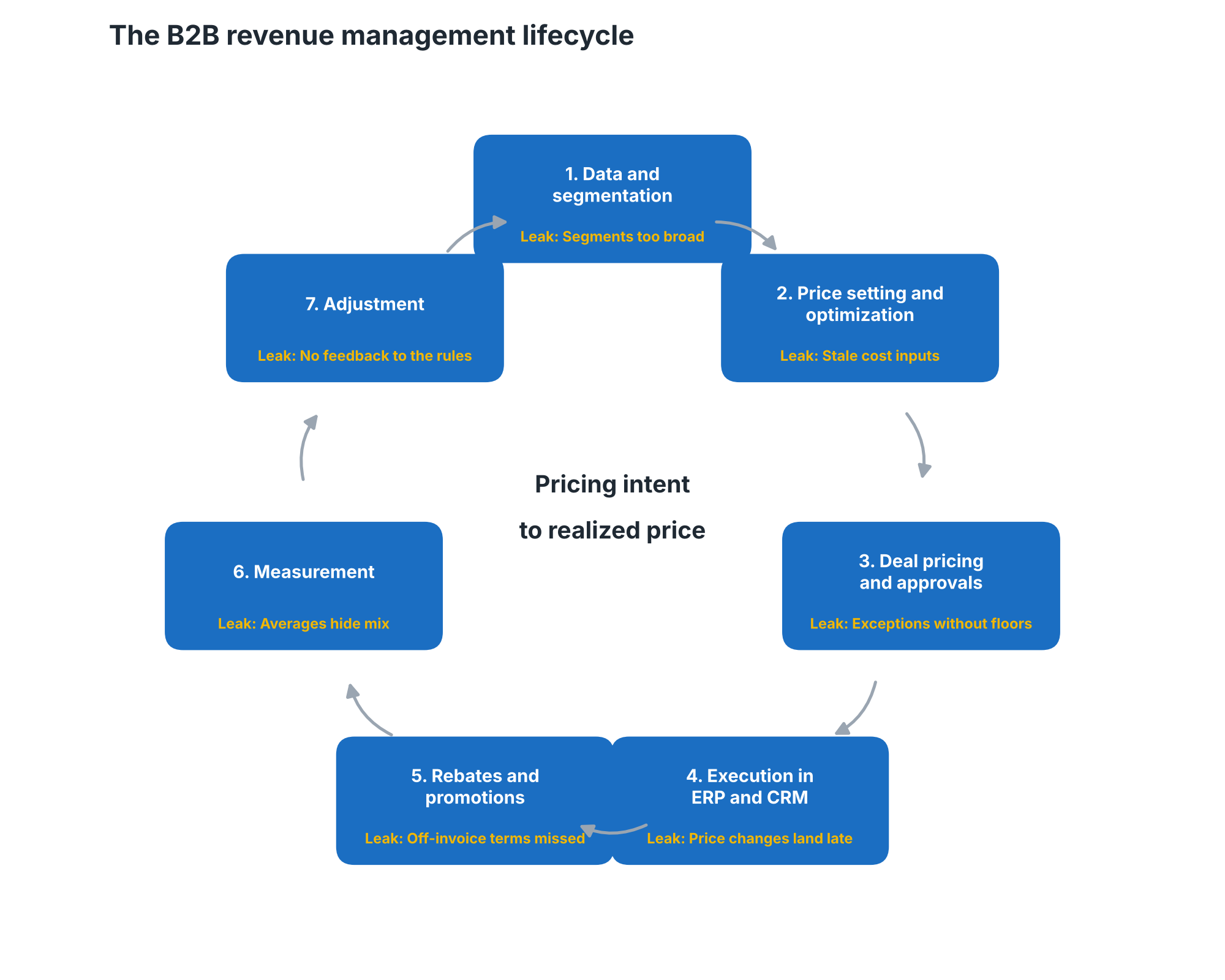
- Data and segmentation: Group customers by buying pattern and price sensitivity, since a segment that lumps a 40-truck fleet buyer with a single-site contractor forces one price onto two very different customers
- Price setting and optimization: Set list and customer prices against cost and value, with price optimization applied wherever transaction history supports it
- Deal pricing and approvals: Give each rep a target price and a floor, with a defined route for any quote below the floor
- Execution in ERP and CRM: Publish approved prices to every system that quotes or invoices before the next order cycle starts
- Rebates and promotions: Tie each off-invoice program to a measurable behavior and accrue it as qualifying orders ship
- Measurement: Separate the price effect from volume and mix effects, so each team sees what it actually moved
- Adjustment: Feed the findings back into segments and floors before the next pricing cycle
Consider a distributor that announces a 4% list increase on January 1. Its 20 largest accounts negotiate half of it back during the first quarter, and a growth rebate tier then pays out on the higher invoice values.
By June, realized price sits closer to 2%, even though every team involved followed its own process correctly. Each stage therefore needs a named owner, and the pricing approval workflow deserves the same attention as the price recommendation.
Who Owns Revenue Management in a B2B Company
With the lifecycle mapped, ownership becomes the question that stalls programs. The work crosses four functions, so each decision needs a single owner and a short list of people to consult.
The model that holds up in practice puts a central pricing team in charge of rules and floors. Sales negotiates inside those boundaries, and finance owns the measurement that tells everyone whether the system worked.
Some companies run this inside a broader commercial excellence program, which helps when sales effectiveness and pricing report to one executive. The ownership split stays the same in either setup.
Revenue Management Metrics That Show What Actually Happened
Clear owners need numbers that separate cause from effect. Each metric below answers one question well and hides another, so read them as a set.
Leadership often asks for average selling price (ASP) first. ASP can climb while every customer pays less, simply because mix shifted toward higher-priced products, which makes price realization the more reliable read.
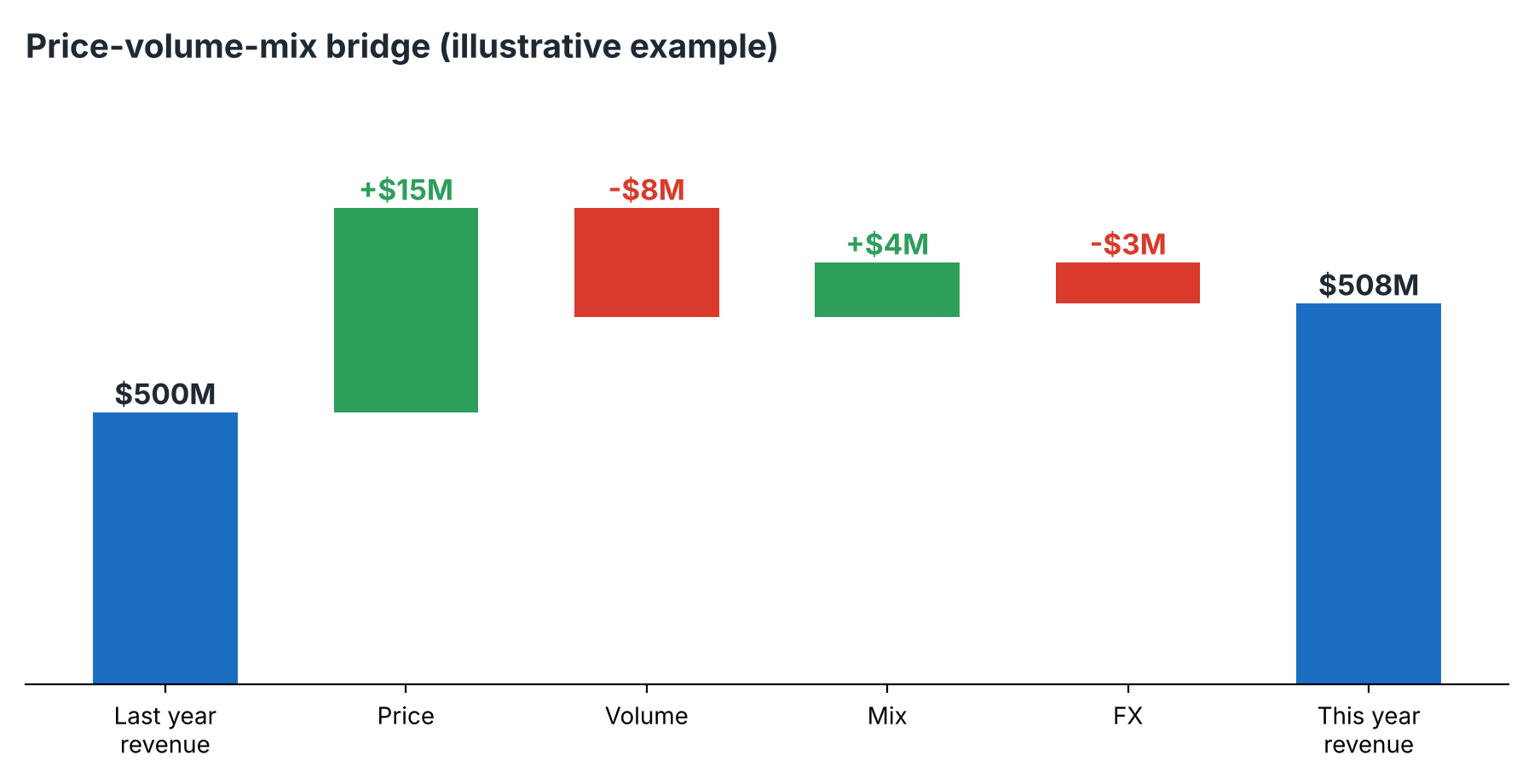
In the illustrative bridge above, a $500 million business grows to $508 million. A price-volume-mix analysis shows that price added $15 million while volume cost $8 million, a split the topline figure hides completely.
Revenue Management Strategies for Manufacturers and Distributors
Metrics show where revenue slips, and the five strategies below address its most common causes. Each one carries a trade-off that sales and finance should agree on up front.
Segment-based price corridors
A price corridor gives each customer and product segment a target and a floor, so a regional contractor and a national account in the same segment pay within a defined range. Reps give up some quoting freedom, and in return they need an exception path that answers within a day.
A Fortune 500 industrial manufacturer with more than 15,000 customers built its program on this model with Vistaar. It paired corridors with elasticity-based simulation and routed approvals by deviation from the recommended price and by estimated margin.
Structured cost pass-through
Tariffs and commodity indices now put cost pass-through on the pricing calendar every quarter. In April 2025, US importers told Boston Fed researchers they expected to pass about two-thirds of cost increases into prices within a year, roughly double the rate they reported from 2023 to early 2025.
Worth Knowing
NBER researchers estimate that 94% of the 2025 US tariffs passed through into the price of imports, so US importers bore most of that cost before deciding what to pass on.
A structured process decides by segment whether to pass a cost through as dollars or as a percentage. Contracts with raw material index pricing clauses should name the base cost and the reset date in writing.
Consistency across sales regions matters as much as the formula itself. A defined tariff response process keeps those calls aligned when the next cost change lands.
Deal guidance with margin floors
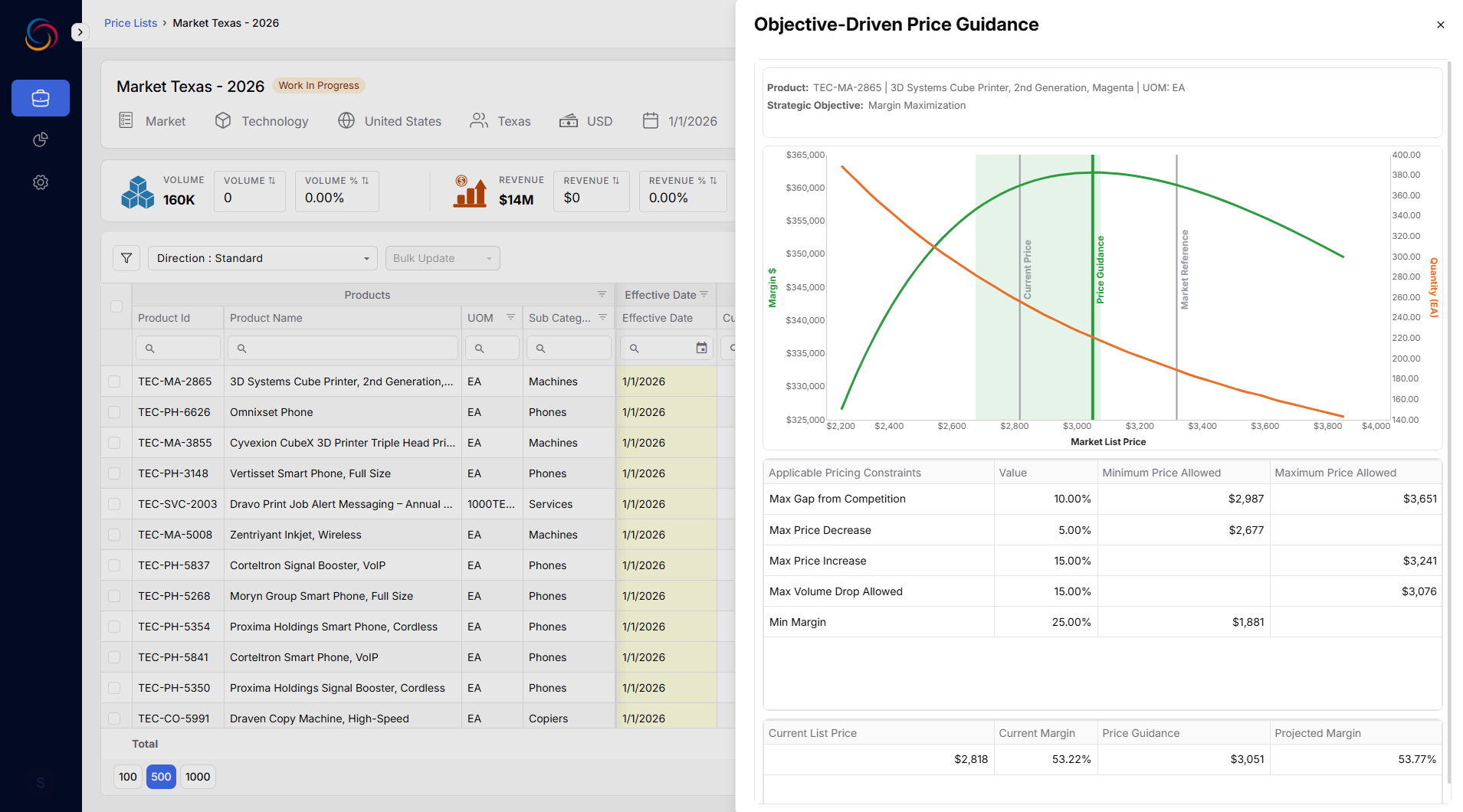
Deal guidance shows the rep the recommended price and the lowest acceptable price before the quote goes out, along with the margin each point between them earns. Those minimums need upkeep as costs move, and that upkeep costs far less than finding below-floor deals after the books close.
Take a steel service center quoting 300 coil orders a week. With floors in place, only the 5% of quotes below floor go to a manager, and the rest leave the same day.
Rebate and promotion design tied to behavior
Each rebate or promotion should pay for one behavior, such as year-over-year growth or a shift toward a premium product line. A program that pays out whatever customers do works as a price cut with extra paperwork.
Finance can test this with rebate program ROI, which compares each payout against the incremental volume or mix the program produced.
Mix management
Shifting volume toward higher-margin SKUs often recovers more than a list increase, especially with customers who resist list changes. At a building products manufacturer, that might mean steering contractors from commodity fasteners toward a coated line that carries eight more points of margin.
Sales incentives have to reward margin dollars for this to work. Changing the comp plan is usually the harder half of the project.
Where Revenue Management Programs Break Down
Even well-designed strategies stall at predictable points. The breakdowns usually sit in the handoffs between teams:
- Spreadsheet bridges: One analyst rebuilds the price-volume-mix workbook each quarter, so leadership sees results months after the decisions that drove them
- Orphaned ERP rules: Surcharges and customer overrides pile up in ERP tables until tracing which rule produced a given price takes days
- Overrides without review: Managers approve unauthorized discounts deal by deal, while the floors behind them stay unchanged for years
- Off-system rebates: Accruals live in spreadsheets outside pricing, so a deal that looked profitable at quote reveals its real margin only after settlement
- Reports without decisions: Dashboards flag margin leakage, and the flags sit there until someone files a ticket to change a rule
The usual response is a request for better reporting. Reporting shows where revenue slipped last quarter, and approval floors tied to execution are what stop it next quarter.
Find where your price realization slips
Vistaar connects deal guidance with rebates and ERP execution, so leaks show up before month-end reporting.
See how deal-level margin works
When Revenue Management Software Makes Sense
ERP systems store and execute prices well. Recommending prices and governing exceptions across 10,000 customer price lists calls for a different kind of tool, and the signals below show when a team has reached that point.
Adoption is moving in this direction. McKinsey's 2026 survey of nearly 4,000 B2B decision-makers found market leaders twice as likely as laggards to have adopted gen AI, at 44% against 22%.
The useful test for any tool is narrower: it should shorten the time between a pricing decision and the price on the invoice. A modern pricing tech stack keeps ERP as the system of record and adds pricing software for guidance and governance.
How Vistaar Supports B2B Revenue Management
Vistaar is enterprise B2B pricing and rebate optimization software, and its products map to the lifecycle stages above:
- Segmentation and optimization: Vistaar SmartOptimizer segments customers and products by purchase behavior and response to price, then simulates alternative price strategies to compare their margin and volume impact
- Price management and execution: Vistaar SmartPricing models price paths against cost movements and syncs approved prices to ERP and CPQ systems
- Deal pricing: Vistaar SmartQuote generates Start-Target-Floor price bands for each quote and sets approval requirements by discount depth or margin impact
- Rebates: Vistaar SmartRebates updates accruals with every qualifying transaction and keeps an audit trail from each accrual down to its transactions
- Promotions: Vistaar SmartPromotions models promotion scenarios before spend is committed and measures ROI at the campaign level
Regulated categories add another layer. In beverage alcohol, Vistaar applies market-specific pricing regulations and excise structures from one configuration, covered further in this review of alcohol revenue management software.
Vistaar was named a Leader in the inaugural 2026 Gartner Magic Quadrant for B2B Pricing and Rebate Optimization Software.
Where to Start Your Revenue Management Program
A B2B revenue management program pays off when the loop from pricing decision to invoice runs short, with a named owner at each stage. The order in which you build it matters more than the sophistication of any single step.
- Baseline: Measure price realization and pocket margin for the last two pricing cycles to see how much intended price actually landed
- Ownership: Assign one owner to each decision in the ownership table, then set floors by segment
- Rebates: Bring accruals into the same data as pricing, so deal margin reflects rebate liability
- Automation: Automate guidance and approvals once the rules are stable enough to encode
Teams that follow this order fix visible leaks first and invest in models once they can use them. Reversing the order tends to produce a sophisticated recommendation that still reaches the invoice weeks late, which is where much revenue leakage begins.
Run pricing and rebates in one connected loop
Talk to Vistaar about connecting segment pricing and approvals with rebates and ERP execution.
Request a demo
Frequently Asked Questions
These answers cover the questions that come up once the operating model is clear.
What is the difference between revenue management and yield management?
Yield management is the airline and hotel practice of pricing fixed, perishable capacity. Revenue management is the broader discipline, and in B2B it covers customer pricing and deal governance more than capacity.
Is revenue management the same as revenue recognition?
They are separate disciplines. Revenue recognition decides when finance books revenue under accounting standards, while revenue management decides what to charge and checks that the price reaches the invoice.
How does revenue growth management in CPG relate?
Revenue growth management, or RGM, is the CPG name for the same discipline. It leans on price-pack architecture and retailer trade terms, while B2B revenue management leans on contract pricing and deal governance.
How is revenue management different from pricing strategy?
Pricing strategy sets direction, such as value-based or cost-plus positioning. The revenue management loop then turns that direction into specific prices and approvals and measures the result.
What does a revenue manager do in a B2B company?
A B2B revenue manager maintains segments and price corridors and reviews exceptions against floors. The role also tracks price realization and coordinates cost pass-through with finance.

As an experienced pricing solutions partner to some of the biggest names in global business, Vistaar offers a range of services to help our customers reach their maximum potential. Talk to us to see how we can help you create a more profitable future.