



Key Takeaways
• Gross-to-net is the path from list price down to what you actually keep, after rebates, chargebacks, promotions, and other deductions.
• The common mistake is calculating it top-down, subtracting a lump-sum deduction from aggregate revenue, which no one can later trace.
• Accurate gross-to-net is built bottom-up: every transaction is enriched with the deductions that apply to it, then rolled up.
• Transaction-level detail lets you follow any deal from list price to net margin, filtered by SKU, customer, plant, or volume.
• Top-down estimates hide where margin actually goes. Bottom-up calculation shows it, which is what makes net numbers defensible.
A business unit reports strong gross revenue, and then the net comes in far lower, and no one can say exactly why. The deductions are real: rebates, chargebacks, promotions, freight, surcharges. Each one was subtracted as a lump sum at the top, so the gap between gross and net is a single big number nobody can break apart. The margin went somewhere. The report just cannot say where.
Calculating gross-to-net accurately is what turns that unexplained gap into a traceable path. Done right, you can follow any dollar from the list price a customer was quoted to the net margin the business kept, through every deduction in between. The method that makes this possible is the opposite of how most teams do it.
What Gross-to-Net Really Measures
Gross-to-net is the full distance between what you list a product for and what you actually keep after every deduction. Gross is the starting price. Net is what survives once rebates, chargebacks, promotions, discounts, freight, and surcharges have all taken their cut.
The deductions in between are the whole story, because that is where margin quietly leaves. A healthy gross number means little if the deductions below it are large and unmanaged. The point of a gross-to-net calculation is to see each deduction clearly. Not as one combined subtraction, but as distinct layers you can measure and question.
This is why gross-to-net is a discipline, not a single figure. It is the practice of accounting for every step down the waterfall, so the net at the bottom can be explained rather than merely reported. That clarity is the foundation of real pricing analysis, since you cannot manage a leak you cannot locate.
The stakes rise with the size of the deductions. In many industries the gap between gross and net runs to a large share of revenue, which means small errors in how deductions are handled move real money. Simon-Kucher reports that companies capture less than half of their intended price increases, and much of that shortfall lives in the deductions gross-to-net is meant to expose. What you cannot see in the waterfall, you cannot defend at the bottom of it.
The Deductions That Sit Between Gross and Net
To calculate gross-to-net, you first have to know what sits in the middle. The deductions are not interchangeable; each behaves differently, hits at a different point, and has to be attributed on its own terms. Treating them as one pool is the first step toward an inaccurate net.
Five categories account for most of the distance between gross and net:
- Discounts: reductions applied on the invoice itself, the most visible deduction and usually the first to be tracked.
- Rebates: back-end incentives paid after the sale, often tied to volume or growth, which makes them hard to attribute in real time.
- Chargebacks: amounts reclaimed after the fact, common in distribution and pharmacy, where the price to the end customer differs from the price to the distributor.
- Promotions: temporary allowances tied to campaigns, which need to be matched to the specific sales they drove.
- Freight and surcharges: logistics and handling costs that quietly move the real economics of a line.
Each of these lands at a different stage and requires its own logic to attribute correctly. A rebate depends on cumulative volume; a chargeback depends on a contracted end price; a promotion depends on a campaign window. Collapsing them into a single deduction figure is exactly what makes a top-down net impossible to defend, and separating them cleanly is what a disciplined pricing model requires.
Why Top-Down Gross-to-Net Falls Apart
The usual way teams calculate gross-to-net is top-down, and it is where accuracy breaks. Someone takes aggregate revenue for a business unit and subtracts an estimated lump for rebates, another for promotions, another for chargebacks. The math balances, but the result is an estimate wearing the costume of a fact.
The problem is that a top-down deduction is not tied to the transactions that caused it. Subtracting a million dollars in rebates from a business unit's revenue tells you the total, but not which customers, SKUs, or deals drove it. When the net looks wrong, there is nothing to drill into, because the deduction was never connected to the sales beneath it.
Two failures follow from the top-down approach, and both are structural:
- No traceability: a lump-sum deduction cannot be opened up, so a wrong or surprising net has no explanation and no fix.
- Misallocation: deductions applied at the aggregate level get spread evenly, hiding which products or customers are actually unprofitable.
Set the two methods side by side and the difference is stark on every measure that matters:
Make it concrete. Two customers each buy a million dollars of product. Top-down, the business unit subtracts its total rebate pool and both customers appear to carry the same deduction rate. In reality one earned a deep growth rebate and a stack of promotions while the other took list price with almost nothing back. The top-down view calls them equally profitable. The bottom-up view shows one is thin and the other is strong, and only the second view tells you which customer to protect and which to renegotiate.
The result is a net number that is roughly right at best and impossible to defend. It reports that margin was lost without showing where, which is the opposite of what a gross-to-net calculation is for. Sound rebate management depends on tying each deduction to its source, and top-down math severs exactly that link.
Build Gross-to-Net From the Transaction Up
Accurate gross-to-net is built the other way around, from the individual transaction upward. Instead of estimating deductions at the top, you attach each deduction to the transaction that generated it, then roll the enriched transactions up to whatever level you need.
The mechanism is transaction enrichment. As each sale enters the system, it is tagged with the specific deductions that apply to it. The line then carries its own full economic picture, rather than waiting for a lump-sum estimate later. Every transaction should carry its own:
- Rebate amount: the back-end incentive that specific sale accrued, under the program that applies.
- Chargeback amount: any chargeback tied to that transaction, calculated on the line, not the total.
- Promotion amount: the promotional cost attributed to that exact sale.
- Other price attributes: the discounts, freight, and surcharges that move the line from list to net.
Once every transaction is enriched this way, rolling up becomes accurate by construction. A business-unit net is the sum of thousands of fully-costed lines, not a top-line figure with estimates subtracted. This is the same transaction-level foundation that makes a pricing platform trustworthy at any level of aggregation.
Follow One Deal From List Price to Net Margin
The payoff of bottom-up gross-to-net is that you can follow a single transaction all the way down the waterfall. Because the line carries every deduction, you can read it from the list price at the top to the net margin at the bottom. Each step shows exactly what it took.
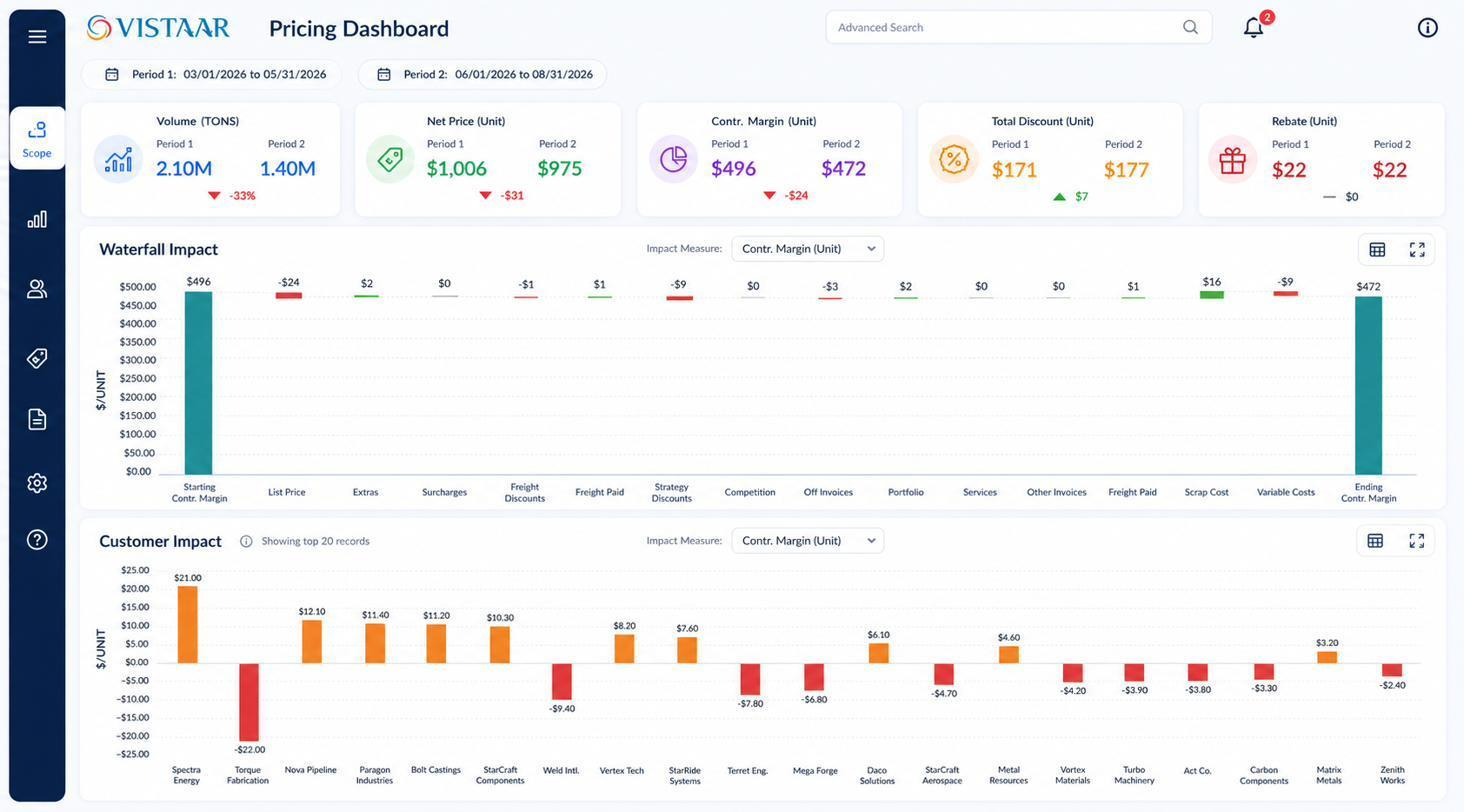
A single enriched line reads like a descent, each step taking its cut from the one above:
The list price was 100 and the net margin is 16.50, and every dollar of the distance is named. A top-down calculation would show only the endpoints and leave the 23.50 of deductions as one unexplained lump. The figures are illustrative; the traceability is the point.
That single-line view scales to any grouping you need. The same enriched transactions filter and roll up by SKU, customer, location, plant, or volume tier. The net stays visible at every level without losing the detail underneath. A question about one customer's true profitability is answered the same way as a question about a whole region: by aggregating the lines that belong to it.
This is what separates a gross-to-net number you can act on from one you can only report. When the net at any level opens up into the transactions that built it, a surprising figure becomes a starting point for investigation instead of a dead end. That traceability is where gross-to-net connects to broader price and margin management, because the same detail that explains the net also shows where to improve it.
Why Enrichment Has to Happen at Ingestion
The timing of enrichment matters as much as the method. Deductions should be attached to a transaction as it enters the system, not reconstructed later, because the context needed to attribute them correctly is freshest at the point of sale. Waiting to allocate deductions after the fact reintroduces the guesswork bottom-up calculation was meant to remove.
When enrichment happens at ingestion, every downstream report inherits accurate detail automatically. Finance does not rebuild the gross-to-net each period; it queries transactions that were already complete when they landed. The work moves from monthly reconstruction to a standing, always-current view, much like the shift a well-run AI-driven pricing process brings to any calculation.
This also keeps the whole chain consistent. Because every report draws from the same enriched transactions, a net margin quoted in one view matches the net margin in another. There is one version of the truth, built once at the source, rather than several estimates assembled separately and reconciled later.
What Accurate Gross-to-Net Makes Possible
Getting gross-to-net right is not an accounting nicety; it changes what a business can see and decide. When net is provable at every level, decisions that were guesses become grounded in real economics.
A few things become possible only with accurate, transaction-level gross-to-net:
- True customer profitability: you can see which customers actually make money after every deduction, not just which buy the most.
- Real product margin: you can rank SKUs by the margin they truly keep, exposing the ones that look busy but earn little.
- Targeted deduction control: you can find the specific programs and deals where deductions run heaviest and address them directly.
Each of these depends on the same thing: net that can be traced to its source. Without it, these questions get answered by instinct. With it, they get answered by the data, which is what a durable pricing strategy is built on. The visibility that gross-to-net provides is often where a business first sees the true shape of its own margin.
Where Gross-to-Net Accuracy Matters Most
Every business has a gross-to-net, but in some the deductions are so large that getting the calculation wrong is expensive fast. Distribution, manufacturing, consumer goods, and regulated sectors like pharmacy run heavy rebate, chargeback, and promotion programs, which makes the gap between gross and net both wide and volatile.
In these settings, the difference between top-down and bottom-up is not academic. A distributor managing supplier rebates on one side and customer incentives on the other has deductions flowing in both directions, and only transaction-level detail can net them correctly. A manufacturer running promotions across channels needs to know which channel actually earned its margin, not an average smeared across all of them.
The common thread is that heavy-deduction businesses cannot price well without seeing net clearly. A value-based approach falls apart if the value captured is hidden behind deductions no one can trace. For these companies, accurate gross-to-net is less a reporting preference than a condition for managing margin at all.
Conclusion
Gross-to-net comes down to one methodological choice, and only one side of it survives scrutiny. Calculate it top-down, subtracting estimated deductions from aggregate revenue, and you get a net number that is roughly right and impossible to defend. Calculate it bottom-up instead, enriching every transaction with the deductions it caused. Now you get a net you can trace from any list price to any margin, at any level of the business.
See gross-to-net at the transaction level. Request a demo to see how enriched transactions roll up into net revenue and margin you can trace by SKU, customer, and program.
Frequently Asked Questions
What is gross-to-net?
Gross-to-net is the path from a product's list price down to the net revenue or margin a business keeps, after rebates, chargebacks, promotions, discounts, freight, and surcharges. It measures every deduction between the price quoted and the money retained.
Why is top-down gross-to-net inaccurate?
Because deductions are estimated as lump sums against aggregate revenue, not tied to the transactions that caused them. The net cannot be traced, and deductions get spread evenly, hiding which customers or products are actually unprofitable.
What does transaction-level gross-to-net mean?
It means each sale is enriched with the specific rebate, chargeback, promotion, and other deductions that apply to it. Net is then built by rolling up fully-costed transactions, so any total traces back to the lines beneath it.
When should deductions be attached to a transaction?
At ingestion, as the transaction enters the system. Attributing deductions at the point of sale, when the context is freshest, avoids the guesswork of reconstructing them later and keeps every downstream report accurate automatically.

As an experienced pricing solutions partner to some of the biggest names in global business, Vistaar offers a range of services to help our customers reach their maximum potential. Talk to us to see how we can help you create a more profitable future.