




Key Takeaways
Pricing software is a category, not one product. It spans four types: analytics, management, optimization, and execution.
Most buying mistakes come from skipping one step: naming the problem that is costing you margin before shortlisting any vendor.
CPQ, rebate management, and revenue management sit next to pricing software, not inside it. Knowing the difference prevents overlap and gaps.
ERP, CRM, and spreadsheets store prices. They do not govern, optimize, or deliver them at scale, which is why companies outgrow them.
The strongest evaluation starts with your problem, your systems, and your data, then tests whether the four capabilities actually connect.
Search for pricing software and most of what you find describes a tool that watches competitors and changes prices by the hour. That is real, but it is built for retail and e-commerce, where a price is a public number on a website. For a pricing manager in manufacturing, distribution, or another B2B business, the problem looks nothing like that. It is thousands of customer-specific prices, discount behavior spread across a sales team, and getting the right price into the right system at the moment a quote goes out.
This guide gives you the category map and the evaluation framework to find the right fit. It covers what pricing software is, the four types and what each solves, the tools that sit next to it, how it works, and how to run an evaluation that ends in the right choice rather than the best demo.
What Is Pricing Software?
Pricing software is the category of software used to set, govern, optimize, and deliver prices across products, customers, channels, and quotes. It sits between pricing strategy and the point of sale. It holds the pricing logic in one place, applies rules and models to it, and pushes the resulting price into the systems where selling happens.
That is broader than the common picture of a tool that just tracks rivals and automates discounts. In B2B, pricing software is less about reacting to a competitor's list price and more about managing complexity. Many price types, many customer agreements, many channels, and several systems that all have to agree on the right price before an order is placed. The category exists because that complexity outgrows the tools most companies start with.
Why ERP, CRM, and Spreadsheets Stop Being Enough
Most companies do not begin with pricing software. They begin with what they already own: an ERP that holds product and customer data, a CRM that tracks deals, and spreadsheets stitching the two together. The spreadsheets carry the logic neither system was built for. That works until complexity grows, and then each part fails in a specific way.
Here is where each one runs out of room:
None of these is a pricing system. They store prices; they do not manage them. The cost of the gap shows up quietly, as margin leakage, inconsistent quotes, and pricing decisions made without the data to support them. Purpose-built pricing software closes that gap. It centralizes the logic and connects it to where decisions get made, the foundation any sound pricing strategy needs to run on.
The 4 Types of Pricing Software
The most common mistake in a pricing software search is treating the category as a single product. There are four types. Each type solves a different problem and sits at a different point in the workflow. Naming which one you need is the single most useful step before you look at any vendor.
The four are not rivals; they are stages of one workflow. Analytics finds the opportunity, management governs the logic, optimization recommends the price, and execution delivers it. The sections below take each in turn.
Price Analytics: See Where Margin Leaks
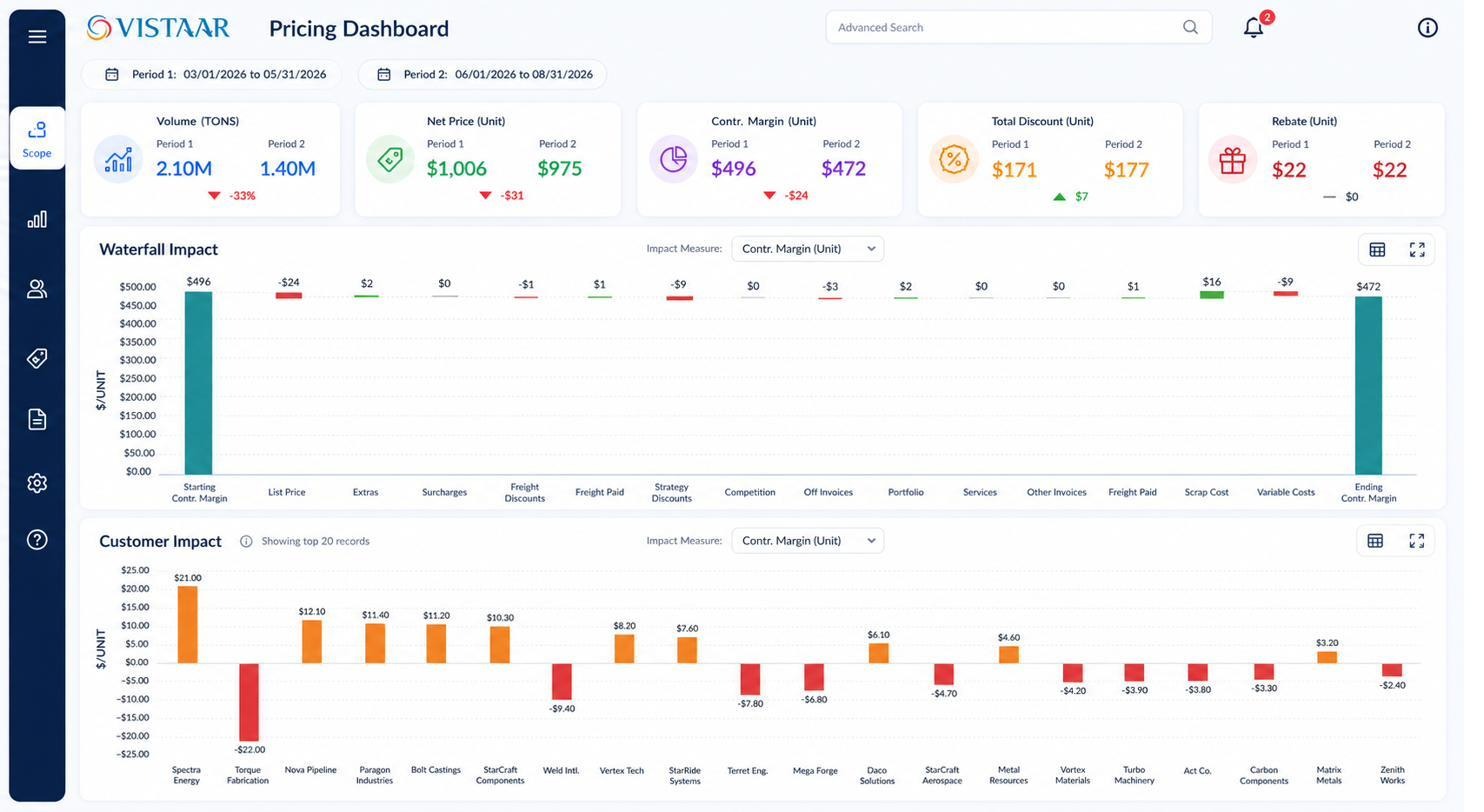
Price analytics tools read your transaction history and show what is actually happening to margin. They benchmark performance, flag where discounts erode profit, and surface the deals and accounts that quietly lose money. The job is diagnosis: you cannot fix a leak you cannot locate.
For most companies this is the honest starting point, because it answers the first question any pricing project runs into, which is where the money is going. Good analytics turns a vague sense that margin is soft into a specific list of where and why, the same rigor a disciplined pricing analysis brings to any number.
Price Management: Govern Prices at Scale
Price management is the system of record for pricing. It holds list prices, customer-specific conditions, contract terms, and price lists, and it lets a team update them under controlled workflows rather than by hand. This is what keeps 50,000 SKUs across direct, distributor, and channel pricing consistent instead of drifting apart.
The value is governance. When prices live as structured, version-controlled rules, the right price applies automatically and every change is authorized and traceable. That is the difference between pricing you can defend and pricing that lives in one person's spreadsheet. It is the core of what a pricing model needs to hold at scale.
Price Optimization: Recommend the Right Price
Price optimization uses historical data, elasticity signals, and AI to recommend a better price than cost-plus or intuition would produce. In B2B, that guidance usually takes the form of a corridor: a floor, a target, and a ceiling for a given customer, product, and volume, with the reasoning attached so a seller can act on it.
The point is guidance a salesperson can understand and defend, not a black-box number. That is what separates optimization that gets adopted from optimization that gets overridden. Grounding those recommendations in a company's own transaction data is what modern AI pricing is built to do.
Price Execution: Deliver the Price Where Decisions Happen
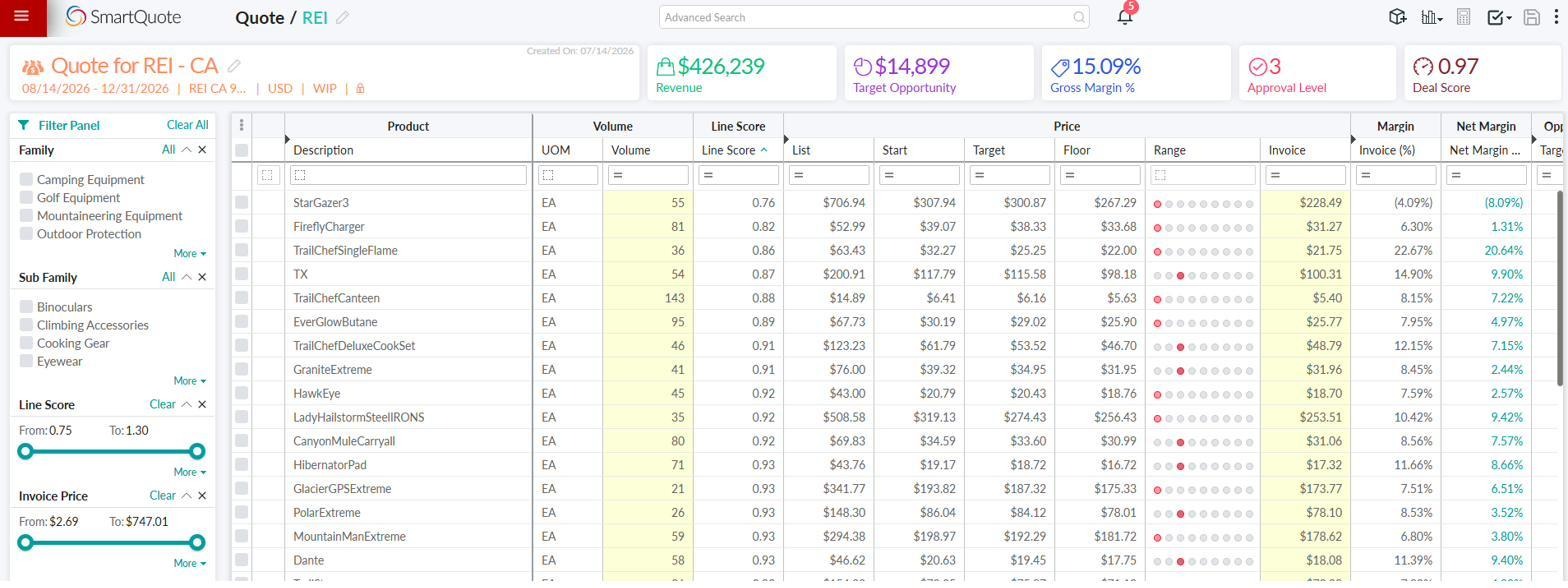
Price execution is where most implementations succeed or fail. A price that is calculated correctly but never reaches the seller, the CPQ, or the ERP at the moment of the quote changes nothing. Execution is the layer that delivers the right price into those systems through integrations, in real time, as the deal is built.
This is the difference between a price that exists and a price that gets used. When guidance arrives inside the quoting workflow, with the floor, target, and ceiling visible, the seller prices from it rather than around it. That is what price optimization software is meant to enable end to end.
How the Four Types Work Together
The strongest pricing platforms combine all four types into one system, so insight connects to action without a spreadsheet in the middle. Analytics surfaces the opportunity, management governs the logic, optimization recommends the price, and execution delivers it, and each hands cleanly to the next.
That does not mean every company needs all four on day one. Some start with analytics to find the leaks. Others have a management problem but not yet an optimization one. The honest move is to diagnose which problem is costing the most margin now and build from there, rather than buying capability you are not ready to use. What matters is that the pieces can connect later, so the tool you start with does not become a wall you have to tear down.
Where CPQ, Rebate Management, and Revenue Management Fit
Pricing software does not run alone. Most B2B environments include adjacent tools that handle specific commercial workflows, and knowing where each sits prevents a buyer from duplicating capability or leaving a gap.
- CPQ: configure, price, quote. It builds product configurations and produces the quote. It overlaps with execution, but it is the workflow layer; pricing software is the logic that tells the CPQ what price to use.
- Rebate and promotion management: handles the accrual, tracking, and settlement of deal commitments, a common source of margin leakage. A pricing decision that ignores an account's rebate obligation is incomplete.
- Revenue management: optimizes prices for perishable, capacity-constrained inventory such as airline seats or hotel rooms. It shares ground with optimization but is built for a different context.
- Price crawlers: monitor competitor prices online and can trigger repricing. Useful in retail and as one market input, but rarely the primary tool in negotiated B2B pricing.
The practical takeaway is simple. Core pricing software covers analytics, management, optimization, and execution. These other tools sit alongside it, feed into it, or serve an adjacent problem. Getting clear on which category solves your primary problem is the most important decision in the whole evaluation.
For B2B teams, the two adjacent tools that matter most are CPQ and rebate management, and each deserves its own evaluation rather than being folded into the pricing decision. The CPQ software guide covers the quoting side.
Rebates deserve the same separate treatment, since an unmanaged rebate obligation is one of the quietest ways margin leaks. The rebate management software guide covers how those commitments get tracked and settled.
How Pricing Software Works in B2B
Pricing software works by connecting the data spread across your business to the decision made at the point of sale. In B2B that means reconciling many price types, customer conditions, channels, and systems into one agreed price before a quote goes out. In practice it runs in five stages.
- Centralize the data: list prices, customer-specific prices, contract terms, discounts, and rebate obligations live in one source of truth instead of scattered across systems and memory.
- Apply rules and governance: floors, ceilings, approval workflows, and segmentation rules govern how prices are set and changed, all version-controlled and auditable.
- Generate price guidance: for teams using optimization, the system recommends a floor, target, and ceiling from transaction data and market context, with the reasoning shown.
- Deliver at the point of decision: the price reaches the CPQ, CRM, or ERP as the quote is built, not after the fact.
- Monitor and feed back: win rates, realized margins, and exception volumes flow back in, so the system stays current instead of going stale after setup.
The result is a pricing function that runs with consistency, speed, and visibility that manual work cannot match. The feedback loop in the last stage is what separates software that compounds in value from software that is configured once and slowly loses relevance.
How to Evaluate and Choose Pricing Software
Most evaluations start in the wrong place, with a vendor shortlist and a feature matrix, before the buyer has defined the problem. That optimizes for demo performance rather than fit, and it usually ends in a longer implementation that delivers less than expected. A better evaluation starts with your own situation, not the software.
Step 1: Start With Four Questions About Your Business
Before any vendor conversation, answer these. They decide which capabilities you actually need and how ready you are to use them:
- What problem is costing you the most margin now? Spreadsheet chaos points to management, chronic erosion to optimization, logic that never reaches sales to execution, and no visibility to analytics.
- What does your current stack look like? Map your ERP, CRM, and CPQ, then ask each vendor how many customers run that exact combination and what integration takes.
- How good is your data? Optimization trained on incomplete transaction data produces weak recommendations, so know how clean your data is before you rely on it.
- What will adoption require? The most common reason pricing software underdelivers is not technology but sales teams that do not trust the guidance, so weigh change management as heavily as features.
Step 2: Test the Capabilities That Actually Differentiate
Once the problem is named, the software comparison gets sharper. A few capabilities consistently separate a mature platform from a thin one, and each is worth testing against your own data rather than a clean demo set:
- A unified data model: analytics, management, optimization, and execution running on one source, not four tools you reconcile.
- Configurable governance: approval workflows, floors, and audit trails you can set to your own policy.
- Explainable recommendations: guidance with the reasoning attached, so sales can act on it and defend it.
- Integration depth: proven connections to your specific ERP and CRM, not a generic promise.
- A track record in your industry: reference customers in your sector with verifiable outcomes, which signals more than an analyst ranking alone.
The test that beats any feature checklist is to bring your own complexity to the demo. A real agreement, a messy discount case, a live integration question, then ask the vendor to run it end to end. The platforms that hold the logic from insight to delivered price will show it; the ones that cannot will lose the thread in the middle.
What Good Pricing Software Looks Like in Practice
The evaluation tells you what to look for. This is what it looks like when it is working, and the pattern is consistent: the results come from the operating model, not model sophistication alone.
Four things tend to be true in a working setup. There is one answer to the question of what the right price is for a given customer, product, and volume, and everyone can find it. Sales teams use the guidance because it is explainable. They stop asking "can I go lower" and start asking "what does the system say and why." Exceptions are governed rather than avoided: made visible, routed for approval, and logged. Outcomes also feed back into the model, so the pricing function gets smarter over time instead of plateauing.
The direction of travel is toward more automation and intelligence in that loop. McKinsey's April 2026 research surveyed more than 400 B2B pricing executives. The share expecting to adopt generative or agentic AI in pricing within one to three years jumps from 10 to 30% today to 65 to 85%. The capability is moving from edge to baseline, which raises the value of choosing a platform built to absorb it rather than one bolted together after the fact.
How Vistaar Brings the Four Types Together
Vistaar is built around the idea that the four types work best as one connected system rather than four tools a company has to integrate itself. Each capability maps to a part of the platform, and they share the same data and governance.
- Analytics: transaction-level visibility into margin, leakage, and performance across customers, products, and channels.
- Management with SmartPricing: list-price and customer-specific price management, agreements, and governed update workflows at scale.
- Optimization with SmartOptimizer: price and deal recommendations grounded in a company's own transaction data, with the reasoning attached.
- Execution with SmartCPQ: the right price and guidance delivered into the quoting workflow, with floor, target, and approval routing in place.
Because these run on one platform and integrate with enterprise systems such as SAP, the price a seller sees is the same one finance can trace and the same one policy governs. Vistaar was named a Leader in the 2026 Gartner Magic Quadrant for B2B Pricing and Rebate Optimization Software. For any buyer, though, the more useful test remains a reference customer in their own industry. The value is not any single module; it is that insight, governance, recommendation, and delivery stay connected, so the right price reaches the decision without a spreadsheet in between.
Conclusion
Choosing pricing software comes down to one discipline: name the problem before you shortlist the tool. Pricing software is a category of four types: analytics to see the leaks, management to govern prices, optimization to recommend them, and execution to deliver them. The right starting point is whichever one is costing you the most margin today. ERP, CRM, and spreadsheets will not do this job, and the adjacent tools like CPQ and rebate management solve neighboring problems, not the core one.
Evaluate for your own situation and your own data, not the smoothest demo, and test whether the capabilities actually connect end to end. The platform worth choosing is the one where insight, governance, recommendation, and delivery run as one system, so the right price reaches the right decision every time. To see the four types working together on your own pricing complexity, a short walkthrough is the fastest way to judge the fit.
Frequently Asked Questions
What is pricing software?
Pricing software is the category used to set, govern, optimize, and deliver prices across products, customers, channels, and quotes. It sits between pricing strategy and the point of sale, replacing the spreadsheets and system workarounds most companies rely on longer than they should.
What are the four types of pricing software?
Price analytics, price management, price optimization, and price execution. Analytics finds where margin leaks, management governs prices at scale, optimization recommends the right price, and execution delivers it into the systems where selling happens. Strong platforms combine all four.
What is the difference between pricing software and CPQ?
Pricing software is the logic layer that centralizes rules and calculates the right price. CPQ is the workflow layer that configures products and produces the quote. Pricing software sits upstream of CPQ; buying CPQ without it means fast quotes built on inconsistent logic.
Do I need pricing software if I already have SAP or Salesforce?
Usually yes. SAP stores prices but cannot tell you whether they are consistent or correctly applied. Salesforce tracks deals but does not centralize pricing logic or govern discounts at scale. Pricing software integrates with both and adds the layer neither was built to provide.
How long does pricing software take to implement?
A focused rollout targeting one capability can show impact in weeks. Broader deployments across multiple ERPs, channels, and regions typically run three to twelve months. The biggest factor is not the software but the clarity of requirements and readiness to adopt new workflows.

As an experienced pricing solutions partner to some of the biggest names in global business, Vistaar offers a range of services to help our customers reach their maximum potential. Talk to us to see how we can help you create a more profitable future.