




Key Takeaways
Quote automation, discount approvals, and dashboards are commodities. Every platform has them, so they do not separate the winners.
The real question is whether the software can operationalize a pricing strategy, or only automate whatever pricing you already have.
For manufacturers and distributors, the strategy that has to be encoded is segmentation, cost-to-margin logic, and getting the right price into a quote across thousands of SKUs.
Most implementations fail for a strategic reason, not a technical one: the tool faithfully automates a pricing model no one validated.
Evaluate against your own data, your own margin structure, and how your sales team actually quotes, not a feature checklist.
The search for B2B pricing software usually starts after a margin problem. A round of cost increases cannot be passed through cleanly. A big account turns out to be barely profitable once every discount and rebate is counted. Or finance asks why realized margin keeps slipping, and the honest answer is a spreadsheet no one fully trusts. If that is roughly where you are, this guide is built to help you evaluate tools rather than admire them.
The trap is that every vendor demo looks the same. Each shows a clean quote builder, an approval workflow, and a dashboard, and each calls itself a B2B pricing platform. Those features are real, and they are also table stakes. One harder question separates a tool that changes your margins from one that just adds software on top of the same problems. Can it operationalize a pricing strategy, or does it only automate the pricing you already have? For how the whole category fits together, the guide to pricing software gives the map; this article focuses on the B2B cut, and especially on manufacturers and distributors, where the stakes and the complexity are highest.
What B2B Pricing Software Should Actually Do
B2B pricing software is the system that sets, governs, and delivers prices across products, customers, channels, and quotes to hit a business objective, usually margin, within the rules a company defines. It sits between pricing strategy and the point of sale, holding the pricing logic in one place and pushing the right price into the systems where selling happens.
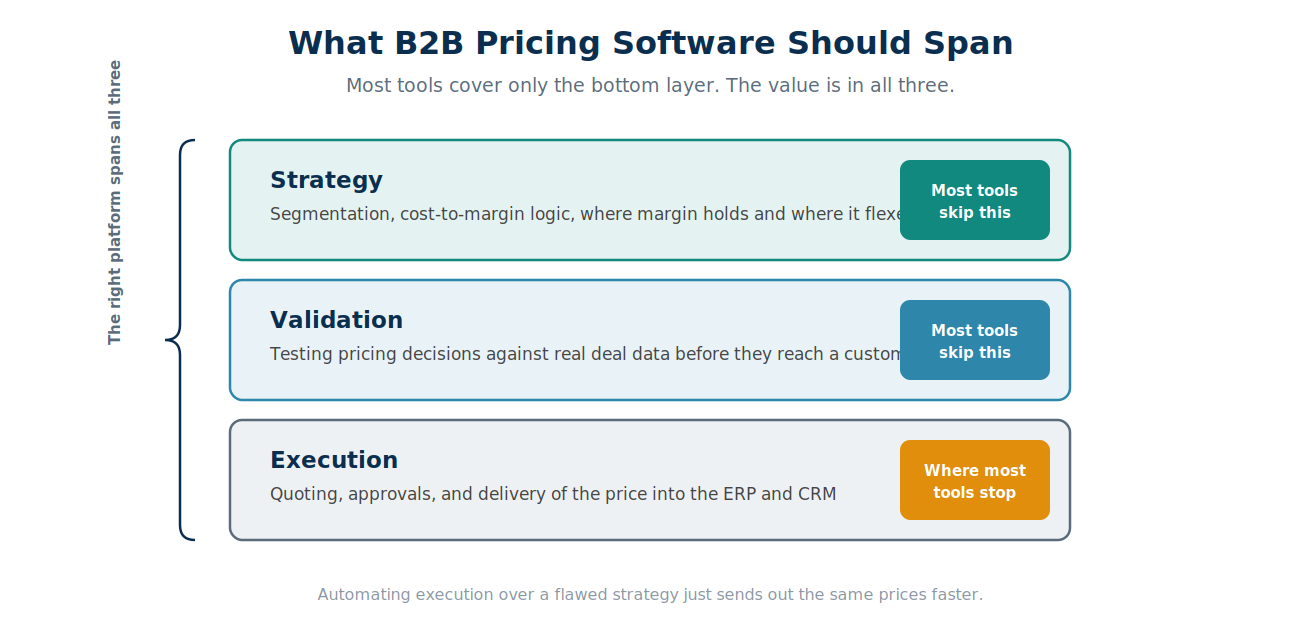
The distinction that matters is what the software actually operationalizes. Three things have to work together for it to help:
- Strategy: the pricing decisions themselves, how customers are segmented, how price relates to cost and value, where margin is protected and where it flexes.
- Validation: the ability to test those decisions against real transaction data before they reach a customer, so a change is checked rather than guessed.
- Execution: the operational layer that makes the strategy real in a quote: pricing guidance, approvals, and delivery into the ERP and CRM.
Most B2B pricing tools only occupy the third piece. They automate execution and leave the strategy and validation to spreadsheets and instinct. A platform that spans all three is what separates real pricing software from a faster way to send out the same flawed prices, and it is the foundation any sound pricing strategy needs to run on.
Why Most Tools Only Solve the Execution Layer
The reason most B2B pricing software stops at execution is that execution is the easy part to build and the easy part to demo. Automating a quote or an approval is a solved problem. Encoding a defensible pricing strategy, and checking it against how customers actually behave, is much harder. So most tools skip it and hope the customer already has the strategy figured out.
The result is a familiar failure. A manufacturer buys a slick quoting tool, points it at prices that were never right, and now sends out the same underpriced deals faster and with better formatting. A distributor automates discount approvals over a discount policy no one has questioned in years. The tool faithfully enforces rules that are themselves the source of the margin leak. The software works exactly as sold. The pricing was the problem, and the software was never asked to fix it.
This is why the strategy question matters more than the feature list. A tool that only executes will optimize whatever it is given, including a pricing model quietly costing you margin on every deal. That is exactly what careful pricing analysis is meant to catch before a purchase.
The Strategy Questions to Answer Before You Buy
Before evaluating any platform, a business should be able to answer a few questions about its own pricing. If these are unresolved, no software fixes them; it just automates the confusion faster. For a manufacturer or distributor, the questions are concrete.
- How are customers actually segmented? Not by size alone, but by how they buy, what they value, and what margin each segment should carry. A price that ignores this treats a strategic account and a one-off buyer the same.
- How does price relate to cost and value? Cost-plus is simple and quietly leaves money on the table; value and segment-based pricing capture more but need the data to support them. The tool has to fit the answer.
- Where does margin actually leak? Between list price and pocket price, margin drains through discounts, rebates, freight, and surcharges. Knowing where is a prerequisite, because software cannot plug a leak no one has located.
- How should a price reach a quote? As a firm number, or as guidance a rep works within? The answer shapes which capabilities matter and which are noise.
Answering these first is what turns a software search into a real evaluation. The right platform then encodes those answers; the wrong one forces you into its own assumptions. This is the same groundwork that a clear pricing model depends on, whatever tool you eventually choose.
What to Evaluate in a B2B Pricing Platform
Once the strategy is clear, the software comparison gets sharper. Set aside the commodity features every vendor has and look at the capabilities that decide whether a platform can operationalize your strategy rather than just run quotes.
Segmentation and Price Setting
The platform has to hold pricing the way your business actually differentiates it: by customer segment, channel, region, and volume, not one list with exceptions bolted on. For a distributor managing thousands of SKUs across many customer types, this is the core capability. Ask whether the tool can model your real segmentation, or whether it flattens everything into tiers that fit no customer well.
Margin and Deal Visibility
A quote can look healthy on invoice terms and be thin once discounts, rebates, and freight are counted. The platform should show true margin, the pocket margin after every deduction, as a deal is built, not in a report weeks later. Without that, a sales team is negotiating blind, and margin leaks in plain sight.
Integration That Enforces, Not Just Connects
Pricing logic that lives inside a CRM or a spreadsheet is whatever those tools happen to enforce, which drifts over time. The right platform holds the pricing logic centrally and pushes it into the ERP and CRM, the systems that quote and invoice. Every quote then traces back to the strategy. If a sales rep can quote from memory or a side spreadsheet, the software has stopped governing pricing. It becomes a reporting tool that documents the chaos after the fact. This is where a full pricing platform earns its place over a bolt-on.
Optimization and Guidance
Beyond enforcing rules, a strong platform recommends a better price, a floor, target, and ceiling for a segment and deal, grounded in the company's own transaction history. In a negotiated B2B setting the guidance has to be explainable, because a rep has to defend the number, which is the standard modern AI pricing has to meet.
Why Most B2B Pricing Software Implementations Fail
Most implementation guides give a tidy five-step process. That is not where implementations actually fail. They fail for reasons that have little to do with the configuration and everything to do with the pricing underneath.
Three failure modes account for most of it:
- The wrong-model problem: the software automates a pricing model no one validated, so discounting continues because the underlying prices were never defensible, and the analytics look good in a demo but drive no action.
- The data-quality trap: teams spend months cleaning data to fit the old model instead of asking whether the old model should survive, and end up with a more efficient version of the same problem.
- The sales-team pushback: reps resist a system that constrains their discounting, and rather than fix the pricing, the company loosens the rules until the tool permits exactly the behavior it was bought to prevent.
The common thread is that the software is the execution layer, not the decision. Fix the strategy, the data, and the governance first, and the tool compounds their value. Skip them, and it faithfully automates the wrong thing, which is why grounding the purchase in a clear value-based approach matters more than any feature.
How B2B Pricing Software Differs for Manufacturers and Distributors
Most B2B pricing content assumes a software company: subscription tiers, per-seat metrics, billing platforms. Manufacturing and distribution are a different world, and the pricing software built for one rarely fits the other. The complexity is not in a subscription metric; it is in the sheer scale and the two-sided economics of the business.
A few characteristics set these industries apart and should shape the evaluation:
- Scale of the catalog: tens of thousands of SKUs across many customer segments and channels, where consistency is impossible to maintain by hand.
- Cost volatility: raw material, freight, and tariff costs move constantly, so the software has to reprice quickly or margin erodes before anyone reacts.
- Two-sided margin for distributors: supplier rebates and claimbacks on one side, customer pricing and rebates on the other, and the real margin is what survives both.
- Negotiated, quote-based selling: the price reaches the customer through a rep and a quote, so guidance and margin visibility at the deal matter more than a public list.
Set the two worlds side by side and the mismatch is obvious on every axis that matters.
A platform built for SaaS subscriptions will not handle the right column well, and a generic tool flattens it into tiers that miss the point. This is the same distinction that runs through choosing rebate management and any other capability for an industrial business: the software has to fit how the industry actually makes and loses margin.
The B2B Pricing Software Buying Checklist
Pulling it together, here is a checklist to take into any evaluation. It is ordered deliberately, strategy first, because a tool that aces the features and fails the fit will still disappoint.
Take the same checklist to every vendor, and weight strategy fit and industry fit most heavily. A tool your team will actually use, that fits how your business makes margin, beats a more powerful one that does not.
How Vistaar Fits a Manufacturing and Distribution Pricing Evaluation
For an industrial business running this evaluation, Vistaar is built to operationalize a pricing strategy, not just automate quotes, and it is built for the scale and economics of manufacturing and distribution specifically.
Against the checklist above, the pieces line up by design. Pricing is held by segment, channel, region, and volume across large catalogs. Optimization draws on a company's own transaction history to set defensible price corridors rather than blanket tiers. Margin visibility reaches true pocket margin, after discounts, rebates, and freight, as a deal is built, so a rep negotiates with the real number in front of them. Because it runs on one platform spanning list pricing, agreements, and rebates, and integrates with enterprise systems such as SAP, the price reaches the quote and order workflow. It stays consistent with the rest of a company's pricing. Vistaar's fit for this segment is reflected in its recognition as a Leader in the 2026 Gartner Magic Quadrant for B2B Pricing and Rebate Optimization Software, though the more useful test for any buyer is a reference customer in their own industry. The direction of the market supports the shift toward this kind of capability: McKinsey's April 2026 research found that among more than 400 B2B pricing leaders, the share expecting to adopt generative or agentic AI in pricing within one to three years rises from 10 to 30% today to 65 to 85%.
To judge the fit against your own catalog, margin structure, and quoting motion, a short walkthrough is the fastest test.
Conclusion
Choosing B2B pricing software comes down to one distinction the demos rarely make. Quote automation, discount approvals, and dashboards are commodities that every platform offers, so they cannot be what you buy on. What matters is whether the software can operationalize a pricing strategy, encoding your segmentation, cost-to-margin logic, and real margin picture. Or whether it only automates the pricing you already have, flaws and all.
For manufacturers and distributors, that strategy is specific: segmentation across thousands of SKUs, true margin after every discount and rebate, and the right price reaching a negotiated quote. Answer the strategy questions first, evaluate against your own data and your own way of selling, and weight industry fit heavily. The platform worth choosing is the one that fits how your business actually makes and loses margin, and that your team will use every day. To see strategy-led B2B pricing on your own numbers, a short walkthrough is the fastest way to judge it.
Frequently Asked Questions
What is B2B pricing software?
It is software that sets, governs, and delivers prices across products, customers, channels, and quotes to meet a business objective within defined rules. Beyond automating quotes and approvals, the strongest platforms operationalize a pricing strategy rather than just executing whatever pricing exists.
What features matter most in B2B pricing software?
Beyond commodity quoting and dashboards: segmentation and price setting that matches how you differentiate, true margin visibility on a deal, integration that enforces pricing in your ERP and CRM, and explainable optimization. Strategy fit and industry fit matter more than raw feature count.
Why do B2B pricing software implementations fail?
Usually for a strategic reason, not a technical one. The tool automates a pricing model no one validated, so discounting and margin leakage continue. Data cleanup drags, and sales teams push back until the rules are loosened to what the tool was bought to prevent.
How is pricing software different for manufacturers and distributors?
The complexity is scale and two-sided economics, not subscription metrics: tens of thousands of SKUs, volatile costs, supplier and customer rebates, and negotiated quotes. Software built for SaaS subscriptions or retail rarely fits how industrial businesses make and lose margin.
What is the difference between B2B pricing software and CPQ?
CPQ configures products and produces quotes, the execution layer. Pricing software is the logic that decides what price the CPQ should use. Pricing software sits upstream; buying CPQ without it means fast quotes built on pricing no one validated.

As an experienced pricing solutions partner to some of the biggest names in global business, Vistaar offers a range of services to help our customers reach their maximum potential. Talk to us to see how we can help you create a more profitable future.