




Key Takeaways
A pricing engine is the logic layer that turns inputs like cost, competitor data, and rules into a final price, sitting between source systems and sales channels.
It works in three stages: ingest data, run it through a cascade of rules, and publish the resulting price with an audit trail.
The rule cascade is what makes it a B2B tool: base list, customer-specific, contract, and volume-tier prices resolve by priority, with a margin-floor check last.
A pricing engine is broader than a repricer. A repricer reacts to competitors; an engine governs the whole pricing logic.
Selection turns on integration with ERP and PIM, the scale of SKUs and rules it handles, and whether your team can configure it without IT.
When a B2B sales rep asks "what is our price for this customer on this product at this quantity," the honest answer is rarely a single lookup. It is the result of a base list price, a customer-specific agreement, a possible contract rate, a volume-tier discount, and a margin floor. All of it resolved in the right order. A pricing engine is the software that resolves that chain automatically, every time, instead of leaving it to a spreadsheet and someone's memory.
This guide explains how pricing engine software actually works, not just what it does. It walks the three stages of price resolution, goes deep on the rule cascade that makes an engine a genuine B2B tool, and covers the contract and customer-specific logic that distinguishes serious engines. It then lays out the types and features and finishes with the selection criteria that matter. For the wider category, the guide to pricing software gives the map; this article drills into the engine at its core.
What Is a Pricing Engine?
A pricing engine is software that centrally determines and manages prices by applying defined logic to input data. It sits as a logic layer between source systems, the ERP that holds cost and the PIM that holds product data, and the channels where selling happens, the online store, the marketplace, or the B2B quote. Every price passes through its rules, gets validated, and is logged.
It is worth separating a pricing engine from a repricer, because the terms get used loosely. A repricer reacts to competitor prices and adjusts yours to match. A pricing engine is broader: it governs base price lists, commercial rules, customer segmentation, promotions, and integrations across the whole stack. Repricing can be one input a pricing engine considers, but the engine is the system that resolves the final number. That distinction matters most in B2B, where a price depends on far more than what a competitor is charging, which is where a governed price optimization layer proves its worth.
How a Pricing Engine Works
A pricing engine works in three stages: it ingests data, applies rules to it, and publishes the resulting price. The whole cycle runs automatically, either in real time or on a schedule, and repeats whenever an input changes.
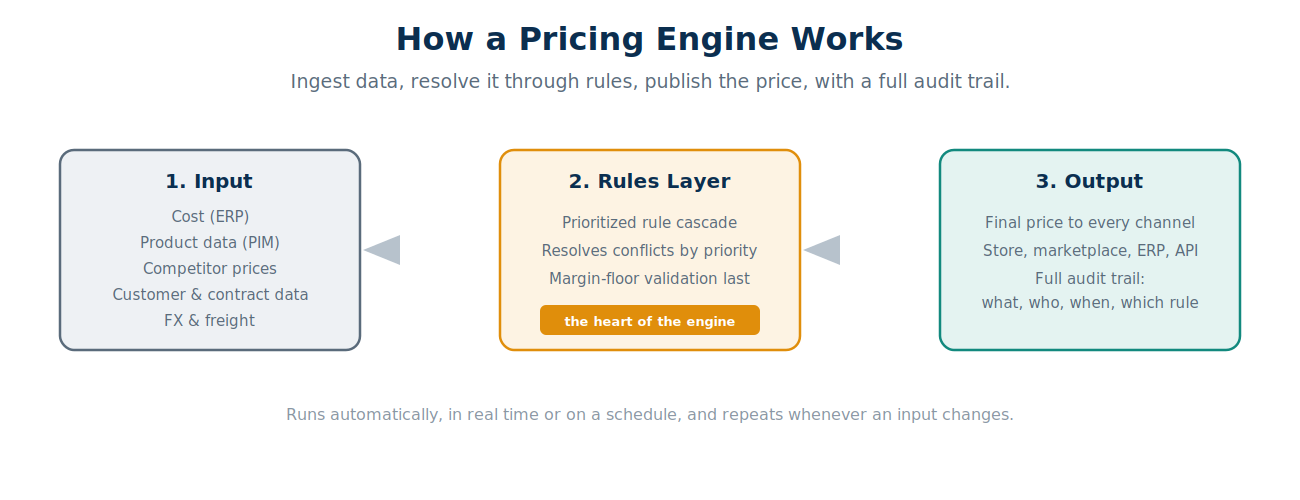
Input: The Data the Engine Reads
The engine pulls from multiple sources. Typical inputs are purchase and standard cost from the ERP, product attributes from the PIM, and competitor prices from market monitoring, plus exchange rates, freight, and customer and contract data. Data arrives by real-time API, scheduled file feed, or direct ERP sync, and the right method depends on how fast each input changes. Cost may refresh daily; competitor prices may need hourly updates.
Processing: The Rules Layer
The core of the engine is the rules layer, where pricing logic lives as conditional, prioritized rules. This is where the real work happens, and it is worth understanding in its own right, so the next section walks the cascade in detail. In short, rules are processed in a defined order, and when two rules conflict, the higher-priority one wins.
Output: Publishing the Price
After the rules resolve a final price, the engine distributes it to every connected channel: the store, the marketplace, the ERP, or an API for partners. It records the change with a full audit trail of who or what set it, when, and which rule applied. Publishing happens by API push, API pull, or file export, and most businesses combine methods, with the store fetching prices live while a marketplace takes a periodic feed.
How the Rule Cascade Resolves a B2B Price
The rule cascade is the part most explanations skip, and it is exactly what makes a pricing engine a B2B tool rather than a fancy calculator. In B2B, a single product does not have one price; it has a different price depending on the customer, the contract, and the quantity. The cascade is how the engine resolves all of that into one number, in the right order.
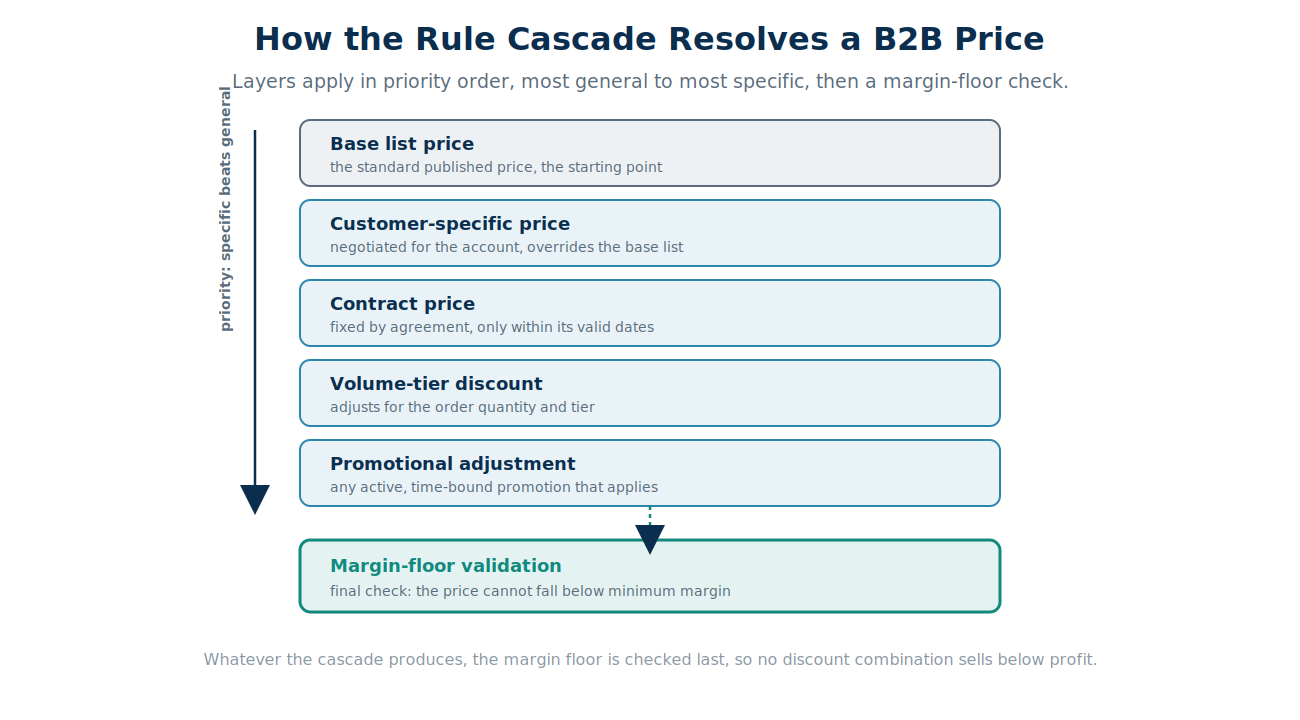
A typical cascade resolves a price through layers, from most general to most specific, with a validation step at the end:
- Base list price: the standard published price for the product, the starting point when nothing more specific applies.
- Customer-specific price: a negotiated price tied to a particular account, which overrides the base list for that customer.
- Contract price: a rate fixed by a signed agreement, applied only within the contract's valid dates and reverting to the standard price when it expires.
- Volume-tier discount: the adjustment for the order quantity, assigning the customer to the right tier based on the volume being purchased.
- Promotional adjustment: any active, time-bound promotion that applies to the product, customer, or period.
- Margin-floor validation: a final check that the resolved price does not fall below the minimum acceptable margin, regardless of what the layers above produced.
Two properties make this reliable. First, priority. The layers apply in a set order, so a customer-specific price beats the base list, and a contract price beats a general customer rate, without ambiguity. Second, validation last: whatever the cascade produces, the margin floor is checked at the end, so no combination of discounts can accidentally sell below the profitability threshold. That final guardrail is what lets a business hand pricing to automation without handing over margin control, the same discipline that underpins any serious pricing analysis.
Contract and Customer-Specific Pricing Logic
The cascade only works if the engine handles the two hardest B2B cases well: contract pricing and customer-specific price lists. These are where generalist and e-commerce-oriented engines tend to fall short, and where a B2B engine earns its place.
Contract pricing means a customer has agreed prices fixed for a defined period. A real engine manages the whole lifecycle. It applies the contract rate only during the valid window, reverts to the standard price the moment it expires, and flags agreements approaching their end so they can be renegotiated rather than lapsing silently. Without that time-awareness, a contract price either lingers past its term or gets forgotten.
Customer-specific price lists let a key account hold negotiated prices on specific products that take priority over the general list. The important detail is that these overrides still pass through the same validation, so a customer-specific price is bound by the same margin floor as any other. That prevents a rep from quoting a negotiated price that quietly breaches profitability. Handling both cleanly is what separates a B2B pricing engine from a retail repricer, and it connects directly to how rebate and off-invoice terms are accounted for in the true price.
The Types of Pricing Engines
Pricing engines fall into three types by how they decide a price. They are not mutually exclusive, and many businesses combine them, but the distinction clarifies what a given tool is actually doing.
For most B2B companies, a rule-based engine is the right center of gravity, because every price change can be justified and controlled, which B2B governance demands. Many start rule-based and add dynamic or AI elements as their data and confidence grow, so the practical requirement is an engine that allows that progression without a platform switch. That gradual path toward more automated AI pricing is easier when the foundation is a solid rules engine.
Key Features to Look For
Beyond the type, a capable pricing engine shares a set of core features. Judge them against your own pricing complexity, not a demo catalog.
- Centralized price-list management: one place to create and distribute multiple lists, base, customer, contract, promotional, each with its own rules and validity periods.
- Configurable rules without code: a visual editor so a pricing manager can change logic directly, without a developer or a support ticket.
- ERP, PIM, and channel integration: clean connection to the systems that hold cost and product data and the channels that sell, since an engine in isolation is useless.
- Audit trail: a full record of every change, what it was, who or what made it, and which rule fired, for compliance and analysis.
- Simulation: the ability to model a rule change and see its margin and revenue impact before it goes live.
- Multi-currency and localization: automatic conversion with local rounding and market-appropriate pricing, not just raw exchange-rate math.
The features that matter most follow your problem. A B2B distributor weights contract handling and integration heavily; a multi-market seller weights localization. Naming the biggest gap before the demo keeps the evaluation grounded.
Selection Criteria for Pricing Engine Software
Choosing a pricing engine is a structured decision, and a few criteria separate a fit from a costly mismatch. Weight them by your own model rather than a feature count.
- Fit with your business model: a B2B engine needs customer-specific lists, contract pricing, and quote integration; a B2C one prioritizes dynamic pricing and channel distribution. Do not buy for the wrong model.
- Integration depth: confirm ready connectors for your ERP, PIM, and channels, and a documented API for the rest, since integration effort decides time to value.
- Scale of SKUs and rules: ask the concrete limits, how many products, rules, and simultaneous price lists it handles, and whether it holds up at the size you will reach in two years.
- Configurability without IT: the team that owns pricing should be able to change rules themselves through a visual editor, or every update becomes a development request.
- Total cost of ownership: weigh license, implementation, and internal time together, not the license alone, since a tool that needs constant specialist attention costs more than its invoice.
The two criteria that most often decide success are integration depth and configurability without IT, because a pricing engine that cannot reach your data or that your team cannot adjust will underdeliver regardless of how capable it looks. Grounding the choice in how you actually build a pricing strategy keeps the evaluation honest.
How Vistaar Approaches the Pricing Engine for B2B
Vistaar's pricing engine is built for exactly the B2B resolution described above, where a price depends on the customer, the contract, and the quantity, not just a competitor's move. It is a rule-based foundation that resolves the full cascade and validates every result against margin policy.
Against the mechanics covered here, the pieces line up:
- Full cascade resolution: base, customer-specific, and contract prices held as governed rules and resolved by priority for any customer and quantity.
- Margin-floor validation: every resolved price checked against a margin floor before it is set, so no discount combination sells below profit.
- Time-aware contracts: contract rates applied only within their valid window, reverting to standard pricing on expiry.
- Governed overrides: customer-specific prices pass the same validation as any other, with an audit trail a finance team can read.
- One connected platform: the engine spans pricing, quoting, and rebates and integrates with enterprise systems such as SAP, so the resolved price reaches the quote and order workflow.
That is the shift toward automated but governed pricing reflected in Vistaar's standing as a Leader in the 2026 Gartner Magic Quadrant for B2B Pricing and Rebate Optimization Software, though the more useful test for any buyer is a reference customer in their own industry. To see the engine resolve prices on your own data, a short walkthrough is the fastest test.
Conclusion
A pricing engine is best understood as a resolution layer rather than a price calculator. It takes cost, product, customer, contract, and market data, runs it through a prioritized cascade of rules, validates the result against margin policy, and publishes a defensible price with a full record of why. In B2B, that cascade, base list to customer-specific to contract to volume tier, with a margin floor last, is the whole point, because it is how a single product resolves to the right price for a specific deal.
Choosing one comes down to fit with your model, the depth of its integration with your ERP and PIM, the scale it handles, and whether your team can configure it without IT. Get those right, and a pricing engine turns thousands of daily pricing decisions from a manual, error-prone chore into a governed, auditable system. To see governed B2B price resolution on your own numbers, a short walkthrough is the fastest way to judge the fit.
Frequently Asked Questions
What is a pricing engine?
A pricing engine is software that determines and manages prices by applying defined logic to input data. It sits between source systems like the ERP and PIM and the sales channels, resolving every price through prioritized rules and recording each change with an audit trail.
What is the difference between a pricing engine and repricing software?
A repricer reacts to competitor prices and adjusts yours to match. A pricing engine is broader: it governs base lists, customer-specific and contract prices, promotions, and integrations, resolving the final price. Repricing can be one input a pricing engine considers, not the whole system.
How does a pricing engine handle B2B contract pricing?
It applies the contract rate only during the agreement's valid dates, reverts to the standard price when it expires, and flags contracts nearing their end. Contract prices still pass margin-floor validation, so a fixed rate cannot breach the profitability threshold.
What are the types of pricing engines?
Rule-based engines apply user-defined conditional rules with full control, best for B2B. Dynamic engines adjust in real time to market signals, best for competitive B2C. AI engines recommend prices from historical data and elasticity, best for large catalogs with substantial history.
How do you choose a pricing engine?
Match it to your business model, confirm integration with your ERP, PIM, and channels, check it scales to your SKU and rule volume, and confirm your team can configure rules without IT. Integration depth and configurability most often decide whether it delivers.

As an experienced pricing solutions partner to some of the biggest names in global business, Vistaar offers a range of services to help our customers reach their maximum potential. Talk to us to see how we can help you create a more profitable future.