




Key Takeaways
Value-based pricing is a discipline, not a feature you buy. Software supports it by turning the requirements into working capabilities.
The requirements come first: understand how customers derive value, segment by that value, quantify it, and hold the price consistently.
Willingness-to-pay surveys mislead in B2B. Stated preferences carry systematic bias; real behavior and deal data are the reliable signal.
Value-based pricing is not charging the most each customer will bear. That is situational pricing, and it collapses when buyers compare notes.
The capability that matters most is consistency: the same value and volume producing the same price, enforced by governance, not left to a rep.
A software vendor once ran a willingness-to-pay survey, priced a product to the number it produced, and watched the sales team discount straight through that price within a quarter. The survey said customers would pay a certain amount. The signed invoices said otherwise. The number was precise, confident, and wrong, and it is the reason "value-based pricing software" is one of the most misunderstood searches in pricing. Buyers expect a shortlist of tools. What the query actually calls for is a way to price on value without falling into the trap that vendor did.
Value-based pricing is a discipline, not a product you install, and software either supports the discipline or quietly undermines it. A tool that generates a number for what customers "will pay" sells the appearance of value-based pricing. A tool that reads what customers actually do, and then holds a consistent price against it, supports the real thing. This guide lays out what value-based pricing genuinely requires, corrects the expensive misconception about how you find the value price, and maps each requirement to the capability that supports it. The focus is B2B, where value is complex, deals are negotiated, and the gap between the pricing deck and the signed invoice is widest. For the strategy itself, the guide to value-based pricing covers the method; this article is about operationalizing it.
What Value-Based Pricing Actually Requires
Value-based pricing means setting the price on the value a product delivers to the customer rather than on your cost or a competitor's price. The concept is simple; the execution is where companies fail, because pricing on value requires inputs that most pricing processes never gather. Before any software question, four requirements have to be met.
- Understand how customers derive value: not what they say they value, but how they actually use the product and what outcomes it produces for them.
- Segment by value derivation: group customers by how they get value, which rarely matches firmographic buckets like size or industry.
- Quantify the value and set a price to it: translate the value into a defensible number for each segment, grounded in evidence rather than opinion.
- Hold the price consistently: keep the same value and volume producing the same price across customers, or the model collapses into discounting.
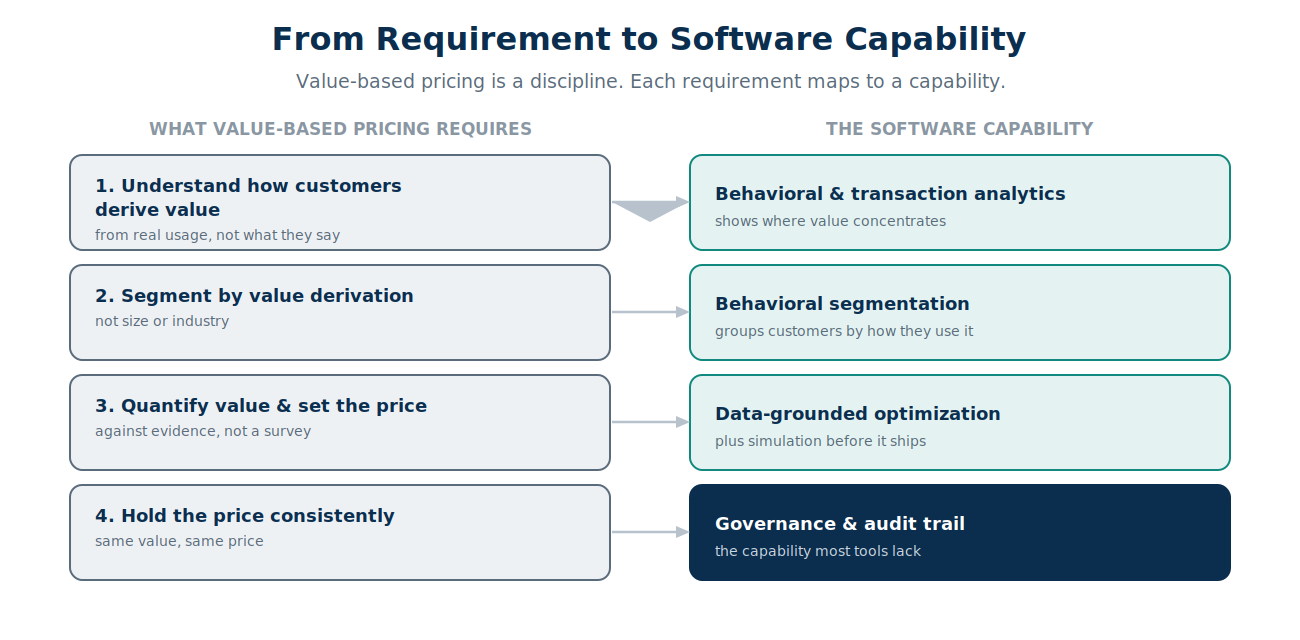
Each of these is a requirement first and a software capability second. Software cannot supply the strategy; it can only make the strategy executable at scale. That is why the right question is not "which tool does value-based pricing" but "which capabilities support each requirement," which is how a durable pricing strategy gets built.
Why Surveys Cannot Give You the Value Price
The most common and most expensive mistake in value-based pricing is trying to find the value price by asking. Willingness-to-pay surveys, conjoint analysis, and price-sensitivity meters produce precise-looking numbers, and in B2B those numbers are systematically wrong.
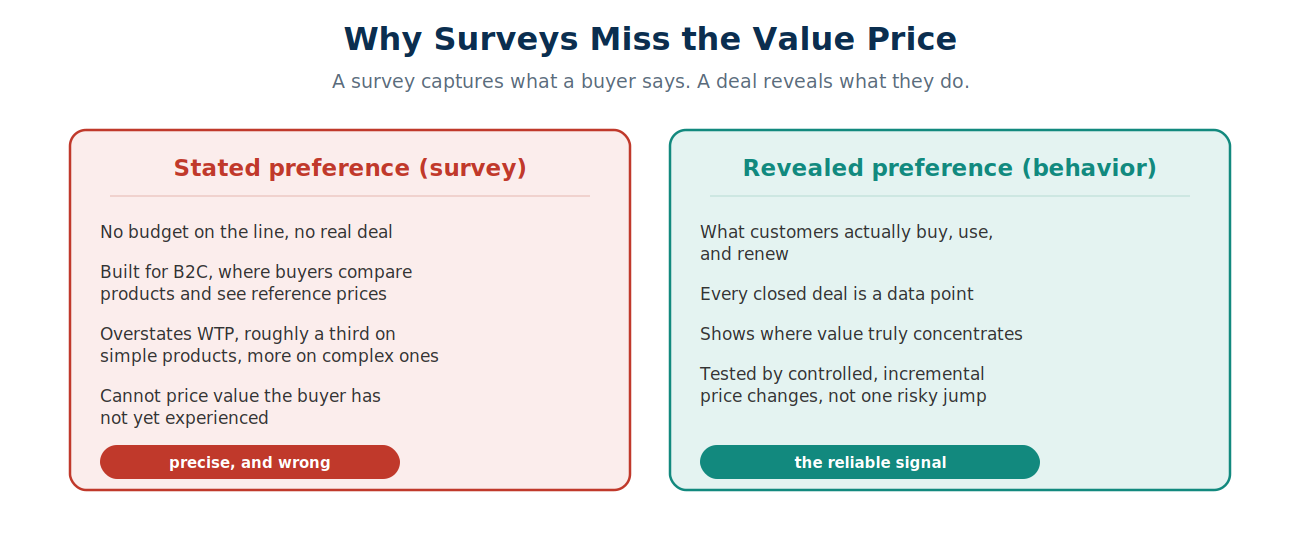
The reason is that a survey captures a stated preference, not a revealed one. A buyer with no budget on the line and no deal in front of them will answer differently than the same buyer negotiating a real contract. Research on hypothetical bias has measured the gap directly: stated willingness to pay routinely overstates real behavior, by roughly a third on simpler products and more on complex ones. Those methods were built for consumer markets where buyers compare products and see reference prices, and B2B breaks every assumption behind them.
Three features of B2B make surveys especially unreliable:
- Value is usage-dependent: it comes from operational outcomes over time, not a feature comparison a respondent can rate on a card.
- Decisions are multi-stakeholder: a single respondent cannot speak for a buying committee that will negotiate over months.
- Value hides in the unfamiliar: the highest value often sits in capabilities the buyer has not experienced yet and cannot price in the abstract.
There is also a force no survey captures: the sales team's willingness to discount. A large share of B2B deals close under quarter-end pressure with deeper discounts, and that discretionary discounting shapes the real price far more than any stated number. The takeaway is not that data is useless; it is that the right data is behavioral, what customers actually buy, use, and renew, which is exactly what sound pricing analysis reads.
Requirement to Capability: Reading Value from Real Behavior
The first requirement, understanding how customers derive value, maps to a capability for reading behavioral and transaction data rather than survey responses. The software has to show what customers actually do, purchases, usage, and outcomes, and make those patterns analyzable.
What this looks like in practice is transaction-level visibility: which customers buy what, at what volume, how their consumption differs, and where the outcomes concentrate. A pattern that a survey would never surface, a subset of accounts using a capability far more intensively than the rest, is the kind of signal that reveals a distinct value driver. Raw data does not interpret itself, so the capability is not just storage but the analysis that separates the patterns that matter from noise, the foundation a modern AI pricing approach builds on.
Requirement to Capability: Segmenting by Value, Not Firmographics
The second requirement, segmenting by how customers derive value, maps to a capability for grouping customers on behavioral characteristics rather than size or industry. This matters because value-based segments rarely match the firmographic buckets most companies default to.
A capable system lets you define segments from usage and outcome patterns, so two very different companies that use the product the same way land in the same group, and two similar-looking companies that use it differently do not. That is the difference between a segmentation that predicts what a customer will pay for and one that just sorts by headcount. Getting this right is what stops packaging and pricing from being built for an average customer who does not exist, and it connects directly to how a clear pricing model assigns the right price to the right group.
Requirement to Capability: Quantifying and Setting the Value Price
The third requirement, quantifying value and setting a price to it, maps to a capability for translating value into a defensible price per segment and testing it against evidence. This is where the value price is actually determined, and where the survey shortcut has to be replaced with something reliable.
The capability has two parts. First, optimization grounded in a company's own transaction history, so a recommended price reflects how similar customers have actually behaved, not a hypothetical. Second, simulation, the ability to model a price change and see its likely margin and revenue impact before it ships, and to move in measured steps rather than one large, risky jump. Together they replace "what do we think they will pay" with "what does the evidence support," which is the analytical core of any real price optimization.
Requirement to Capability: Holding the Price Consistently
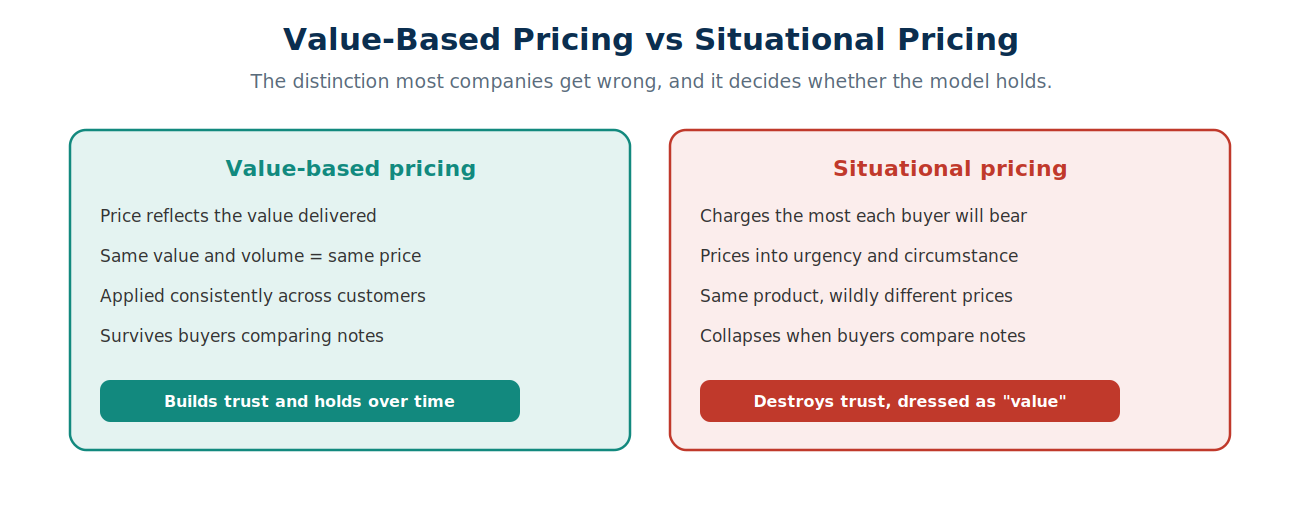
The fourth requirement is the one most tools ignore and the one that decides whether value-based pricing survives contact with the field: consistency. Value-based pricing only holds when the same value and volume produce the same price across customers. The moment two similar customers pay very different prices because of who negotiated, the model is no longer value-based, whatever the strategy deck says.
This is a critical distinction worth stating plainly, because it is where value-based pricing is most often misunderstood. Value-based pricing is not charging the most each individual customer will bear. That is situational pricing, pricing into a customer's urgency or circumstances, and it destroys trust the moment buyers compare notes, which in B2B they always do. Real value-based pricing is consistent and fair: the price reflects the value delivered, applied the same way to customers with the same usage.
The capability that supports this is governance, guardrails, approval workflows, and margin floors that keep a negotiated price from drifting below the value-based number, plus an audit trail that makes every price defensible. Without it, discretionary discounting quietly turns a value-based model back into cost-plus with a narrative. The same discipline that keeps rebate and off-invoice economics honest is what holds the value price in place here.
What to Look For in Value-Based Pricing Software
Pulling the requirements and capabilities together gives a clean set of criteria to evaluate any tool against. The table maps each requirement to the capability that supports it and what to test for.
Two criteria matter most. The optimization has to be grounded in your own behavioral data rather than survey inputs, and the governance has to be strong enough to hold the price in real negotiations. A tool strong on analytics but weak on governance will produce a value-based recommendation that the sales floor promptly discounts away, so both halves have to be present for the software to actually deliver value-based pricing.
How Vistaar Supports Value-Based Pricing for B2B
Vistaar approaches value-based pricing as an operating capability rather than a survey exercise, which fits manufacturers and distributors whose value is usage and outcome dependent rather than a simple feature comparison.
Against the requirements above, the pieces line up:
- Behavioral visibility: transaction-level analytics that show how value and margin actually concentrate across customers, products, and segments.
- Value-based segmentation: the ability to group customers by how they buy and derive value, not by size or industry alone.
- Data-grounded optimization: price and deal guidance built on a company's own transaction history, with simulation to model a change before it ships.
- Consistency by governance: guardrails, approval workflows, and margin floors that hold the value price in negotiation, with an audit trail for every deal.
- One connected platform: pricing, quoting, and rebates on a single system that integrates with enterprise tools like SAP, so the value price reaches the quote intact.
That combination, behavioral evidence plus governance to hold the price, is what turns value-based pricing from a philosophy into a system, and it is reflected in Vistaar's standing as a Leader in the 2026 Gartner Magic Quadrant for B2B Pricing and Rebate Optimization Software. The more useful test for any buyer, though, is a reference customer in their own industry. To see value-based price guidance and the governance that protects it on your own data, a short walkthrough is the fastest test.
Conclusion
Return to the vendor from the opening, the one whose survey number got discounted away in a quarter. The failure was not the analysis; it was the belief that a number, once found, would hold. It never does on its own. Value-based pricing lives or dies on two things: reading value from what customers actually do, and having the governance to keep the resulting price intact when a rep is under pressure to close. Software that does the first but not the second produces exactly that vendor's outcome, a precise price that erodes on contact with the sales floor.
That is why "value-based pricing software" is the wrong thing to shortlist and the right thing to understand as a set of capabilities. Read behavior, segment by value, quantify against evidence, and hold the price consistently, and the discipline becomes a system rather than a slide. Miss the last one, and even the best analysis becomes cost-plus with a better story. To see behavioral evidence and price-holding governance work together on your own numbers, a short walkthrough is the fastest way to judge the fit.
Frequently Asked Questions
What is value-based pricing software?
It is software that supports pricing on the value delivered rather than on cost or competitors. It works through behavioral analytics, value-based segmentation, data-grounded optimization, and the governance to hold a consistent price, rather than by generating a willingness-to-pay number from a survey.
Can software tell me what customers are willing to pay?
Not reliably through surveys. Stated willingness to pay carries systematic bias and rarely matches real behavior, especially in B2B. The dependable signal is behavioral: what customers actually buy, use, and renew. Good software reads that behavior and tests price changes against it, rather than asking.
Is value-based pricing the same as charging the most each customer will pay?
No. Charging the most each customer will bear based on their situation is situational pricing, which erodes trust when buyers compare notes. Value-based pricing is consistent: the same value and volume produce the same price. Consistency is what lets the model hold over time.
What capabilities matter most in value-based pricing software?
Two above the rest: optimization grounded in your own transaction data rather than survey inputs, and governance strong enough to hold the value price in real negotiations. Analytics without governance produces a recommendation the sales floor discounts away, so both are required.
Does value-based pricing software work for manufacturers and distributors?
Yes. It fits any business whose value is usage and outcome dependent rather than a simple feature comparison. For manufacturers and distributors, behavioral segmentation and margin governance matter more than the SaaS-style metric questions, and the software should reflect that.

As an experienced pricing solutions partner to some of the biggest names in global business, Vistaar offers a range of services to help our customers reach their maximum potential. Talk to us to see how we can help you create a more profitable future.