




Key Takeaways
Pricing management software sets, governs, and optimizes prices at scale, replacing the spreadsheets and static rules most teams outgrow.
ERP and CRM systems can store prices but cannot simulate changes, run optimization, or support frequent-change workflows, which is why companies move to dedicated tools.
The category splits into distinct types, price optimization and management, CPQ, revenue management, retail pricing, and price crawlers, each solving a different problem.
The first decision is which type your business actually needs, followed by whether to run one platform or best-of-breed tools.
The right fit matches your pricing model, your systems, and how you sell, not the longest feature list.
Pricing management software gets bought when the spreadsheet finally breaks: a price list that four people edit and no one trusts, a discount structure no one can see through, a cost increase that takes weeks to push into quotes. The category exists to replace that with something governed and fast. The hard part is that "pricing management software" covers several genuinely different types of tool, and buying the wrong type is the most common and expensive mistake in the search.
This guide sorts that out. It defines what the category does, explains why the ERP or CRM you already own is not enough, lays out the types and which one fits which problem, and walks the decisions that follow: one platform or several, build or buy, and how to run the evaluation. The focus is B2B, especially manufacturers and distributors, where the pricing is complex and the stakes are highest. For the wider category map, the guide to pricing software gives the overview this article drills into.
What Pricing Management Software Is
Pricing management software is a system that sets, governs, and optimizes prices across products, customers, and channels, using data and workflows instead of manual spreadsheets. At a basic level it replaces static price lists and infrequent reviews with a single, governed source of pricing logic. At an advanced level it adds optimization and AI to recommend the best price for each product and customer, not just store the one someone typed in.
The distinction from a spreadsheet is control. When pricing lives in structured, version-controlled rules, every price traces to a policy, every change is authorized, and the whole team works from one source rather than a dozen conflicting files. That shift, from scattered files to a governed system, is the core of what the category delivers, and the foundation any sound pricing strategy needs to run on.
Why ERP and CRM Pricing Falls Short
Most companies already own an ERP or a CRM, both of which touch pricing, so the natural first question is whether the existing system can just do the job. For simple pricing, it can. As pricing gets more complex, it cannot, and understanding why is the clearest way to know whether you actually need dedicated software.
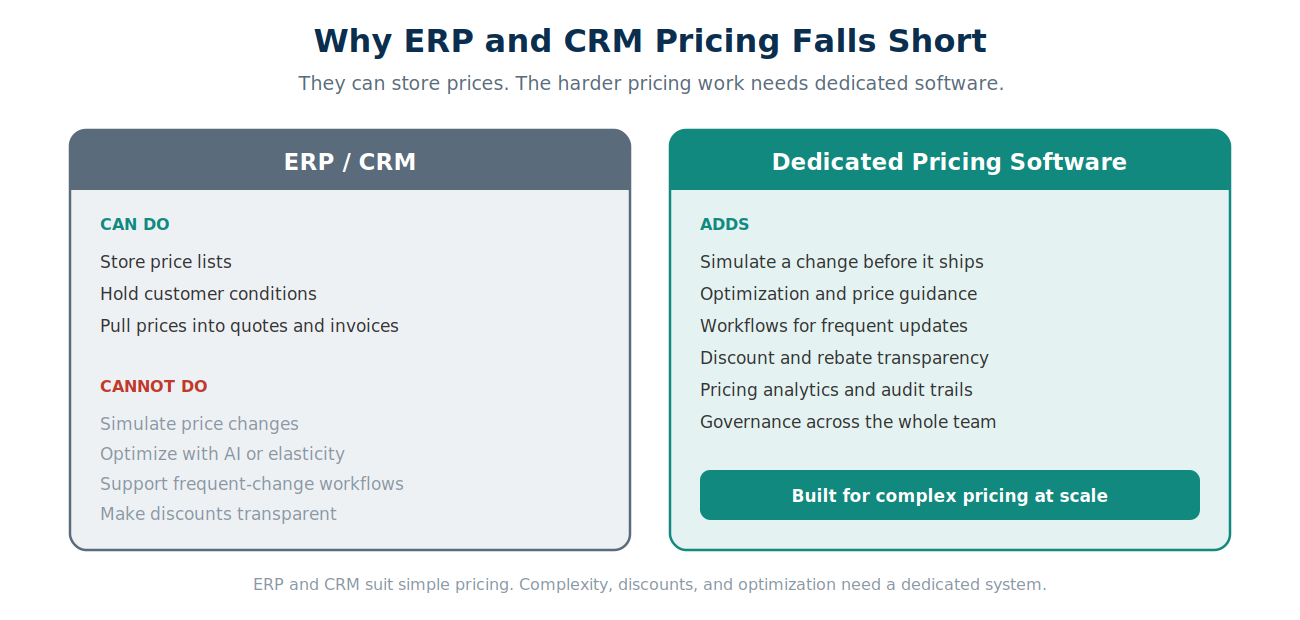
ERP and CRM systems can hold a price list and some customer conditions, and pull them into a quote or invoice. What they were never built to do is the harder pricing work:
- Simulate price changes: they cannot model what a price move does across customers before you commit to it.
- Support frequent-change workflows: they have no efficient path for the constant updates that volatile costs demand.
- Optimize: they have no elasticity modeling or AI to recommend a better price, only the number entered.
- Make discounts transparent: they give little visibility into where discounting erodes margin.
- Run real pricing analytics: their reporting and pricing workflows are limited to basic calculation logic.
So an ERP or CRM is enough for simple price lists and stable costs. Once pricing involves many segments, frequent changes, discount governance, or optimization, the gaps become expensive, and dedicated software is the answer. This is exactly the point where a governed price optimization layer earns its place over a bolt-on to the ERP.
The Types of Pricing Management Software
The category is not one product. It splits into several types, each built for a different pricing problem, and the fastest way to narrow the market is to match the type to how your business prices. The table maps the main types to what they do and who they fit.
For most B2B companies, price optimization and management is the center of gravity. It is the all-rounder: it calculates and manages list prices, analyzes and governs discounts, and applies price guidance, giving every department one view of pricing instead of Excel silos only a few people can open. CPQ, covered in the guide to CPQ software, often sits alongside it for the quoting motion, and many providers offer both. The others, revenue management, retail, and crawlers, solve narrower or adjacent problems, so the first job is honestly naming which one your pricing actually is.
Key Features to Look For
Within the right type, a few capabilities separate a system that delivers from one that just stores prices in a nicer interface. Evaluate these against your own pricing, not a demo.
- Price setting and management: the ability to hold list, customer-specific, and segment pricing as governed rules, updated under controlled workflows rather than by hand.
- Optimization and guidance: elasticity and data-driven recommendations that suggest a better price, with a floor, target, and ceiling a seller can work within.
- Discount and rebate management: transparency into off-invoice economics, so margin leakage through discounts and rebates is visible and controlled.
- Analytics and simulation: the ability to model a price change and forecast its margin and volume impact before it goes live.
- Governance and audit: approval workflows, guardrails, and an audit trail on every change, so pricing is defensible to finance.
- Integration: clean connection to the ERP and CRM, so prices reach the systems that quote and invoice rather than sitting in a separate tool.
The features that matter most depend on your problem. A distributor drowning in discount and rebate complexity needs that transparency first; a manufacturer with volatile costs needs simulation and fast repricing.
Naming the biggest gap before the demo keeps the evaluation honest, which is what disciplined pricing analysis brings to any purchase.
One Platform or Best-of-Breed?
Once the type is clear, a structural decision follows: run a single pricing platform, or combine best-of-breed tools from several vendors. Neither is automatically right, and the trade-off is worth deciding early rather than discovering mid-implementation.
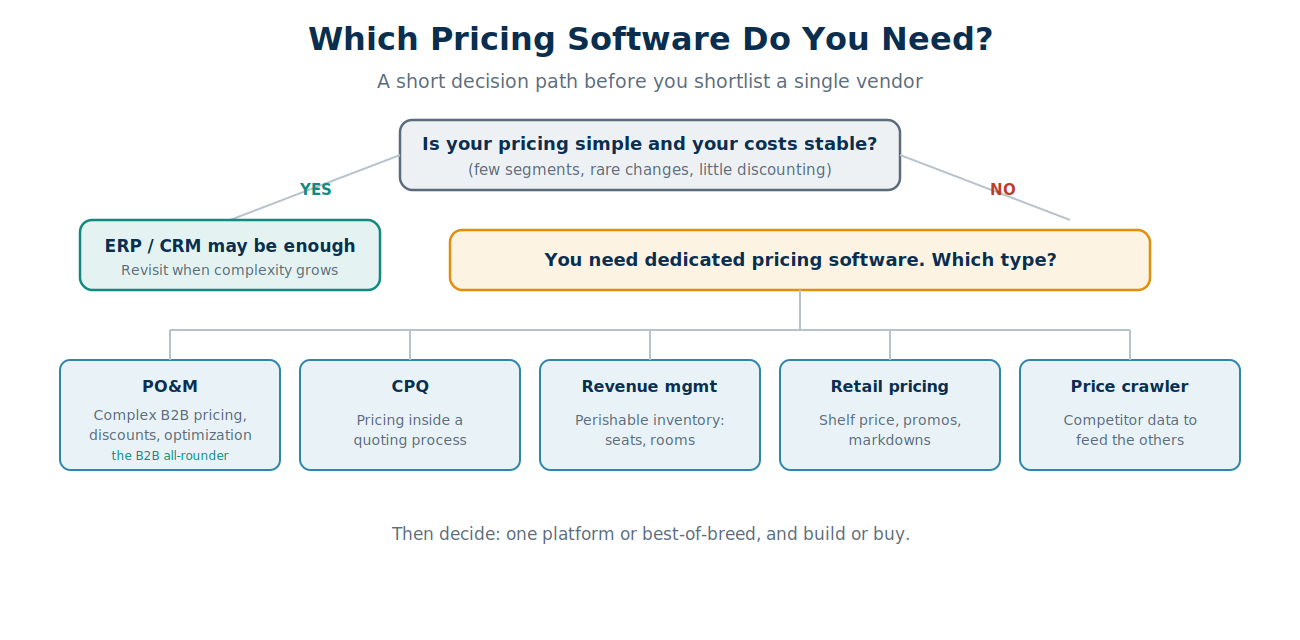
A common best-of-breed pattern is price optimization and management for setting and governing prices, plus a separate CPQ for the quoting motion. That can give deeper functional coverage in each area. The cost is coordination: two vendors, two integrations, and the ongoing work of keeping them in sync. A single platform that spans both trades some depth for consistency and a single source of truth. The right answer depends on whether the extra coverage justifies the extra effort, and on how much a company values one governed system over specialized tools that have to be stitched together.
Build or Buy?
Some companies consider building pricing software in-house rather than buying it, and for narrow cases that can make sense. A team that needs only pricing dashboards and already has a data team can build them on existing business intelligence tools without new software. Low-code platforms can also map simple approval workflows or a basic deal desk.
The catch is ownership over time. Building the tool is only the start; the company then owns the maintenance, the updates, and the specialist knowledge to keep it running, indefinitely. For complex pricing, that burden usually outweighs the customization benefit, which is why most companies with real pricing complexity buy rather than build. The honest test is whether pricing is a core system you want to maintain forever, or a capability you would rather have supported.
How to Choose the Right Pricing Management Software
With the type identified and the structural decisions made, the selection itself follows a clear sequence. Run it in order, and the shortlist narrows on evidence rather than demos.
- Define your pricing goals: protecting margin under cost pressure, governing discounts, scaling across segments, or cutting manual effort. Different tools optimize for different goals.
- Assess data and decision logic: ask how often data refreshes, what signals drive a price, and whether the system explains why a price changed, not just that it did.
- Evaluate integration depth: confirm prices flow cleanly to and from your ERP and CRM, and that the connection enforces pricing rather than just exporting it.
- Review onboarding and support: pricing mistakes are costly, so weigh structured onboarding and ongoing strategy support, not just technical setup.
- Pilot before committing: a pilot on one market or category is a cheaper way to confirm fit than a full rollout on faith.
Take the same questions to every vendor, and weight the type fit and integration depth most heavily. A tool that matches how your business actually prices, and that your team will use, beats a more powerful one that does not, the same principle that guides any value-based pricing decision.
How Vistaar Fits a B2B Pricing Management Evaluation
For a manufacturer or distributor, Vistaar is a price optimization and management platform, the B2B all-rounder in the type table above, built to govern complex pricing at scale rather than bolt onto an ERP.
Against the features above, the pieces line up. It holds list, customer-specific, and segment pricing as governed rules, adds optimization that recommends prices grounded in a company's own transaction data, and makes discount and rebate economics transparent so margin leakage is visible. Simulation lets teams model a change before it ships, and every change carries an audit trail a finance team can read. Because it runs on one platform spanning pricing, quoting, and rebates, and integrates with enterprise systems such as SAP, prices reach the quote and order workflow rather than sitting in a separate tool, which addresses the exact ERP and CRM gaps that push companies to dedicated software in the first place. Vistaar's standing in the category is reflected in its recognition as a Leader in the 2026 Gartner Magic Quadrant for B2B Pricing and Rebate Optimization Software, though the more useful test for any buyer is a reference customer in their own industry. To judge the fit against your own pricing, a short walkthrough is the fastest test.
Conclusion
Choosing pricing management software starts with two questions the demos rarely ask first: is the ERP or CRM you already own actually enough, and if not, which type of pricing software does your business need? For simple pricing, the existing system may do. For complex pricing, discount governance, or optimization, it will not, and the type that fits, most often price optimization and management for B2B, is the real decision.
Once the type is right, the rest follows in order: one platform or best-of-breed, build or buy, then a structured evaluation weighted toward type fit and integration. The tool worth choosing is the one that matches how your business prices and that your team will use every day. To see governed B2B pricing management on your own numbers, a short walkthrough is the fastest way to judge the fit.
Frequently Asked Questions
What is pricing management software?
Pricing management software sets, governs, and optimizes prices across products, customers, and channels using structured rules and workflows instead of spreadsheets. It replaces static price lists with a governed system, and at the advanced level adds optimization and AI to recommend the best price.
Why is ERP or CRM not enough for pricing?
ERP and CRM systems can store price lists and conditions but cannot simulate price changes, run optimization or AI, support frequent-change workflows, or make discounts transparent. They suit simple pricing; complex pricing, discount governance, and optimization need dedicated software.
What are the types of pricing management software?
Price optimization and management (the B2B all-rounder), configure-price-quote for quoting, revenue management for perishable inventory, retail pricing for shelf and markdowns, and price crawlers for competitor data. The first step is matching the type to how your business prices.
Should we use one pricing platform or best-of-breed tools?
One platform gives consistency and a single source of truth; best-of-breed gives deeper functional coverage at the cost of coordinating multiple vendors. A common pattern pairs price optimization and management with a separate CPQ. The right choice depends on whether the extra coverage justifies the effort.
How do you choose pricing management software?
Define your pricing goals, assess data quality and decision logic, evaluate integration depth with your ERP and CRM, review onboarding and support, and pilot on one category before committing. Weight type fit and integration most heavily, and take the same questions to every vendor.

As an experienced pricing solutions partner to some of the biggest names in global business, Vistaar offers a range of services to help our customers reach their maximum potential. Talk to us to see how we can help you create a more profitable future.