



Key Takeaways
- Markup divides gross profit by cost and margin divides it by selling price, so a $70 cost sold at $100 carries a 42.9% markup and a 30% margin
- Holding the markup percentage and holding the margin percentage are the same pricing policy, so the real cost pass-through decision is whether to pass through dollars or a percentage
- A 5% discount on a product with a 30% margin cuts gross profit per unit by one-sixth, which means volume has to rise 20% just to stand still
- Invoice margin overstates what you keep once rebates, freight, and payment terms are counted, and a stale standard cost overstates it further
- Set targets, floors, and approvals in margin measured as close to pocket margin as your data allows, and keep markup for contracts and surcharges written that way
Markup vs margin comes down to the denominator. Markup is gross profit divided by cost, and margin is gross profit divided by selling price. A product that costs $70 and sells for $100 carries a 42.9% markup and a 30% margin, even though the $30 of profit behind both numbers is identical.
For a pricing team managing thousands of SKUs and customer-specific prices, the formula is rarely the problem. The trouble starts when an ERP rule applies a markup to standard cost, sales quotes a discount off list, and finance reports margin on net revenue. Three teams describe the same price with three different numbers, and each assumes the others mean the same thing.
The sections below cover the formulas and conversion first, then the three places where the gap gets expensive: cost changes, discounts and rebates, and the cost that sits under your margin.
Markup vs Margin at a Glance
Both metrics use the same two inputs, cost and selling price, and the same dollar of gross profit. The only difference is what you divide by, which is why markup is always the larger percentage on any profitable sale.
The markup and margin formulas
The two formulas share a numerator and differ only in the denominator:
- Markup percentage: (Selling price minus cost) ÷ cost × 100
- Margin percentage: (Selling price minus cost) ÷ selling price × 100
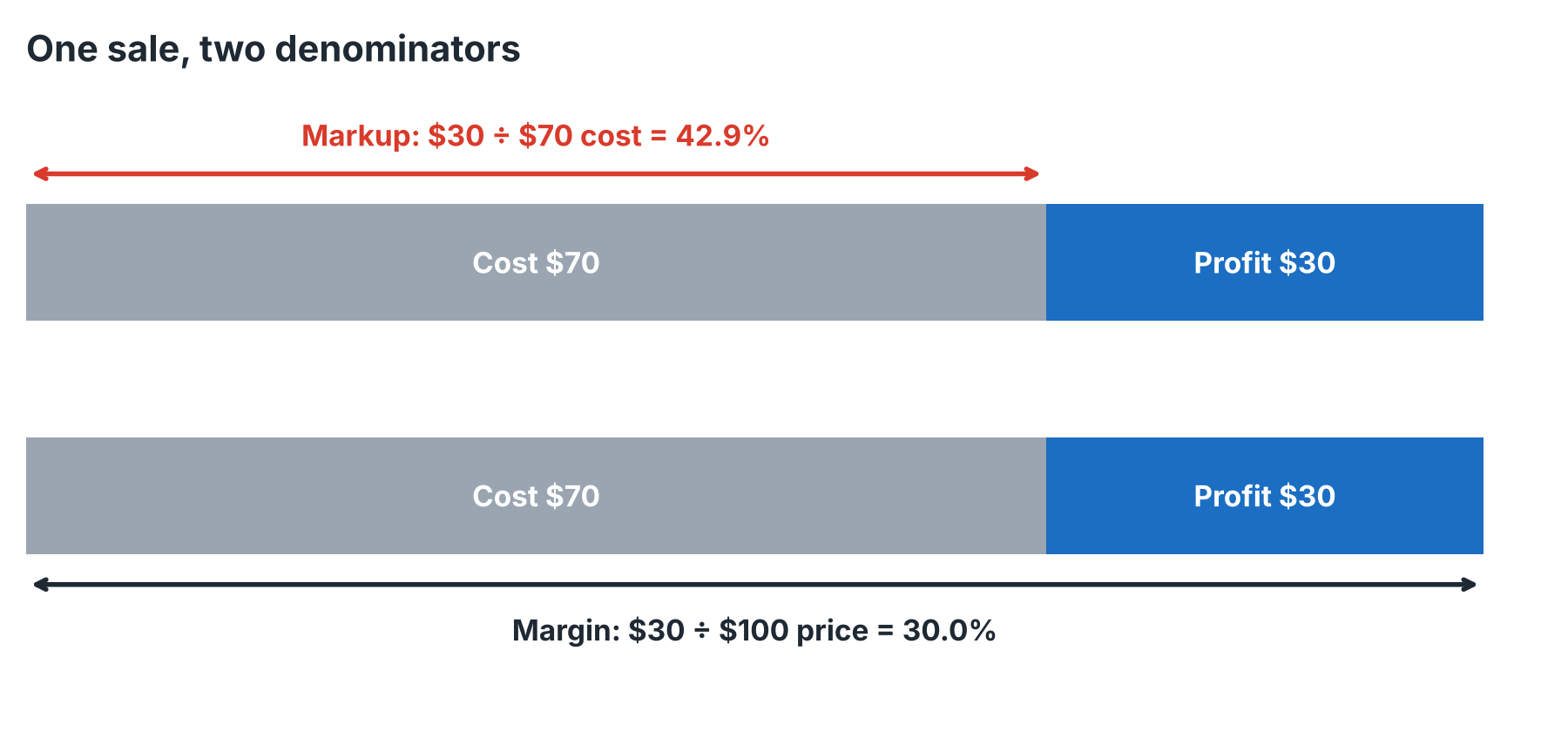
With a $70 cost and a $100 price, gross profit is $30. Divide by $70 and you get a 42.9% markup. Divide by $100 and you get a 30% gross margin.
In pricing conversations, "profit margin" usually means this same gross margin figure. Operating margin and net margin sit further down the income statement, after overhead, interest, and taxes come out.
How to convert markup to margin and back
Because both numbers describe the same sale, one converts directly into the other. Margin equals markup ÷ (1 + markup), and markup equals margin ÷ (1 minus margin).
The gap widens as the percentages grow. At low numbers the two figures sit close together, which is exactly why teams get comfortable treating them as interchangeable until a high-margin product line or a large quote exposes the difference.
Where the Markup and Margin Gap Shows Up in Large Pricing Organizations
In a small business, mixing up markup and margin is usually one person's arithmetic slip. At enterprise scale, the mismatch gets built into systems, contracts, and incentive plans, so it repeats on every transaction until someone traces it back to the source.
- ERP pricing rules: Surcharges and cost-plus conditions are often stored as a percentage on standard cost, which makes them a markup even when the policy behind them was written as a margin target
- Sales quotes and compensation: Reps tend to think in discount off list or gross profit dollars, and comp plans built on markup reward deals that look richer than they are
- Finance reporting: The P&L reports margin on revenue, so the number the CFO reviews rarely lines up with the percentage written into the pricing rule
- Customer contracts: Terms such as "cost plus 10%" seldom say whether 10% is a markup on cost or a margin on price, and the difference compounds across a multi-year agreement
- Distributor cost-plus accounts: Large contracted distribution accounts often pay landed cost plus a fixed markup, which caps the distributor's margin and changes how hard it promotes your product
The cost of that ambiguity is easy to put a number on. A target written as a 30% margin but executed as a 30% markup lands at a 23.1% margin, a gap of nearly seven points on every line the rule touches.
What Happens to Markup and Margin When Costs Move
A definitional mismatch stays quiet while costs are stable. Once costs start moving, it turns into a decision, and tariffs, commodity indices, and freight have made that decision a recurring item on pricing committee agendas.
The pressure is broad. In April 2025, US importers told Boston Fed researchers they expected to pass about two-thirds of their cost increases into prices within a year, roughly double the one-third rate firms reported from 2023 through early 2025. By August 2025, importers and non-importers alike expected to pass through about half, so the pressure had spread well beyond companies that import directly.
Dollar pass-through vs percentage pass-through
Take the same product and raise its cost by 10%, from $70 to $77. You have two basic ways to respond, and they produce different outcomes for both you and the customer.
Option A keeps gross profit dollars flat and lets the margin percentage slip by two points. Option B holds the percentage and earns $3 more per unit, which comes to $3 million of gross profit on a line selling one million units a year.
The catch sits on the customer's side of the table. Option B asks for a 10% increase to cover a 7% cost change, and procurement teams that track your input costs will notice.
Worth Knowing
NBER researchers estimate that 94% of the 2025 US tariffs passed through into the price of imports. US importers bore most of that cost before deciding how much of it to pass on to their own customers.
Why holding markup and holding margin are the same policy
Most markup vs margin guides treat the two as competing pricing methods. During a cost change, they behave identically. Hold a 42.9% markup and the new price is $77 × 1.429, or $110, while holding a 30% margin gives $77 ÷ 0.70, also $110.
Both rules keep the ratio of price to cost fixed, so choosing between them changes nothing about the price you send. The decision that actually moves the outcome is whether you pass through the cost in dollars or as a percentage, and that is a negotiation question more than a math question.
Customers tend to accept a dollar pass-through more readily, because it maps to a cost they can see in the news. A percentage pass-through can read as margin added on top of a tariff. A practical answer is to split by segment: percentage pass-through where differentiation and contract terms support it, and dollar pass-through where the account is price-sensitive or the cost is publicly indexed.
How Discounts and Rebates Change the Margin You Keep
Cost changes move the bottom of the equation. Discounts, rebates, and other price adjustments move the top, and they hit margin harder than most sales teams expect, because every dollar comes straight out of gross profit.
The discount break-even math
Using the same $100 price and $70 cost, you can find the volume any discount needs in four steps:
- Start with gross profit per unit at full price: $100 minus $70 is $30
- Apply the discount to the price: a 5% discount gives a $95 price and $25 of gross profit
- Divide the old gross profit by the new gross profit: $30 ÷ $25 is 1.2
- Read the result as required volume: you need 20% more units to earn the same gross profit dollars
That 5% discount also drops margin from 30% to 26.3%. A rep who thinks in markup still sees a comfortable 35.7% after the cut, which is how a discount that feels small ends up costing a sixth of the profit on the deal.
The same math runs in reverse for price increases. A 3% increase on that product lifts gross profit per unit from $30 to $33, a 10% gain that would otherwise take 10% more volume to match.
Invoice margin vs pocket margin
Invoice margin is only the first stop in the price waterfall. Rebates, freight, early-payment discounts, and promotional allowances sit off the invoice, so the margin your reporting shows is usually higher than the margin your business keeps.
Add a 3% rebate accrual to the same $100 sale and the net price falls to $97, taking margin from 30% to 27.8%. Layer on freight paid and payment terms, and pocket margin drops another point or two without anyone touching a list price.
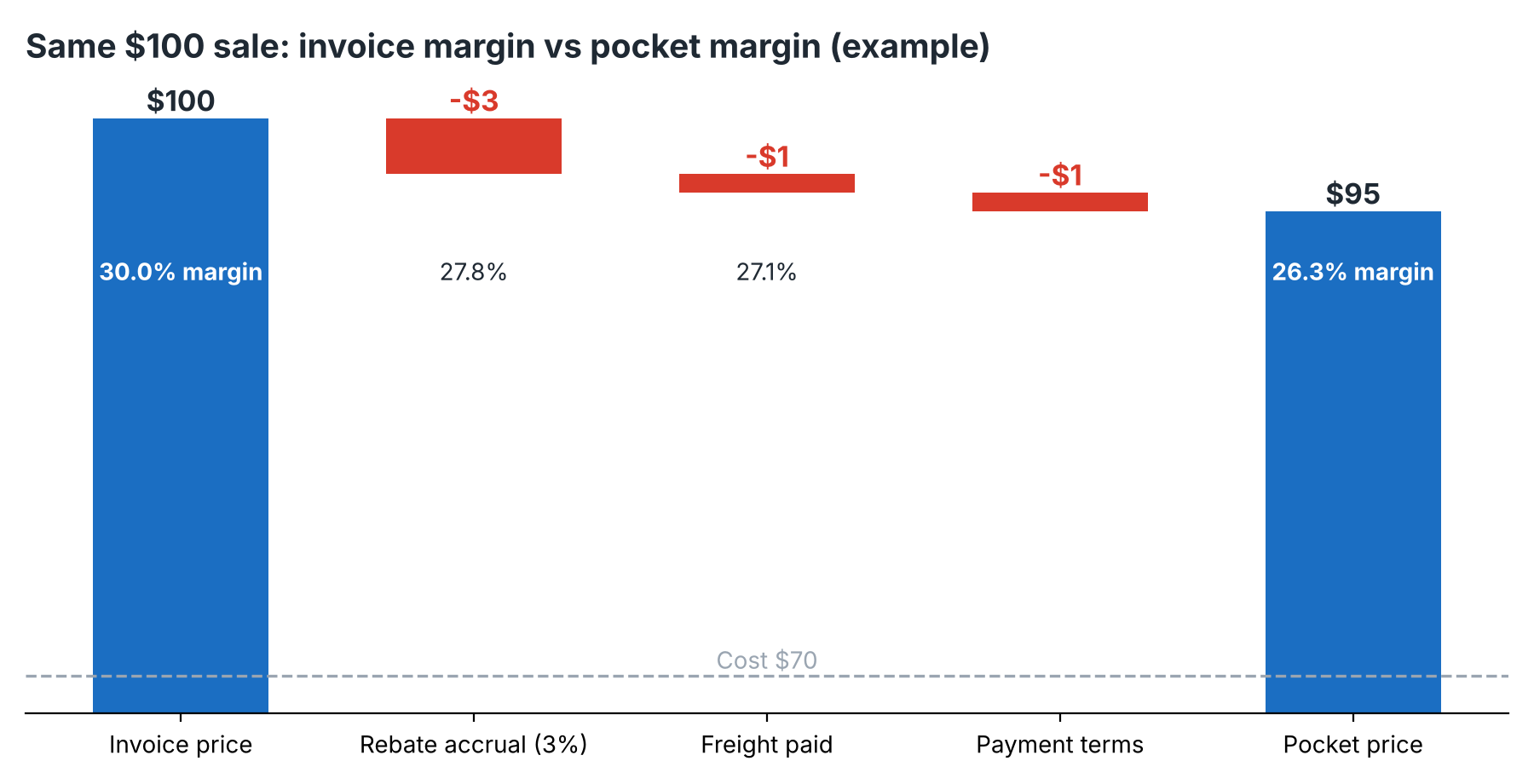
Rebates make the gap harder to see because they often settle months after the sale. If accruals live in a spreadsheet that finance reconciles at quarter close, the quote that looked profitable in March may only show its real margin in July.
Put net margin on every quote line
If reps quote from list and finance reports margin after rebates, the gap only surfaces at quarter close. Vistaar SmartQuote puts net margin on every quote before it goes out.
See deal-level margin visibility
Which Cost Sits Under Your Margin?
Every margin calculation assumes a cost, and that assumption often matters more than the markup vs margin debate itself. If the cost in the formula is out of date or incomplete, the percentage on the report can be precise and wrong at the same time.
Consider a standard cost of $70 set in January. If replacement cost reaches $75 by June, the report still shows a 30% margin at a $100 price, while the next unit you restock earns 25%.
Distributors feel this first, because their margin is the spread between what they pay and what they charge. Manufacturers feel it a quarter later, once higher raw material costs work through inventory and into cost of goods sold.
Contribution margin adds one more layer. It subtracts variable costs such as freight and commissions from revenue, which makes it a better guide for deal approvals than gross margin, since it reflects the costs that change with each order.
Should You Price on Markup or Margin?
Set targets, floors, and approvals in margin, measured as close to pocket margin as your data allows. Keep markup for the places where a contract, an index clause, or a surcharge is written that way, and convert it to margin before it reaches a report.
The usual advice in markup vs margin guides is to price with markup and measure with margin. That works for a store owner pricing a few hundred items from supplier invoices. Across thousands of SKUs, pricing from cost with either ratio carries cost noise straight into price and ignores what customers will pay for differentiated products.
A cleaner approach is to let the job decide the metric:
Margin floors also work better when they vary. A single company-wide floor is either too loose for commodity lines or too tight for strategic accounts, so floors set by product family and customer tier, with anything below them routed to approval, give sales room to negotiate without giving away the margin the business planned on.
How Vistaar Supports Margin-Based Pricing Decisions
Vistaar is enterprise B2B pricing and rebate optimization software, and its role in this problem is keeping one margin definition consistent from the price recommendation through the quote, the rebate accrual, and the report. Its capabilities map to the mechanics covered above:
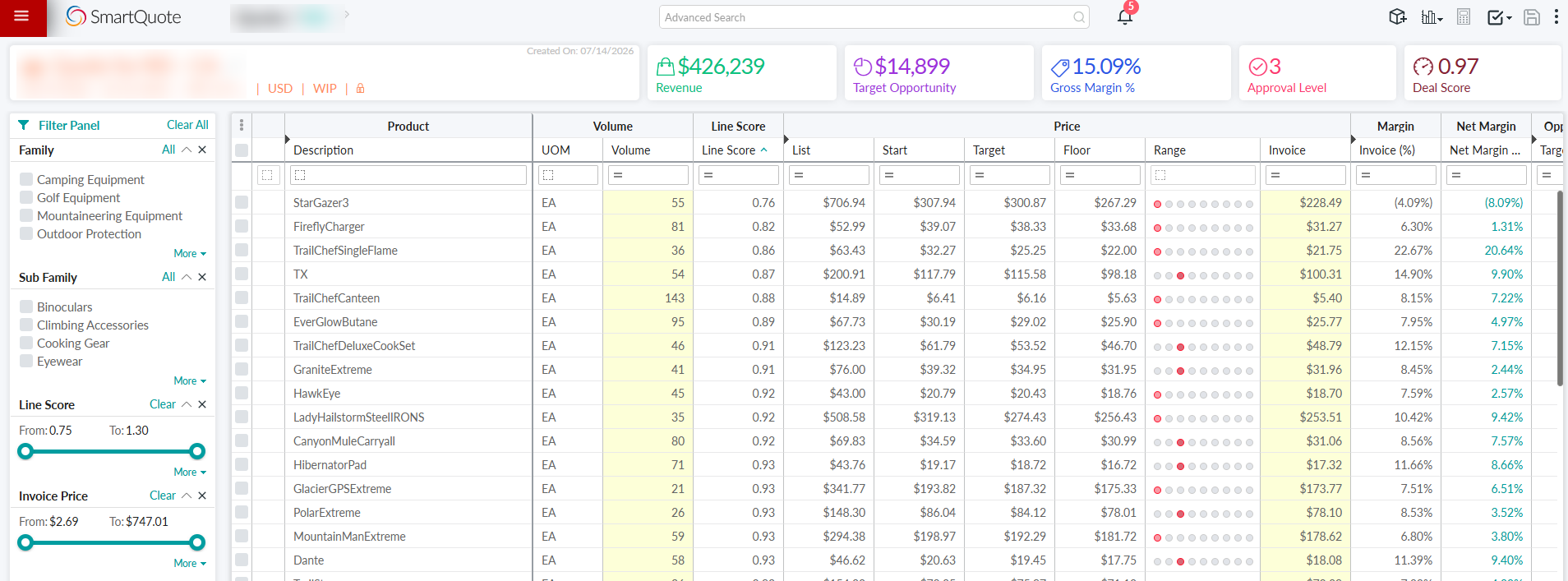
- Deal-level margin visibility: Vistaar SmartQuote brings pricing data, discount parameters, and rebate terms into one view, so every quote carries net margin alongside Start, Target, and Floor price bands
- Margin-based approvals: Approval requirements can be set by discount depth, deal size, or margin impact, the setup a Fortune 500 industrial manufacturer with more than 15,000 customers built around deviation from recommended price, estimated margin, and quote value
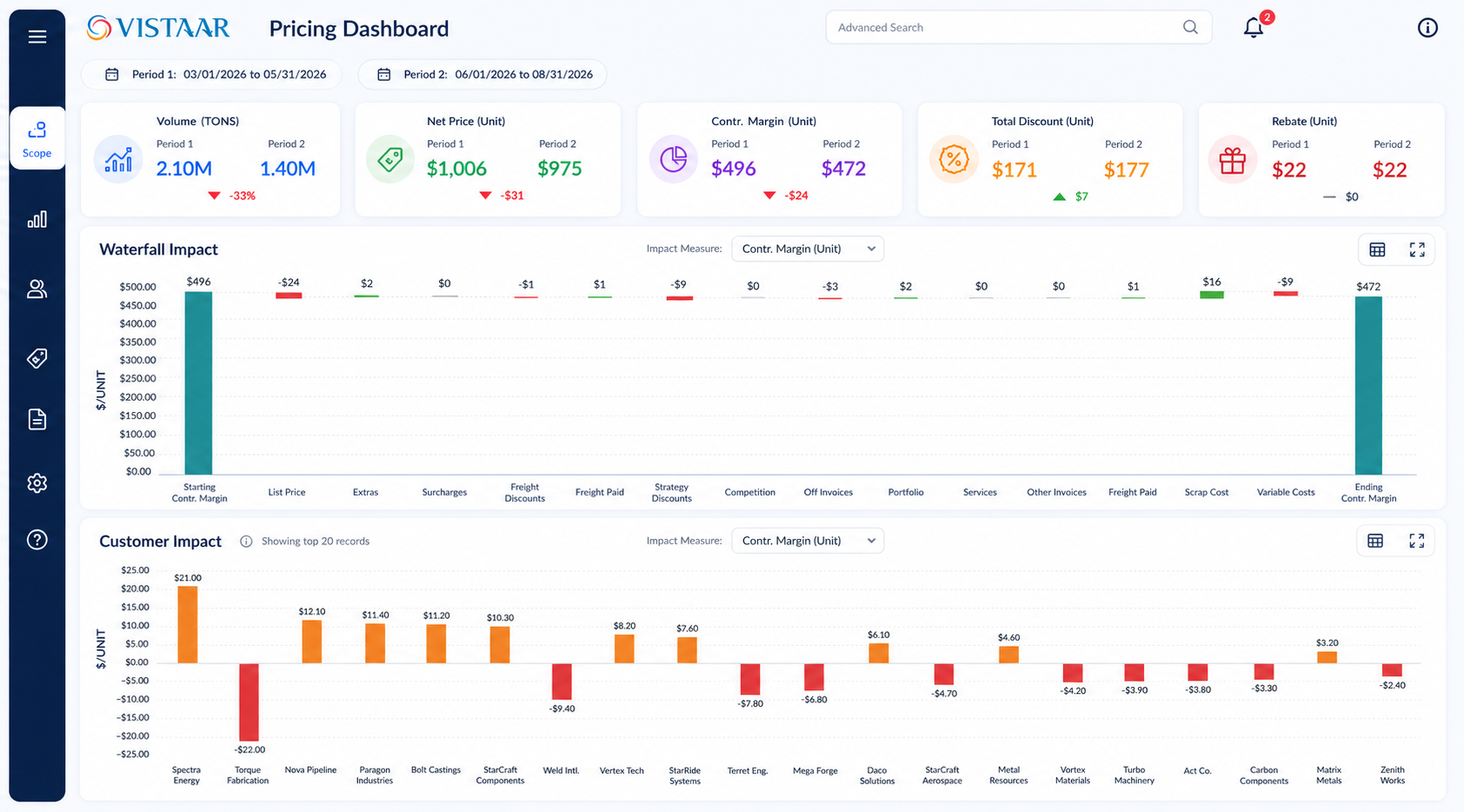
- Margin bridges: Vistaar's pricing dashboard breaks contribution margin down from list price through discounts, freight, surcharges, and cost changes, by period and by customer
- Cost-change scenarios: Vistaar SmartPricing models price paths and cost movements to project the margin and revenue impact of a pass-through, then syncs approved prices to ERP, CRM, and CPQ systems
- Rebate accruals: In Vistaar SmartRebates, every qualifying transaction updates accruals automatically, and rebate terms feed quote approval and net margin analytics
Vistaar was named a Leader in the inaugural 2026 Gartner Magic Quadrant for B2B Pricing and Rebate Optimization Software.
Put One Margin Definition Behind Every Price
The markup vs margin formulas take a minute to learn. Keeping one definition behind every rule, quote, contract, and report is the harder work, and it is where enterprise pricing teams recover the points that slip away between policy and pocket.
Before your next pricing committee, test your current setup against four questions:
- Which cost is your margin calculated on, and when was it last updated?
- Which price does your reporting use: invoice, net, or pocket?
- Are your ERP rules, contracts, and comp plans written in the same metric?
- Who approves a deal below the floor, and which margin number do they see?
If any answer depends on a spreadsheet someone rebuilds each quarter, the gap between markup and margin is probably still costing you on live deals.
See where your margin slips between quote and pocket
Talk to Vistaar about margin floors, approval rules, and cost pass-through across your portfolio.
Request a demo
Frequently Asked Questions
These answers cover the edge cases that come up once the basic formulas are settled.
Can margin be more than 100%?
No. Margin divides profit by selling price, and profit can never exceed the price, so gross margin always stays below 100%. Markup has no ceiling: a product sold at three times its cost carries a 200% markup and a 66.7% margin.
What margin is a 25% markup?
A 25% markup equals a 20% margin. Divide the markup by one plus the markup: 0.25 ÷ 1.25 is 0.20. On a $70 cost, a 25% markup gives an $87.50 price and $17.50 of gross profit.
How should a cost-plus contract define the "plus"?
State whether the percentage applies to cost or to price, which cost is used (standard, landed, or replacement), and how often that cost resets. A vague "cost plus 10%" can be read two ways for the life of the contract.
Should sales commissions be paid on markup or margin?
Paying on margin or gross profit dollars keeps reps aligned with what the business keeps. Markup-based commission overstates how profitable a deal is, and the gap widens once rebates and freight come off the invoice.
Does a constant markup protect margin during a price increase?
It protects the margin percentage, since a constant markup and a constant margin produce the same price. It does not protect volume, because a percentage pass-through raises price by more than the cost change and price-sensitive accounts may push back.

As an experienced pricing solutions partner to some of the biggest names in global business, Vistaar offers a range of services to help our customers reach their maximum potential. Talk to us to see how we can help you create a more profitable future.