




Key Takeaways
Most retail pricing software purchases stall on internal disagreement, not vendor choice. Align your team on the problem before comparing platforms.
Every serious platform is built from four capabilities: competitive intelligence, an optimization engine, rules and guardrails, and workflow.
Feature checklists blur together because every vendor checks the same boxes. Demo questions about real workflows reveal the differences.
A defensible ROI case is simple math: the margin gap across your catalog, minus total cost, divided into a payback window.
The right choice is a fit decision, the platform that matches your team, your catalog, and how you actually sell, not the longest feature list.
The search for retail pricing software usually starts after a margin problem, a cost increase that cannot be absorbed, a competitor undercutting a key category for weeks before anyone noticed, or a finance review that no spreadsheet can fully answer. Then the real difficulty begins, because the category is crowded, the vendor language is nearly identical, and every demo looks cleaner than production.
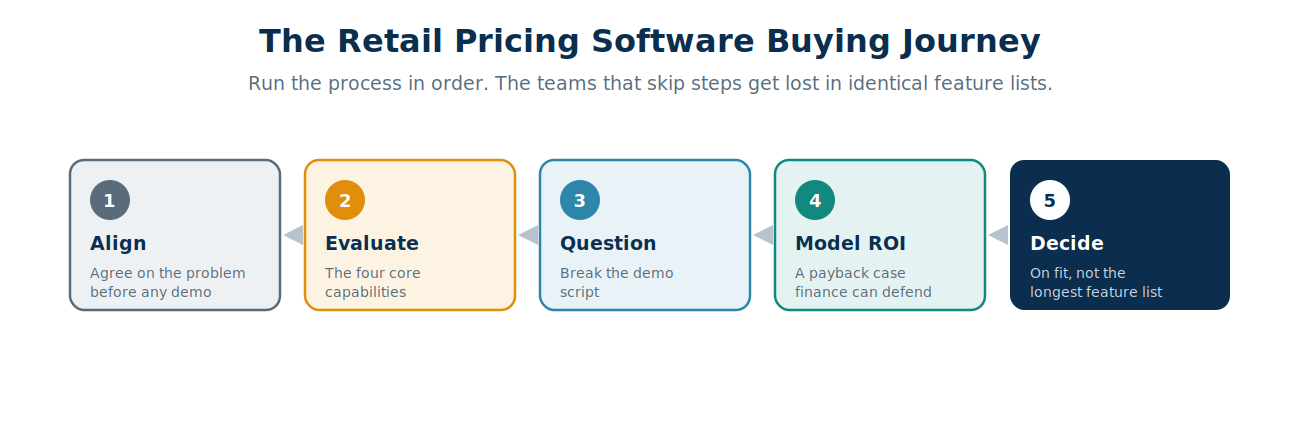
The teams that choose well are not the ones that find the perfect tool. They are the ones that run a good process. Align internally first, evaluate the capabilities that matter, ask questions that break the demo script, and build an ROI case defensible at board level. This guide walks that process in order, so a decision that usually drags becomes one you can make with confidence. If you are still deciding whether you need pricing software at all, the broader guide to pricing software gives the category map; this one is for teams already evaluating retail options.
Align Your Team Before You Compare Vendors
The most common reason a pricing software purchase stalls has nothing to do with a lack of information. It is too much of it, combined with a team that never agreed on what it was buying. Once the search begins, open tabs multiply, product pages blur, and different departments start arguing for different things.
Those departments genuinely want different outcomes, and naming that upfront saves weeks of circular debate:
- IT: security, control, and integration that does not create ongoing maintenance.
- Category and pricing managers: usable automation, filters, reporting, and the ability to change rules without a support ticket.
- Finance and leadership: a clear ROI case, scalability, and defensible pricing decisions.
Before any demo, agree on a short set of answers as a team. What problem are we actually solving? Which outcomes tell us it worked? Which teams need access, and what do they care about? What must the software connect with? Where do we need flexibility, and where consistency? Rough answers are enough; the alignment is what matters, and it gives your team sharper questions and a stronger position with every vendor. This is the same groundwork a sound pricing strategy depends on, whatever tool you land on.
The Core Capabilities to Evaluate
Once the team is aligned, strip away the marketing and look at what every serious retail pricing platform is actually built from. Knowing which of these a vendor genuinely has, versus relabels, is the fastest way to read a demo.
Competitive Intelligence
This is the data foundation: competitor prices, refreshed on a defined cycle, matched to your products, and feeding decisions automatically. Two things decide quality, and neither is on a feature slide. Match accuracy matters more than refresh speed, because a confidently wrong match produces a confidently wrong price. Refresh frequency, meanwhile, should be judged on your high-velocity items, not the catalog average. Ask to see match accuracy demonstrated on a sample from your own catalog.
The Optimization Engine
This is where elasticity modeling and margin analysis happen. A genuine engine runs demand models per item, scores recommendations by confidence, and treats a bestseller with years of history differently from a new item with three months of data. The question that separates a real optimization engine from a rules engine with a better name is simple: what happens to recommendations on low-confidence items? A vague answer is the answer. Grounding recommendations in real data is what a genuine price optimization engine, powered by modern AI, is built to do.
Rules and Guardrails
Margin floors, competitor position targets, MAP compliance, and markdown triggers are the commercial policies the business runs on. The platform should enforce them automatically and let category managers configure them in plain language, without technical help. If changing a rule needs SQL, a developer, or a vendor ticket, it is not self-service, whatever the product page says.
Workflow and Approval
The layer buyers evaluate last and should evaluate first. A platform that generates a thousand recommendations but has no exception queue, no bulk approval, and no audit trail is capped at the size of your team's manual review capacity. Look for exception queues that surface only the prices outside defined limits, bulk approval on clean low-risk items, and an audit trail a finance team can read: what changed, why, who approved it, and what happened.
The Questions to Ask in a Demo
Feature checklists blur because every vendor checks the same boxes. What a feature does in a real workflow, across teams, channels, and messy data, is where platforms diverge, and no spreadsheet column captures how a vendor behaves once the rollout starts. These questions break the script.
- Show me one price recommendation and explain every input behind it. If they cannot break it down in plain language, your team will not trust it, and untrusted software changes nothing.
- How are low-confidence items handled differently from high-confidence ones? This reveals whether there is a real optimization engine underneath.
- How is your market data collected, and at what frequency per product group? In-house, third-party, or a mix, and can you set frequency by group so you do not overpay on the long tail.
- What does onboarding actually require from us, and how long for a comparable retailer? Push for a real timeline and who owns implementation after go-live.
- Where does the audit trail live and what does it show when finance asks why a price moved? It should be on by default and traceable to a signal, a rule, and an approver.
How comfortable the vendor is with these questions tells you as much as the answers. There is also a second dimension worth weighing beyond the software itself: the partnership. B2B software is never only the tool. It is the team that supports the setup, flags blind spots, and adapts as your business changes, so bring partnership fit into the evaluation early, not after the contract. Sound pricing analysis in the evaluation itself is what surfaces both.
How to Build the ROI Case
Finance will ask for the number, so build it before the first demo. The calculation takes about twenty minutes on your own business and gives the whole evaluation a defensible anchor.
Two variables decide the outcome, and both are measurable before you buy: how much of your revenue the tool actually touches, and the margin gap between your current prices and your policy-compliant prices. Add deployment time to the math too, since a platform that takes six months to go live pushes the payback window six months out. The figures above are illustrative; the framework is what makes the case defensible, and it is the discipline any value-based pricing program relies on.
How to Make the Final Decision
With the team aligned, the capabilities evaluated, the questions asked, and the ROI modeled, the decision comes down to fit rather than feature count. The best buyers are not chasing the perfect tool; they are choosing the right one for their team, their catalog, and how they sell.
A few principles keep the final call clean. Weight the capability that solves your biggest problem most heavily, not the longest feature list. Favor a platform your category managers will use every week over a more powerful one that needs a specialist to operate. Judge deployment realism honestly, since months of implementation are months of margin leakage added to the cost. Treat the vendor relationship as part of the product too, because you are choosing the team that will support you long after the contract is signed. Match the choice to your own operation, and the shortlist narrows itself.
How Vistaar Fits a Retail Pricing Evaluation
For a retailer whose evaluation points toward the governed, enterprise end of the category, Vistaar is built around these capabilities rather than a single feature. Its retail pricing solution spans the full lifecycle, base price, promotions, and markdowns, on explainable science.
Against the criteria above, the pieces line up. Competitive intelligence feeds recommendations while filtering noise, the optimization engine models elasticity at the category, segment, or store level while staying explainable, in the way AI-driven pricing should, and rules and guardrails enforce margin floors, MAP, and price-image constraints with role-based approvals. Every change carries an audit trail a finance team can read, and store clustering supports local variation inside a consistent national strategy.
Vistaar's standing in the category is reflected in its recognition as a Leader in the 2026 Gartner Magic Quadrant for B2B Pricing and Rebate Optimization Software, though the more useful test for any buyer is a reference retailer in their own segment. To judge the fit against your own catalog and team, a short walkthrough is the fastest test.
Conclusion
Choosing retail pricing software is less about the tool than the process. The purchases that succeed start with a team aligned on the problem, then evaluate the four capabilities that actually matter, ask demo questions that reveal how a platform behaves in a real workflow, and build an ROI case finance can defend. The ones that struggle skip the alignment, get lost in identical feature lists, and pick on a demo rather than a fit.
Run the process in order and the decision gets easier and better. Align first, evaluate the capabilities, ask the sharp questions, model the return, and choose the platform that fits how your team and catalog actually work. To see governed, lifecycle retail pricing on your own numbers, a short walkthrough is the fastest way to judge the fit.
Frequently Asked Questions
What is retail pricing software?
Retail pricing software uses competitor data, demand models, and business rules to recommend and manage prices across a catalog, covering base price, promotions, and markdowns. It replaces spreadsheet-based pricing with governed, auditable decisions at the scale of thousands of items.
What features matter most in retail pricing software?
Four capabilities: competitive intelligence with accurate matching, a real optimization engine that handles low-confidence items, rules and guardrails category managers can configure themselves, and workflow with exception queues, bulk approval, and an audit trail. Fit to your team matters more than feature count.
How do you calculate the ROI of retail pricing software?
Estimate the margin gap across your catalog, multiply by the revenue affected, subtract total cost of ownership, and divide into a payback window. A defensible case pays back inside 18 months. Catalog coverage and deployment time are the variables that decide it.
Who should be involved in choosing retail pricing software?
Pricing and category management, e-commerce, IT, finance, and leadership. Each cares about different outcomes, so aligning them on the problem and success metrics before comparing vendors prevents the circular debate that stalls most purchases.
How long does retail pricing software take to deploy?
It ranges widely. Self-serve tools can reach a first live price in days from a catalog upload; enterprise platforms can take six to nine months. Every month of deployment delay pushes the ROI payback window further out, so treat time to value as a core criterion.

As an experienced pricing solutions partner to some of the biggest names in global business, Vistaar offers a range of services to help our customers reach their maximum potential. Talk to us to see how we can help you create a more profitable future.