




Key Takeaways
Pricing optimization software recommends the price most likely to hit a stated objective, margin, revenue, or volume, within the rules you set.
Every serious tool is built from four layers: data, rules and guardrails, optimization, and workflow. Knowing which a vendor truly has cuts through any demo.
Optimization depends on elasticity and segmentation, which need real price variation in your transaction history. A vendor promising optimal prices on day one is a warning sign.
In B2B, the output is deal guidance a rep can defend, not automated shelf prices, so explainability and CPQ or ERP integration decide fit.
The category will not fix bad cost data, a missing pricing strategy, or an organization that is not allowed to use the tool.
Most searches for pricing optimization software start after a margin event. A cost increase lands that no one can absorb, a large account is discovered to be unprofitable, or finance asks why margin slipped and the only answer is a spreadsheet and a shrug. If that is roughly where you are, this guide is built to help you evaluate tools rather than admire them.
The hard part of the search is that every vendor sounds the same. Each one shows a clean recommendation screen and a confident price, and each calls itself a pricing optimization platform. Underneath, they are wildly different tools, and some of the most confident ones are really rules engines with a better name. The trick is knowing what actually separates them, which comes down to a handful of capabilities and one question a demo rarely answers on its own: can the software explain why it recommended a price, on your data, in a way your team will trust.
That matters most in B2B, where the output is not a shelf price that changes on its own but guidance a salesperson has to defend in a negotiation. For how the whole category fits together, the guide to pricing software gives the map; this article drills into the optimization part of it.
What Pricing Optimization Software Actually Does
Pricing optimization software recommends or sets the price most likely to meet a stated objective, usually margin, revenue, or volume, within the constraints a business defines. The constraints are where the real work sits: minimum margins, floor and ceiling rules, segment and channel differences, and the exceptions that make a company's pricing its own.
The distinction that matters is what the software produces. A competitor price tracker reports what the market is doing but decides nothing. A dashboard tells you what happened last quarter. Pricing optimization software is different in one specific way: it produces a price recommendation you can act on, for a given product, customer, and situation, with a reason attached. That last part, the reason, is what makes the recommendation usable, since a price a person has to approve has to be a price they can understand. This is a narrower job than the broader category of price optimization as a discipline, which spans strategy as well as software.
The Four Capability Layers of Pricing Optimization Software
Strip away the marketing and every pricing optimization tool is some combination of four layers. Knowing which layers a vendor genuinely has, and which they relabel, is the fastest way to read a demo. The layers build on each other, from raw inputs to a price that reaches the point of sale.
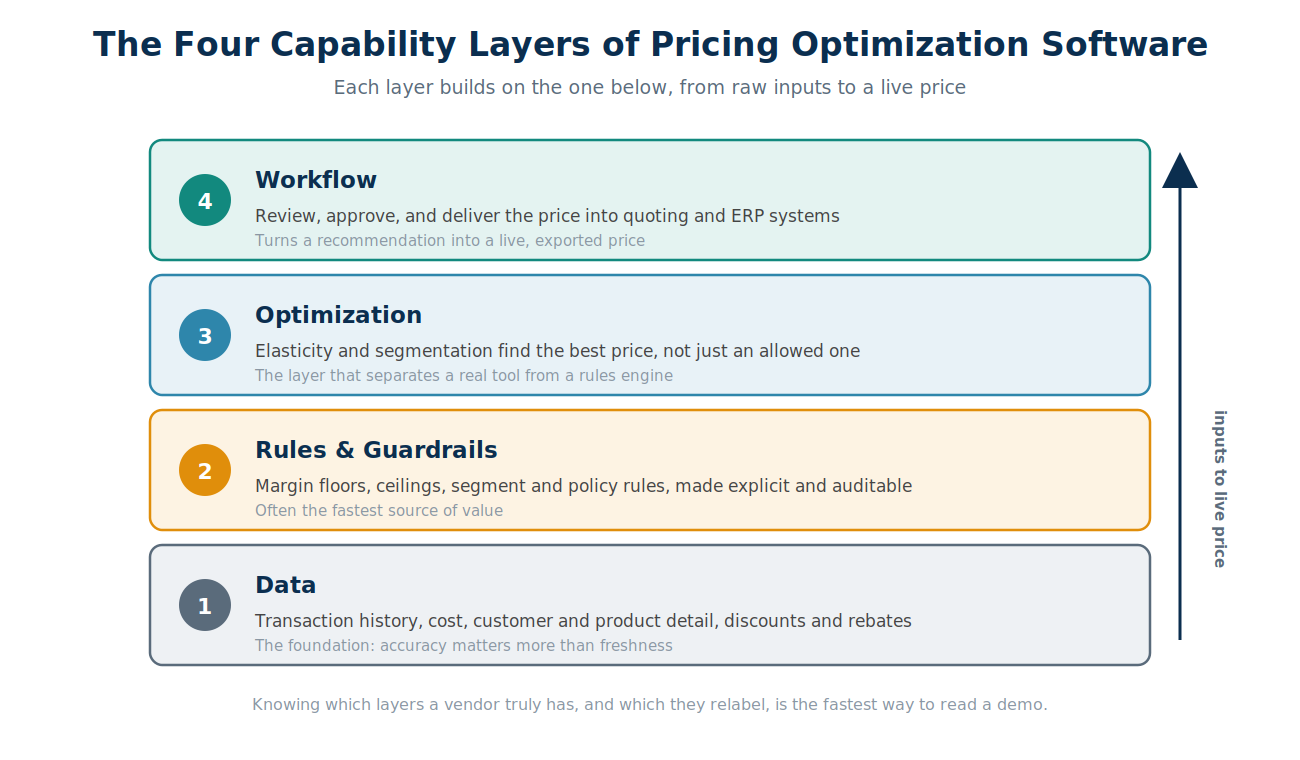
Layer 1: Data
Everything rests on the inputs. For a B2B business the core data is internal: transaction history, cost, customer and product attributes, and the discounts and rebates that shape the real margin. Competitor and market signals matter too, but the transaction history is what makes optimization possible. The quality test is completeness and accuracy, not freshness. A recommendation built on wrong cost or a mismatched product is confidently wrong.
Layer 2: Rules and Guardrails
The rules engine encodes pricing policy: margin floors, ceilings, competitive position, segment differences, and the exceptions a business lives by. For many teams this layer creates the most value fastest, because today those rules live in someone's memory or a spreadsheet column no one else can read. A rules engine makes policy explicit, auditable, and applied consistently. The evaluation question is whether the people who own pricing can configure a rule themselves, in plain language, without a support ticket.
Layer 3: Optimization
The optimization layer estimates how demand responds to price and finds the price that best meets the objective within the rules. This is where elasticity models, segmentation, and machine learning live, and it is where vendors most often oversell. It is also the layer that most distinguishes real optimization from a rules engine wearing the name, so it deserves a closer look, below.
Layer 4: Workflow
The layer buyers underweight most. A recommendation only matters if it becomes a live price, which means someone reviews it, handles exceptions, gets approval, and pushes it to the systems that quote and invoice. If the software produces a thousand recommendations and the team can review fifty, the real coverage is fifty. Look for exception-based review, approval routing, an audit trail of who changed what and why, and integration into the quoting and ERP systems where selling happens.
How Optimization Works: Elasticity and Segmentation
The optimization layer is where a real tool separates from a repriced rules engine, so it is worth understanding what it actually does. Two ideas carry most of the weight: price elasticity and segmentation. Together they answer the question a rules engine cannot, which is not "what price is allowed" but "what price is best."
Price Elasticity: How Demand Responds to Price
Elasticity is the measure of how much demand changes when the price changes. A product whose volume barely moves as price rises is inelastic and can often bear more; one whose volume drops sharply is elastic and cannot. Optimization software estimates elasticity from transaction history and uses it to find the price that maximizes the objective without losing more volume than the gain is worth.
The honest limit is data. Elasticity can only be learned from history that contains real price variation. If a company's prices barely moved for two years, there is little for a model to learn, and no algorithm invents signal that is not there. A credible vendor says this plainly and shows how it handles thin-data products; a less credible one promises optimal prices from day one, which is the clearest warning sign in the category.
Segmentation: The Right Price for the Right Customer
Segmentation is where B2B optimization earns its keep, because a single market price rarely fits a business selling to different customers, volumes, and channels. Willingness to pay varies by segment, and optimization software groups customers and products into segments with similar price response, then sets guidance for each rather than one blanket number.
Worth knowing: Segmentation is also where optimization stays defensible. Because the price varies by measurable business factors like volume and channel, not by an individual's identity, it holds up commercially and avoids the trust problems that come with personalized pricing.
How Pricing Optimization Differs in B2B
Most pricing optimization content, and much of the software, assumes retail: public prices, competitor feeds, automated repricing. B2B optimization is a different discipline, and buying a retail tool for a B2B business is one of the most common mismatches in this category.
The core difference is the output and who acts on it. A few distinctions decide fit:
- Guidance, not automation: the tool recommends a price corridor to a salesperson rather than changing a public price on its own.
- Explainable by requirement: because deals are negotiated, a rep has to justify the number, so the reasoning behind a price matters as much as the price.
- Segment and deal-level: optimization works at the level of customer segment and individual deal, not a single catalog-wide price.
- Integrated with quoting: the guidance has to reach the CPQ or ERP where the quote is built, not sit in a separate dashboard.
If a business sells through negotiated deals, these are the capabilities that decide whether the software gets used or ignored. The retail checklist of competitor-feed accuracy misses them, which is why matching the tool to how you actually sell matters more than any feature count. This is the same distinction that runs through the wider question of building a pricing strategy for a B2B business.
Questions to Ask in a Pricing Optimization Software Demo
Demos are choreographed. These questions break the script, because they force a vendor off the prepared path and onto your data, your team, and your constraints. Take the same set to every vendor so the answers are comparable.
- Show me why this price was recommended. You want a plain-language reason: which rule applied, what the elasticity or segment implied, what the margin impact is. "The model decided" means your team will not trust it.
- What happens when two rules conflict? Real pricing policy contradicts itself daily. Ask how the conflict resolves, whether it is visible, and whether you can change the priority yourself.
- What data do you need, and what happens to the gaps? Your data has holes. A serious tool has defined behavior for missing cost or attributes; a fragile one silently prices on bad inputs.
- Can my team change the rules without your professional services? If every change is a support ticket, you have bought a consulting relationship with a login.
- How does a recommendation reach our quoting and ERP systems? Ask to see the integration, not the architecture slide, and what happens when a push fails.
- Which of your customers looks like us? Same industry, deal model, and team size. Then ask what those customers stopped doing once the tool was live.
How comfortable the sales team is with these questions tells you as much as the answers. A vendor who knows their product answers precisely; one who sells services answers vaguely.
Red Flags to Watch For
A few signals reliably predict a project that disappoints, and they are visible before you sign. Each one is worth treating as a reason to slow down and dig deeper.
- Black-box recommendations: no price explanation means no adoption. In pricing, auditability is not a nice-to-have, it is the feature.
- Optimal-from-day-one claims: elasticity models need your transaction history and real price variation to learn. Optimized prices promised before the vendor has seen your data is a sign of selling the demo, not the product.
- Implementation measured in quarters: a long runway usually means the product needs services to function, and every month of delay is margin left on the table.
- No answer on workflow: if a vendor cannot show how a recommendation becomes an approved, exported, live price, that gap will be filled by your team in a spreadsheet, which is where you started.
None of these is subtle once you are looking for it. The pattern behind all of them is a tool that demos well but does not fit how a real pricing team works day to day, which is exactly what careful pricing analysis is meant to surface before a purchase.
What Pricing Optimization Software Will Not Fix
A buyer's guide should also say what the category cannot do, because most failed projects trace back to expecting software to solve a problem that is not a software problem.
Three limits are worth naming before you buy. It will not fix bad cost data. If landed costs are wrong or stale, every margin downstream is fiction, so budget for a cost cleanup as part of the project. It will not write your pricing strategy. Software executes a strategy, where you position and which segments lead on price, and if those decisions are unmade, the tool optimizes toward an objective no one chose. It also will not survive an organization that is not allowed to use it. If sales is measured only on revenue while the tool optimizes margin, or every recommendation needs a director's sign-off, adoption dies in a quarter.
The common thread is that the software is the execution layer, not the decision. Get the strategy, the data, and the governance right first, and the tool compounds their value. Skip them, and it optimizes toward the wrong target, precisely, which is why grounding the purchase in a clear value-based approach matters more than any feature.
How Vistaar Approaches Pricing Optimization for B2B
For a B2B business running this evaluation, Vistaar is built around the four layers with the optimization and workflow depth that negotiated selling requires. It is designed to produce defensible deal guidance, not automated public prices.
Against the framework above, the pieces line up by design. Optimization draws on a company's own transaction history to estimate elasticity and set segment-level price corridors, a floor, target, and ceiling, rather than a single blanket price. Every recommendation carries the reasoning a rep can defend and moves within margin guardrails the business sets, so the output is guidance a sales team can use and finance can trust.
Because it runs on one platform with list pricing, agreements, and rebates, and integrates with enterprise systems such as SAP, an optimized price reaches the quote and order workflow and stays consistent with the rest of a company's pricing.
The direction of the market supports this shift. McKinsey's April 2026 research found that among more than 400 B2B pricing leaders, the share expecting to adopt generative or agentic AI in pricing within one to three years rises from 10 to 30% today to 65 to 85%.
To judge the fit against your own data, a short walkthrough is the fastest test.
Conclusion
Choosing pricing optimization software comes down to reading past the demo to the four layers underneath: the data it runs on, the rules it enforces, the optimization it actually performs, and the workflow that turns a recommendation into a live price. The optimization layer, where elasticity and segmentation live, is the one that separates a real tool from a rules engine with a better name, and in B2B it has to produce a defensible corridor a salesperson can work within, not an automated shelf price.
Evaluate against your own data, your own team, and your own way of selling, not a feature checklist. Ask every vendor to explain a recommendation, handle a rule conflict, and show how a price reaches your quoting systems. Be honest, too, about what the software cannot fix. The tool worth choosing is the one your team will actually use and your finance function can actually defend. To see B2B optimization, segment-level guidance, and guardrails on your own numbers, a short walkthrough is the fastest way to judge the fit.
Frequently Asked Questions
What is pricing optimization software?
It is software that recommends or sets the price most likely to meet an objective such as margin, revenue, or volume, within defined constraints. Unlike a price tracker or dashboard, it produces an actionable recommendation for a product, customer, and situation, with a reason attached.
What are the capabilities of pricing optimization software?
Four layers: data inputs, a rules and guardrails engine, an optimization layer using elasticity and segmentation, and a workflow layer that reviews, approves, and delivers prices. The optimization layer is what distinguishes a true tool from a rules engine.
How does price optimization use elasticity?
It estimates how demand responds to price from transaction history, then finds the price that maximizes the objective without losing more volume than the gain is worth. Elasticity can only be learned where prices have varied, so thin-data products need honest handling.
How is pricing optimization software different for B2B?
B2B tools produce a price corridor as guidance to a salesperson for a segment and deal, integrated with quoting and ERP, with the reasoning attached. Retail tools automate public prices against competitor feeds. Buying the wrong type is a common, costly mismatch.
What should you ask in a pricing optimization demo?
Ask the vendor to explain why a price was recommended, resolve a rule conflict, list the data they need and how gaps are handled, show how a price reaches your systems, and name a customer like you. Consistent questions across vendors make answers comparable.

As an experienced pricing solutions partner to some of the biggest names in global business, Vistaar offers a range of services to help our customers reach their maximum potential. Talk to us to see how we can help you create a more profitable future.