



TL;DR
• CPQ software automates the configure, price, and quote process, cutting quote turnaround from days to minutes while holding every quote to pricing policy
• The biggest difference between platforms sits in the price step: some only enforce discount floors, while others guide each deal toward a target price using win-loss and margin data
• Net margin visibility matters as much as speed, because a quote that clears policy on front-end margin can still lose money once rebates and backend incentives are counted
• Evaluate CPQ on configuration depth, pricing intelligence, approval governance, rebate visibility, integration, and industry fit, then test finalists on your own deals
• Implementation planning decides the outcome, since only 40% of pricing and quoting implementations fully succeed
At a $1B manufacturer with 40,000 SKUs, a one-point margin leak rarely looks dramatic. It shows up quietly: millions lost across hundreds of quotes, shaped by inconsistent discounting and decisions that no one can explain.
That usually starts with quoting. When a rep needs four days to turn around a quote on a deal that should close in 30, the buyer's attention shifts to the faster supplier.
When discounting lives in tribal knowledge instead of policy, pricing gets applied unevenly. When finance only sees deal economics after signature, protecting margin becomes a cleanup job.
Configure, Price, Quote (CPQ) software is the operational infrastructure built to close these gaps. Not every platform solves the same problem, though: some are built to make quoting faster, and others are built to make pricing smarter.
This guide covers how CPQ software works, which features separate capable platforms from limited ones, and how to structure an evaluation that does not end with a tool that simply automates bad pricing faster.
What Is CPQ Software?
Configure, Price, Quote (CPQ) software automates product configuration, price calculation, and the creation of customer-ready quotes. Instead of spreadsheets and email approvals, a CPQ system uses predefined rules and pricing models to produce accurate quotes.
CPQ sits across sales, pricing, and finance. Sales teams use it to build quotes faster, pricing teams use it to enforce strategy and control discounts, and finance uses it to see the revenue and margin impact of each deal before it is signed, as covered in our introduction to what CPQ is.
In a revenue operations stack, CPQ connects to CRM, ERP, and billing systems so quote data flows directly into order management and finance.
Gartner defines CPQ applications as software that helps sales organizations automate quote creation and order capture. Early tools focused on sales efficiency, while modern CPQ platforms now serve as revenue infrastructure for pricing and deal governance.
Configure: Building the right product or service bundle
The configure stage makes sure sales teams build valid product or service combinations before pricing is applied. CPQ software uses rules-based configuration to guide reps through the correct options, blocking incompatible selections and reducing quoting errors.
A guided selling workflow walks reps step by step through product choices. This reduces reliance on tribal knowledge and lets new or less experienced sellers build accurate deals.
Modern CPQ platforms can manage complex product catalogs with dependencies, exclusions, and compatibility rules. This matters most in industries with high product variability, such as manufacturing and consumer packaged goods (CPG).
Price: Guiding each deal to the right price
Pricing is where most CPQ implementations either earn their value or quietly underdeliver. The gap comes down to one thing: whether the platform only enforces pricing policy or actively guides pricing decisions.
Basic CPQ platforms apply static discount rules without context. They do not account for what a specific customer has historically paid, where a deal sits relative to comparable wins and losses, or what net margin looks like once rebates are counted, so they set a floor and nothing above it.
Advanced platforms use machine learning to move from enforcement into guidance. Vistaar SmartQuote does this through its Start-Target-Floor framework: Start is the recommended opening price, Target is the price that meets the margin objective, and Floor is the guardrail below which no deal closes without escalation.
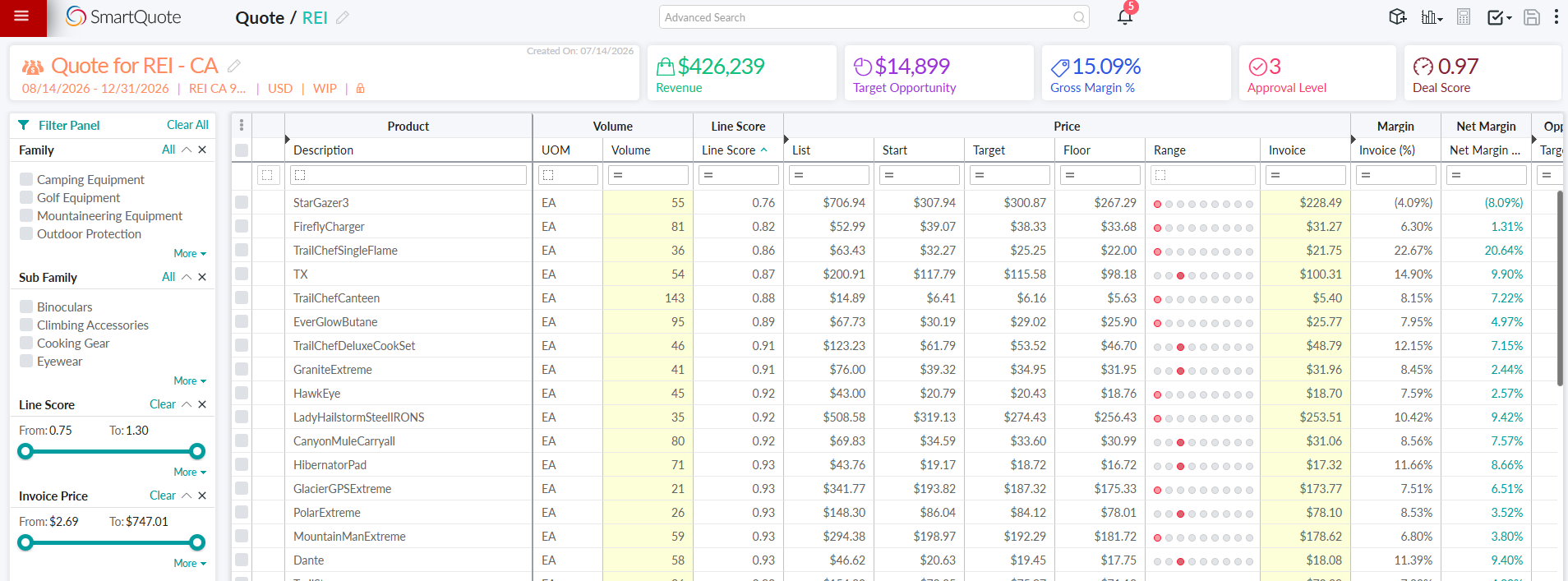
Alt text: Vistaar SmartQuote deal view showing list, start, target, floor, and invoice price per line, with gross margin, net margin, deal score, and approval level
Instead of a binary approved or rejected outcome, reps see where each line sits against its price band, what the deal is worth in gross and net margin, and which approval level it will need.
The pricing logic must also handle structural complexity: volume and tiered pricing, multi-currency and regional structures, contract-specific rates, and subscription or usage-based models. For global enterprises selling through direct sales, distributors, and channel partners, consistent pricing logic across every channel is a baseline requirement.
Quote: Generating accurate, actionable proposals
The quote stage turns configured products and approved pricing into a professional proposal for the customer. CPQ software automates this step, removing manual errors and cutting quote turnaround time.
Automated approval workflows route deals to the right stakeholders based on rules such as deal size, discount depth, or margin impact. Standard deals can be approved instantly, while exceptions go to review with the full deal context attached.
Most CPQ platforms also generate branded proposals and contract documents, which keeps output consistent across sales teams. Integration with CRM and ERP systems carries quote data into order management, billing, and financial reporting.
How CPQ Software Works
A typical CPQ workflow looks like this:
1. Customer request enters the pipeline: A sales rep receives a quote request and opens the CPQ tool directly within the CRM, where the opportunity is tracked
2. Product configuration: Guided selling helps the rep select the right products or services, while rules block incompatible combinations and narrow the valid options
3. Pricing applied: The system calculates the price using pricing rules, customer segment data, historical deal performance, and internal margin targets
4. Deal scoring and analytics: The platform shows win probability, peer-group benchmarks, and line-level scores so the rep can judge how competitive the deal is
5. Approval routing: Automated workflows send deals for approval based on thresholds such as discount depth or deal size, and low-risk deals are approved instantly
6. Quote generation and delivery: The platform generates the proposal and sends it to the customer, and all deal data syncs back to CRM and ERP systems
Basic Quoting Automation vs. Pricing-Intelligent CPQ
Most CPQ shortlists mix two kinds of platforms. Both produce quotes faster, but they differ in how much they change the price that ends up on the quote.
If your quotes often land far below target, or reps discount more aggressively than the deal requires, faster quoting alone will not recover that margin.
Key Benefits of CPQ Software for B2B Enterprises
When implemented well, CPQ software improves quoting speed, pricing accuracy, and cross-team alignment across the revenue process. Here are the benefits B2B enterprises see most often.
Faster Quote Turnaround and Shorter Sales Cycles
The most immediate benefit is faster quote creation. Reps who once built quotes from spreadsheets, product catalogs, and email approvals can produce them in minutes, because CPQ handles configuration, pricing calculations, and document generation.
The gain is measurable. Simon-Kucher research published in February 2026, based on a survey of 200 business leaders, found that CPQ shortens lead-to-quote time by 27%.
Speed also reduces deal friction, since buyers receive clear proposals without long delays. Over time, this shortens the overall sales cycle and lets teams handle more opportunities.
Improved Pricing Accuracy and Margin Protection
Margin protection in CPQ is usually framed as a discounting problem. It is also a visibility problem, and for many enterprises, visibility is the more expensive one.
Centralized pricing rules and automated guardrails are the baseline. They remove spreadsheet errors, enforce discount limits, and flag deals that fall outside policy before they are committed, which alone delivers measurable margin improvement in high-volume quoting.
Guardrails only govern what the rep can see, however. In industries where backend rebate programs are a structural part of deal economics, such as beverage alcohol, the front-end price is only part of the margin story.
As a case in point, a distributor deal quoted at 12% gross margin may realize 7% once back-margin rebates are counted. Without a connection between the quoting system and rebate management, the rep never sees the gap, and the deal clears policy while the margin does not.
Vistaar SmartQuote addresses this through its integration with SmartRebates. Relevant rebates and backend incentives are visible in the deal while the quote is being built, so net margin after program impact is known when the pricing decision is made.
For companies where rebate complexity is a commercial reality, this turns CPQ from a quoting tool into a margin management tool.
Better Alignment Between Sales, Pricing, and Finance
In many organizations, sales, pricing, and finance work in separate systems. That split leads to delayed approvals, inconsistent pricing decisions, and limited visibility into deal profitability.
CPQ software gives these teams a shared platform for every deal. Sales configures products and generates quotes quickly, while pricing teams keep control of pricing rules and discount policies.
Finance sees pipeline pricing and margin impact before deals are finalized. At the same time, well-designed approval workflows send exceptions to the approvers who own them, without long email chains.
Deal Insights for Continuous Improvement
CPQ software captures detailed data from every quote and deal. Deal analytics show which products win most often, where discounts run deeper than needed, and which customer segments are most price-sensitive.
Pricing and revenue teams use these patterns to refine pricing strategy over time. Advanced platforms also use machine learning to flag at-risk customers and unusual discounting, so teams can act before margin slips further.
Scalability Across Regions, Channels, and Product Lines
As companies grow, running the configure, price, quote process across regions and sales channels gets harder. CPQ software provides the scale to support global operations while keeping pricing governance consistent.
Modern platforms support multi-currency, multi-language, and multi-entity environments, so teams can quote accurately in different markets. Centralized pricing rules keep direct sales teams, distributors, and channel partners working from the same customer-specific prices.
Standardizing the workflow across the organization also makes it easier to launch product lines, enter new markets, and hold pricing control as deal volumes rise.
Key Features to Evaluate in CPQ Software
Choosing CPQ software takes more than comparing basic quoting capabilities. Enterprise buyers should judge platforms on how well they support complex products, pricing strategy, integrations, and deal governance.
The following feature areas show whether a CPQ solution can scale with your business.
Product Configuration and Rules Engine
A strong configuration engine lets sales teams quote only valid product or service combinations. CPQ software uses dependency logic and exclusion rules to block incompatible selections and apply the correct product relationships automatically.
Guided selling walks reps through configuration step by step, reducing reliance on tribal knowledge and cutting quoting errors. Bundle management lets organizations package products, services, and add-ons into structured offerings that can be configured quickly.
Where product complexity is a commercial reality, the configuration engine must go further. In manufacturing, a single quote request can involve thousands of component combinations, each with its own compatibility constraints, lead-time dependencies, and engineering specifications.
A rep configuring a custom industrial system cannot hold this logic in their head, and a rules engine that only blocks invalid selections is not enough. Guided configuration for configure-to-order and engineer-to-order offerings mirrors the physical and technical relationships between components, so every quoted solution is one the plant can actually build.
Pricing Engine and Optimization
The pricing engine is one of the most important parts of any CPQ platform. It needs to handle tiered, volume-based, contract, subscription, and usage-based pricing models.
That flexibility lets companies apply the right pricing approach across different products, customer segments, and markets.
More advanced platforms add machine learning price guidance, which helps sales teams land on competitive prices without giving away margin. Frameworks such as Start-Target-Floor make that easier by giving reps clear boundaries for where a deal should land.
Speed matters too. A pricing engine that returns prices in milliseconds keeps quotes in line with the latest rules, discounts, and promotions.
For example, Vistaar's SmartPricingEngine evaluates price requests in real time, applying business rules, deal-specific discounts, and promotional conditions.
Approval Workflows and Deal Governance
Approval workflows are as much about keeping deals moving as they are about compliance. When they are poorly designed, they become one of the biggest sources of friction in enterprise sales.
Deals that should pass automatically get stuck, reps chase approvals instead of moving opportunities forward, and quotes go out after the buying window starts to close. At a minimum, standard deals should auto-approve, exceptions should route to the right person with the full deal context, and no one should need a manual email to keep things moving.
In regulated industries, the compliance challenge goes well beyond discount controls:
- Pharmaceutical manufacturers need quotes that align with Average Manufacturer Price calculations tied to Medicaid rebate obligations
- Beverage alcohol companies operate under three-tier distribution rules that vary by state
- Cannabis businesses deal with frequently changing state-by-state pricing restrictions and serious legal risk
- Tobacco pricing is subject to minimum price laws in several states, where a noncompliant quote becomes a regulatory issue as well as a policy miss
A generic CPQ platform with configurable approval thresholds is not built for that environment. The Vistaar Platform builds regulatory logic directly into pricing and approval rules, instead of relying on someone to catch problems later through manual review.
All of this depends on a complete audit trail, with every pricing decision, approval, and exception time-stamped and easy to retrieve. Organizations working under SOX, federal pricing rules, or state-level requirements need that record on demand.
CRM and ERP Integration
CPQ software delivers full value only when it is connected to existing enterprise systems. Native connectors to CRM platforms such as Salesforce and Microsoft Dynamics let sales teams work in CPQ directly within the environment where opportunities are managed.
Bi-directional sync with ERP keeps pricing data, orders, and financial records aligned between quoting, order management, and finance. This removes data silos and reduces manual data entry across teams.
Many modern platforms also offer an open API architecture, which makes it easier to connect CPQ with billing platforms, analytics systems, and custom applications. It is worth mapping these pricing software integrations early, since integration scope drives much of the implementation timeline.
Analytics, Reporting, and Deal Intelligence
Strong analytics show how pricing and quoting decisions affect deal outcomes. Because every quote is recorded at line level, the platform enables both line-level and deal-level scoring.
These insights let teams analyze win and loss patterns, benchmark deals against peer groups, and identify price-sensitive customer segments. Over time, this visibility helps pricing and revenue teams refine their strategies.
Advanced CPQ platforms also show contextual deal intelligence, such as win probability indicators that update as the discount changes and the projected margin impact of each change.
Rebate and Incentive Alignment
Rebate visibility is the most consistently overlooked capability in CPQ evaluation. For enterprises that rely on backend programs to win and keep distributors, it is also the most expensive gap to ignore.
The problem is architectural. Most CPQ platforms are built around the front-end price, while volume rebates, promotional programs, and channel incentives live in separate systems and get reconciled after the deal closes.
From the rep's perspective, the quote looks clean. From finance's perspective, the realized margin tells a different story.
Consider a consumer goods manufacturer running a tiered volume rebate program across a distributor network. A rep quotes a deal at 14% margin, within policy and approved automatically, while the program terms mean the distributor's rebate cost brings realized margin closer to 9%.
Multiplied across a portfolio of distributor relationships, that gap becomes a material forecasting problem. The quoting system approved every deal, and none of them showed the program cost.
Vistaar SmartQuote addresses this by bringing rebate terms into the deal view. Applicable rebates, backend incentives, and program conditions appear at the moment of quoting, so the rep and pricing team see net margin before the quote is sent.
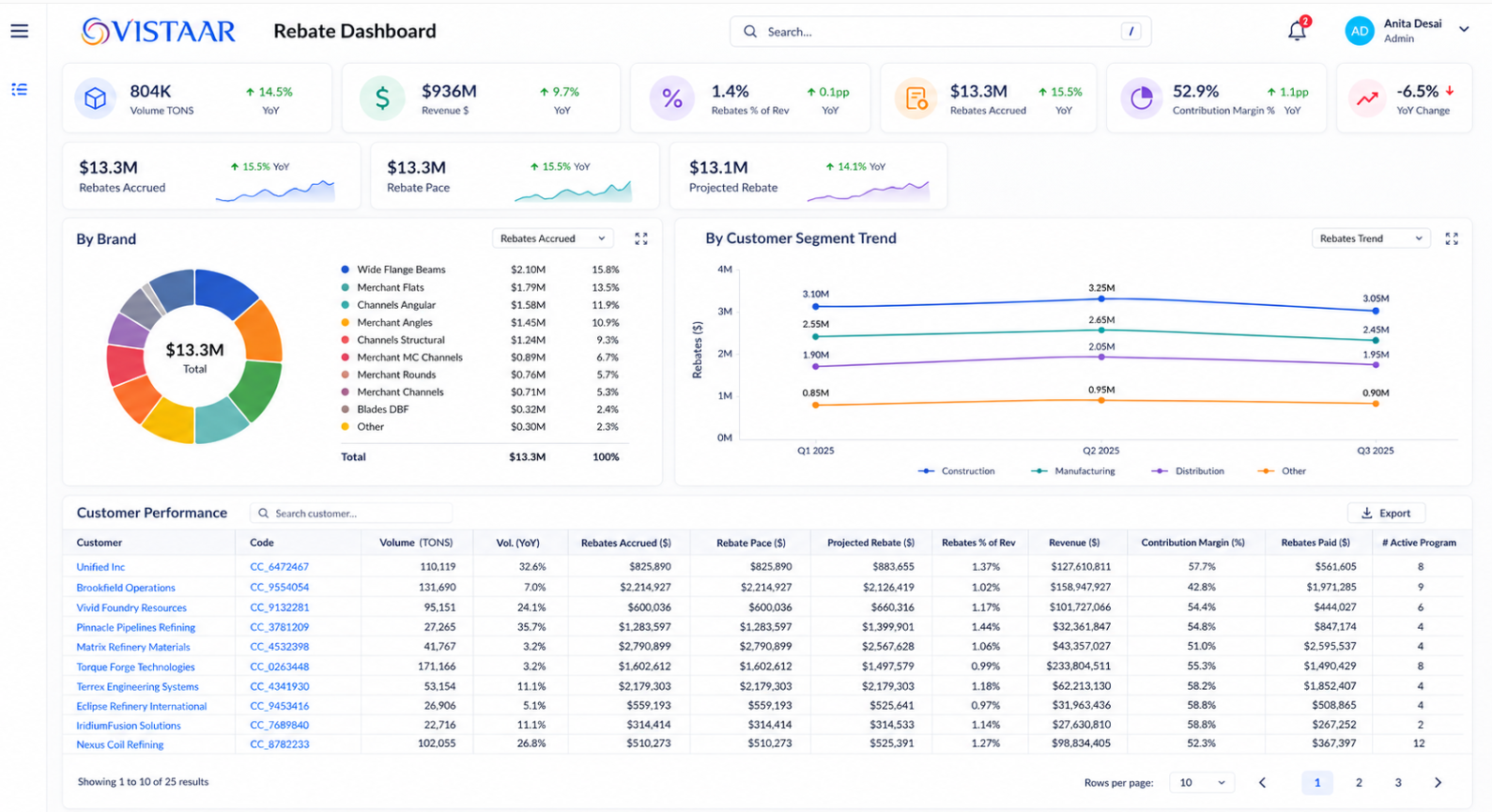
The connection to SmartRebates extends this further. Rebate accruals, claims, and settlements link back to the quoting decisions that created them, giving one view across the full rebate lifecycle, as covered in our guide to rebate management software.
How AI and Machine Learning Are Changing CPQ
Whether a CPQ platform uses AI matters less than whether its recommendations are specific enough to change the price on a deal. That depends on what the models learn from, how often they update, and whether they reflect current market conditions or long-run averages.
Consider a rep quoting a long-standing mid-market distributor. Territory history suggests a 9% discount, but the model sees that this segment closes just as often at 5% in the fourth quarter, so the guidance points to a higher price and the closed deal feeds the next recommendation.
That feedback loop is the value. Every win, loss, and market shift adds evidence, so price guidance gets sharper over time instead of drifting with averages.
AI in CPQ also extends beyond price. Models can recommend configurations based on buying patterns, score opportunities on likelihood to close, and surface cross-sell options during quoting, as covered in our guide to AI pricing software.
Pricing leaders expect adoption to climb quickly. In McKinsey's November 2025 survey of 419 B2B pricing executives, 65 to 85 percent expected to adopt gen AI or agentic AI in pricing within one to three years, up from 10 to 30 percent at the time of the survey.
For CPQ buyers, the practical test is explainability. Reps and approvers need to see why the model recommends a price, or they will override it. Vistaar SmartQuote provides explainable, objective-driven guidance for that reason.
How to Plan a CPQ Implementation
Selecting the right platform is only half the outcome. The same Simon-Kucher study found that only 40% of pricing and quoting implementations fully succeed, and the usual causes sit in scope, data, and ownership rather than in the software.
1. Clean up pricing logic first: Document discount rules, price precedence, and exception policies before configuring them, so CPQ does not lock in the inconsistencies it was bought to fix
2. Prepare the product catalog: Confirm product attributes, bundles, and compatibility rules are complete, since configuration rules can only be as accurate as the catalog behind them
3. Sequence integrations: Start with the CRM and the pricing source, then add ERP order flow, billing, and rebate systems in planned phases
4. Pilot with one business unit: Run live deals through the new process with a single region or product line, then compare quote time, approval time, and realized margin against the old process
5. Assign rule ownership: Name who maintains pricing rules, price bands, and approval thresholds after go-live, because unmaintained rules erode trust in the system quickly
Most of these steps are about decisions the business owns, which is why pricing software implementations often fail for organizational reasons more than technical ones.
How to Choose the Right CPQ Software for Your Business
The following framework helps organizations find a solution that supports both current quoting needs and long-term revenue strategy.
Step 1: Map Your Quoting and Pricing Requirements
Start by reviewing how your current quoting process works and where the biggest friction points are. Common problems include manual workflows, pricing inconsistencies, and slow approval cycles.
Document the complexity of your pricing models, including one-time product pricing, subscription models, usage-based pricing, or hybrid structures. Identify critical integrations too, such as CRM systems, ERP platforms, and billing tools.
Step 2: Evaluate Integration Depth
Integration capability is central to a successful CPQ implementation. The platform should connect deeply with your CRM so sales teams can configure and price deals without leaving their opportunity workflow.
Equally important is bi-directional integration with ERP systems for order management, pricing data, and financial reporting. Organizations that run rebate programs or channel incentives should also check how the CPQ platform connects with rebate and incentive management systems.
Step 3: Assess Scalability and Enterprise Readiness
Enterprise CPQ platforms must support growth across multiple markets and business units. Look for multi-currency pricing, multi-language support, and multi-entity management.
Security and governance are non-negotiable. Role-based access controls, data governance policies, and compliance features keep pricing and deal data protected as the system scales across global teams.
Step 4: Prioritize Pricing Intelligence Over Basic Quoting
Many CPQ platforms focus mainly on automating quote generation. That improves efficiency, but it does not necessarily improve pricing outcomes.
Prioritize solutions that provide pricing intelligence, such as machine learning price guidance and real-time price guidance tied to business objectives. Instead of relying only on discount floors, advanced platforms guide sales teams toward prices that balance revenue growth, margin protection, and customer retention.
Step 5: Validate Vendor Industry Expertise
Domain expertise is a genuine differentiator in CPQ, and the evaluation should be specific. A vendor who understands your industry's pricing architecture will deliver faster implementations, more relevant default configurations, and fewer surprises during rollout.
The questions to ask depend on your vertical:
- Beverage alcohol: Ask whether the vendor understands FOB-to-shelf pricing governance and how the platform handles three-tier compliance across state lines
- Pharmaceuticals: Ask about AMP calculation compliance and how pricing decisions are documented for Medicaid rebate reporting
- Manufacturing: Ask how the platform handles multi-attribute pricing across customer segments, geographies, and distribution tiers at the same time
- Consumer goods: Ask about trade promotion integration and how backend program costs are surfaced at the deal level
Generic answers to specific questions are a signal. Vendors with real vertical experience will answer in the language of your business.
Request references from companies in your sector, and ask those references about implementation accuracy as well as outcome metrics.
Step 6: Test Finalists on Your Own Deals
Scripted demos show a platform at its best. Give each finalist a set of 10 to 20 recent deals, including a complex configuration, a rebate-heavy distributor deal, and one that needed several approvals.
Compare how each platform configures, prices, and routes those deals, and whether the recommended prices would have changed the outcome. This reveals gaps in pricing logic and integration that feature checklists miss.
How Vistaar SmartQuote Approaches CPQ Differently
Vistaar SmartQuote, also presented as SmartCPQ, is built for pricing-led organizations that want intelligence embedded directly in the quoting process. Instead of only enforcing discount thresholds, it gives sales teams objective-driven deal guidance that balances revenue growth, margin protection, and customer retention.
- Explainable price guidance: Machine learning recommendations with Start-Target-Floor price bands show reps the right pricing range for each deal and the reasoning behind it
- Net margin visibility: Pricing data, discount parameters, rebate terms, and business constraints appear in one view, with SmartRebates connecting rebate accruals and settlements to the deal
- Deal insights: Win probability updates as discount levels change, and deal scoring ranks opportunities on profitability, strategic value, and likelihood to close
- Guided approvals: Approval requirements are defined by discount depth, deal size, or margin impact, with exceptions routed automatically and a complete audit trail
- Complex quoting at scale: Configure-to-order and engineer-to-order offerings, multi-country deals, and multi-year contracts with renewals and modifications are handled in one workflow
- Open integration: Native CRM integration with Salesforce and Microsoft Dynamics, plus an open API architecture for custom applications
At a $10B+ industrial manufacturer, SmartQuote supports 10 million+ SKUs and about 5 million price points, handling 2,000+ API calls a day with 24x7 availability.
Vistaar is also a Leader in the inaugural 2026 Gartner Magic Quadrant for B2B Pricing and Rebate Optimization Software.
Conclusion: Bringing Pricing Intelligence to Every Quote
As B2B pricing and product complexity grow, spreadsheets and manual approvals stop scaling. CPQ software standardizes the configure, price, quote process while improving speed, accuracy, and margin control on every deal.
The platforms that deliver the most value do more than generate quotes quickly. They guide each deal toward a target price, show net margin before the quote goes out, and learn from every win and loss, so the evaluation should test pricing intelligence as hard as it tests quoting speed.
See Pricing Intelligence in Every Quote
If margin erosion is happening deal by deal across your portfolio, the fix starts at the quote. See how Vistaar SmartQuote brings price guidance, rebate visibility, and guided approvals into every deal.
FAQs
1. Can CPQ Software Use Prices From a Separate Pricing Engine?
Yes. Many enterprises keep price logic in a central pricing engine and have CPQ call it for each line item. This keeps quotes, e-commerce, and ERP orders on the same prices instead of maintaining separate rules inside CPQ.
2. Do You Need CPQ If You Sell Mostly Standard Products?
Possibly. Even without complex configuration, CPQ helps when pricing varies by customer, contract, volume, or region, or when discount approvals slow deals down. The pricing and approval layers often deliver more value than configuration in these cases.
3. How Does CPQ Handle Multi-Year Contracts and Renewals?
Enterprise CPQ platforms track contract terms, pricing tiers, renewals, and modifications with a full change history. Renewal quotes can start from the existing contract, apply agreed escalators, and flag lines where the price has fallen below current targets.
4. Can CPQ Show Net Margin After Rebates Before a Deal Is Signed?
Only if the CPQ platform connects to rebate and incentive data. Without that link, reps see front-end margin only, and backend program costs appear after the deal closes, when the price can no longer change.
5. Who Should Own CPQ Pricing Rules After Go-Live?
Pricing operations or a deal desk usually owns price bands, discount rules, and approval thresholds, while sales operations owns the quoting workflow. Naming owners before go-live prevents outdated rules from piling up.
6. Can CPQ Enforce Regulatory Minimum Pricing?
Yes, if the platform supports jurisdiction-specific pricing rules. Floors for state minimum price laws, excise changes, or government pricing obligations can be built into the price logic, so noncompliant quotes are blocked before they reach the customer.

As an experienced pricing solutions partner to some of the biggest names in global business, Vistaar offers a range of services to help our customers reach their maximum potential. Talk to us to see how we can help you create a more profitable future.