



TL;DR
- Vendor rebates are post-purchase incentives earned when buyers meet agreed targets.
- Enterprises lose 4–5% of rebate value each year due to poor tracking and manual processes.
- Unlike discounts, rebates preserve list prices while still influencing buyer behavior.
- The seven main types are volume, growth, tiered, product mix, ship-and-debit, price shelter, and loyalty rebates.
- Vendor rebates do more than improve margins. They also strengthen supplier relationships and support better planning.
- Spreadsheets and basic ERP workflows often fail to manage rebate complexity at enterprise scale.
- Effective rebate programs need automation, accurate matching, accrual tracking, and pricing integration.
- Connected rebate management helps enterprises protect margins and capture more earned value.
Every year, enterprises leave significant rebate dollars unclaimed. The programs exist, agreements are signed, and money is earned. Yet it never arrives, because the systems tracking it simply cannot keep up.
Research from MMIT (published in Contract Pharma, November 2023) puts the leakage at 4–5% for large manufacturers. On a $1 billion annual rebate portfolio, that translates to $40–50 million lost, not to poor program design, but to poor management.
That gap between earned rebates and collected rebates is exactly where margin dies. This guide breaks down the types of vendor rebates enterprises actually use, the strategic benefits that extend well beyond cost savings, and what it takes to manage them effectively at scale. Along the way, we will ground every concept with examples from Coca-Cola, Procter & Gamble, Dell, and enterprise case studies.
To use that playbook effectively, though, it helps to start with what vendor rebates actually are, and, just as importantly, what they are not.
What Are Vendor Rebates?
A vendor rebate is a financial incentive from a supplier to a buyer, paid after a transaction is completed and specific conditions are met. The buyer purchases goods at full list price, tracks purchases over an agreed period, and earns a rebate once they cross a defined threshold, say, $500K in annual spend or 10% year-over-year growth.
The mechanics follow a predictable five-step cycle: agreement, purchasing, threshold attainment, claim submission, and settlement. Each step sounds straightforward. At enterprise scale, across dozens of vendors, hundreds of SKUs, and multiple geographies, it rarely is.
These programs are especially prevalent in manufacturing, distribution, consumer goods, beverage alcohol, and retail — industries where multi-layered distribution chains make pricing strategy a competitive differentiator.
Beam Suntory, the fourth largest premium spirits company globally, has used structured pricing and rebate programs with Vistaar since 2008 to manage segmented prices and distributor margins across its full portfolio. That is a growth strategy.
Still, the first question most leadership teams ask when rebates come up is a fair one: why not just lower the price and avoid this complexity altogether? The answer reveals why rebates exist in the first place.
Vendor Rebates vs. Discounts: Why the Distinction Matters
A discount reduces the purchase price at the point of sale. It is immediate, unconditional, and visible to everyone, including competitors. A rebate, by contrast, is earned after the fact, only when the buyer hits specific performance criteria. That difference shapes everything from buyer behavior to brand positioning.
Consider why premium brands like Porsche or Rolex never publicly discount. Price fluctuations damage brand equity and perceived value. Rebates offer a degree of separation from the published price, which means they can be deployed across different buyer segments and channel structures without signaling a price cut to the entire market.

That strategic flexibility is precisely why vendor rebates come in so many forms. Each type is designed to incentivize a different buyer behavior, and choosing the right structure (or the right combination) can mean the difference between a rebate program that drives growth and one that just adds complexity.
Types of Vendor Rebates Every Enterprise Should Know
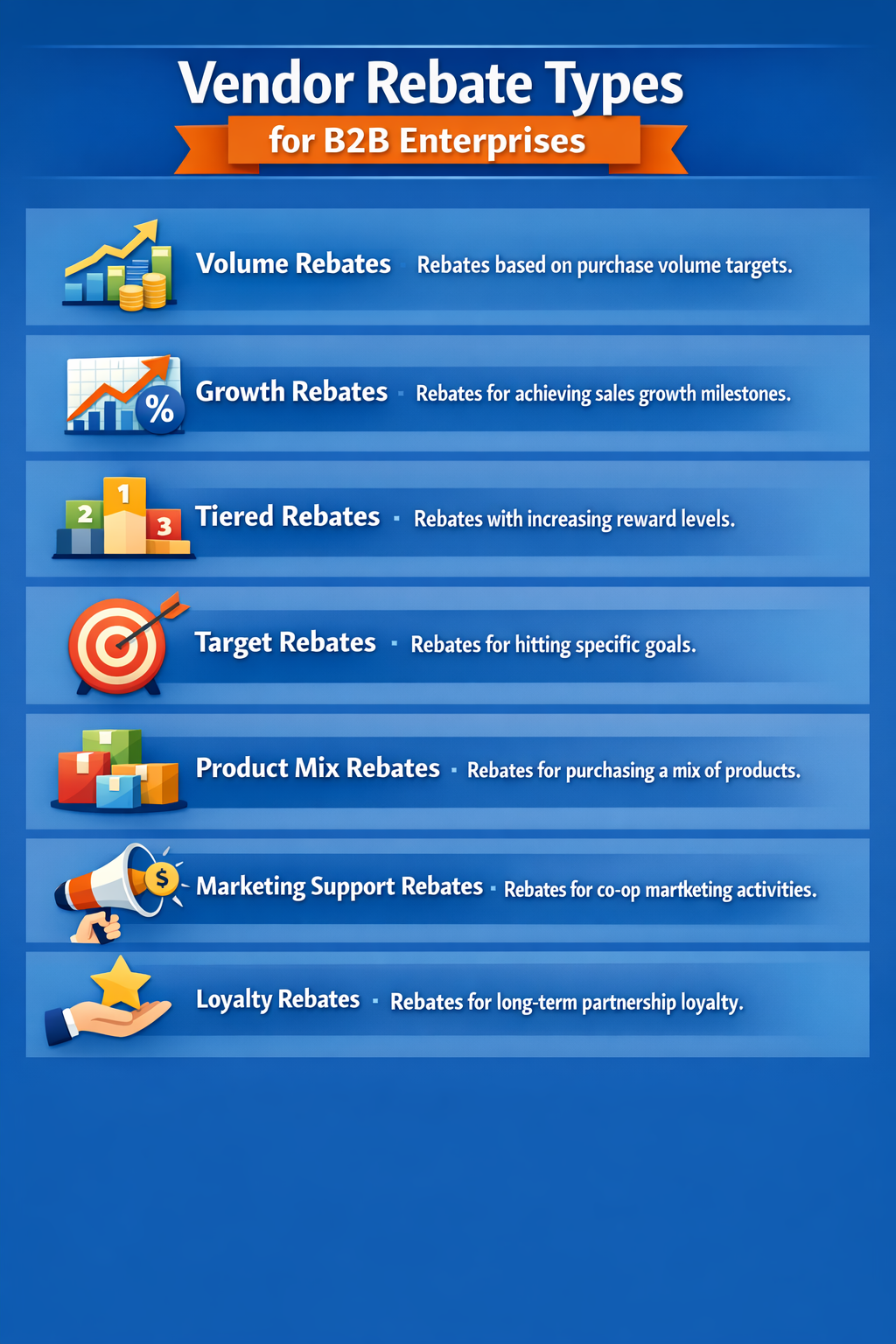
Most enterprises run several rebate types simultaneously across customer segments, channels, and geographies. Understanding the full taxonomy matters, because using the wrong structure, or overlooking one that fits your purchasing pattern, directly translates to uncaptured margin.
Here are the seven types that show up most frequently in enterprise B2B programs, each illustrated with a real-world example.
1. Volume-based rebates
The most common type. Buyers earn a rebate when total purchases exceed a defined threshold within a set period, often structured in tiers: 2% on $250K–$500K in purchases, scaling to 4% above $500K.
Coca-Cola uses this model with its distribution partners. Once distributors surpass specific quantity thresholds, each additional bottle yields a fixed per-unit incentive. The structure encourages consistent volume rather than one-off purchasing spikes, which also gives Coca-Cola better demand visibility for production planning.
Volume rebates are simple to understand, yet deceptively hard to track when tiers span multiple product categories or regions. Vistaar’s detailed guide on volume incentive rebates breaks down the mechanics with examples across beverage alcohol, retail, and manufacturing.
Volume rebates reward total spend. Growth rebates take a different angle: they reward improvement.
2. Growth-based rebates
Instead of measuring absolute volume, growth rebates reward buyers for exceeding prior-period purchase levels year-over-year or quarter-over-quarter. This makes them especially effective in mature, competitive markets where total volume may already be high.
In the beverage alcohol industry, for instance, a spirits supplier offers distributors a 5% rebate on all cases purchased above last year’s total. A distributor that buys 12,000 cases after purchasing 10,000 last year receives a 5% rebate on the 2,000 “growth” units, directly rewarding the incremental behavior the supplier wants to encourage.
The challenge is that growth rebates require accurate historical baselines. When that data lives in disconnected ERP systems and spreadsheets, establishing a reliable baseline becomes its own project before the rebate program can even launch.
Where growth rebates add a single layer of complexity, tiered rebates add several.
3. Tiered rebates
Tiered rebates are multi-level structures where rebate rates escalate as the buyer hits progressively higher thresholds. They can be layered by product category, region, or customer group, making them more granular than simple volume rebates.
Dell Technologies runs this model with its reseller network. Higher annual sales volumes unlock progressively higher rebate percentages, which incentivizes resellers to consolidate purchases with Dell rather than splitting spend across competing vendors.
Managing tiered rebates across multiple dimensions demands sophisticated tracking, precisely where spreadsheets break down and purpose-built rebate management software becomes essential.
While tiered rebates reward how much a buyer spends, product mix rebates reward what they spend it on.
4. Product mix rebates
These incentivize buyers to purchase across a balanced portfolio of product categories rather than concentrating on a few high-margin SKUs. For vendors, this ensures broader product adoption across their catalog. For buyers, it creates rebate opportunities on diversified purchasing they would likely be doing anyway, if the program is structured correctly.
Procter & Gamble uses product mix incentives to encourage retailers to stock a balanced range of premium and economy brands across personal care and cleaning categories. Nestlé Professional takes a similar approach, offering foodservice distributors rebates when they buy from at least five different product categories: beverages, frozen foods, confectionery, and more.
The rebate types covered so far all focus on what or how much a buyer purchases. Ship-and-debit rebates work differently, they focus on the price at which a distributor sells.
5. Ship-and-debit rebates
Common in electronics, industrial distribution, and B2B manufacturing. In this model, a distributor sells at a competitive market price, then claims back the margin difference from the manufacturer. The distributor stays competitive in the field; the manufacturer maintains its list price integrity.
The catch is that ship-and-debit programs require precise transaction-level matching between what was sold and what the agreement covers. Research from AIMDek Technologies shows that 18% of valid claims are rejected purely due to product ID mismatches between systems. That is not a rounding error; it is nearly one in five legitimate claims denied because of data inconsistency.
This is a key differentiator for Vistaar’s SmartRebates, which natively supports ship-and-debit programs with an automated matching engine that reconciles claims at configurable intervals: daily, weekly, or monthly.
Ship-and-debit rebates protect distributor margins in competitive markets. Price shelter rebates protect buyer margins in volatile ones.
6. Price shelter rebates
One of the lesser-known types, yet critical for any enterprise dealing with commodity-linked inputs. Price shelter rebates protect the buyer against raw material price fluctuations during a contract period. If costs spike and the vendor raises prices, a price shelter rebate compensates the buyer for the differential.
In the steel industry, where iron ore can swing 20% in a single quarter, this protection is essential. One of the largest long steel producers in the Americas partnered with Vistaar to centralize its rebate management alongside pricing data through SAP ERP integration. The result was automated, accurate rebate calculations aligned directly with the company’s pricing strategy across both inside sales and field sales teams.
For these industries, price shelter rebates are a margin defense mechanism.
The types covered so far all incentivize short-to-medium-term purchasing behavior. The final category takes a longer view, locking in buyer commitment over years, not quarters.
7. Loyalty and future purchase rebates
Future purchase incentives offer rebate credits that can only be applied to subsequent orders, locking in future purchasing behavior and increasing customer lifetime value. Loyalty rebates work similarly, rewarding sustained relationships over multiple periods.
The beverage industry offers a clear illustration. Companies like PepsiCo and Coca-Cola structure multi-year “pouring rights” agreements with universities and restaurant chains that include rebates, sponsorship funding, and volume-based allowances paid in arrears. These agreements lock in exclusive purchasing for years, demonstrating how loyalty rebates drive revenue predictability at a scale that one-off discounts never could.
The table below summarizes each type, how it works, and where it fits best.
Vendor rebate types at a glance
Knowing the types is the foundation. The next question is why enterprises invest so heavily in these programs, because the benefits extend far beyond the obvious cost savings that most articles focus on.
Key Benefits of Vendor Rebates for Enterprises
Cost savings is the headline benefit, and it is real. A retailer earning a 5% rebate on $600K in purchases recovers $30K, lifting gross margin from 20% to roughly 24% on that spend. The vendor, meanwhile, has not publicly signaled a price cut to anyone.
That margin improvement, however, is only the first of five strategic advantages that compound over time.
1. Stronger supplier partnerships
Rebate agreements create mutual accountability. The buyer commits to volume. The vendor commits to rewarding it. That shared commitment builds trust, the kind that opens doors to priority allocation during shortages, better terms on future contracts, and early access to new products. Industry surveys of North American CFOs found that 87% say rebate programs have directly increased organizational revenue (Vendavo 2024 CFO Survey, 300+ respondents).
2. Better demand forecasting and inventory planning
When buyers commit to volume or growth targets, purchasing patterns become more predictable. Vendors gain better visibility into demand. Buyers plan inventory more efficiently. The result is fewer stockouts, less overstock waste, and lower carrying costs on both sides of the transaction.
3. Competitive pricing without a race to the bottom
Rebates allow enterprises to pass savings to their customers selectively: by segment, by channel, by geography, without publishing a lower price that every competitor can see and undercut. That kind of surgical pricing control is impossible with flat discounts.
4. Budget predictability and cash flow optimization
Negotiated rebate programs make procurement expenses more predictable for financial planning. Accrual-based management directly improves cash flow forecasting accuracy, assuming the organization can track accruals reliably. This is where closing the pricing-rebate management loop becomes critical for enterprises that want rebate outcomes connected to their broader pricing strategy.
These benefits are well documented. So why do most enterprises still fail to capture the full value of their rebate programs? The answer has less to do with the programs themselves and more to do with how they are managed.
Why Most Enterprises Struggle with Vendor Rebate Management
Managing rebates is where enterprises hemorrhage money. The reasons are structural:
- The spreadsheet trap is pervasive. Industry surveys consistently show that over half of companies still manage rebates on spreadsheets and email. Academic research from the University of Hawaii found that 88% of accounting spreadsheets contain errors. When a rebate portfolio spans dozens of vendors, hundreds of agreements, and multiple geographies, those errors compound into real revenue loss.
- The “rebate guru” risk is underestimated. Many companies depend on a single person managing massive, complex files without a documented process. If that person is unavailable, the entire rebate program risks stalling or collapsing entirely.
Case in point
A $500M medical manufacturer discovered millions in margin loss from rebate errors despite having strong ERP functionality (ProfitOptics, 2024). Their rebate programs were technically in a system—the system just could not handle the complexity of their actual agreements. Teams supplemented with spreadsheets, and the leakage went undetected for years.
- ERP limitations compound the problem further. Standard SAP or Oracle modules handle simple rebate deals effectively. With over 300 different agreement structures in practice, however, those modules cover only a fraction. SAP community forums document persistent issues: VBOX index table bloat reaching 2–5 TB for consumer goods companies, limitations on complex tier structures, and disruptive S/4HANA migration paths.
- Then there is the silent margin erosion that no one notices until it appears in the P&L. Tier acceleration opportunities, claim submission deadlines, and program end dates pass without alerts in spreadsheet-managed programs. A product with a 40% gross margin can fall to 28% once volume rebates, market-share incentives, and loyalty payments are all applied. Without integrated tracking, that erosion is invisible.
The pattern is clear: complexity is growing, yet most organizations are still managing it with tools designed for a simpler era. The question then becomes: what does effective rebate management actually look like at enterprise scale?
How to Manage Vendor Rebates Effectively at Scale
The path from spreadsheet chaos to strategic rebate management is not an overnight transformation. It requires the right capabilities, clean data, and organizational alignment. The enterprises that capture 98% of earned rebates, instead of leaking 4–5%, share a common set of non-negotiable capabilities.
- Program design flexibility: support for flat, tiered, growth, price-based, ship-and-debit, promotional, and lump sum types, not just the two or three an ERP handles natively.
- Granular rate planning: the ability to set rebate rates by customer, location, product category, or plant, with defined exclusions for each.
- Automated matching: auto-matching claims and transaction line items at configurable intervals, eliminating the product ID mismatches that cause 18% of claim rejections.
- Predictive analytics: what-if modeling to forecast outcomes before committing budget, plus AI-driven predictions of partner tier attainment based on historical patterns and current run rates.
- Pricing integration: this is the capability most rebate tools miss entirely. If rebate management software cannot show how rebates affect net realized price and deal profitability, the organization is optimizing in a silo.
The market is moving in this direction. The rebate management platform market grew to $1.92 billion in 2024 and is projected to reach $5.27 billion by 2033 (Growth Market Reports), driven by enterprises recognizing that manual processes cannot handle the complexity of modern B2B incentive structures.
That shift from manual to intelligent management is exactly where Vistaar’s approach differs from most tools in this space.
How Vistaar SmartRebates Helps Enterprises Optimize Vendor Rebate Programs
Vistaar SmartRebates is purpose-built for B2B enterprises managing complex rebate programs across manufacturing, consumer goods, retail, and beverage alcohol. The question worth asking is not whether it handles rebates, every tool in this category does. The question is what it does differently.
The core differentiator is end-to-end pricing integration. Most rebate management tools operate in isolation. They track rebates effectively, yet they cannot show how those rebates affect net pricing strategy. SmartRebates is part of the Vistaar platform, connecting rebate management directly to list pricing (SmartPricing), deal guidance (SmartQuote), and optimization analytics (SmartOptimizer). That means rebate decisions are informed by, and aligned with, the full deal-margin picture.
In practice, that integration surfaces capabilities standalone tools struggle to match: diverse program support across all major rebate types, an advanced matching engine operating at configurable intervals, monthly-level accrual forecasting across multiple dimensions, transaction-level audit trails for dispute prevention, and predictive what-if modeling that uses AI to forecast partner tier attainment before the quarter closes.
An enterprise implementation illustrates what this looks like in practice.
Case study: $13B global electrification manufacturer
A Fortune 500 electrification products leader with approximately $13B in annual revenue implemented Vistaar’s pricing solutions integrated with SAP Order Processing and homegrown CRM + Order-to-Cash systems. The integration enabled the company to manage complex rebate structures across its North American operations within a unified pricing platform—eliminating the fragmentation that had plagued its previous approach.
The result pattern across these implementations is consistent: calculation cycles compressed from 12–14 days to 36–48 hours, labor reduced from three full-time analysts to 0.5 FTE, and partner payments accelerated from 90 days to 30 days.
See how SmartRebates fits into your pricing strategy
Frequently Asked Questions
What is a vendor rebate?
A vendor rebate is a post-purchase financial incentive from a supplier to a buyer, earned when the buyer meets agreed-upon targets such as volume thresholds, growth benchmarks, or product mix criteria. Unlike discounts, rebates are paid retroactively after performance is verified.
How do vendor rebates work?
The buyer and vendor agree on rebate terms including thresholds, rates, and measurement periods. The buyer purchases at full price and accumulates qualifying transactions. Once conditions are met, the buyer submits a claim, and the vendor verifies and settles the rebate as a credit memo, direct payment, or offset against future purchases.
What is the difference between a vendor rebate and a discount?
Discounts reduce price at the point of sale and are unconditional. Rebates are earned after the transaction when specific criteria are met. Rebates preserve list prices and encourage sustained purchasing, while discounts typically produce one-time spikes.
What is rebate leakage and how much does it cost?
Rebate leakage refers to earned rebates that go unclaimed due to poor tracking, missed deadlines, calculation errors, or data mismatches. Research from MMIT indicates enterprises lose 4–5% of total rebate value to leakage annually—translating to tens of millions for large manufacturers.
Can ERP systems handle vendor rebate management?
Standard ERP modules handle simple rebate deals effectively. With over 300 different agreement structures in practice, however, most ERPs cover only a fraction. Organizations frequently supplement with spreadsheets, which introduces error and leakage risk.
Are vendor rebates taxable?
In most jurisdictions, vendor rebates reduce cost of goods sold rather than being treated as income. Tax treatment varies by rebate structure and local regulations, especially for cross-border programs. Consulting a tax advisor is recommended.
What industries benefit most from vendor rebate programs?
Manufacturing, distribution, consumer goods, beverage alcohol, retail, electronics, and pharma rely heavily on vendor rebates. Any industry with multi-tiered distribution, high transaction volumes, and complex pricing structures benefits from structured programs.

As an experienced pricing solutions partner to some of the biggest names in global business, Vistaar offers a range of services to help our customers reach their maximum potential. Talk to us to see how we can help you create a more profitable future.