




TL;DR
• AI pricing software uses predictive models for demand, elasticity, and win probability to recommend prices, then checks each recommendation against business rules such as floors, ceilings, and regulatory limits
• Rules set the boundaries for policy, contracts, and compliance, models choose the price within them, and pricing leaders own objectives and exceptions; dropping the rules layer is the fastest way to lose sales and finance trust
• The strongest B2B use cases are cost-driven list pricing, trade promotion planning, omnichannel price consistency, regulated beverage alcohol pricing with rebates, and AI-guided quoting
• AI pricing struggles with sparse data, new products, and recommendations sales cannot explain, which is why explainability, data quality, and adoption matter as much as the model
• Evaluate platforms on lifecycle coverage, ERP and CRM integration, explainability, governance, and scenario modeling, and start with one high-impact use case before scaling
AI pricing software uses machine learning and predictive analytics to recommend prices from demand, cost, competitive, and deal data, then applies business rules so every recommendation stays within approved limits. For B2B enterprises, it handles the pricing complexity that spreadsheets and static ERP price tables were never built for.
That complexity looks like this across industries:
- Manufacturing: 20,000 SKUs priced across regions and customer tiers, with input costs moving between price updates
- Beverage alcohol: A supplier managing state-by-state pricing and tax rules while tracking distributor and retailer incentive commitments
- Distribution: A catalog of 50,000+ SKUs, where every quote carries customer-specific prices and discounts
Manual pricing breaks down under that weight, and the result is margin erosion, compliance risk, and revenue leakage across thousands of transactions a day.
What Is AI Pricing Software (and How Is It Different)?
In short, AI pricing software is a category of pricing platform in which statistical and machine learning models, rather than fixed markups or manually maintained tables, produce the recommended price, and configured guardrails decide how far that price may move.
The main difference from traditional systems is adaptability. Traditional tools rely on static rules and manual updates, while AI systems keep modeling cost, demand, and competitive signals and refresh recommendations as conditions change.
Its five core functions are:
- Price optimization and demand modeling: Price optimization engines estimate elasticity, test scenarios, and recommend the most profitable price points within constraints
- Deal guidance and CPQ (configure, price, quote): Sales teams get AI-guided price ranges and guardrails while they build quotes
- Rebate management and accrual automation: Complex incentive programs are tracked, forecast, and accrued automatically
- Promotional pricing and trade spend planning: Predictive models forecast which promotions will drive incremental volume and which will dilute margin
- Pricing analytics and scenario modeling: Teams simulate the margin and volume impact of price changes, cost spikes, and contract changes before execution
How AI Pricing Models Actually Work
"AI pricing" covers several different models, and knowing which one sits behind a recommendation helps teams judge how far to trust it:
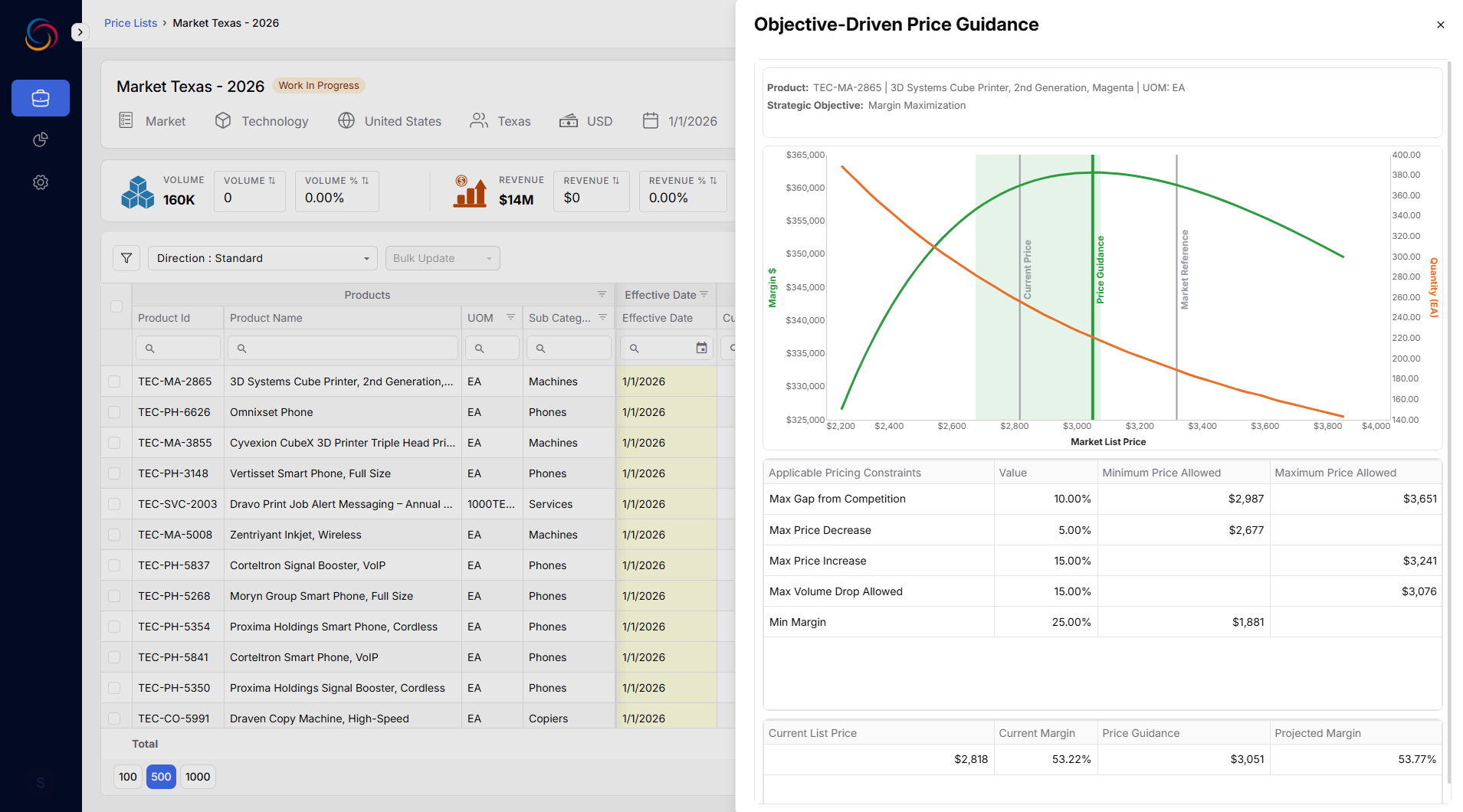
The recommendation step is where business intent enters. The team sets an objective, such as margin maximization or volume protection, and constraints such as maximum price change, minimum margin, and competitive gap, and the model recommends the price that best meets the objective inside those limits.
Rules and AI Work as Layers
A common misconception is that AI pricing replaces rule-based pricing. In enterprise B2B, the two work as layers: rules encode policy, contracts, and regulation, and models recommend the best price inside those boundaries.
- Rules layer: Floors, ceilings, contract prices, regulatory pricing requirements, and approval thresholds that no recommendation may cross
- Model layer: Elasticity, segmentation, and win-probability estimates that decide where inside those limits the price should sit
- Human layer: Pricing leaders who set objectives, review exceptions, and override recommendations with a recorded reason
Programs that try to replace rules with models tend to lose credibility with sales and finance after the first recommendation that breaks a contract term or a minimum margin. Programs that layer them keep the controls finance relies on and still gain the model's precision.
Predictive, Generative, and Agentic AI in Pricing
Most AI pricing today is predictive: machine learning that forecasts demand, elasticity, and win probability, and produces the price recommendation itself. Generative AI adds a natural-language layer for questions and explanations, and agentic AI goes a step further by carrying out defined tasks, such as preparing scenarios or routing approvals, with limited supervision.
Adoption of the newer layers is climbing fast. In McKinsey's November 2025 survey of 419 B2B pricing executives, 65 to 85 percent expected to adopt gen AI or agentic AI in pricing within one to three years, up from 10 to 30 percent at the time of the survey.
5 Real-World Use Cases of AI Pricing Software
The clearest way to understand AI pricing software is to see where it changes a specific pricing workflow. Below are five industry use cases where manual processes stop scaling.
Use Case 1: Manufacturing: Dynamic List Pricing Amid Raw Material Volatility
A manufacturer of industrial components, such as valves and specialty chemicals, maintains thousands of SKUs with different prices by region and customer tier.
Raw material and tariff volatility makes quarterly price updates insufficient. Kearney's Supply Chain Navigator 2026 H1 briefing reports that applied tariff rates have risen 30% on average, and by the time a quarterly price file is approved, costs have often moved again, leading to:
- Margin erosion: Cost-sensitive products sell below target before the next update
- Outdated quotes: Pricing teams and reps quote from stale lists
- Sales friction: Pricing delays slow deals and frustrate sales
- Regional inconsistency: Price realization varies across regions
How AI Pricing Software Solves It
The system models commodity costs, demand signals, and customer segmentation to recommend SKU-level price adjustments as costs move. Recommendations stay within guardrails such as maximum price increase thresholds and regional ceiling rules.
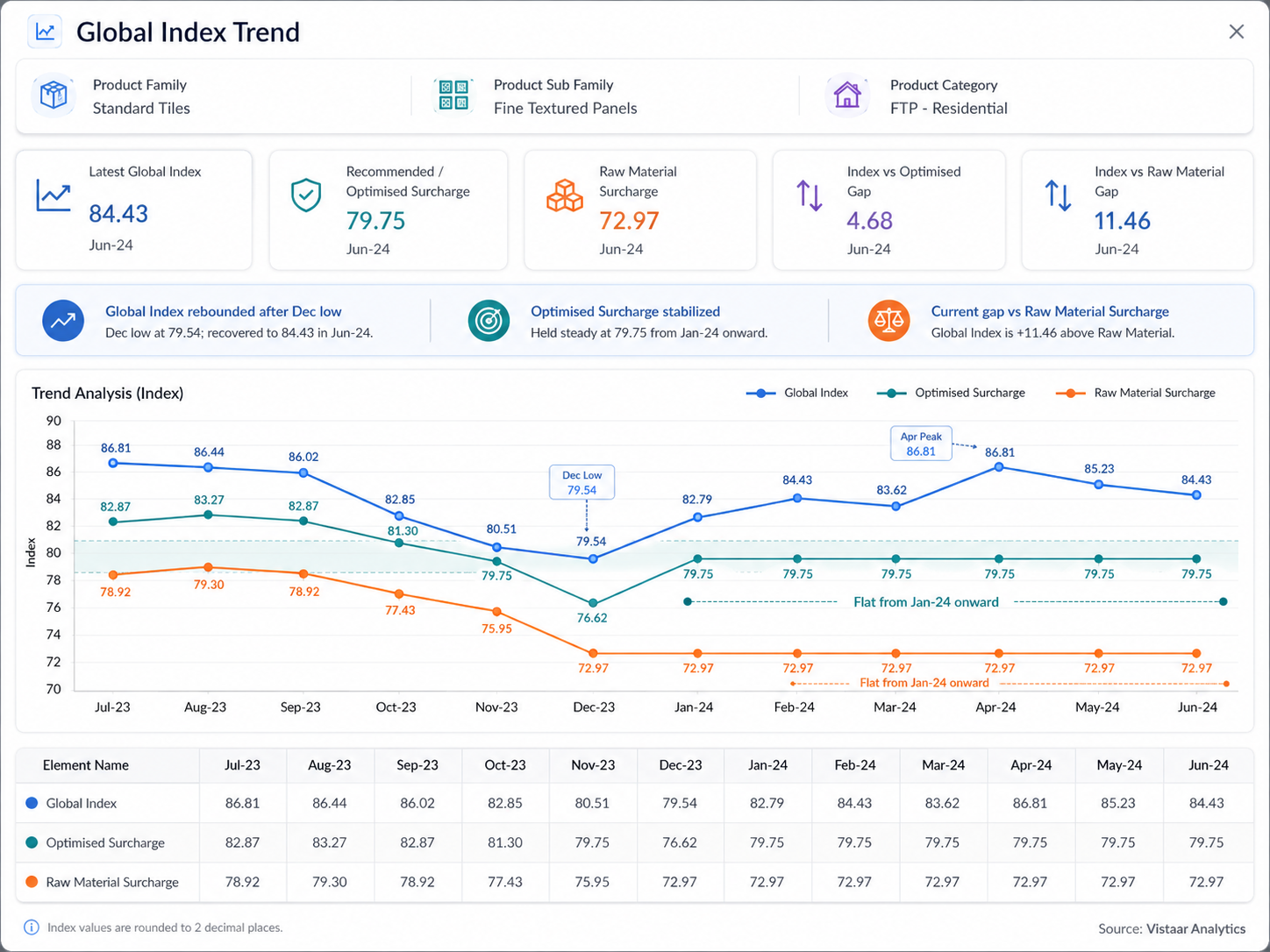
Pricing teams review recommendations in a central dashboard, approve or adjust them in bulk, and push updated prices directly to the ERP. Pricing solutions for manufacturing companies, such as Vistaar's SmartPricing, support complex price structure management and model-driven list price recommendations.
The Measurable Outcome
- Faster cycles: Price updates move from weeks to days or hours
- Consistent margins: Margin consistency improves across regions and product lines
- Better negotiations: Sales teams receive current price bands, so negotiations start from today's cost position
Use Case 2: Consumer Packaged Goods: Trade Promotion Planning
An enterprise CPG brand can run hundreds of promotions a year across retailers and regions, and many are planned on historical precedent ("what worked last year") and retailer pressure. Teams have limited visibility into baseline demand, incremental lift, or cannibalization.
For instance, a brand promoting Product A may pull demand away from Product B in the same category, creating a margin trade-off that only becomes visible after the spend is committed.
How AI Pricing Software Solves It
AI-driven systems analyze historical lift curves, baseline sales velocity, and cannibalization across the category and SKU matrix. Before any promotion launches, the system forecasts expected volume lift, margin impact, and net ROI, so teams can approve, adjust mechanics, or cancel weak promotions before trade spend is locked in.
After the promotion, the system compares predicted and actual performance and feeds the results back into the model. Platforms such as Vistaar SmartPromotions help CPG teams plan, track, and evaluate trade promotions in one system, linking promotional spend to sales lift and rebate performance.
The Measurable Outcome
- Fewer losing promotions: Unprofitable promotions decline, improving realized margin
- Better allocation: Trade spend moves from low-impact to high-impact programs
- Cannibalization visibility: Category managers see cross-product effects before committing spend
Use Case 3: Retail: Omnichannel Price Consistency and Markdown Planning
The Pricing Challenge
A multi-format retailer running stores, e-commerce, and marketplaces often operates disconnected pricing systems. Online prices change quickly, while in-store shelf prices lag by days or weeks because they depend on manual label changes and store-level execution.
Customers notice the gaps. A shopper who sees $34.99 online and $39.99 in-store may feel overcharged, which leads to price-matching complaints, margin overrides, and lost trust.
Markdowns compound the problem when they are taken reactively. Without forecasts of the right timing and depth, inventory ages and margins compress more than they need to.
How AI Pricing Software Solves It
AI applies pricing rules across all channels through a single pricing engine that processes demand signals, competitor prices, and channel-specific constraints together. For everyday pricing, the system enforces consistency or intentional, rule-governed variation, such as online prices differing from in-store only within an approved band.
For markdowns, the approach shifts from reactive to predictive, with timing and depth forecast at the SKU and store level from sell-through velocity, inventory age, and elasticity. Centralized price management of this kind is what retail pricing teams need to publish approved prices to ERP and e-commerce systems from one place.
The Measurable Outcome
- Lower markdown loss: Markdowns are timed and sized from forecasts rather than aged inventory
- Fewer disputes: Cross-channel price disputes and overrides decline
- Faster clearance: Inventory clears sooner with lower carrying costs
Use Case 4: Beverage Alcohol: Regulatory Pricing and Rebate Automation
A beverage alcohol supplier operating across many states has to comply with state-specific pricing and tax rules. Each jurisdiction calculates taxes differently and sets its own constraints, so a promotional discount allowed in one state may be restricted in another.
The same supplier manages rebate programs spanning distributors and retailers, with volume tiers, performance incentives, and seasonal bonuses. Manual beverage alcohol pricing processes raise compliance risk and delay settlements.
How AI Pricing Software Solves It
Pricing software embeds regulatory logic in pricing workflows, so prices that break a configured rule are flagged or blocked before publication. Rebate liabilities are calculated automatically by distributor, product, and region, and claims, approvals, and settlements follow structured workflows with full audit trails.
Predictive analytics then show which programs drive incremental volume and which dilute margin, so programs are redesigned on measured contribution. Vistaar's SmartRebates automates rebate setup, accruals, and settlement, while Vistaar iPSM recalculates price structures when excise duties, VAT, or minimum unit pricing thresholds change.
The Measurable Outcome
- Lower compliance risk: Regulatory rules are enforced by the system, not by memory
- Faster settlement: Rebate processing moves from weeks toward days
- Liability visibility: Rebate liability is visible by program, partner, and SKU
- Better programs: Underperforming rebate programs are restructured on data
Use Case 5: B2B Distribution: AI-Guided Quoting for Complex Deal Structures
A B2B distributor processes thousands of quotes a month drawn from more than 50,000 catalog items, and each deal carries negotiated discounts, customer-specific pricing, and volume breaks.
Spreadsheets give no real-time margin visibility, so reps apply discounts inconsistently. Some over-discount to close deals, others underprice without realizing the margin impact, and approval by email stretches turnaround to days, long enough for customers to move to a competitor.
The result is margin leakage that often surfaces only at quarterly reviews.
How AI Pricing Software Solves It
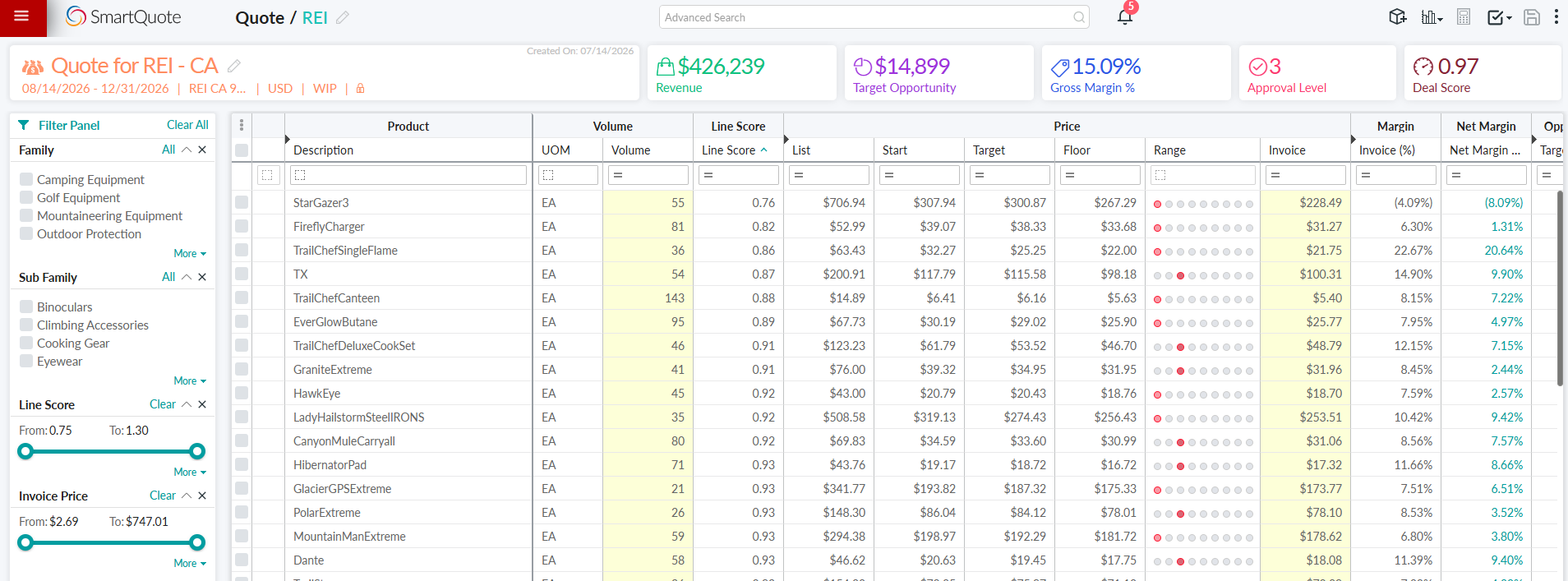
An AI-guided CPQ system integrates with ERP and CRM, so when a quote starts, the system surfaces price guidance for every line item based on customer segment, win/loss history, order volume, and cost.
Vistaar SmartQuote shows start, target, and floor prices for each line, with margin and the approval level required. Prices outside guidance route automatically for approval with margin visibility, and the model recalibrates as deal outcomes come in.
The Measurable Outcome
- Tighter margins: Deal margin variance narrows as more quotes land inside guidance
- Faster quotes: Quote turnaround moves from days to hours
- Stronger governance: Unauthorized discounts decline
- More selling time: Reps spend less time chasing approvals
Where AI Pricing Software Falls Short
AI pricing software is powerful where data is rich and decisions repeat. It is weaker in a few predictable places, and a vendor that says otherwise is overselling:
- Sparse data: New products, low-volume SKUs, and one-off project deals give models little history, so recommendations need wider bands and more human review
- Dirty data: Duplicate customers, missing cost data, and off-invoice deductions stored outside the ERP produce confident recommendations built on the wrong numbers
- Unexplained recommendations: Reps who cannot explain a price to a customer override it, and override rates are the fastest signal that adoption is failing
- Structural shifts: Tariff shocks and supply disruptions break the historical patterns models learn from, so scenario planning and human judgment carry more weight in those periods
None of these is a reason to avoid AI pricing. They are reasons to fix data quality first, demand explainability, and measure override rates from day one.
What to Look for When Evaluating AI Pricing Software
AI pricing platforms are not built the same. If the use cases above reflect challenges your team faces, use this checklist to guide the assessment:
The Vistaar Platform is built around these principles, supporting the pricing lifecycle from list price through rebate settlement.
The same criteria apply when comparing platforms for AI price optimization specifically.
Getting Started With AI Pricing Software
Successful deployments of AI in pricing follow a consistent sequence:
1. Clean and centralize the data: Transactions, costs, and off-invoice deductions in one governed view
2. Start with one high-impact use case: A single problem with measurable margin at stake, such as cost pass-through or quote guidance
3. Set guardrails before recommendations go live: Floors, ceilings, approval thresholds, and override rules agreed with sales and finance
4. Invest in explainability and enablement: Reps and approvers need to understand the drivers behind each price
5. Measure and expand: Track realization, margin, and override rates, then extend to the next use case
Vendor expertise matters as much as the model. Vistaar's Price Science team supports deployments with diagnostic studies and elasticity modeling.
After go-live, Vistaar's Center of Excellence provides ongoing pricing expertise embedded with the customer team.
Companies that get the most from AI pricing software rarely start with the most advanced technology. They start with a defined pricing problem and scale from there.
Conclusion: Drive Measurable Margin Growth With AI Pricing Software
AI pricing software is delivering results today across manufacturing, CPG, retail, beverage alcohol, and B2B distribution. The programs that succeed treat it as a decision system: rules for policy, models for precision, and people for judgment, all connected to the systems where prices are actually executed.
Vistaar is a Leader in the inaugural 2026 Gartner Magic Quadrant for B2B Pricing and Rebate Optimization Software, with pricing, quoting, promotion, and rebate capabilities in one platform.
See AI Pricing on Your Own Pricing Problem
If these use cases match the pricing challenges your team faces, see how Vistaar applies AI-guided pricing, quoting, and rebate management to your data and business rules.
Talk to a pricing expert
FAQs
1. How Much Data Does AI Pricing Software Need?
Two to three years of clean transaction history is a practical starting point for elasticity and win-probability models. Products with little history can use segment-level estimates from similar items until their own data builds up.
2. Can Sales Override AI Price Recommendations?
Yes, and they should be able to within limits. Overrides inside the approved band proceed, overrides outside it route for approval, and every override should record a reason so the model and the rules can be improved.
3. What Is the Difference Between AI Pricing and Dynamic Pricing?
Dynamic pricing changes prices frequently in response to demand, typically in B2C. AI pricing in B2B usually recommends list, contract, and deal prices within guardrails, and changes happen on business cycles rather than minute by minute.
4. Does AI Pricing Software Work for Regulated Industries?
Yes, when regulatory rules are configured as hard constraints the model cannot cross. Beverage alcohol, tobacco, and pharmacy pricing all use this approach, with audit trails recording how each price was set and approved.

As an experienced pricing solutions partner to some of the biggest names in global business, Vistaar offers a range of services to help our customers reach their maximum potential. Talk to us to see how we can help you create a more profitable future.